Yarn Along

Yarn Along 8.24.16

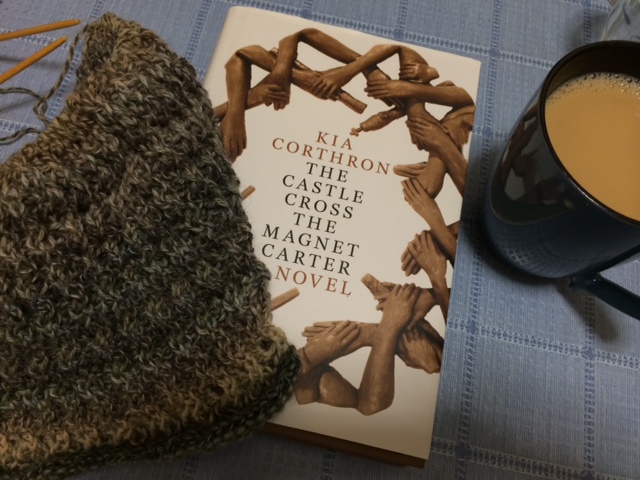
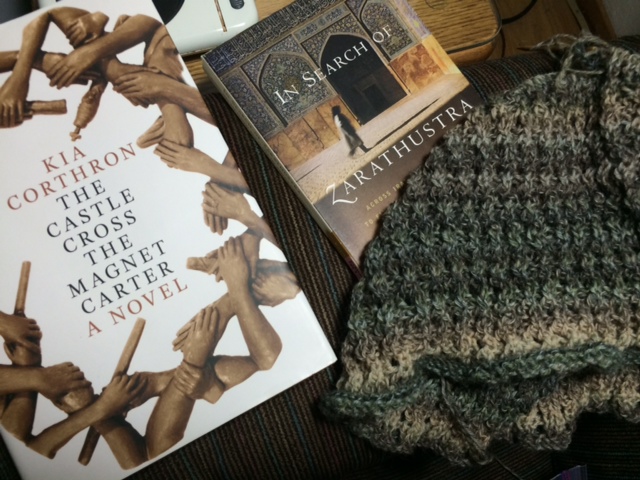
The title of Kia Corthron’s book doesn’t make any more sense than it did last week at this time, though to be fair, I haven’t gotten much reading done. I’ve read enough to know that the book is really intriguing – and also to know that Corthron is making some references to Faulkner – specifically to The Sound and the Fury – through her characters and narrative style, and I am looking forward to finding out where the novel goes. Most of my reading time this week has been devoted to Paul Kriwaczek’s In Search of Zarathustra, which I’ve been reading slowly for a month or so. I should finish it in a day or so.

My Game of Thrones cowl is progressing as well. I hope to be able to show you the finished product soon.

Yarn Along is hosted by Ginny on her blog, Small Things.

Posted in Uncategorized | 2 Comments

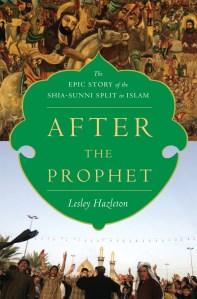
A Review of Lesley Hazleton’s After the Prophet: The Epic Story of the Shia-Sunni Split in Islam

after the prophet cover image

I’ve been interested in the ancient and medieval Middle East for a long time – since I was a teenager, really, but this current flurry of reading on the subject dates back to my reading of The House of Wisdom at the beginning of the summer. I thought I knew the story of how and why Muhammad’s followers split into two opposing factions, and I did know part of it, but I was placing too much emphasis on the twelfth imam, who is a messianic figure in Shia Islam. I missed the role of a horrific massacre of Hussein, the son of Muhammad’s son-in-law Ali, and 72 of his followers; the descendants of the people who committed that massacre became the Sunnis; the descendants of Hussein and his followers are the Shia.

Cultural appropriation is on my mind when I review books like this one. Every time I write the word “they” or “them” about a racial, ethnic, or religious group not my own, I start stealing cryptic little looks over my shoulders looking for angry readers. Nobody is actually reading this, right? I ask myself nervously. I mean, this is the internet. People are just here for the porn, right? Someday, when linguists look back on the early 21st century, they’ll call the 2010’s “the decade when pronouns got complicated.” Complicated in good ways, sure – but complicated nonetheless.

So since I’m loathe to tell you what “they” and “them” did in the Arabian desert 1500 years ago that still reverberates today, I’m going to grab onto a little tangent and run with it. First I’m going to tell you that I enjoyed this book a good deal, that it’s very readable, and that I recommend it. Then I’m going to talk about Shakespeare. Shakespeare was on my mind while I was reading this book because I found myself wishing that Shakespeare had known this history and could have written a play about it. My favorite of Shakespeare’s themes (and, I think, his favorite too) is the question of what constitutes legitimate authority.

Muhammad died without naming an heir, which seems like an awfully obtuse thing for a prophet to do, though Hazleton provides the fascinating detail that many of Muhammad’s followers expected him to rise from the dead three days after his death, like Jesus. She never states or implies that Muhammad himself expected a quick resurrection, but it seems the idea was floating around. Anyway, in the days and weeks after Muhammad’s death, various whispered conclaves were held around Medina. There were several qualified candidates: the elderly Abu Bakr, father of Muhammad’s favorite wife Aisha, a stern military commander named Omar, a wealthy aristocrat named Othman, and a young philosopher-warrior named Ali, Muhammad’s son-in-law. Hazelton devotes the first third of her book to the events that transpired just before and after Muhammad’s death: bodies being spirited away and buried in strange places, gate-crashers disrupting secret conclaves, and something called “the episode of the pen and paper,” when Muhammad (who was illiterate) asked for a pen and paper moments before his death and the dozens of people at his bedside kept stalling one another, preventing the prophet from writing down (he was illiterate!) the name of his successor because they wanted to continue to duke it out for their preferred candidates after his death. And duke it out they did.

The circumstances surrounding Muhammad’s death would make for great intrigue in a Shakespeare play (consider the soliloquies!), but the main reason I invoked Shakespeare in this review is that Muhammad’s youngest and favorite wife would make a fantastic Shakespearean heroine. Aisha hated Ali ever since an incident called “the affair of the necklace” (no joke, the incidents surrounding Muhammad’s life and death all sound like the titles of Friends episodes), when Aisha left the caravan during a journey in order to find a place to pee. While she was gone, she snagged her necklace on a branch and the beads scattered all over the place. By the time she gathered them all up, the caravan had left without her. Since she was the prophet’s favorite wife and the daughter of one of his closest advisors, she assumed they would notice her absence and immediately turn around. But that didn’t happen, and she ended up having to resort to the 7th-century equivalent of hitchhiking, which is to say that she accepted an offer from a young warrior who was heading in the same direction of the caravan. Of course, when the teenaged Aisha turned up on a strange man’s camel, many in Muhammad’s household – who hated her for her brazenness, for her youth, for her status as Muhammad’s favorite, or for all three – were ready to cast her out for adultery. In Hazleton’s words: “Overnight, the poets got busy. They were the gossip columnists, the op-ed writers, the bloggers, the entertainers of the time, and the poems they wrote now were not lyrical odes, but the other great form of traditional Arabic poetry: satires. Laced with puns and double entendres, they were irresistibly repeatable, building up momentum the more they spread. The barbed rhyming couplets acted like lances, verbal attacks all the more powerful in a society where alliances were made on a promise and a handshake, and men were literally taken at their word” (28).

Muhammad asked Ali for advice, and Ali recommended that he divorce Aisha and move on. Muhammad did not accept this advice, and soon he had received a revelation declaring Aisha innocent – a revelation that, long story short, led to the veiling of women in Islam, but I’m not going to go into detail about that. What I do want to tell you about is “the Battle of the Camel,” in which Aisha led an army into battle against Ali’s forces. She rode a camel into battle all decked out in chain mail and very much in command of her men. Hazleton reports that “this was the traditional role of women in battle, though never before from the center” (114) and provides examples of other women who were famous not only for screaming and ululating during battles to motivate the troops but also for performing acts of – ummm – courage (?) like slicing open the abdomen of an enemy soldier, pulling out his liver, and then tearing the liver apart with her teeth à la Daenerys Targaryen. So Aisha’s antics on top of her camel were not as singular as one might expect. The battle ended when Aisha’s best warriors were killed and Ali made the decision to hamstring the poor camel and take Aisha into custody rather than let the prophet’s favorite wife be killed. When one of Ali’s lieutenants opened the chain mail compartment and asked Aisha how she was doing, she replied, “I have an arrow in me” (121).

In other words, Aisha was a badass, perfect for Shakespeare’s stage – or for any stage, really. I enjoyed this book all the way to the end, though it was never quite the page-turner that it was when Aisha was at center stage. The rest of the book includes plenty more carnage, leading up to the horrific murder of 72 warriors (and their wives and children) who were followers of Ali’s son Hussein – a massacre that formalized the split that already existed between Shia and Sunni Islam.

I recommend this book for the general reader. A historian might find it too sensationalized (and you should be able to tell from this review that I am no historian), and God knows what a scholar of Islam would think of it. Looking back on this review, I seem to have indulged in more irreverence than I’d planned, and I hope no one is offended. Where is the line drawn between cultural appropriation and loving a story and wanting to make it my own? Wherever the line is, we can be sure it’s a fine one, and I would rather walk that line, even clumsily sometimes, than never approach it at all.
Posted in Authors, Lesley Hazleton, Non-fiction - History, Nonfiction - General, Nonfiction - Military, Nonfiction - Religion, Reviews by Bethany, Uncategorized | Leave a comment

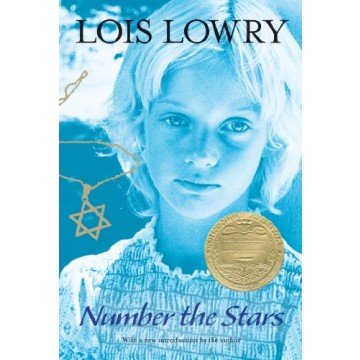
A Review of Lois Lowry’s Number the Stars

number the stars cover image

Two of my tutoring clients were assigned this book for summer reading, so of course it ended up on my reading list as well. If you’ve been reading this blog for some time, you may have noticed that I have a pattern of reading middle grade or young adult novels and then eviscerating their authors for not being subtle and Proustian and so forth (you can find examples here, here, here, and probably also here). Knowing that this review was coming up, I tried hard to temper this tendency while I was reading Number the Stars. For God’s sake, I said, the only reason this book exists is to provide middle-grade readers with a gentle introduction to the Holocaust. Give it a break. But then another one of the voices in my head (you know, the one that’s voting for Trump) said that the author’s not in middle school and all literature should be held to the same standards and how hard is it to show not tell and a “gentle introduction to the Holocaust” isn’t even a thing, for God’s sake. Though there is some truth to these statements, I really did plan to write a sympathetic, kid-friendly review – that is, until I discussed it with a student and found that the book is even less sophisticated than I thought. I’ll explain.

Like many teachers, I often start discussing a novel by introducing or reviewing terms like protagonist, antagonist, and conflict. I mention that while most short stories and novels have a single protagonist, many or most will have multiple antagonists and multiple conflicts. It’s such a standard part of my routine that I don’t even bother to jot down any notes first. So when I assured my student that all novels have multiple conflicts and then asked her to see how many she could find, I was not at all prepared for the fact that this book only contains one conflict: the innocent, idealized citizens of wartime Denmark vs. the Nazis.

Now – if a book has to be simplistic, then sure, the Nazis make excellent bad guys. Cliché bad guys, mind you, but they fit the mold perfectly. No arguments. But the thing is, the best protagonists are complicated and flawed, and if there are Nazis in a novel, the author has nearly free rein to make the protagonist flawed. The protagonist can be a rapist, a serial killer, a drowner of kittens – and s/he will still be a good guy compared to the Nazis. And then get this: this is a Holocaust novel with a happy ending. I don’t mean a Life is Beautiful happy ending, where the father is dead and the American soldiers are carrying the little boy in the tank and he sees his mother with her shorn hair, and you’re bawling your eyes out because it’s the happiest ending you’ve ever seen and the saddest ending you’ve ever seen all at the same time – that kind of happy ending is just fine. But this book literally has a happy ending, where all the Jewish characters are smuggled off to safety in Sweden. With the exception of Peter, the idealized Resistance fighter who dies an idealized death, everyone makes it safely through the war. Even in the protagonist’s thoughts, we never really see her waver. We see her contemplate the idea that she might not be as brave as she wants to be, but in the climactic scene – which is based on, no joke – “Little Red Riding Hood” – she maintains her preternatural poise and equanimity like no nine year-old ever and eludes the Nazis and their dogs and save the day.

I know that there is a school of thought that says children need these kinds of stories, in which good confronts evil. The children empathize with the idealized protagonist and imagine themselves defeating Nazis, and the act of imagining creates synaptic pathways (or something) that prepare the children for times when they will need to act quickly and wisely to defeat an antagonist of their own. I do not deny that this may be true. But I can’t help thinking of Francine Prose’s essay “I Know Why the Caged Bird Can’t Read,” which I’ve discussed with many high school students over the years and which never fails to provoke debate. Prose zeroes in on To Kill a Mockingbird, which many teenagers love, and judges it a simplistic book because the lesson of To Kill a Mockingbird is that evil is “out there” – in other words, in people other than ourselves. In that novel, Bob Ewell is evil – and some of the other citizens who join him in lynching Tom Robinson are evil as well, or on the verge of becoming so. Scout is not evil; nor is Jem or Atticus or Calpurnia or even the bitchy Mrs. Dubose down the street or the corset-worshipping Aunt Alexandra. Good fiction, Francine Prose asserts, teaches us not that evil is “out there” but that evil is “in here” – that we’re complicit in it, that we sometimes benefit from it, that our own comfortable lives are built on the backs of others less fortunate than ourselves. The intended audience of Number the Stars seems to be children in grades 3-5 – though one of my students who was assigned to read it is in the eighth grade, for God’s sake – and I don’t know exactly where the line falls between laying pathways for future courageous behavior and Nietszche’s arresting notion that “when you look long into the abyss, the abyss also looks into you.” My favorite novel for preteens and young teenagers is Ender’s Game, which in addition to being a rip-roaring wild ride of a read also contains one of the most moving meditations on guilt and redemption that I have ever read. In that novel the youthful protagonist does commit evil and is forever changed by it, even though his community lauds him as a hero. The “good guys” in Ender’s Game behave much worse than the Nazis in Number the Stars, because the characters in Ender’s Game are so well-drawn that readers are tricked into thinking that real lives are at stake, and their cynicism and condescension are shocking. The Nazis in Number the Stars, on the other hand, are cardboard cut-outs, caricatures. Colonel Klink, monocle and all.

Now, after my rough treatment of Lowry’s novel, I do want to end on a positive note. If you are a parent or teacher and are discussing this book with a child who has read it, consider asking the student to decipher the meaning the title. If the child needs help, point him or her to chapter 10 (pp. 86-87 in my edition), and point out the Psalm that Peter reads, which contains the phrase “number the stars,” then follow the imagery and see where it takes you. It helps if you know that the psalms were written by King David, of “Star of” fame, and if you wanted to explore a parallel between King David and Denmark’s wartime King Christian, you might find your discussion traveling to some interesting places. And if you want to mention the idea that to kill one person is in effect to destroy the entire world – an idea that appears in both Jewish teachings and in the Qu’ran – I suppose you could do that too.

Posted in Authors, Fiction - Children's, Fiction - general, Fiction - Historical, Fiction - Important Award Winners, Fiction - Young Adult, Lois Lowry, Reviews by Bethany, Uncategorized | 2 Comments

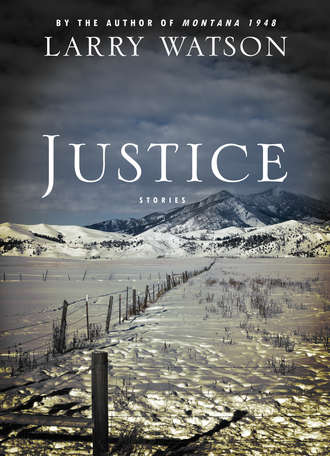
A Review of Larry Watson’s Justice

Justice cover image

I loved this book – probably more than any other book I’ve read this year. This is one of those collections of linked stories that masquerade as a novel. I actually like it better when I think of its chapters as stories, because I’m doubly impressed by the nuanced work that went into giving each story or chapter an integrity of its own without sacrificing the overall narrative of the collection. Justice is a prequel to Montana, 1948; its plot follows David Hayden’s father, Wesley, who is the protagonist of Justice if anyone is. The first story is more of a novella. It’s about a road trip Wesley takes with his older brother Frank and two of Frank’s friends. The chapter is called “Outside the Jurisdiction,” a title that alludes to the fact that Wesley and Frank’s father is the sheriff of Mercer County, Montana. Frank uses the phrase “outside the jurisdiction” to refer to everywhere in the world other than Mercer County – but in this story it refers to a little town in North Dakota called McCoy, where the four teenage boys stop for dinner and a hotel when a blizzard cuts short their hunting trip. The pace of this novella is leisurely; we listen in on the banter of the four boys and get a sense for the differences in their characters. Frank is the leader of the four, undoubtedly because he imitates his father’s authoritative mien. Tommy tries to imitate Frank’s confidence and suavity, but others see through his act. Lester comes from one of the poor families in town, and Frank intuitively pays for Lester’s share of the hotel room and dinner, just as – we learn – his father often buys the vagrants and drunks he arrests train tickets to their hometowns in exchange for their promise not to return. We also learn that Sheriff Julian Hayden’s acts of generosity are usually performed in private. When Julian becomes aware of an outsider causing trouble in town, he usually manhandles this individual for a while, shoving him to the ground or into his car, even dragging him around by his heels. The money for a train ticket or other gifts are given silently, out of sight and earshot of others in town.

This idea that people with power sometimes like to be draconian in public but merciful in private is explored on some level in each chapter or story in this collection. On the road trip in chapter 1, Frank and his friends encounter two Native American girls and begin to circle and approach. Wesley watches the scene more than he participates, but he’s in awe of his older brother’s seductive prowess: “He had seen Frank around girls before, at school, at football games, at the drugstore counter, and Frank was always louder and funnier and bigger and bolder than anyone else. Girls couldn’t stay away from him – because he was handsome, yes, but also because there was something dangerous about him. They had to keep an eye on him. And they were right. Wesley had heard the way his brother talked about girls, as if he could tear chunks from them, get ‘a piece of ass,’ ‘a little tail,’ ‘some tit,’ or how he could punish them with sex, make them ‘moan’ or ‘squeal’ or ‘beg for more,’ or how he’d reduce them to animality and have them ‘crawling on their hands and knees.’ Now Wesley saw this courtly young gentleman who seemed more interested in the Indian language than… than what Wesley knew his brother wanted from these girls” (35).

Everyone in this collection is two-faced, and the plot is driven forward by the characters’ slow but insistent chipping away at one another’s secrets. This, along with the motif of public “justice” acting as a curtain concealing private mercy – and that the opportunity to offer mercy in this way is a side effect of privilege and can, when used with skill, be an act of the deepest condescension – is the essence of this book.

Frank and his friends never get to drag their Indian prey back to their hotel room, and one of the girls slips and falls on her way out of the restaurant, chipping her tooth. In the middle of the night the local sheriff appears at the hotel and orders the boys to come with him to the police station. The sheriff and the deputy accompanying seem to know that Frank and the other boys did not commit any crimes by talking to the girls and that the injury was not their fault, but they are determined to humiliate and scare them away from ever returning to McCoy to chat up the local women. The public “justice” they deliver is cruel on several levels; the private mercy is the opportunity to drive home in the morning and agree never to return.

Each story in the book is told from a different point of view, though the focus never strays too far from Wesley. We see the young Julian Hayden’s inexplicable decision to stake out and attack his sister’s employer to retaliate against a modest slight instead of confronting the man verbally. We see Wesley’s mother, whose miserable childhood left her perennially frightened; Wesley’s wife, Gail, who more than anyone else in the novel has Julian Hayden figured out and who is deeply troubled when she sees Julian’s patterns of law enforcement replicated in Wesley, who becomes sheriff when Julian retires; and Julian’s deputy Len McAuley, whose own secrets are legion. It’s a book about masculinity, about friendship and family, about secrets, and about the starkness of life in a rural Montana town in the middle of the 20th century. I recommend it highly, both as a quick, compelling read and as a text with a lot to teach fiction writers about the many ways that short stories can be made to resonate and harmonize with one another.

Posted in Authors, Fiction - general, Fiction - literary, Fiction - short story collections, Larry Watson, Reviews by Bethany, Uncategorized | 2 Comments

Yarn Along

Yarn Along 8.17.16.jpg

I haven’t made too much progress on my Game of Thrones cowl since last week, but I’m still enjoying it. I’m about 30 pages into The Castle Cross the Magnet Carter and am enjoying it, but I’m a little annoyed that the title doesn’t make sense. I have a thing about ambiguous titles. If it still doesn’t make sense after about 200 pages, you’d better believe you’ll here about it here.

Happy Wednesday, everyone!

Yarn Along is hosted by Ginny on her blog, Small Things.

Posted in Uncategorized | 4 Comments

Thoughts on the Silliness of Shakespeare’s The Comedy of Errors and the Pleasures of Seeing It Anyway

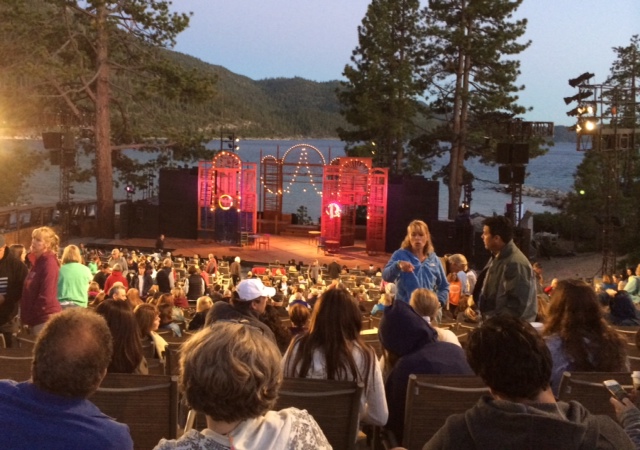
Comedy of Errors photo

Back in grad school I was part of a short-lived Shakespeare reading group. Four or five of us met on weekend mornings to read all or part of a Shakespeare play. We started working through the plays in alphabetical order, and I’m pretty sure The Comedy of Errors was the last one we read. I remember shaking my head as we were reading and thinking that this play is just as kooky as Shakespeare’s other comedies but that it never reached (or even really aspired to reach) the profound moments that most of Shakespeare’s other comedies eventually achieve. This may have been the reason our group stopped meeting – though as I recall, the fact that the next play on the docket was Coriolanus may have had something to do with the permanent adjournment.

I reread this play a few weeks ago because Jill and I were making our now-traditional (i.e. we’ve done it twice) trip to the Lake Tahoe Shakespeare festival – and this summer’s play is The Comedy of Errors. The trip was fantastic, in spite of the hotel desk clerk who admitted that our room was ready when we arrived but refused to check us in until three o’clock on the dot. One of my favorite things about live performances of Shakespeare is seeing what different directors do with the all the empty space. Shakespeare’s plays include almost no stage directions (beyond such bare bones instructions as “Enter King”), and in modern productions the thing to do is to create a setting that fits the mood of the play. In 2014, when we saw As You Like It, the play was set in a mill town in early-20th-century Massachusetts. This year’s production of A Comedy of Errors was set in Brazil during Carnivale. Whether this was a deliberate Rio Olympics tie-in I don’t know – but the Carnivale setting seemed true to the spirit of The Comedy of Errors – mainly because the only way real people would get as confused as the four key characters in this play is with the help of masks and lots of alcohol. The Brazilian music and dancing were fun too.

Before this play begins, Egeon and Emilia gave birth to twin boys (and by that I mean that Emilia gave birth to the twin boys; Egeon just parked the car and held the camcorder). For reasons I don’t understand, they named both babies Antipholus. They were from Syracuse but happened to be in Epidamium when Emilia gave birth. Right about the time they decide to go back to Syracuse, they meet an “exceeding poor” (I.i.56) couple who also just gave birth to twin boys and – again, for some reason, they named both of their babies Dromio. Egeon and Emilia “bought” (I.i.57) these babies so their two Antipholi would have servants. They head back to Syracuse by ship and there’s a storm and long story short, Egeon ends up in Syracuse with one Antipholus and one Dromio, and Emilia ends up in Ephesus with the other set. When the play opens, Egeon is sort of an Ancient Mariner figure. He has arrived in Ephesus in search of his Antipholus and Dromio, who left Syracuse ten years earlier to hunt down their brothers. Upon arrival in Ephesus, Egeon is immediately arrested because it is illegal for anyone from Syracuse to set foot in Ephesus, which I guess is sort of like the North Korea of the semi-mythical Mediterranean.

Both Antipholi have grown up to be assholes. They routinely beat up the Dromios, and Antipholus of Ephesus also gets in a few punches on his wife Adriana. The spousal-abuse scenes were left out of the production we saw, which was likely for the best, though the beating of loyal lifelong servants apparently still qualifies as comedy. The rest of the play consists of various misunderstandings among the two sets of twins, most of which result in the Dromios getting clobbered. Some hijinks ensue when Adriana gets hold of the wrong Antipholus and when Antipholus of Syracuse, who is not married, puts the moves on Adriana’s sister Luciana. There are lots of sight gags, and of course it’s funny to see people running around and crashing into one another, but ultimately the comedy is hollow because we’re told from the beginning that Antipholus and Dromio of Syracuse came to Ephesus specifically to find their identical twins – so as soon as the first misunderstanding happens it should be clear to them that they have reached their goal. But they don’t. The insanity just keeps going on, and the Duke of Ephesus gets involved, having seemingly never heard of the concept of twins: “One of these men is genius to the other. / And so, of these, which is the natural man / and which the spirit? Who deciphers them?” (V.i.343-5). And shortly after Antipholus of Syracuse finds Adriana and Dromio of Ephesus – and should have all the facts he needs to conclude that his twin brother is nearby, I wrote in the margin: “the human tendency to get exactly what we want and then beat the shit out of it.” Nearby, I wrote: “It’s always such a small world in Shakespeare’s comedies. Like Friends, Seinfeld, the characters always running into their friends even though they’re in a huge city. Is this quality essential to comedy? A response to the fact that we feel lost and alone in a wider world?”

When I read this play, I had it in my head that it was one of Shakespeare’s very first, and I was willing to forgive the total collapse of its logic for that reason. However, on further research, I find that it’s actually his ninth play – still from early in his career but not as early as I thought. It’s hard for me to find much to admire in this play, but I do see little glimmers of the characters and themes that will recur in his later plays. Many of the characters in this play are constantly on the verge of being arrested for debt – a foretaste of The Merchant of Venice – and the Duke’s determination to enforce Ephesus’ laws to the letter and execute Egeus for setting foot in Ephesus suggests Measure for Measure, as does a subplot involving some nuns. Shipwrecks and twins will recur in Twelfth Night, and Egeon himself is sort of a comic version of Lear in the wilderness scene. I also enjoyed the poetry, which is in blank verse when the emotional content of the language is low and then starts to rhyme more as the emotions become more intense. I’m not sure if I’ve seen rhyme used in exactly this way before.

I can’t blame The Comedy of Errors too much, since after all it brought Jill and me to Tahoe, where we watched the play with sand between our toes. And we read in our hotel beds, blogged in a Carson City Starbucks, and bought sandwiches in a grocery store deli staffed by people about as competent as the characters in The Comedy of Errors. Let’s do it again next year, OK?

Posted in Authors, Drama, Glimpses into Real Life, Reviews by Bethany, Uncategorized, William Shakespeare | Leave a comment

Why Don’t I Know More About Italy? – And Other Thoughts (Actually Not That Many Other Thoughts) on Umberto Eco’s Numero Zero

Balki

When I was preparing to write this review, I realized that I needed a really good metaphor to describe what it feels like to read a work of social satire from a culture one doesn’t know well. The closest I could find was “like Balki Bartokomous reading Don DeLillo,” and while I relish any opportunity to write about Balki Bartokomous on the internet, even this simile falls short of capturing my bewilderment.

I mean, I’ve been to Italy. In fact, with the exception of the United States, Italy is the country in which I’ve spent the most time. The Latin classes I took in high school covered at least as much history as language, and I can Augustus-Tiberius-Caligula-Claudius-Nero along with the best of them. I know that “toast” means a grilled-cheese sandwich and that under no circumstances should one go anywhere near the Italian police. I even have a little bit of Italian blood – an eighth to be exact – though it’s true that my dad managed to live for 54 years with a hard-core Sicilian mother without picking up on the fact that “ravioli” is a plural noun (a plate full of this food item, he insists, is called “raviolis”).

Have I charmed you yet? Have you forgotten that this is supposed to be a book review? You haven’t? Fine.

I read Numero Zero because its plot sounded interesting, similar to David Mamet’s Wag the Dog. The premise is that a rich media magnate hires the protagonist, Colonna, to write a book about the long and storied history of a newspaper that, in fact, does not exist. Others are recruited to make some “dummy” editions of this paper, with the goal that, since the papers are being created after the fact, they are laid out with perfect prescience. In real life, sometimes what seems like a major story is placed on the front page, only to fizzle out in a day or two, while a story that an editor buries in a low-prestige place ends up being huge. In this newspaper, this problem will never happen because the editors making the dummy editions will know how each news story will end. Colonna’s job is to embed himself with the team making the dummy editions and then write a book about the “history” of the newspaper.

The irony of the situation above has great appeal, and I enjoyed the opening chapter about Colonna’s miserable life before he took this writing job. I even underlined a passage that intrigued me: “Losers, like autodidacts, always know so much more than winners. If you want to win, you need to know just one thing and not waste your time on anything else: the pleasures of erudition are reserved for losers. The more a person knows, the more things have gone wrong” (8-9). The only time I really felt like a partner in Eco’s satire, however, was when I noticed, about twenty pages in, that all of the characters are named after fonts. I noticed Colonna, Cambria, Palatino, and Braggadocio, and when I Googled a few other names that I did not recognize, I found that these were fonts as well. I enjoyed that little moment in a Paul-Auster sort of way, which is to say that I smiled at it and then continued unsuccessfully to find something to latch onto in this book.

I’m not really criticizing Umberto Eco. He has every right to write a satire of Italian media and culture, and I am clearly not the intended audience for this novel. I hoped that Numero Zero would give me a quick crash course in Eco before I take another stab at The Name of the Rose, but it didn’t work out that way and that’s fine. I still plan to dive into The Name of the Rose soon. It’s a different sort of book and I’m sure I’ll enjoy it, even without an introductory crash course.

Posted in Authors, Fiction - general, Fiction - literary, Reviews by Bethany, Umberto Eco, Uncategorized | 1 Comment

Yarn Along

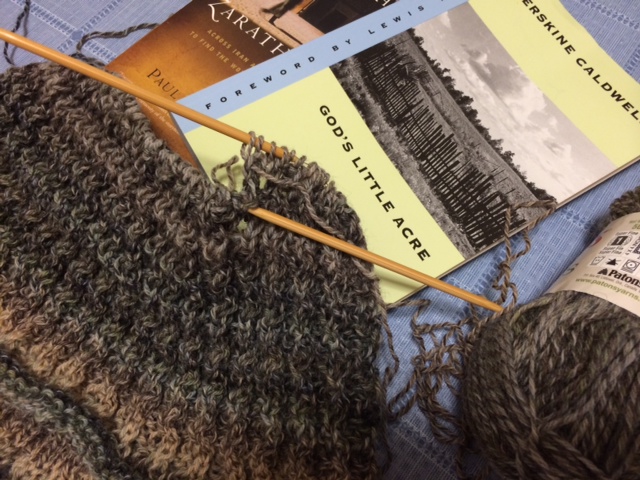
Yarn Along 8.10.16

When I started this project, I called it my Game of Thrones cowl, partly because I was watching Game of Thrones while I worked on it but mostly because of the storminess of its color scheme. It’s exactly the color of Ramsay Bolton’s soul. Over time, it’s become my Olympics cowl, for obvious reasons. I’m having a busy week, but I’ve been able to relax with my knitting and the folks in Rio for at least an hour or so each night.

Erksine Caldwell’s God’s Little Acre is quite a ride. Think Southern Gothic meets the Joads, plus a non-evil albino and a lot of people lusting after their in-laws. I’ll be back to tell you more soon. Underneath God’s Little Acre is In Search of Zarathustra, which I’ve been reading slowly for several weeks now.

Yarn Along is hosted by Ginny on her blog, Small Things.


Posted in Uncategorized, Yarn Along | 4 Comments

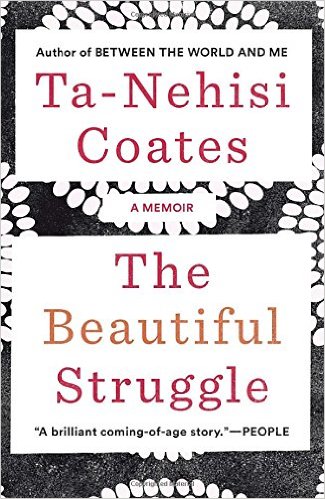
A Review of Ta-Nehisi Coates’ The Beautiful Struggle

the beautiful struggle cover image

Earlier this year I reviewed Ta-Nehisi Coates’ new and highly-praised memoir Between the World and Me, and you can read my review of that book here. The Beautiful Struggle, published in 2008, is just as good. I read it in a few sittings over the course of about a day and a half, and I was totally engrossed. This is Coates’ coming of age narrative and intellectual autobiography; it’s also a sociological study of the culture in which Coates grew up. It’s about the strange, terrifying, and in some ways numbing experience of growing up in a vulnerable neighborhood in Baltimore just a few years before the time period documented in The Wire while also being Coates’ father’s fifth child born within seven years to three different women. It’s certainly also a memoir of family, but “family” is defined nontraditionally. Coates’ father fought fiercely against the intellectual (not to mention physical, psychological, and emotional) stunting of African American communities that live in ghettos like the one Coates grew up in. For years he ran a press out of his basement with the goal of reprinting and distributing works by African American intellectuals and activists that were otherwise unpublished or out of print. He also worked as a librarian at Howard University (referred to in both of Coates’ memoirs as “the Mecca”) and working what was probably a third full-time job shepherding five teenagers through their inner-city adolescence, away from drugs, violence, and crime and out of prison.

This memoir is also a wake-up call for people, like me circa a couple of weeks ago, who imagine that Coates emerged fully-formed as a staff writer for the Atlantic. This memoir makes clear how tenuous Coates’ adolescence was, how many escape strategies he cultivated – comic books, role-playing games, TV – and what a struggle it was for his parents and teachers to steer him toward “enlightenment” (of the non-Buddhist sort) and “awakening” – meaning an awakening to the truth about racial prejudice in this country in both the present (i.e. in the ‘80’s and ‘90’s) and in the past. It’s no accident that both of these words also appear in the writing of Transcendentalists like Emerson and Thoreau – Coates’ father is in a way a 20th-century Transcendentalist, embodying both Transcendentalist ideals and also the contradictions at the core of the flawed thinkers of 19th-century Concord.

This memoir begins with the incident – a very close call during a confrontation between rival gangs – that prompted Coates’ older brother to begin carrying a gun at all times. It proceeds through Coates’ middle and high school years, through his endless attempts to check out even as his father insisted that he wake up, through the teachers that reached and did not reach him, through his first encounter with gifted classes (“All our homework was weird and open-ended” [96]), through the complicated role of violence in his family: “And then he was swinging away, channeling a chi ancient as Equiano. The power was passed down from mothers guarding their sons from the lash, and later from the pyre, rope, and fat sheriff. My father swung with the power of an army of slaves in revolt. He swung like he was afraid, like the world was closing in and cornering him, like he was trying to save my life. I was upstairs crying myself to sleep when they held a brief conference. The conference consisted of only one sentence that mattered – Cheryl, who would you rather do this: me or the police?” (141).

I mentioned in my review of Between the World and Me that I was uncomfortable with how many words and phrases I needed to Google when I was reading it. I had a similar experience reading this memoir, but this time I resisted the urge to go right to my search engine. The expressions I didn’t know didn’t stop me from understanding the book as a whole, and in some ways to resist the desire for answers is one way to show respect for a book when you can only partly understand its author’s language. There is something healthy in letting that kind of confusion continue. Also, while in Between the World and Me the language I didn’t understand was mostly African-American slang, I found in this novel that I was equally confused by some of the other cultural differences between Coates and me. Take this passage, for example, which I think is about Dungeons and Dragons or some similar role-playing game, though really your guess is as good as mine: “What did I know of white kids gone demonic, Patricia Pulling, and steam tunnels? Fuck the dumb dichotomies and what people think this means. Even then, I was dreaming of Raistlin’s black robes one moment, and Dorsett’s spin move the next. This is what my father deeded – that our Knowledge of Self be more than America, that we understand the brain death that sprawled from the projects to the subdivisions. Consciousness was a beginning, but the imagine that could turn straight 18’s into paladins in plate, could make warrens in tunnels from graph paper, could pull armies of gnolls from miniatures – this was the Knowledge that ultimately would find a way out” (93).

Coates is willing to be unflinching in relating both the events and the epiphanies of his difficult adolescence; as a result, this book is fascinating and complex. And because he has a virtuosic ear for language, this book is profound, sad, and sometimes aphoristic. For any readers who might be planning an American literature curriculum at the high school level: this memoir would make a fabulous text at that level, paired with other works of African-American literature or even – my preference – with the Transcendentalists. Forget Into the Wild, which I taught for years: Chris McCandless and his silly bus. This is the book to read alongside Walden and, perhaps even more aptly, alongside Walt Whitman, whose lines echo in Coates’ marvelous internally-rhymed sentences like “She would stop by and find Dad in the back with brother Howard tackling a pint of Jack” (88) and “I was young and could not see the weaponry my ancestors had left for me, the shield in the tall brown grass, the ax lying right next to the tree” (41).

I could go on. Read it, folks.

Posted in Authors, Nonfiction - Anthropology, Nonfiction - Education, Nonfiction - General, Nonfiction - Memoir/Biography, Reviews by Bethany, Ta-Nehisi Coates, Uncategorized | Leave a comment

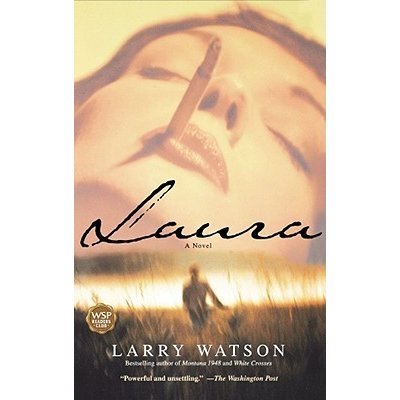
Thoughts on Larry Watson’s Laura

Laura cover image

Recently I learned that Larry Watson has written other books besides Montana 1948. I’m not sure why this surprised me, except perhaps is that when an author emerges, publishes one book, and then disappears, that one book is often something much like Montana 1948 – an elegantly written modern parable, the sort of story people have in mind when they say that “everyone has a story inside them.” When I discovered that Watson was not in fact a one-hit wonder, I reserved six of his other titles at the library. Since unfortunately he’s not as widely known as he should be, five of the six were available right away. I stacked them up, did a little thinking, then sat down with Laura.

The protagonist is Paul Finley, who wakes up in the middle of the night to find a young woman named Laura in his room. Laura is a guest of his parents’ and a celebrated young poet (you know, as far as any poets are ever “celebrated”). Laura is drunk, as 22 year-old poets often are, and she begins a rambling conversation with 11 year-old Paul in which she grills him about the articles in his Boy’s Life magazine, shares her fascination with baby snakes, and – oh yeah – also says, “My problem is very simple. It’s this: I came to Vermont to be alone with your father, and I can’t seem to manage this arrangement” (9).

This moment sets off Paul’s decades-long obsession with Laura, who seems to love torturing Paul for his Boy-Scout wholesomeness. On a bike ride, she suddenly veers off the road and down a steep gravelly embankment, where Paul falls and gets scraped up and is stunned when Laura doesn’t come back to find out if he is OK. This sensitivity – he’s almost a hypochondriac – persists throughout his youth and adulthood, and at every stage Laura tempts him to a point where he is damaged in some way – not by her, exactly, but because she leads him places where he’s not prepared to go – and then abandons him there.

Laura becomes the reason for Paul’s parents’ divorce, though both Laura and Paul’s mother, Doreen, insist for the rest of their lives that they are “friends.” Laura is the impetus for Paul’s first serious relationship in college: his girlfriend, Martha, is an aspiring poet who idolizes Laura, and Laura skewers Martha’s poetry, her confidence, and her relationship with Paul when Paul begs her to critique Martha’s work. Paul’s father dies young, and after the funeral Paul clings to Laura, who takes him for a ride in a borrowed MG and torments him because he had never asked his father personal questions and therefore had never learned that his father was a gifted storyteller with a rich history. When Laura falls asleep and Paul can’t resist touching her breast, she wakes up and says, “Why didn’t you say that was what you wanted, Paul? Why didn’t you just say that on the day of your father’s funeral you wanted to fuck a woman he fucked?” (158).

This is the sort of novel that makes me wonder if I would feel differently about the characters if their genders were reversed. A thirtysomething man taking a grief-stricken early-twentysomething woman for a drunken ride in a sports car – would I condemn that man as, if not a pedophile, than at least an opportunist and a lech? I think I would – but in some ways my feelings about Laura are even worse. I’m not proud of this, but I really do look down on women who don’t behave maternally toward younger people (correction: younger men; excuse me while I contemplate why I apparently think it’s perfectly OK for women to be manipulative and cruel to younger women – OK, I’m back, still a little confused). If Laura had had sex with Paul, certainly when he was eleven and probably also when he was in his teens and twenties, I would have mentally condemned her for it, but I’m not sure if my emotional reaction to the novel would be any different. The push-and-pull relationship she initiates with Paul and then sustains until both are in mid-life seems every bit as cruel, to me, as an inappropriate sexual relationship.

To sum up, gender relations are complicated. I have many feelings about male-female shenanigans that I haven’t fully investigated, and I imagine others may as well. But I did enjoy this book, which is beautifully written and just the right kind of heartbreaking.

Posted in Authors, Fiction - general, Fiction - literary, Larry Watson, Reviews by Bethany, Uncategorized | Leave a comment