The fourth annual PAT CONROY MONTH!!!! is here. Welcome.

Pat Conroy

It’s September 1st.  Some people may be starting to think about scarves and pumpkin spice lattes, but when the days begin to shorten (and it’s still in the 90s in Sacramento), here at Postcards from Purgatory our thoughts turn to our favorite Southern writer, Pat Conroy. As anyone who reads this blog knows, Bethany and I have a soft spot where Mr. Conroy is concerned. Please just search the blog archive if you’re interested, because I don’t want to bore our legions of long-time readers (all ten of you) with a rehash of how we both first became acquainted with Pat Conroy’s oeuvre.

But now it’s the fourth annual PAT CONROY MONTH!!!! It seems like this milestone should be commemorated somehow, but I have no idea how one celebrates blog milestones besides writing about it on the blog. Probably if we were super popular we’d arrange some sort of Pat Conroy block party in one of our neighborhoods, complete with all the recipes from his cookbook that Bethany reviewed a couple of years ago. All of the recipes contained mayonnaise, from what I remember. We don’t like mayonnaise very much, so the menu for our block party probably won’t contain many of these recipes…. If anyone has any menu recommendations for our hypothetical block party that don’t contain mayonnaise, please comment on this post.

My plan for PAT CONROY MONTH!!!! this year is to reread The Water is Wide, Conroy’s first successful published work, which is a memoir of the year he spent teaching on an island off the coast of South Carolina. Bethany reviewed it during our first PAT CONROY MONTH! in 2012. This is the last of what I consider Conroy’s “early works” (i.e. the books that he had published before I started reading him like some sort of zealot in the early nineties) that I need to reread for the blog, and it’s also the first book of his that I read. I was assigned it for my sophomore honors English class in high school, and I remember loving it, but I haven’t touched my copy of it in years, except to move it around from place to place with me. I’m very excited to see if it’s stood the test of time.

I guess that’s it! This is our favorite month on the blog, and I am looking forward to spending it with Pat Conroy once again.

Posted in PAT CONROY MONTH!, Reviews by Jill | Leave a comment

A Review of Markus Zusak’s The Book Thief (by Bethany)

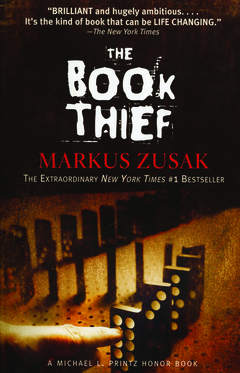
Book-Thief cover image

I am slightly less annoyed with this book than I was the last time I wrote about it (which was here). It is possible at times to forget that “Death” is telling the story, although I still snorted whenever I was reminded, and Liesel and her circle of friends and acquaintances are relatively compelling. This novel begins with Liesel on a train with her mother and brother. They are on their way to the town of Molching, where Liesel and her brother will be left with foster parents and their mother will be taken away by authorities. Much later, Liesel puts the pieces of her memory back together and deduces that her parents were executed for being Communists. At the time, though, Liesel was baffled by the experience of being taken to live with strangers, especially after her brother dies alongside the train while they are still en route.

Liesel’s foster parents – Hans and Rosa Hubermann – are basically Joe and Mrs. Joe from Great Expectations – or at least that’s how they seem at first. Rosa is known for calling everyone in town, especially her immediate family, by a series of swear words, and Hans comes off as childlike and long-suffering and not too smart. Like Joe, Hans always takes Liesel’s side and helps her navigate the dangerous experience of living with Rosa. We learn later, though, that there is more to Rosa and Hans than we know early on. They are definitely round characters, while Joe and Mrs. Joe are flat.

The reality is that Hans and Rosa are heroes. Rosa feeds her family on nearly nothing, even after she loses all her customers and can no longer work as a laundress. When through a long sequence of events Hans and Rosa are asked to shelter Max, the son of a Jewish soldier who saved Hans’ life back in World War I, they take Max into their home in spite of the danger of hiding a Jew, and they feed him and care for him in spite of their poverty. Over time, they really do become a mother and father to Liesel as well, modeling strength and sacrifice and honor.

Everything I’ve said above is dancing uncomfortably close to one of my least favorite things: Books With Morals. I hate books that try to tell me what to admire and value or how to live my life – even though it’s also true that when I do want some advice about how to live my life I do often turn to books: to The Grapes of Wrath, to East of Eden, to Macbeth, to Thoreau and Robert Frost and Franny and Zooey.

OK, fine. I was kidding about the Macbeth part. Happy now?

I am always intrigued by the kind of dramatic irony that emerges when a reader knows things that the characters in a novel do not, not because of anything the author has said but because history has made the character’s trajectory common knowledge. We don’t know until the end, of course, which characters will live happily after the war and which will not, though the fact that this novel is usually sold from the Young Adult shelves suggests, correctly, that its good guys will either survive the war or die nobly. There wasn’t a lot of suspense in this novel in this sense. Liesel, the Hubermanns, Max, and Liesel’s friend Rudy are never anything but good. They never seem tempted to be anything but good. In Rosa’s case, her goodness is often hidden under her nasty behavior, but it is always there. The fact that very little fundamental change takes place in any of the characters bored me a bit. OK, it bored me a lot.

Another thing that annoys me about this book is the whole motif of stealing books. Since it’s in the book’s title, Zusak clearly means book stealing to be essential to the book’s identity, but it always felt tacked on and artificial to me. Liesel started stealing books at the moment when her brother died on the journey to Molching. One of the officials who took away his body left behind a book called The Grave Digger’s Handbook (am I truly expected to think this is a real book that an SS officer might have carried around with him? I kept thinking of the Joyce Carol Oates novel The Gravedigger’s Daughter, and I wanted to go back in time and whisper in Liesel’s ear, “Leave that book alone, kid. It’s not worth the trouble of carrying it home. WAY too many comma splices.”) At this point in the novel, Liesel is illiterate. When she begins having chronic nightmares at the Hubermanns’ home, Hans visits her each night in her room when she wakes up, and slowly they read through The Grave Digger’s Handbook together. Eventually Hans teaches her to read, and as time passes she acquires more books – mostly via thievery, although she receives some books as gifts too – and she and Hans read those together as well. I suppose this is one hint that Hans is more than just another simple-minded Joe Gargery; in Great Expectations, it is Pip who teaches Joe to read. Later, when Max is in hiding in the Hubermanns’ basement, Liesel reads to and with Max also, and he writes two books for her by slowly and methodically disassembling a copy of Mein Kampf, whitewashing each page and letting the pages dry, and then writing his own story on the pages. Like most whitewashing jobs (of both the literal and figurative varieties), these pages still bear the shadowy presence of the original words of the book. These palimpsests appear in the novel and are a nice touch. Nevertheless, there is no reason that Liesel has to steal books in order for this novel to work. I know what Zusak is going for – stealing books is Liesel’s secret way of defying a government determined to burn books, and that’s fine. I approve of defying Nazis. I also know that what matters in this book is the fact that literacy is ultimately what saves Liesel, and books are tangible symbols of that literacy. All of this aside, though, this book does not require Liesel to steal books in order to succeed, and I would prefer that this tacked-on moralistic trope had not made it into the novel’s final draft.

This book certainly does have strengths. It’s about survival and love and hope, and all of the key characters are well drawn. “Death” never quite stopped making me snort, though I do know why Zusak chose this strategy of narration. In a world where the truth, beauty, and information are guarded zealously by Nazis and individual freedoms are hunted down and bludgeoned, using “Death” as the novel’s narrator gives Zusak a handy way to provide the reader with information that the characters in the book could never know. I also think that “Death” works as a narrator because only an immortal creature with a long familiarity with human suffering can keep an even keel in the midst of such a violent period in history. “Death” is actually remarkably compassionate and does not enjoy the job of collecting the souls of the dead, but he does understand this job, and he’s good at it. He can speak matter-of-factly about terrible things as someone like Liesel could not.

I didn’t love this book, but I did start to feel more of a connection with its characters as time went on. It’s OK. It may be the most OK book I have ever read.

Posted in Authors, Fiction - general, Fiction - Historical, Fiction - literary, Fiction - Young Adult, Markus Zusak, Reviews by Bethany | Tagged , , , , | 1 Comment

A Review of Anne Rice’s The Wolves of Midwinter (by Jill)

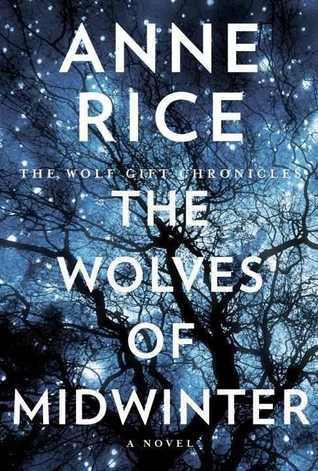
The Wolves of Midwinter cover

The more I think about The Wolves of Midwinter, Anne Rice’s follow up to 2012’s The Wolf Gift, the less I want to think about it. There are, let’s say, issues with this book. As everyone who has been reading this blog for a while knows, I have a soft spot for Anne Rice, nay, let’s call a spade a spade. I have a blind eye where she is concerned. I love everything she writes, even when it’s drivel, even when I freaking know that it’s drivel. I’ll keep reading these Man Wolf books of hers even though they seem to be descending rapidly into nonsense, and I’ll love them. And hate myself a little for loving them.

Where were we? Oh yes, Reuben Golding, the Man Wolf. He’s ensconced at Nideck Point, his mansion in Mendocino County, where it seems to always rain (does Anne Rice not know that we’re in the middle of a drought here in California?), living with the Distinguished Gentlemen, Stuart, and a rapidly growing collection of servants who are more than they appear to be. The Distinguished Gentlemen are others of his kind, the Morphenkinder, as is Stuart. He is in love with Laura, the woman he met in the midst of his early time as the Man Wolf in The Wolf Gift. But the ghost of Marchent Nideck, the woman he slept with once and who was promptly murdered shortly after changing her will so he inherited the entire estate upon her death, is literally haunting him. And his ex-girlfriend Celeste is apparently pregnant with his child. And marrying his best friend Mort (is anyone under the age of seventy named Mort anymore?). But never mind all that! There’s a Christmas Bazaar to plan in the tiny town of Nideck. Oh and by the way, Ruben’s big brother Jim, the selfless priest, used to be a raging alcoholic, and a violent one. He beat his girlfriend/professor’s wife so severely once when he was on a bender that she lost their baby! There are so many more examples of the far-fetchedness going on here. And this is why I don’t want to keep thinking about this book. Since I finished it I’ve been in a bubble I’m afraid to burst—the bubble is the delusion that this is actually a good book. It’s not. It’s actually fairly terrible. I recommend it to no one but the most die-hard of Anne Rice fans. But I read the whole thing cover to cover. And I’ll read the next one in the series too.

In my post about The Wolf Gift I speculated about whether or not Anne Rice was going to make this into a series. I guess I was right. The characters in the book also seem aware that they are in it for the long haul: Reuben and Stuart keep bugging the Distinguished Gentlemen for answers to everything about the origins of the Morphenkinder, traditions, locations of others. And Felix, Margon, and the rest keep telling them to relax and let everything be revealed in time. They have the rest of their now immortal lives to learn all that, they don’t need to know everything right now. It’s almost like Anne is telling her readers that she will get to all of our questions eventually, and to be patient. And yes, there are questions. Some are answered in this book—we met other Morphenkind at the big Midwinter celebration, which ends in tragedy and violence, but what do you expect when a bunch of werewolves get together to drink and run around a bonfire in the woods?

A major complaint I have about The Wolves of Midwinter (besides that it’s awful but I think I’m beyond that at this point) is that plot threads seem to get picked up and dropped often. I suspect that Anne will be getting back to things in the next book, but I think I would have preferred resolution with the Celeste pregnancy situation before we jumped into Jim’s crisis of faith during the last fifty pages of the book. I think I understand why she did things this way—she wants to leave hanging plot threads so people want to know what happens and will buy the next book. I get it. She’s creating a fictional universe and all good horror series have cliffhanger endings of one kind or another. But…. I don’t know. The way she does it seems awkward, and I can’t quite figure out why.

The writing in The Wolves of Midwinter is traditional Anne Rice—lush descriptions (the way she describes Nideck Point when it’s done up for Christmas is just amazing) and flowery dialogue. There are two twelve-year-olds who turn up at the end of the novel, though, who absolutely do not speak like any twelve-year-old I’ve ever met. It’s borderline absurd. Bethany would know better, because she’s around kids a lot more than I am, but I simply cannot believe that a twelve year old boy would say “a boy his age had a right to sue the school authorities to remain out of sports in which he could break his neck or his back, or fracture his skull…. ‘Certainly you know as well as I do that the state and all its subordinate institutions face the same problem with the young males of any society. The armed services exist to siphon off the dangerous exuberance of young males…. (364-5)’” Or maybe kids are more mature now than they used to be.

One other, final, complaint about this book, and then I’ll get back to trying to figure out when the next one in the series comes out so I can pre-order it. The blurb on the dust jacket makes it seem like the ghost of Marchent Nideck haunting Reuben is going to be a key, pivotal part of this story. And it’s there, but only as one subplot amongst all the rest; it’s more prominent early on than Jim and his crisis of faith, but it just isn’t the major plot I thought it was going to be. I was looking forward to Anne’s version of ghosts, quite honestly, and what little I got was disappointing. Marchent’s ghost is more talked about than actually present on-page, and I expected her to be doing a bit more active haunting than she actually did. The whole novel was very episodic, much more so than I remember prior Anne Rice books being. I think she should have picked one or two of the five or so subplots and really focused on expanding them and doing a good job, as opposed to superficially skimming through a bunch of things. After all, this series is going to be a marathon, not a sprint. Why rush?

Like I said before, don’t read this unless you love Anne Rice, or werewolves, or both. I enjoyed it much more than my review probably makes you think I did. But it’s definitely a book one should not think that much about. Because when you think about it, everything completely falls apart. That being said, I’m looking forward to the next installment in this series, for reasons that are very convoluted and involve the memory of a sixteen year old version of myself discovering a dark fictional world that still captivates her twenty-two years later.

Posted in Anne Rice, Fiction - Fantasy, Fiction - general, Reviews by Jill | Tagged , , | Leave a comment

Yarn Along

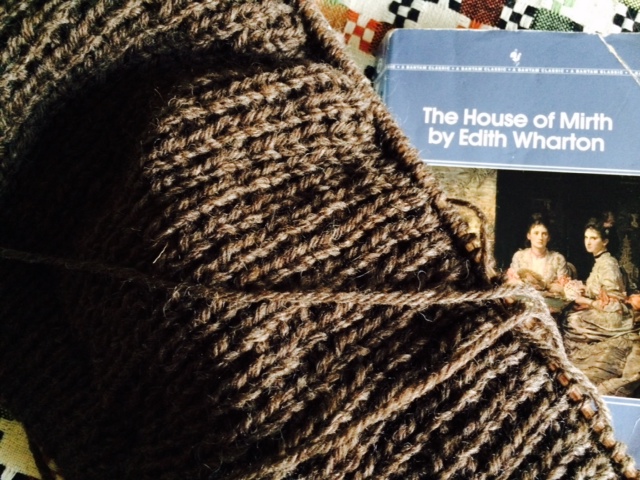
Yarn Along 8.26.15

It’s perhaps a stretch to say that this is the last photo you’ll see of the brown sweater before it’s all pieced and finished – but this IS the final sleeve, and I DO have the next five days off from work, and I DID raid the yarn store today to buy yarn for my next two projects, and I AM super motivated to get this sweater done. I’m just saying – it could happen.

My next two sweaters will NOT be brown. They will be the anti-brown. And I can’t wait.

I am reading all kinds of things, but I’m still enjoying The House of Mirth on top of my other projects. I’ll tell you more about it soon. Happy Wednesday!

Yarn Along is hosted by Ginny on her blog, Small Things.

Posted in Yarn Along | Tagged , , , , , , , , , , , , | 12 Comments

Here’s Your One Chance, Fancy: Thoughts on the First Third of Edith Wharton’s The House of Mirth (by Bethany)

house-mirth-edith-wharton-paperback-cover-art

This may be the most irony-dense book I’ve ever read. I really don’t want to write a review – what I want to do is quote entire passages (page-long paragraphs in some cases) and then say “Isn’t this just horrible? And yet so honest? And yet so hilarious?” I’m not ashamed to admit that the point-and-grunt school of literary criticism sometimes has its appeal.

Our heroine is Lily Bart, who falls into the same general category as Ellen Olenska in The Age of Innocence and Isabel Archer in The Portrait of a Lady, which is to say that she has been raised wealthy and taught to live like a person of tremendous privilege but does not actually have any money herself. In Lily’s case, her father came home one day, said, “I’m ruined,” and then commenced his “slow and difficult dying” (30). Mrs. Bart spent a bit longer than average in Kübler-Ross’s first stage of grief – denial – insisting that Lily should continue to live like an heiress. For a while, Mrs. Bart and Lily “wandered from place to place, now paying long visits to relations whose house-keeping Mrs. Bart criticized… and now vegetating in cheap continental refuges, where Mrs. Bart held herself fiercely aloof from the frugal tea-tables of her companions in misfortune” (31). Eventually Mrs. Bart kicks the bucket as well, leaving Lily, who “became the centre of a family council composed of the wealthy relatives whom she had been taught to despise for living like pigs. It may be that they had an inkling of the sentiments in which she had been brought up, for none of them manifested a very lively desire for her company; indeed, the question threatened to remain unsolved until Mrs. Peniston with a sigh announced: ‘I’ll try her for a year’” (33).

Hang on. I want to say that one more time. Why? Because I can. Mrs. Peniston.

And again: Mrs. Peniston. Never gets old.

I’m joking around, but there is no question that the situation Lily is in is a grave one. It was through Wharton’s later novel The Age of Innocence, which I love, that I came to understand how the daughters of ultra-wealthy families in late-nineteenth and early-twentieth century were raised with blinders on. Men in these families were encouraged to look forward to introducing their wives to the world (to great art, to literature, to travel, etc. – and also to sex, of course, which is rarely even euphemistically mentioned), and young women then were kept distant from all of these subjects in order not to deprive their future husbands of the pleasures of educating them. One of the larger points made in The Age of Innocence is that in so carefully guarding their words and actions to make men think they are innocent, young women (and older ones too) are actually less innocent than men, who are innocent enough to believe that their wives have no opinions except the ones they have given them. So far in The House of Mirth the situation is graver: Lily really is innocent – dangerously so – and is also the locus of her family’s resentment at how Lily’s mother treated others. She is also 100% devoid of skills, except those involving flirting and manipulation. I think of Dorothea in Middlemarch exclaiming to Will Ladislaw with what she thought was audacious abandon, “We shall be married – and I will learn what everything costs!” As adorably innocent as this statement sounds, it reflects a knowledge of the world that Lily does not possess.

Except for the chapter spent on the backstory on how Lily’s parents lost their money and died, the first 80-some pages of this novel all concern a party held at the home of Gus and Judy Trenor somewhere in upstate New York. In chapter 1, Lily is in New York City waiting for the train to take her to the party when she meets Lawrence Selden, an acquaintance, who invites her up to tea and reveals that he lives in such squalor that he is required to turn his lamps off and on by himself. Their conversation in this scene is animated and honest, and I predict that Lawrence will be the Ralph Touchett of this novel – the decent, generous man the heroine embraces as a friend but passes up for marriage in favor of someone richer.

Next, Lily goes back to the train station and leaves for the party. On the train she encounters Percy Gryce, a rich young man who collects bric-a-brac. Gryce is the second bric-a-brac collector I have encountered in literature, the first being some yahoo in The Portrait of a Lady. Is ‘collecting bric-a-brac’ a fin de siècle euphemism for being a hoarder? I don’t know. Let’s just say that Percy Gryce is the guy who hid little doo-dads in attics all over New York, doo-dads that a hundred years later would be unearthed and trotted in front of the cameras on Antiques Roadshow.

With Gryce’s arrival, Wharton’s language becomes a bit… Darwinian. “She began to cut the pages of the novel,” Wharton writes, “tranquilly studying her prey through downcast lashes while she organized a method of attack. Something in his attitude of conscious absorption told her that he was aware of her presence: no one had ever been quite so engrossed in an evening paper! She guessed that he was too shy to come up to her, and that she would have to devise some means of approach which should not appear to be an advance on her part. It amused her to think that anyone as rich as Mr. Percy Gryce should be shy; but she was gifted with treasures of indulgence for such idiosyncrasies” (16). This kind of inner plotting continues for several pages, wherein we also learn that the Gryce fortune comes from Percy’s father, who invented “a patent device for excluding fresh air from hotels” (21) and that Percy’s mother is “a monumental woman with the voice of a pulpit orator and a mind preoccupied with the iniquities of her servants” (20).

There’s more, of course. We meet any number of Lily’s shallow acquaintances and learn the ins and outs of avoiding church when one is a young wealthy individual in the upstate New York of the early 20th century. Lily toys with Percy Gryce’s emotions at the party, is offended when she is summoned to her hostess’ room in the morning to help Mrs. Trenor answer her mail (apparently this is what happened to guests of this era who could not foot their own bill at parties) and (rightly) upset to the point of tears when she is pressured into playing cards and loses a significant amount of money to a guest she knows to be extremely rich, and then shocked when Lawrence Selden shows up, even after he said he wasn’t planning to, and seems determined to keep Lily company throughout the weekend.

So there you go. This novel is beautifully written though sometimes difficult to read because of some of the cringeworthy behavior of Lily’s social set. I’m reading it slowly, but I can always jump back in and feel well oriented even if I’ve been away from it for a week or more. I’m looking forward to reading more.

Posted in Authors, Edith Wharton, Fiction - general, Fiction - literary, Reviews by Bethany, The Numbers Challenge | Tagged , , , , , , | Leave a comment

A Review of Anthony Doerr’s All the Light We Cannot See (by Jill)

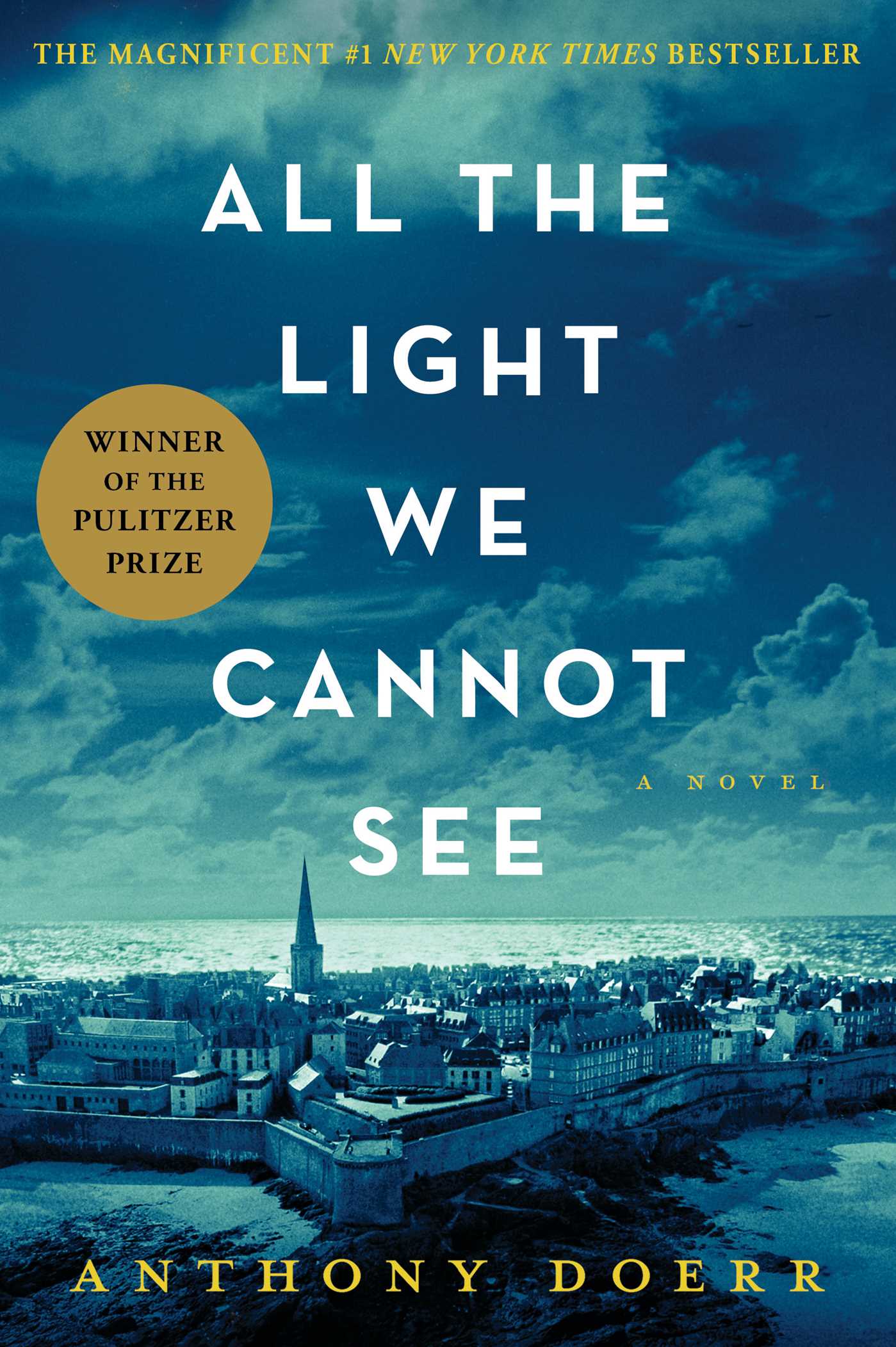
all the light we cannot see coverLong before this book became the 2015 Pulitzer Prize winner, to me it was a book with a pretty cover that Powell’s Indiespensible book club sent me. And then it was everywhere. And continues to be, over a year after it was first published. You know a book is popular when the paperback release date gets pushed back to two year after the release of the hardcover version. I, as is customary, got to this super-popular novel in my own damn sweet time, not because I wanted it to be less popular by the time I read it (that’s so something I did back in my twenties), but simply because it got buried in line behind other books that I enjoyed less, and some that I enjoyed more.

I’m sure most of the book-reading world knows by now that All the Light We Cannot See takes place in Europe during World War II. There are two protagonists: Marie-Laure LeBlanc, a young French girl, and Werner Pfennig, a young German boy. Their paths do not cross until the very end of the novel, in the French coastal town of Saint-Malo. The novel starts in 1944, right before Marie-Laure and Werner meet, and quickly jumps back to 1934, when Marie-Laure is six and Werner is eight. Marie-Laure lives in Paris with her father, who is the locksmith for the Museum of Natural History in Paris. She develops cataracts and goes blind shortly after her sixth birthday, so her father makes her a very detailed model of their neighborhood that she can learn where things are based on feel. Marie-Laure is generally a pretty happy kid. She goes to work with her father, she reads Jules Verne in braille. Werner, on the other hand, lives in a mining town in Germany, in an orphanage, with his sister. He discovers a propensity with radios at a young age, and he and his sister listen to voices far and near and it’s their means of escaping their dreary little town.

In 1940, everything changes for Werner and Marie-Laure. With the invasion of Paris, she and her father flee to Saint-Malo to stay with Marie’s shut-in uncle Etienne and his housekeeper Madame Manec. The story of their journey to the northern coast of France is not a pleasant one. At the same time, Werner is accepted into the National Political Institutes of Education; it’s a military school for the Third Reich. It’s kind of awful. The beauty of Saint-Malo and the bleakness of this school are well-juxtaposed in these sections. Eventually, Werner gets conscripted into the army at the age of sixteen (one of his teachers tells the army that he’s older than he is so he can use his talents in the war), and eventually ends up driving around Europe looking for illegal radio transmissions, which is how he ends up in Saint-Malo in August of 1944.

I don’t feel like doing any more plot summary, so I’m going to stop now. I enjoyed this book. Does it confuse me that a fairly simple historical novel won the Pulitzer Prize? Kind of. There were some subplots that I didn’t mention, of course. Werner’s friend from military school, Frederick, who is beaten half to death in an “exercise” late one night, and loves birds, is a tragic figure who has stuck with me. Etienne’s PTSD from The Great War that he works to overcome over the course of the novel is another subplot that I enjoyed. The hiding of the mysterious Sea of Flame diamond and the German officer’s never-ending quest for it, which is how Marie-Laure and her father ended up in Saint-Malo in the first place. He is charged with keeping it safe from the Nazis. (His name is Von Rumpel—he’s the face Doerr gives to Nazi Germany. And it’s not a friendly or a reasonable one.) It seems lately that lots of authors are presenting the Germans of the Third Reich as being equally as much victims of Hitler as the rest of the world. I always sort of thought that all Germans were happy followers of Hitler, but some of the books I’ve read over the past few years paint a different picture. Here, Werner is not a willing participant in Hitler Youth shenanigans, but he doesn’t have a choice in the matter. In The Book Thief, Liesel and her family and the other residents of her town are almost as terrorized as the Jews (that’s an oversimplification, of course, but they don’t really thrive under Hitler’s leadership). I know there are more examples, but since Bethany was just talking about The Book Thief it’s fresh in my mind. All the Light We Cannot See is, perhaps, deceptively simple, so deceptive that I didn’t realize how much goes on in its pages until I started listing off subplots in this very paragraph. It’s beautifully written without being too flowery. Its characters are well-developed, though I feel like Marie-Laure was not as well-rounded as Werner and some of the supporting characters. Mostly she was just Blind, and missing her father. She is brave, of course, but she never, for me, got beyond being a brave Blind girl.

I do think most people will get something out of this book and recommend it highly. Do I think it should have won the Pulitzer? It’s not for me to say. It’s definitely less of a downer than The Goldfinch. But it’s not a sweeping tale like, say, The Known World. It doesn’t “deal with American life,” like the Pulitzer folks say their winners “preferably” do. In fact, there aren’t any Americans in the novel, with the exception of the ones who bomb Saint-Malo practically to smithereens. And none of them are mentioned by name. But then, The Amazing Adventures of Kavalier and Clay won back in 2001 and that was a book about comic books. I guess there may not be any rhyme or reason to the Pulitzer Prize after all…. I half expect this book will be turned into a movie sometime in the next few years, and I’ll go see it if it is.

Posted in Anthony Doerr, Fiction - general, Fiction - Historical, Fiction - Important Award Winners, Fiction - literary, Reviews by Jill | 2 Comments

Yarn Along

Yarn Along photo 8.19

The brown English rib sweater (Yes… still) is the perfect project for me this week because it’s easy and can be worked on mindlessly, which is what I need during my first week on a new job. I got a lot of knitting done this weekend and even spent some quality time with CNN, the sweater, and takeout dinner from Noori Indian restaurant on Tuesday night. All right – I didn’t actually knit while I was eating my chicken saag – but close enough.

Back when all the hype about The Book Thief was in its heyday, I considered reading it and then decided against it. My reason can be loosely summed up as follows: I already know that tragic subject matter like the Holocaust can be written about in unusual and even lighthearted ways, and this is a lesson one needs to learn only once. I don’t need to read this book, my reasoning proceeds, because I’ve already read Time’s Arrow, I’ve already seen Life is Beautiful, and I’m familiar with the comedy of Mel Brooks. (I’ve also been yelled at by Mel Brooks on a boat, but that is a story for another day.) I will be teaching this book beginning next week, so I’m reading it and making plans about how to discuss it, and I know that many of my young students may find this novel BRILLIANT and LIFE CHANGING, as its cover insists it is (the cover says it is ambitious also, but only in lower case). For that reason, I don’t dread teaching it, and I think our discussions will be fun. But for myself as a reader, I’m not too impressed. I don’t care one whit about any of the characters, not even the ones who are clearly undoubtedly doomed, and every time the first-person narrator says something to remind me that he is supposed to be “Death,” I just snort.

But in other news, my new job is just down the road from one of my favorite yarn store. Than longen folk to goon on pilgrimages, as they say, though I don’t see myself waiting for April.

***

Yarn Along is hosted by Ginny on her blog, Small Things!

Posted in Yarn Along | Tagged , , , , , , , | 13 Comments

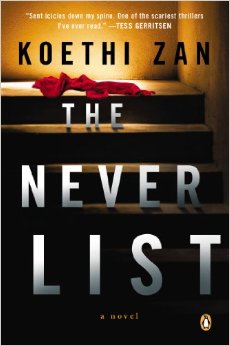
A Review of Koethi Zan’s The Never List (by Bethany)

The Never List cover image

This novel is the prose equivalent of the stereotypical horror movie – you know, the one where the scantily-clad girl keeps going back in the creepy mansion where all the screams and chainsaw noises are coming from. The first half of this novel (which is better than the second half) establishes the protagonist, Sarah, as a kidnapping/torture survivor who is so deeply traumatized by her three years in captivity that she lives as a near-recluse. She is an actuary for an insurance company, a career that allows her to work from home and that makes use of her obsession with the statistics of danger, an obsession that began even before she was abducted. She lives in a New York City apartment where the doorman accepts packages and other deliveries for her and turns unwanted callers away. Her psychiatrist pays house calls; other than that, her only other visitors are her parents and an FBI agent named Jim McCordy, who is assigned to keep Sarah and the other victims of her kidnapper informed about the status of his case.

All of this makes perfect sense to me. Sarah’s living situation sounds pretty great to me, and I’ve never had a trauma anywhere near as severe as what Sarah experienced. I’ve had trips to the grocery store that have made me want to isolate myself from society in the way that Sarah does. Suspension of disbelief was not a problem for me while I was reading the first half of this book, though I imagine it is for some. So many of our cultural norms are directed at extroverts, and I got the sense that I was supposed to see Sarah’s closed-off world as a trauma in and of itself.

Eventually, Sarah leaves her ordered, controlled world – a departure that had to happen in order for this book to have a plot, of course, although it was when she left her apartment and started raiding BDSM clubs on dirt roads in the middle of forests in rural Oregon (yes, really!) that my willingness to suspend disbelief was tested. Here’s what happens: Jim the FBI agent arrives to deliver a letter to Sarah from her former kidnapper, who has been writing to her and to his other victims from his prison cell for a long time. Sarah always reads his letters – which are ambiguous and creepy – because she is convinced that Jack (that’s the kidnapper) is sending her clues that will lead her to the spot where he buried Jennifer, another one of his kidnap victims. Even though Jack’s letters upset her, Sarah always reads them because she is determined to put the clues together. On this visit, though, Jim the FBI agent tells Sarah that Jack will be up for parole soon. Jim wants to persuade Sarah to appear at his hearing. This conversation, which takes place in the second chapter of the novel, serves as the novel’s exposition – we learn about Tracy and Christine, the other two women who were kept prisoner with Sarah and Jennifer. Tracy is the founder and editor of a radical feminist academic journal, and Christine has become a Park Avenue trophy wife and mother who refuses to maintain any connections with her past. From Jim’s perspective, Sarah is a perfect witness to speak at the hearing because Tracy, as an outspoken crusader against violence toward women, will appear to have an axe to grind and because Christine will refuse even to take calls from the FBI. Sarah is important to the FBI because she looks and acts the most victimlike.

Sarah refuses to agree to speak at the hearing, but she does promise to think about it. When Jim leaves, she quickly goes back to mining Jack’s recent letter for clues, and – long story short – decides to go to Oregon to investigate some of the theories she has formulated based on Jack’s letters. As a result, the novel grows quickly ridiculous. All of a sudden, the traumatized reclusive actuary is flying cross country, renting cars, staying in hotels, and chatting up creepy strangers. She reunites with Tracy, who has in general been distant toward Sarah ever since they were rescued from Jack’s house; we learn that Tracy is angry with Sarah because of something that happened during their escape. She also connects with a woman named Adele Hinton, who was his research assistant during the years that Sarah and the others were held captive (Jack was a psychology professor at the University of Oregon) and who later replaced Jack in the psychology department after his arrest.

I’ll skip over most of the rest of the plot, but suffice it to say that Jack does not get out on parole, that Sarah and Tracy reunite with Christine, that a human trafficking ring is uncovered, and that a creepy preacher is involved, but that even the presence of the creepy preacher does not save the novel from mediocrity. Sarah and Tracy do briefly get kidnapped again, but they turn out fine. We learn why Tracy was mad at Sarah about the circumstances of their rescue, and Sarah does reunite with Jennifer, sort of. There’s some suspense, I guess, and I certainly did not mind picking the novel up each day, but there is also very little here that is out of the ordinary. This novel seems to come out of the same general image bank that produces Law and Order: SVU – which I enjoy sometimes, especially as the backdrop to a long day of knitting – but this also means that this novel is scaffolded by clichés. Every single last detail, from the by-the-book FBI agent and the uniformed doorman to the waitress in the small-town coffee shop and the BDSM couples to whom Adele introduces Sarah, might as well come from some public reservoir of stock characters. Even Jack, the psychology professor-turned serial kidnapper and rapist, is Hannibal Lecter viewed through a slightly modified lens. There is not a single element of this novel that seems to emerge from the unique worldview or imagination of its author. And that really is too bad.

Posted in Authors, Fiction - general, fiction - thriller, koethi zan, Reviews by Bethany | Tagged , , | Leave a comment

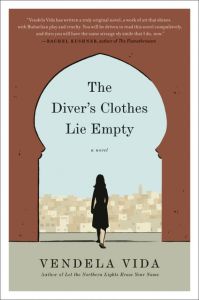
A Review of Vendela Vida’s The Diver’s Clothes Lie Empty (by Bethany)

The Diver's Clothes Lie Empty cover image

I spent last weekend totally engrossed in this book. I don’t even remember turning the pages. Its worldview is microscopic rather than macroscopic – the plot unfolds over approximately 1-2 weeks, and we’re focused throughout on a protagonist about whom we know almost nothing – and the protagonist’s past intrudes on the present only very rarely. Its unnamed protagonist strikes me as a female Frederic Henry, adrift in an unfamiliar world.

This novel is written in the second person. I think I’ve read a few novels and stories written in second person over the years, but aside from a few Choose-Your-Own-Adventure books back in elementary school, this novel may be the first one I’ve enjoyed. The second person point of view – used not to refer to a particular listener but to the speaker or narrator herself – bothers me because it’s imprecise. In real life, “you” often means “me and everyone who agrees with me, which I assume to mean everyone in the world,” as in “The last thing you expect on your vacation is a thunderstorm.” This was a huge pet peeve of mine as a teacher. “You” is meant to refer to a specific, known audience. I don’t like pronouns that ask me to infer things. Bossy pronouns have a way of making you (wait – me) feel put upon.

This novel – in spite of the fact that its point of view constantly tries to deflect attention off of itself and back onto “you” – stays painfully close to its protagonist, closer even than most first-person novels. The protagonist is never called by her name. This is yet another strategy I have a history of disliking. I forgive Ralph Ellison, somewhat grudgingly, and have been known to be nasty in classes and workshops when protagonists are known only as “he” or “she.” It occurs to me, though, that there is something sad and desperate in the second person pronoun that isn’t present in the third person. The second person is begging for an intimacy with the reader that it is too shy to ask for directly.

In this novel, the ploy worked. I felt an intimacy with the protagonist from the beginning and was happy to follow her through a dozen or so aimless days in Casablanca, Morocco, even when she makes some bizarre decisions. As the novel begins, we know that the protagonist is recently divorced and that she has planned a trip to several cities in Morocco as a way of escaping the misery of her daily life. We also learn early on that she is a twin – that ever since she was an embryo, coupledom has been part of her essential reality.

Before the events of the novel start to turn against the protagonist, it is already clear that she feels cursed: “You tip the driver with a twenty-dollar bill. Later, you will wonder if this was your initial mistake” (9), she remarks (or you remark – I can’t even figure out how to write about this character properly; the second-person narration warps everything, though in fascinating ways). There are other omniscient moments like these – whispers from the voice that says “later” – and I suppose that this is another advantage of the second-person point of view. A first-person narrator by definition can’t be omniscient.

The first thing that happens to the protagonist after she overtips the driver is that her backpack is stolen. She is checking into her hotel in Casablanca when she looks away for a moment and then turns her head again to find that her backpack – which contains her wallet, passport, and credit cards – is gone. Security camera footage confirms the theft, and the hotel staff put her in touch with the local police. At the police station the next day, a detective approaches her triumphantly and announces that they have located her backpack. He hands her a black backpack that is similar to hers but not exactly the same; this pack, of course, contains someone else’s ID and credit cards. The protagonist is asked to sign a statement saying that her property has been returned to her, and she does. This is one of those moments when I was screeching at the protagonist not to do something so terribly stupid – but of course she didn’t listen. At the time I couldn’t fathom why she would do such a thing – essentially, confess to identity theft and leave behind any possibility of getting her own property back without repercussions – but as the novel progresses, I came to realize that the protagonist – either innately or as a result of recent trauma in her personal life – is drawn to risk-taking behavior. Not risk-taking in the physical sense – bungee jumping and so forth – but risk-taking in the quiet sense. Risk-taking in the paperwork sense. Of course, it’s also true that on some level she doesn’t want her identity back; the chance to be someone else is literally handed to her in a black backpack, and she accepts not only the backpack but a new name: Sabine Alyse.

The protagonist does visit the American embassy, but what can she possibly do there? She can’t show them a stranger’s passport. She leaves, promising to return with the proper documentation. When she returns to her hotel, she checks out and uses Sabine Alyse’s credit card to pay for a night at a more exclusive and expensive hotel, knowing all along that she is leaving herself deeply vulnerable to getting caught using the card fraudulently. She compares herself to her twin: “Unlike your sister, whose brain is a beehive, and who has excelled at continuously planning her next step, you have always been good at staring out of windows for long periods of time. You try not to calculate how much of your life you have wasted doing exactly what you are doing now” (73). The fact that this novel is not divided into chapters but meanders right along with the thoughts of its meandering protagonist mirrors this quality. It’s as if the protagonist’s brain is divided in two: the part that understands how the world works (that identity theft is a serious crime, that the U.S. embassy would have helped her if she had only gone there instead of to the police station, that she never should have signed the release at the police station, etc.) and the part that absorbs this knowledge yet acts against it anyway.

When she moves into the more elite hotel, the protagonist is approached by a woman she calls “the practical secretary” and offered an unusual job. A film crew is making a movie in the hotel and in Casablanca as a whole, and the stand-in for the star has just quit to go home to manage a family crisis. The protagonist bears a strong resemblance to the star (again, that motif of pairing, of twins, of coupledom; again, a chance for the protagonist to distance herself from her true identity), and she accepts the job readily, recognizing it as a chance to earn enough money to settle her debts in Morocco and fly home. As a few days pass, the star (usually called “the famous American actress”; the star doesn’t have a name either) reaches out to the protagonist socially, and they begin getting together for drinks, for coffee, for dinner. These get-togethers are always initiated by the actress, who sometimes seems to be in the middle of a manic episode or something similar, yet it is the actress who pushes the protagonist to reveal bits and pieces of her real life in the U.S. To the reader the protagonist reveals nothing, but to the actress, she confesses to overwhelming anger and humiliation (“In the minds of people who knew us – and even people who didn’t – I failed. It’s horrific and humiliating on so many levels” [91]).

With all the costuming and acting in these scenes, the narrator’s confusions about her identity are developed in detail. She adapts easily to being called by the name of the previous stand-in (the film crew calls her “the new Ivy” [106]) and makes convoluted statements to herself like “You are putting on a wig so you more closely resemble the way you looked before you weren’t you” (109). She begins to think of herself as a true replica of the actress, though she also berates herself for not embodying the actress’s glamor and stage presence: “You watch the famous American actress go through the scene you just rehearsed and you can see all your shortcomings and failures. You were pretending to be Maria; she inhabits Maria” (114). The actress serves at times as a stand-in for the reader, when she asks questions about the protagonist’s past and demands answers that we have no way of demanding, and at times she becomes conflated with the protagonist’s twin: “You get the feeling that the famous American actress wants something from you, that her extending of friendship toward you is calculated. When your sister was most effusive in her kindness toward you, it was because she needed something” (126). Elsewhere, the protagonist’s experience as a stand-in gives her what Nick Carraway calls “satisfactory glimpses of the unreality of reality, a promise that the rock of the world is founded securely on a fairy’s wing,” except that in the protagonist’s case these glimpses are less satisfactory and more unsettling, as when she is traveling to the set of the day’s filming and notes that “you are stuck in real traffic making your way to the manufactured traffic” (127).

Of course, even without a movie star and a film crew present, any novel set in Casablanca is going to set off alarm bells for American readers – or for followers of American cinema anywhere. I’m not sure I’ve seen Casablanca all the way through even once in my life, but even I know that it’s about American expats during World War II, savoring a brief sojourn in the Moroccan city while also making wrenching choices between the present and the past, between personal love and political loyalty, between anonymity and glory, and between the taking of meaningful risks and the urge to burrow away unseen and wait out the war in safety. “Casablanca” is also Spanish for “white house,” and in this novel this reference is not a political call to arms but a hint at the possibility of a blank slate. The protagonist in this novel does not just face an opportunity for any blank slate, but for a blank slate that is specifically domestic – as indicated by the “casa” in “Casablanca.” Not once does this novel enter a private home; all of its scenes take place in public spaces or in hotel rooms, and all of its major characters are hiding their true identities under layers of pretense.

I admire this novel so much. Its language is evocative and precise, and its author is so skilled with well-crafted figurative language (“Your brain feels like it’s just been broken into seven continents” [171]) and haunting imagery, such as the moment when the protagonist is climbing the steps to the police station on her way to becoming Sabine Alyse, and she passes, inexplicably, a couple leaving the station pushing a stroller with no child in it, no child anywhere in sight. The protagonist is struck by the sight of this couple and wonders about their story, and the image is striking enough to stay with reader long enough for us (or me? or you?) to recognize where the arrow in this image is pointing – and of course, because this author is so shrewd and subtle, the arrow points directly into the protagonist’s own past, which we do learn about eventually, and this revelation makes the experience of wading through all the ambiguity in the novel’s opening pages more than worthwhile.

I recommend this novel highly, even for those who think reading a novel written in the second person sounds like a bit of a headache. We were wrong about that – or I was. Or you were.
Posted in Authors, Fiction - Fantasy, Fiction - literary, Reviews by Bethany, Vendela Vida | Tagged , , , , , | 4 Comments

Yarn Along

Yarn Along 8.12.15

I don’t remember where and when I acquired Wool, and this failure of memory is out of character for me. I usually remember where my books came from. Wool is a postapocalyptic/dystopian fantasy novel – you know, like just about everything else being published these days. What I didn’t realize until recently, though, is that it is a postapocalyptic/dystopian fantasy novel that is built around a series of knitting metaphors. This is not quite so common. The title, Wool, is one of these references, of course, but Wool could mean anything. I didn’t recognize the knitting references until I looked at the table of contents and saw section titles called “Proper Gauge,” “Casting Off,” “The Unraveling,” and so forth. Then I decided that not only did I have to read this novel ASAP but that it absolutely had to be a Yarn Along book.

So far I’m not seeing a lot of substance in the knitting references. This is a novel about a bunch of people who live in an underground silo because the air outdoors has become so toxic that breathing it means certain death. The interrelationships between the people in the silo are as contentious as one might expect; politics and the struggle for power play themselves out as they do in most human communities, and there are divided loyalties and evil scheming sociopaths and the like. One key character, the mayor of the silo, has just been killed by a canteen of poison water that was meant for the sheriff’s deputy, Marnes, who has been “traveling” with the mayor (i.e. descending hundreds of floors into the silo and then climbing up again) in an attempt to find a new sheriff after the previous sheriff “cleaned.” “Cleaned” means that he was sent outside in a special suit with the task of cleaning the sensors that give the silo residents a view of the world outside. “Cleaning” ends in death, because the toxins in the air buy a person a little bit of time but end up eating their way through their protective clothing. In fact, “cleaning” is used as a synonym for death in this novel. Usually “cleaning” is a punishment for a crime, but in the sheriff’s case he volunteered. His wife had “cleaned” three years earlier, and he had decided that he no longer wanted to live without her. When he does leave the silo, however, we’re given a few hints to suggest that maybe the physical limitations of this world are not what they appear. It may be that someone, somewhere, lied to all these people about the air being toxic. We don’t know for sure. I’ll tell you more when I finish the book. I will also try to tell you what all of this has to do with knitting. I’m as curious as you are.

What you see in the photo is a sleeve of the brown sweater. I’m making progress, I promise!

Yarn Along is hosted by Ginny on her blog, Small Things.

Happy Wednesday!

Posted in Uncategorized, Yarn Along | 7 Comments