Some Brief Early Thoughts on Thomas Mallon’s Henry and Clara

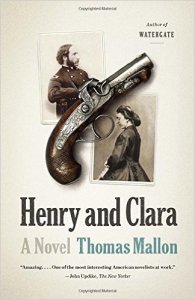
Henry and Clara cover image

I didn’t read all day today – not by a long shot – but I did do some other things, like getting lost in the Financial District in the rain and interviewing a startup CEO and changing my mind about Philz (it’s awesome!) and getting a ticket for not coming to a complete stop at a stop sign and giving someone advice on how to draw a castrated person (long story). I’m going to make a concerted effort to set next Friday aside for reading. Setting a day aside for reading really is an awfully civilized thing to do.

I’m reading Thomas Mallon’s Henry and Clara. It’s the first in his series of historical novels about U.S. history. It’s about Henry Rathbone and Clara Harris, the young engaged couple who were in the presidential box with Lincoln on the night he was shot in Ford’s Theatre. For some reason I expected the whole novel to cover the night of the shooting, with lots of detail and psychological realism, but the novel actually begins almost twenty years earlier, when Henry and Clara met because Henry’s mother married Clara’s father. They fall in love while they are still teenaged step-siblings, but their parents refuse to let them get married because they think it would be a scandal, even though Henry and Clara are not blood relatives. I’m enjoying the book, even though it’s clear that Mallon is a historian first and a fiction writer second. I’m hoping to be done by Sunday so I can review the book in detail.

Posted in Authors, Fiction - general, Fiction - Historical, Glimpses into Real Life, Reviews by Bethany, Thomas Mallon, Uncategorized | Leave a comment

Review of Lev Grossman’s Codex, part 1 (by Jill)


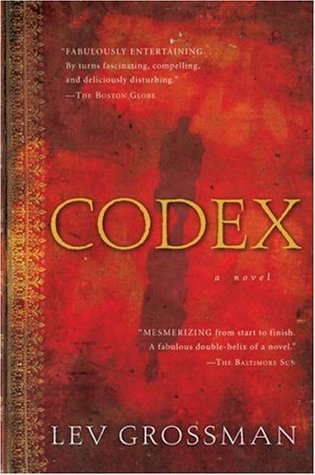
Codex coverI was just on goodreads.com organizing my books, and I was looking at Codex and trying to figure out what shelves it belongs on. I feel like I need to create a shelf for mysteries concerning encoded illuminated manuscripts. Dan Brown’s Robert Langdon books belong in this genre too. And the more I think about Codex, the more I feel like Lev Grossman may have been trying to write Robert Langdon fanfiction when he wrote it. Yeah, okay, that’s sort of mean. But it was funny. And also a little bit true.

Our hero in Codex is a twenty-five year old investment banker named Edward Wozny. He is an up and coming rising star at his firm, and has recently been transferred to the London Office, from the New York Office. I think that’s considered a promotion. Edward has just begun a two-week vacation from work, his first since he graduated from Yale four years earlier. During this time he is supposed to be packing up his apartment, moving to London, finding an apartment in London, and he hasn’t even scheduled a flight to England yet! Managing all this in two weeks seems very ambitious to me. And the other weird thing that Edward is supposed to be doing in fourteen days is a quick side project for some really rich, important clients of his firm (who happen to be a Duke and Duchess). And that project? Cataloging and organizing their library that was shipped from the estate back in England sometime either right before or during World War II, and got sort of forgotten about. Why Edward, you ask? Well, we never do find out why. And neither does Edward. But something about the collection of antique books (and books that are so old they aren’t even books, they’re manuscripts and pamphlets) speaks to Edward, as does the side project that the Duchess has in mind for Edward: finding in the crates of books a lost manuscript by Gervase of Langford called A Viage to the Contree of the Cimmerians. Shortly after starting on this project, Edward is told that the Duke wants him to cease and desist the entire project. Edward becomes obsessed with this manuscript, and decides he is going to keep looking for it, despite being told not to.

The other thing that Edward decides to get obsessed with at the worst possible time is a video game called MOMUS, an open source project. The gaming technology involved in this seems more than a little dated (granted, this book was published in 2004), but Edward gets the game on a CD from a friend, he carries his game around on a portable drive around his neck (don’t saved games just live in the cloud now?), and Edward has to buy a $5000 laptop to run it efficiently. Do $5000 laptops even exist any more? Anyway, that’s a complaint that I don’t even know is valid at this point. The computer tech described just seems dated to me. I may be completely off base, because I don’t know much about laptops besides how I can use them to type blog posts, cruise the internet, check my email, and look at my pictures.

The thing that fascinates me about Edward is that he’s this professed type A banker who finds himself at loose ends for two weeks, and turns into a gamer as well as becomes wrapped up in an ages-old literary mystery. It’s just such a personality change and I don’t know that I’ve ever known anyone to have such a one hundred eighty degree alteration in attitude so quickly before, in real life or in fiction, unless there was a stroke, or head trauma, or if the character was a spy or having a complete mental breakdown.

Edward goes on a search at a rare book repository in Manhattan, and there he meets Margaret, a graduate student doing her dissertation on Gervase of Langford. She provides exceedingly important exposition about the book the duke and duchess are after, and its author, and the controversy surrounding whether or not the book exists, and whether or not Gervase actually wrote it. This mystery aspect was my favorite part of Codex, and it’s unfortunate that there was so much else going on that this plot got overshadowed sometimes.

I’m going to do something here that I don’t think I’ve never done before on PfP: I’m going to purposefully stop right now, and finish this review on Saturday. I only have one day off this week (because I took a few days off at the beginning of the week to go to Yosemite), and I don’t think I’ll be able to read enough of anything tomorrow to get enough material together for a post on Saturday. So I’m putting a pin in my Codex review for now, and I’ll get back to you about it. I’m also hoping by then to have reread the last two chapters (for the third time) of the book, so I can be sure that I understand what happened. I don’t love that the ending was so confusing to me last night.

Posted in Fiction - general, Fiction - Inspired by The Da Vinci Code, Fiction - Mystery, fiction - thriller, Lev Grossman, Reviews by Jill, Uncategorized | 6 Comments

Yarn Along

YA 3.2

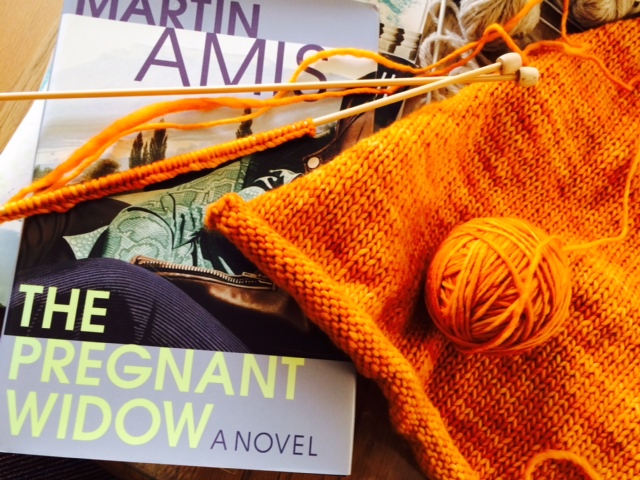
After months and months of neutral hues, I am loving knitting with this bright yellowy-orangeish heathered yarn that I impulse-purchased on sale last Wednesday. It’s merino wool, worsted weight, and fabulous in every way. I’m making another child-sized rollneck sweater (I never get tired of those); I finished the back in only 2-3 days after I bought the yarn, thanks to a knitting and HAMILTON SOUNDTRACK extravaganza last week with friend and PFP reader Maria and also to a lot of mellow TV watching (and one very non-mellow Republican debate) over the weekend. In the photo you can see that I’ve just cast on for the front of the sweater.

I’m reading several books as usual, but this photo features Martin Amis’ The Pregnant Widow, which comes highly recommended and is good so far.

Happy Wednesday, everyone!

Yarn Along is hosted by Ginny on her blog, Small Things.

Posted in Uncategorized, Yarn Along | 12 Comments

Final Thoughts on David Mitchell’s The Bone Clocks (by Jill)


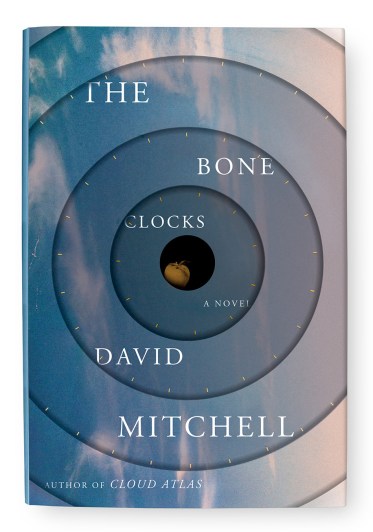
Bone clocks cover

Yes, I’m serious. I actually finished The Bone Clocks. I wish I could say that I managed to take a picture of my copy while it was in Yosemite this weekend, but I didn’t. It wouldn’t have been a great picture, anyway. My copy is a hardcover and I never travel with my dust jackets, so it would have just been a picture of a boring blue hardcover with some trees or something in the background. Of course, they would’ve been Yosemite trees, so there is that.

So when last I left off in my seemingly never-ending posts about The Bone Clocks, things were finally starting to get weird, and we were learning about the ages-old war between the Anchorites and the Horologists. Our first narrator, Holly Sykes, has been dragged into the whole thing, and offers to help the Horologists in their last stand against the Anchorites. The big battle is fairly exciting, in a telekinetic, throwing tables across the room with the power of your mind and having them run into force fields made with the power of your enemy’s mind kind of way. I would have been okay with the novel ending with the climactic battle and Holly’s escape from it (sort of the last spoiler, but maybe there will be more), but no. Mitchell decides to jump forward another eighteen years to 2043.

And in 2043, Holly is seventy-three, and apparently the modern world is coming to an end—horrible gas shortages, the internet is down, electricity is rationed to the point of being unavailable, and famine is knocking at the door of the entire world. One of the Horologists predicts a future very similar to this in the 2025 section. I briefly suspected that we might be in for a bit of a dystopian interlude at the end when I read that prediction, but I kind of forgot in all the excitement of the big fight sequence. Mitchell’s dystopia is not dissimilar to most of the other versions I’ve read about or watched over the years, less the Zombies that are sometimes present, of course. I’m not complaining about Mitchell’s writing here, of course not. The writing is impeccable. But doing a dystopia just stinks of trendiness in writing. I would have much rather read about a 2043 that isn’t everyone’s worst-case scenario coming to life. I’m not saying there needed to be a happy ending all around, but to see the difficulties Holly Sykes endures in a 2043 that doesn’t take place in a 2043 that’s rapidly turning into 1843 would have been a hell of a lot more interesting than reading about what Mitchell decided to write about.

I feel bad making derisive remarks about a book that in general I really, truly enjoyed, but I think that it’s my job as a responsible book blogger to celebrate the good as well as not sweep the bad under the proverbial rug. So, who would enjoy The Bone Clocks? Well, I did. But not literary fiction purists—I think this book is best suited for literary fiction people who also enjoy some sci-fi/fantasy/magical realism mixed in with their well-written prose. I would love to discuss this book with Bethany; I think she would like it for the most part, and I know that she would be able to help me dig deeper into the patterns in Mitchell’s work. I will definitely read more of his books, sooner rather than later, especially so I can figure out whether or not the Horologists have been floating around in his other novels….

Posted in David Mitchell, Fiction - Dystopia, Fiction - Fantasy, Fiction - general, Fiction - literary, Reviews by Jill, Uncategorized | 1 Comment

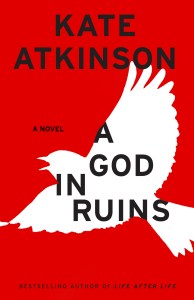
Final Thoughts on Kate Atkinson’s A God in Ruins

a god in ruins cover image

This novel is hard to review without including “spoilers” – and there is no doubt that anticipation of the ending is a significant part of the experience of reading this novel. If you do not want to read a direct and detailed analysis of the novel’s ending, you should not read this review.

***

A God in Ruins begins with Teddy Todd’s aunt Izzie mining his life for fiction. Teddy is eleven. “‘What makes you you? What do you like doing? Who are your friends? Do you have a thingamajig, you know… David and Goliath – a slingshot thingy?’

‘A catapult?’ [Teddy asks.]

‘Yes! For going around hitting people and killing things and so on.’

‘Killing things?’ [Teddy says.] ‘No! I would never do that… I used to use it to get conkers down from the tree” (11).

The end product of Izzie’s interrogation is a series of children’s books about Augustus, Teddy’s rambunctious alter ego. The series makes Izzie rich, and she takes off to do glamorous writerly things and is rarely mentioned again, though Teddy thinks of Augustus occasionally, usually with mild annoyance. Augustus represents a childless middle-aged woman’s stereotype of a young boy – Tom Sawyer, Tom Swift, and so forth. This opening device establishes Teddy as thoughtful and serious, while also establishing him as fundamentally misunderstood. It also hints at the idea that there are “two” Teddys (i.e. Teddy himself and his fictional counterpart, Augustus), an idea that returns later.

“‘Are you a Boy Scout?’ Izzie asks.

‘Used to be,’ Teddy muttered. ‘Used to be a Cub. It was not a topic he wished to explore with her but it was actually impossible for him to lie, as if a spell had been put on him at birth…

‘Did you get kicked out of the Scouts?’ Izzie asked eagerly. ‘Cashiered? Was there some terrible scandal?’

‘Of course not.’

‘Do tell. What happened?’” (11-12)

This opening dialogue establishes the eleven year-old Teddy as honest, thoughtful, and patient. It also establishes him as the origin point of a series of myths created by Izzie and propagated by her readers. He’s almost George Washington with the cherry tree, though I’m not sure how much that story would have been on Atkinson’s mind, as she is British. We also know early on (this narrative is not told chronologically) that Teddy becomes a war hero – a bomber pilot and later wing commander of a bombing unit that flew sorties over Germany nearly every night during the years leading up to D-Day. And if there are any people in our world who are routinely transformed into the objects of myth – in the United States, in Europe, and no doubt elsewhere – it is the World War II generation.

Full disclosure: I am writing a novel about that generation too. It seems few writers can resist it. I think of myself as having above-average street cred in this area because my dad – age 92 – is a veteran of that war himself. I live with him. As I write this review, he is in the next room, reading the paper. By noon he’ll have forgotten everything he read, but he reads the paper every morning because he has always read the paper every morning. The war novel I am writing is stalled, and the main reason it’s stalled is that I am determined to resist cliché. I can stay away from linguistic clichés easily enough, but trying to tell a World War II story without resorting to clichés of plot and character is like navigating a minefield. Atkinson doesn’t wholly avoid these sorts of clichés, but she does better than most.

A God in Ruins is organized into eighteen chapters, beginning with Teddy as an eleven year-old under his aunt Izzie’s microscope in 1925 and ending with Teddy’s death in 2012. The novel does not end in 2012, mind you, because the narration is non-sequential – but 2012 is the latest date the novel reaches. Five chapters concern Teddy’s war years, as he flies more and more bombing missions over Germany, becoming over time an object of superstition for the men on his crew and (later) the men he commands. The two-page first chapter of the book – just before Izzie’s grilling of Teddy – depicts Teddy taking a walk along the airstrip just before his final flight, not because he wants to take a walk but because he always takes this walk, and his men – who have been made deeply superstitious by fear – will be afraid to fly if he doesn’t. This nightly walk reminds me a little of my dad’s daily reading of the newspaper (and his many other routines), which I don’t think is motivated by superstition, but who knows?

We are told throughout the novel that Teddy was a POW for a portion of the war. A POW camp is mentioned, as is the suggestion that his plane went down in the North Sea. I was a little surprised each time a “Teddy’s War” chapter passed and we didn’t glimpse the inside of the POW camp, but I’ve learned in my own writing that if I’m writing about material that I haven’t experienced myself and if that material is already ripe with cliché, sometimes it’s best to leave the scene out altogether and just allude to it – and I thought Atkinson might be thinking along the same lines (I was half right – more on this in a moment).

In the chapters set after the war, we learn that Teddy married his childhood neighbor Nancy, even though he was not “in love with” her in the traditional sense. Nancy was a cryptologist during the war, and Teddy proposed to her when they were both on leave in London. At the time, Teddy didn’t believe in “an afterwards” – he did not expect to survive the war. When he survives, he marries Nancy because he promised to do so. During the war, he has a number of other liaisons, some of which are sexual, because he wants to experience what it is like to be “in love” – and he never really achieves that goal. Teddy and Nancy have one child: Viola. During Viola’s difficult birth, a doctor tells Teddy that he might be forced to choose between saving Nancy and saving the baby, and he answers without forethought that the doctor should save Nancy – a sentiment that to me seems a whole lot better than being “in love.” Nancy develops a brain tumor and dies when Viola is only eight. At Nancy’s request, and with the silent acquiescence of her doctor, Teddy administers a deadly dose of morphine in order to end her suffering. When she doesn’t die from the morphine, he suffocates her – again, by her specific request. Over and over – in the war, of course, but also in the scene in which Nancy dies – the reader is reminded of eleven year-old Teddy’s horror at the prospect of killing animals with a slingshot: “Killing things? No! I would never do that” (11). At the beginning of the novel, this statement seemed to suggest young Teddy’s humanity, his thoughtfulness, his respect for life. By the end, it simply marks him as naïve.

Viola, who loses her mother when she is eight years old – and, we learn along the way, witnessed Teddy suffocating Nancy – grows up awkward and angry. Her relationship with Teddy is highly strained. She marries several men and has two children – Sunny and Bertie – whom Teddy helps to raise. Sunny and Bertie both grow up loathing their mother – who, like Aunt Izzie, eventually becomes a highly successful writer – and adoring their grandfather. We learn that Viola saw Teddy killing her mother too late in the novel for it to impact our sympathy for her – at least in my opinion. Her horrible treatment of both her children and her father make her irredeemable. Yet I also saw myself in Viola, and still do. She’s selfish; so am I. She’s angry about things she can’t change. Like her father, she never seems to be fully “in love” – and there is certainly no one in her life, as far as I can tell, to whom she is as devoted as Teddy is to Nancy, to his grandchildren, to the many men he flew with and commanded during the war, and to Viola herself. Again, Viola, c’est moi. I often say that my dad shows more consideration for the homeless woman who comes each week to rifle through our recycle bin (he organizes the bin for her, making sure the cans and bottles that she can exchange for a deposit are on top – yes, really) than I have ever shown for any other human being in my life. In a Facebook exchange, my friend Tracy wrote, “Viola in general is a melodramatic mess, but that feels like part of Atkinson’s goal – her saga is almost like a red herring. We are all important in our own minds, with Viola just taking it to a ridiculous extreme.” I agree 100% with the second part of Tracy’s statement, but I’m not quite sure that Viola’s plot line is a red herring. This may just be because I’ve been trained to believe that skilled novelists don’t let any of their plot lines become red herrings – and of course there is no way to prove that this is true. But if anything, Viola is a foil to the devotion and self-sacrifice of both of her parents, and she’s the vehicle by which Teddy gets his grandchildren, who love him as his daughter never could – possibly (and ironically) because they are more distanced than Viola is from Teddy’s years as a person who kills others (i.e. Nancy and thousands of nameless Germans).

But in some ways most of this novel is a red herring. After extensive delay of the fate of Teddy’s last flight, we see Teddy “fighting” his burning plane until he reaches the coast and can crash in the North Sea instead of over German territory. He has already given his parachute away to a crew member, and the rest of his crew has already jumped to meet whatever fate they will meet – presumably death or capture. In describing this final flight, Atkinson uses a strange metaphor of “walls” that I am still working to understand. Throughout the war, Teddy has thought of the air campaign against Germany as the act of throwing thousands upon thousands of birds (i.e. planes) against “a wall” in hope that they wall will fall down; as he completes each of his missions, he comments that the wall still stands. The “walls” referred to at the end are different, I think, though of course they echo the imagery from earlier in the novel.

The last chapter in the novel is called “2012: The Last Flight: Dharma.” This title is odd, since the rest of the war chapters are labeled with the years in which they take place: 1942, 1943, and so forth. The use of Dharma – a word used briefly and comically much earlier in the novel, as the name of a classmate of Sunny’s at a Waldorf school – hints at the chapter just before the last, in which Viola, long estranged from Sunny, impulsively flies (flies!) to Bali, where he is a yoga teacher and guru (ministering to American tourists who are “doing the eat-pray-love shit” [431]; what’s not to love about a British novelist who spins that phrase?). Dharma translates roughly as “the behavior that makes life and the universe possible,” and the presence of this word at the end of the novel is remarkably associative. It suggests Teddy’s bravery in conducting mission after mission in spite of terrible odds; also his marriage to Nancy, his steady and dutiful care of her and of Viola and of his grandchildren. It can be read ironically too, since a massive campaign against the lives of German civilians does not seem like a behavior that makes life and the universe possible – unless of course one takes the long view, that the future of life and the universe is possible because of men like Teddy who sacrificed their own innocence and goodness, killing so many for the greater good. Dharma also (dare I mention it?) makes me think of the TV series Lost – an association I wanted to dismiss until I realized that this series also concerns downed planes and matters of love and devotion and fate and has its own highly ambiguous ending.

The “Dharma” chapter begins with Viola taking Sunny’s yoga classes. He won’t agree to see her in any other context. There is a self-sacrifice and an enforced humility to this – it suggests images of Shaolin monks standing motionless outside the temple for weeks before being allowed entry. The narration tells us that each class “was designed with punishment in mind” (435) – punishment of Viola, that is. While all of this is going on, Teddy is dying back in London. Viola gets the call and tells Sunny the news. Sunny – who loves his grandfather deeply – does not return to England for the funeral. In their last conversation before Viola flies home, she admits to being “overwhelmed by love. For [Sunny].” The narration (not Sunny himself), says, “Oh, Viola. At last.”

Next comes the ending that, depending on how one interprets it, may or may not have made all of the above irrelevant. Teddy is dying: “Moments left, Teddy thought. A handful of heartbeats. That was what life was. A heartbeat followed by a heartbeat. A breath followed by a breath. One moment followed by another moment and then there was a last moment. Life was as fragile as a bird’s heartbeat, fleeting as the bluebells in the wood. It didn’t matter, he realized, he didn’t mind, he was going where millions had gone before and where millions would follow after. He shared his fate with the many” (439). This passage could be set in 2012, when Teddy is dying in a hospital bed. There’s no reason that it can’t be set then. But the title of the chapter is “The Last Flight.” Teddy’s acceptance of his death at this moment could take place in 2012, but it could also take place in 1944, as his plane crashes into the North Sea with only Teddy on board – a Teddy who has just sacrificed himself in order to (possibly) save his crew members but also to save whatever civilians may have been on the ground when his plane fell. As many people as Teddy killed in his years as a bomber pilot, he died (if we interpret this passage as taking place in 1944) in a way that saved some people too.

“An alarming crack appears in the golden palace,” writes Atkinson just a page later. What golden palace? I wonder. “The first wall shivers and crumbles. The second wall buckles and falls, stones tumble to the ground” (440). What’s the deal with the walls? Are they the walls of the golden palace? The “walls” of Teddy’s plane as it burns itself up? The metaphorical wall that Teddy imagined the commanders throwing birds at? By the time “the third wall comes down with a great crash, sending up a cloud of dust and debris” (441), I was already thinking of the theatrical concept of “the fourth wall” – a term that is also used to describe written fiction. In theatre, the fourth wall is the conceit that the empty space at the front of the stage is really a wall – that the actors are not aware of the audience and are living out “real” lives rather than lives that have been scripted for them. Playwrights and directors instruct actors to “break the fourth wall” all the time – think of the Stage Manager in Our Town winking at the audience as he tells them to go home and get a good night’s sleep. The effect of this technique can be comic, but it can also comment on the artifice that all drama (and fiction, and poetry…) really is. When “the fourth wall of the solemn temple falls as quietly as feathers,” I was already prepared to think of the “golden palace” as fiction. I did a quick Google search to see if this metaphor was an established one (I suspected Henry James) but got no credible results, so the metaphor is likely Atkinson’s own. With the destruction of the fourth wall, we are now highly aware that we are reading a work of fiction (of metafiction, really). Just as the novel began with Izzie sculpting the real Teddy Todd into a fictional character named Augustus, it ends with Kate Atkinson drawing attention to her own constructed world.

In the next paragraph, Teddy crashes his plane into the North Sea: “It was over. Teddy sank to the silent sea-bed and joined all the tarnished treasure that lay there unseen, forty fathoms deep” (441). And just in case you think the interpretation I laid out in the last paragraph is far-fetched, the next paragraph reads as follows: “And with a massive roar the fifth wall comes down and the house of fiction falls, taking Viola and Sunny and Bertie with it. They melt into the thin air and disappear. Pouf!” (441 – italics are mine). I presume the “fifth wall” is the floor, since Teddy dies by falling from the sky. The chapter proceeds as a litany of how the world will be different without Teddy (speaking of Our Town!): “The books that Viola wrote vanish from bookshelves as if by magic. Dominic Villiers” – Sunny and Bertie’s father – “marries a girl who wears pearls and a twinset and drinks himself to death. Nancy marries a barrister in 1950 and has two sons. During a routine examination, her brain cancer is discovered and successfully removed. Her mind is less keen, her intelligence less bright, but she is still Nancy” (442).

When I read these words last night, they moved me. I was moved by Teddy’s heroism, of course, even though I knew this heroism was coming. I was moved by the various miseries that were undone by Teddy’s early demise: Nancy’s recovery from brain cancer, the non-conception of Viola and Sunny and Bertie, all of whom are unhappy people. This is an ironic play on the Our Town conceit, in which the heroine learns of all the ways life will be terrible after her death. I thought of the larger aesthetic statement the novel was making about the nature of fiction, but that abstract idea didn’t move me as much as the fates of the characters did. My friend Tracy writes, “Why is it that we feel for Teddy? Just because we have been following his story? Is value in life simply the number of lives that counterbalance it? Such an amazing way to demonstrate the power and loss of the RAF airmen and by extension all who lay down their lives for others.”

As I write (or try to write) my own war novel, I ask myself all the time why the world needs one more World War II novel – especially one written by someone who wasn’t there. I am confident that I can add fully fleshed characters to the cast of hundreds of thousands that already populate WWII fiction, and I can do so without relying too much on cliché. I am confident that I can write prose to do my subject matter justice, and I am confident in my ability to balance direct address of atrocity with a willingness to sidestep the horrors that have already taken on the status of cliché: the death camps, D-Day, the blitz, Rosie the Riveter, Hiroshima. But what this novel helped me to understand is that writers will need to keep on innovating new containers to hold material that is too overwhelming to be dealt with directly. Each time a writer devises a new container, that container will (presuming the author’s work is published and read widely) soon become its own cliché. Kate Atkinson has crafted such a container, and now no one else can tell a war story her way. This as much as anything is what moved me at the end of this novel.

I am glad that I read this novel, but mostly I am glad that I read it now, because a time will come when I won’t be able to go anywhere near books like this one. I’m even glad that I read a library copy instead of buying one. When my own veteran dies, an entire genre of fiction (let alone history) will be closed off to me for years, maybe decades. When I was reading the last few pages last night, I wondered if this will be the last WWII novel I have ever read. My dad is healthy and strong at 92, but that doesn’t matter. When he naps, I watch his chest rise and fall – as he must have done when I was a baby, I suppose. When he chokes, I rush to his side. When he takes city buses (I can’t stop him!), I picture him tossed around like a scarecrow whenever the driver brakes. “You do take seats when people offer them to you, right?” I ask. He says he does. I’m not sure I believe him.

And here’s one more thing I thought of as I read the ending of this novel – a story my mom liked to tell. Well before I was born, back when “the war” was still bandied around in conversation without qualifiers – because everyone knew which war – a young relative asked my dad if he was killed in the war.

He answered, “Yes.”
Posted in Authors, Books in which Fictional Children's Books are Used as Plot Devices and/or to give Symbooic Weight to the Protagonist's Relationship to the Past, Fiction - general, Fiction - Historical, Fiction - literary, Kate Atkinson, Reviews by Bethany, Uncategorized | 5 Comments

Some Brief Inarticulate Gasps About A God in Ruins

a god in ruins cover image

I finished it this evening – and yes, it’s fantastic. Kate Atkinson seems to be a bit of a vulture-like novelist, in that she circles, circles, circles, and then swoops (this comparison gets more interesting when you know that the protagonist of this novel was a bomber pilot in World War II and that large objects falling from the sky are an integral part of its fabric). I still think the first half of the book was too slow, but I’m hardly complaining.

I would love to write a detailed review now, but I’ll save that for tomorrow. I’ll be wiser and more articulate then, right?

Posted in Authors, Books in which Fictional Children's Books are Used as Plot Devices and/or to give Symbooic Weight to the Protagonist's Relationship to the Past, Fiction - general, Fiction - Historical, Fiction - literary, Kate Atkinson, Reviews by Bethany, Uncategorized | Leave a comment

Progress Report on David Mitchell’s The Bone Clocks, now with better scenery! (by Jill)


Today I arrived at Yosemite National Park for my annual pilgrimage to the place that played an important role in me adopting a healthier lifestyle in 2012. I wish I could say that upon my arrival I immediately went and hiked to the top of a mountain. I did not. But I did buy a new Yosemite t-shirt. In case you all out there hadn’t heard about the brouhaha going on at Yosemite lately, Delaware North Company is surrendering control of all the hotels and food service to Aramark as of 3/1/16 at midnight. So everything at the gift shops is fifty percent off. I can’t wait to hit up the giant gift shop tomorrow! I’m somewhat concerned that checking out on Tuesday is going to be a shit-show, but I’m trying to not worry about it right now.

I got a fair amount of reading done on the road today, until the road got windy and I had to stop for fear of vomiting in my dad’s truck, and then I got to read during “cocktail hour” while simultaneously watching my mom, dad, and husband get drunk on pre-made Manhattan mix. I swear to God I’m not making this shit up. The most annoying thing about having to stop reading to avoid vomiting is that I was finally getting to the part of the book where the Horology/Anchorite feud/war is explained in detail. But I think I’ve got it all sorted out now. Sort of. I’ll give it a try.

I’ll start with the Horologists because they’re the good guys, at least as far as I know. The Horologists are a group of people also known as Atemporals, and from what I’ve learned so far there are two kinds of Atemporals, the kind who can jump from human to human right away when one body dies, and the kind who have to die and be reborn after a forty-nine day waiting period in someplace called the Dusk. The Atemporals take over the bodies of children who are about to die, and return to the earth with all of their memories of their previous lives intact. The most interesting parts of the book have been when the different Horologists share glimpses of their previous lives. The Horologists are involved in an ages-long war with the Anchorites, who are artificial Atemporals: they attain immortality by murdering children who have some psychic abilities and taking in their souls via a liquid called “Black Wine.” Or “Dark Wine.” I can’t remember which. The Horologists are dedicated to stopping the evildoing of the Anchorites, and somehow Holly Sykes has gotten dragged into all of this. The year is 2025, and she is finally going to learn the truth of her brother’s disappearance back in 1984. Turns out Jacko’s body was being inhabited by the oldest of Horologists, Xi Lo, because the real Jacko died of meningitis when he was five, but he didn’t really, because Xi Lo’s consciousness moved into Jack’s body, and he recovered. Weird, right? But it all makes sense in context, which may or may not be even weirder.

I think I’m going to stop now and leave any other important details for my next (and hopefully final) post on The Bone Clocks. I’ve got less than two hundred pages to go and I’m so excited to see how things end up. I’m enjoying the book, despite the weirdness that increases with every single page.


Posted in David Mitchell, Fiction - general, Fiction - literary, Reviews by Jill | 2 Comments

A Rhyme for Purple (And Other Charmingly Digressive Thoughts on Kate Atkinson’s A God in Ruins)

a god in ruins cover image

Let me tell you a little bit about A God in Ruins. Its protagonist is Teddy Todd, and the narrative swoops around, diving at will into various moments in Teddy’s life. We know his parents are Hugh and Sylvie and that he has two brothers – Maurice and Jimmy – and two sisters – Ursula and Pamela. He marries his neighbor Nancy Shawcross, and they have one daughter, Viola. Viola grows us to be a bit of a hippie; her children are Sunny and Bertie. She is also a bit of a bitch. Right now, she is busy checking Teddy into an assisted living home so she can move into his house and sell off all his stuff.

Teddy is a war hero. We know that he was a pilot in World War II and that he was shot down over Germany and taken prisoner. We also know that in general he does not talk about these experiences, though he thinks of them often. Whenever he contemplates his daughter’s selfishness or the helpless way her son Sunny floats through life, he compares them to his own endurance and courage as a young man – but not in a nasty way. He’s detached – but not from his memories of the war. He’s detached from the present. This detachment is clear to me as a reader but somewhat baffling to his family members.

I am still having some trouble distinguishing these characters from those in Atkinson’s Human Croquet. I do appreciate that A God in Ruins is told in the third person instead of in the weirdly off-putting first-person omniscient of Human Croquet, but I keep feeling like a guest who wandered into the wrong party. Where is the child molesting neighbor? Will Malcolm Lovat ever return the protagonist’s awkward affections? Will the party dress still be hanging on the door in the morning? These are two distinct novels, but some impalpable part of their reality is the same. It goes beyond simply having the same author. Most authors have character types and themes that they explore over the course of their careers. If I were inclined to jump to conclusions based on these two novels (which I am, sort of – but I’m trying to withhold judgment), I would say that Atkinson is a one-trick pony. I have it on good authority that the ending of the novel is fantastic, and I certainly appreciated Human Croquet more at the end than I did at its midpoint.

I did jot down a quotation that I liked: “The whole edifice of civilization turned out to be constructed from an unstable mix of quicksand and imagination” (116). This statement comes from a scene in which Teddy and his family share a meal right after war is declared. Teddy’s sister Ursula is privy to some inside information because she is dating a married naval officer. Teddy remembers that at the time he was shocked that his sister would be someone’s “other woman.” Teddy reminisces that by the end of the war, not much shocked him at all. Teddy’s statement above reminds me of a similar (but more sublime) statement in The Great Gatsby – whose narrator is a WWI vet – “…a satisfactory glimpse of the unreality of reality, a promise that the rock of the world is founded securely upon a fairy’s wing.” This sentence has a tendency to pop unbidden into my head every time I go off my antidepressants and then go out in public, particularly to big-box stores.

I also looked up a couple of words that intrigued me in A God in Ruins. The first is “growlery,” which is a room in Teddy’s childhood home that seems to be a study or a den for Teddy’s father. I more or less understood the word from its context, but I was curious to know whether Atkinson made it up or whether it was a bona fide word. When I googled it, I hardly expected to be directed first to the Frederick Douglass National Historic Site. According to this site, “a growlery is literally a place to growl. Charles Dickens coined the word in Bleak House, and Frederick Douglass apparently liked the word enough to apply it to a tiny stone cabin that sat at the back of Cedar Hill.” Google also directed me to an Atlantic article called “Save Growlery! The Social Networks of Old Words,” which is interesting enough to share.

The second word I looked up was “hirpled.” In the novel, it’s used in this context: “A woman hirpled along the corridor towards them with the aid of a walking frame” (153), so I assumed that it meant something like “hobbled” or “limped.” My Google search indicated that I was right, though Urban Dictionary adds that “hirple” is “pronounced to rhyme with ‘purple’ thereby denouncing the myth that nothing rhymes with purple.” And who doesn’t like denouncing myths?

I hope you enjoyed the little digressions I’ve included here in order to disguise the fact that I really don’t have much to say about A God in Ruins. I had a very busy week with little time to read, but the opposite is true of this weekend, so I’m hoping to be able to review the entire book on Sunday or Monday. I’m looking forward to the ending. My relationship with Kate Atkinson is a little strained at the moment, I’ll admit – but I do trust her to bring me to a good place.

Posted in Authors, Fiction - general, Fiction - Historical, Fiction - literary, Kate Atkinson, Reviews by Bethany, Uncategorized | 5 Comments

Things I was doing today while I was supposed to be reading The Bone Clocks (by Jill)


Bone clocks cover

  1. I was actually reading The Bone Clocks. And it’s getting weird. Crispin Hershey’s section ended with a woman named Soleil killing him so her poetry would be read by the masses. Something something Anchorites and something something The Script. I started the part right after that but had to get up and do other stuff. And that part takes place in 2025. And it’s weird. Holly Sykes’ old psychiatrist, Marinus, has resurfaced and is narrating now. Finally, the story that’s been percolating under the surface has finally become the surface. But I’m a little confused about what’s going on, and I don’t want to hypothesize right now.
  2. I did laundry!
  3. I went to work and volunteered for the Sacramento Animal Area Coalition’s annual Spay Day. I neutered two dogs and one cat. I was supposed to neuter two cats, but someone no-showed. Why in the heck someone would turn down getting a cat neuter for $15 is beyond me. But that’s okay. Neutering is one of my favorite things I get to do as a veterinarian, so it was a fun afternoon.
  4. I almost ran my car out of gas because I didn’t have time to buy any before heading up to work. No one tell Jacob. He doesn’t read the blog so there’s no way he’ll find out unless one of you tells him.
  5. I did dishes!
  6. And now, dear friends, I’m off to walk my dogs with my husband. And for the first time in eight long weeks, neither of us needs to get up early tomorrow morning to go to work. We’ll still be awake at 5am. But hopefully the pets will understand if we don’t want to get up and feed them for a couple more hours. They probably won’t, because they’re furry assholes, but that’s okay. They’re good looking furry assholes.
Posted in David Mitchell, Glimpses into Real Life, Reviews by Jill, Uncategorized | 2 Comments

Yarn Along

Yarn Along photo 2.23

I’m reading A God in Ruins more or less monogamously, but it happened to be in the car when I took this photo, so Ron Chernow’s Alexander Hamilton was kind enough to fill in. I’ve been reading a few chapters of it every time I have a stretch of free time, but sometime soon I would like to really dive into it and finish it.

I am close to giving up on my green blanket. I am just not enjoying it. One of my knitting pet peeves is patterns for items that will regularly be seen on both sides (scarves and blankets, basically) that have a “right side” and a “wrong side” as this pattern does. When an item is knitted mostly in stockinette (as the blanket is, with the exception of some pattern stitches), not only does it look “wrong” on one side but the texture of the piece always feels flimsy to me. Stockinette is fine for sweaters and other garments that will not be seen on the inside, but it doesn’t work for blankets. I knew this, but the blanket looked so nice in the pattern photo that I was sure this blanket would be an exception. Someday I will learn to listen to myself about these things.

The knitting in this photo is a child-sized English rib pullover (nope, not tired of that pattern yet) that I cast on around the same time that I cast on the blanket. I am very happy to get back into it.

And finally, in case you’re wondering: No, we did not paint our front porch with blood. That’s just ordinary red paint with lots of sunlight on it, I promise. It’s much less horror-movie-looking in the fog.

Yarn Along is hosted by Ginny on her blog, Small Things.


Posted in Uncategorized, Yarn Along | 13 Comments