A Review of J.D. Vance’s Hillbilly Elegy: A Memoir of a Family and Culture in Crisis

hillbilly-elegy-cover-image

On the one hand, reacting to the Trump victory by immediately reading a bunch of books about poor people is a condescending and despicable thing to do. I feel a little dirty about it, honestly. On the other hand, the performance of J.D. Vance’s Hillbilly Elegy on various bestseller lists suggests that I am not the only one drawn to retroactive study of the forces behind Trump’s recent coup.

Remember the time, right after Trump won the Republican primary in Nevada, when he leaned forward over the podium, scanned his audience, and enunciated every syllable of “I LOVE the poorly educated”? I remember looking up from my knitting and thinking, “Well, THAT was a dog whistle” – but then we were on to the next appalling scandal and I (mostly) forgot. Just to indicate that I’m not alone, I’ll share that “When did Trump say I love the poorly educated” was the fourth item that pops up under the search bar when I typed in “When did Trump.” Numbers 1, 2, and 3 were “When did Trump go to Mexico,” “When did Trump say bigly” (N.B. When DIDN’T he?), and “When did Trump get married” – all of which are general-interest tabloid-type questions, meaning that the question about his praise of the poorly educated* is the most commonly Googled** question about the details of Trump’s political timeline.

(* My reaction to this statement would be different, by the way, if Trump had said, “I support the poorly educated,” “I will fight for the needs of the poorly educated,” or something similar. It was the tone, the pace, and the emphasis he gave to the word “love” that gave me the willies. Also the word “poorly,” which implies a negative judgment but is then canceled out according to some weird Trumpian algebra when he counterbalanced it with the word “love.”)

(** I am skeptical of everything the internet does these days and have no doubt that a person of a different demographic and search history would get different results.)

Hillbilly Elegy is Vance’s memoir of growing up as part of an extended family with roots in Jackson, Kentucky. Like many “hillbillies” – which is not a word I would use on my own, but I’ll use it in this review because Vance seems to identify with it – Vance’s grandparents left Appalachia in the post-World War II years to work for Armco Kawasaki, a steel company in southern Ohio. Vance describes this migration as a resettlement of entire Appalachian families, much like the migration of black families and individuals to Chicago, Detroit, Pittsburgh, and other northern cities during and after Reconstruction, and he indicates that at first AK Steel did a good job of rewarding family members who moved as large, presumptively-stable units and individuals who logged long careers with the company. Over time, though, management of the company changed hands and changes in demographics and other factors caused the company to downsize and move entire divisions out of the area, leaving a vacuum behind in which thousands were left unemployed.

A person would have to live under a rock not to know the bare bones of this story. I think I became aware of the decline of Midwestern industry when I first saw Roger and Me, the film that made Michael Moore’s reputation back in the late 1980’s. This region – especially the auto industry – was decimated by the economic crash, and of course we know, at least in general terms, of all the jobs that have been “shipped overseas to Mexico and China,” which I place in quotation marks because I’m taking the word of various loud people on television. I don’t have my own statistics on this matter, though I wish I did.

This book is extremely well written – I read it over two days, staying up late last night to finish it – and populated with wonderful characters. Vance had to walk a tough line here, boldly sketching out the lines of his hard-living, gun-toting grandparents, eccentric uncles, drug-addicted mother and her parade of underachieving boyfriends. He approaches the realm of cliché, acknowledges it, and then transcends it. He pulls off this feat over and over again, on every page. He balances his feelings of frustration, love, and empathy for his flawed family with an academic approach, citing studies here and there to indicate his understanding of how his own experience fits into the context of the country as a whole. A fiction professor of mine once told our class that what we had to understand about “mountain people” (in our context this meant the people of the Arkansas Ozarks, but it applies in Vance’s memoir too) is that they are both much better and much worse than outsiders believe them to be. I remember embracing this idea and seeing what this understanding could do for me as a fiction writer, though I was also uncomfortable with the word “mountain.” Didn’t this truism apply to all people, regardless of origin? Aren’t we all both angels and beasts?

Early in his memoir, Vance addresses this question tangentially by pointing to the common ethnicity of Appalachian “hillbillies” – who, apparently, are of Scots-Irish descent. “In traveling across America,” Vance quotes a source, “the Scots-Irish have consistently blown my mind as far and away the most persistent and unchanging regional subculture in the country. Their family structures, religion and politics, and social lives all remain unchanged compared to the wholesale abandonment of tradition that’s occurred nearly everywhere else” (3). Vance goes on to explain that while this cultural continuity exists, the ethnic Scots-Irish Americans of Appalachia have made one major demographic shift in the past 30 years that reverberates through today’s politics: they switched their allegiance, en masse, from Democratic to Republican. They seemed to blame the failed steel industry on various social programs that promised them a brighter future – programs embodied by the New Deal and FDR’s Democratic ethos, which they saw as failed and hollow.

Vance reports that his family’s demographic is also the most pessimistic group in the contemporary U.S. – even among individuals that do not suffer financially. Vance recalls the jobs he held as a young man – good jobs that paid decent wages – and the way so many of his co-workers sabotaged their own success through constant absences and other inappropriate behavior on the job, even when their bosses were initially forgiving, and even when they had spouses and children at home who relied on their wages and benefits. Vance agrees that corporations have created some problems by shipping jobs overseas, but his focus is on “what goes on in the lives of real people when the industrial economy goes south. It’s about reacting to bad circumstances in the worst way possible. It’s about a culture that increasingly encourages social decay instead of counteracting it… There is a lack of agency here – a feeling that you have little control over your life and a willingness to blame everyone but yourself” (6).

My only real complaint about this book is that I wish Vance had spent more time on the cultural critique implied in the above statement. I would have happily read more about the cultural continuity among Americans of Scots-Irish descent – even going so far as to investigate the often horrible circumstances under which their ancestors immigrated to the U.S. I admire Vance’s book so much that I am loath to compare it to Outlander, but I couldn’t help thinking of one of the few bright spots in The Fiery Cross when Diana Gabaldon incorporates into her narrative that Highland Scots immigrants brought along their tradition of setting a large cross on fire as a signal that the clan leader had called a meeting – a tradition that evolved into the cross burning made notorious by the KKK. I would have loved to see Vance delve into this connection in a more scholarly and/or more personal sort of way. However, I do understand why he backed away from this topic. Arguments based on ethnicity are a touchy thing, for one thing, and ultimately this memoir is a story about the very well rounded and richly textured people Vance grew up with. I wouldn’t want to lose one sentence of the story he tells, and while I would enjoy more cultural analysis I suspect that approach might cause some readers to back away – and I do think this is a book that Americans should read – with care, with sympathy, and with an open mind – whether or not they’re game for scholarly analysis.

I haven’t really followed through on my promise to connect Vance’s memoir to the results of our election. Over and over again, Vance recreates the pessimism his family and friends fell constant victim to – the tendency to escape from problems, either physically or via drugs and alcohol, rather than confront them, as well as an apparent need to blame others (e.g. immigrants who steal jobs) for one’s problems. Vance credits his grandparents for the fact that he was able to escape his community’s usual; cycle of failure and blame, and the portrait he paints of them alone makes this memoir worth reading. I’m not finished with my Grand Tour of Poverty Books – next up is George Packer’s The Unwinding: An Inner History of the New America – and I will be back soon to share my thoughts.

Posted in Authors, Bethany's Grand Tour of Poverty Books, J.D. Vance, Nonfiction - General, Nonfiction - Memoir/Biography, Nonfiction - Politics/Current Events, Reviews by Bethany, Uncategorized | Leave a comment

Yarn Along

yarn-along-photo-11-16-16

It’s official: no one cares about book blogs in Trump’s America.

I’m exaggerating a little, of course. After all, you’re here. But the fact is that our daily page views are lower than they’ve been since the pre-Outlander years. For myself, I haven’t read more than 20 pages of the same book since Election Day – unless you count that I read the first 20 pages of Gods without Men twice.

What I have done is write. Holy crap, have I been writing. And planning to write. And jotting down first lines and last lines and metaphors and character names and opening scenes and strangely aggressive little nuggets like this:

switzerland-tidbit

Yes, the election of Donald Trump has made me question the judgment and decency of somewhat less than half of my fellow Americans, and it has also made me consider the possibility that I have been seeking answers in the wrong places – that we all have, and that relearning where to look for answers is our central task from here on out. But on a personal note, the confusion of the past week has made me want to get busy. Finish revising the novel and write like a million more. Compose first drafts of short stories in the Notes section of my phone. Seek out collaborators. Try out new genres. Dust off my iambic pentameter. And maybe, on occasion, finish something.

And by finish something, I am not referring to the Obnoxiously Orange scarf, which is still plugging along at the rate of a few rows a day. But it makes a nice backdrop for my Kindle in the photo, no? J.D. Vance’s Hillbilly Elegy comes highly recommended, and I’m enjoying it so far. I’ve read exactly 20 pages.

Yarn Along is hosted by Ginny on her beautiful blog, Small Things.

Posted in Uncategorized, Yarn Along | 11 Comments

Yarn Along

yarn-along-11-9-16

I’m just a few chapters into Hari Kunzru’s Gods Without Men, and I’m loving it. I’ve wanted to read this novel ever since it was published four-ish years ago, but the first chapter is sort of a meditation on some aspect of Native American mythology – something about Coyote the Trickster or some such, and I had enough of Coyote the Trickster on a third grade field trip to the Miwok Village* and just couldn’t bring myself to move on. This is a drawback of Kindle books, I think. When I read a hard copy (and, often, before I even purchase it), I take myself on a little tour. How long are the chapters? Are they numbered, titled, dated, epigraphed, not delineated at all? Does the book jump around in time? Are there long passages of italics, and if so, why? Are there 80 pages of Power Point slides?** If I were reading a hard copy of Gods Without Men, I would have seen immediately that the mythology in the first chapter was only a few pages long and that immediately afterwards there are actual human characters – really compelling ones. But I was reading my Kindle, and even though it is possible (though less convenient) to browse around in a Kindle book, I don’t think to do it. But anyway. Good book. I’ll tell you more soon.

(*I mean no disrespect to Native American mythology – and yes, I do know that Coyote the Trickster is part of Navajo mythology, not Miwok. My tolerance for anthropomorphized animals is low in general, regardless of origin.)

(**Yeah, I know this one only applies to A Visit from the Goon Squad, but a girl can dream.)

This orange cowl will be finished any minute. I may even stop back in later and post a finished photo. This project has been a tortoise rather than a hare – and when I started it I promised myself a trip to someplace cold enough*** for me to wear it. And now winter approaches again. We’ll see…

(***Canada?????)

Yarn Along is hosted by Ginny on her blog, Small Things.


Posted in E-Readers vs. Hard Copies, Uncategorized, Yarn Along | Leave a comment

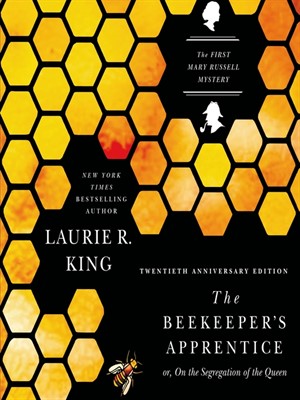
A Review of Laurie R. King’s The Beekeeper’s Apprentice; Or, On the Segregation of the Queen

cover-photo-of-the-beekeepers-apprentice

This is the first installment in a series about a young woman who becomes Sherlock Holmes’ apprentice and, later, his lover and wife. The fact that Sherlock Holmes is a fictional character is pooh-poohed at the beginning of the novel, which I suppose is how these sorts of suspension-of-disbelief matters ought to be handled. The premise is that Holmes retired at the end of his sleuthing career and retreated to his rural home to take care of his beehives – which sounds like a euphemism but isn’t. Mary Russell is a young women about to begin her collegiate studies at the women’s college at Oxford sometime in the late nineteen-teens. The war years pass in a few short chapters, during which Holmes’ intensive lessons in detective work are summarized, and then Mary emerges as a smart and mostly-trained, mostly-trusted associate of Holmes’, who has decided to hang up his shingle once again as a detective. “It is, I can even say, a new and occasionally remarkable experience to work with a person who inspires, not by vacuum, but by actual contribution” (122), croons Holmes. Take that, Watson.

I’ve never read any of Arthur Conan Doyle’s novels or stories, though of course I know who Watson is. I had even heard of Professor Moriarty somehow, though I missed the fact that Holmes sometimes likes to dress up as a woman. I had no idea, though, that Watson is the narrator of Doyle’s stories and novels, and that his general obtuseness gives these narratives a lot of their irony. When I discovered this, I was amazed that Doyle’s work never made its way onto any of my college syllabi, since ironic narration was by far the most common preoccupation of the Dartmouth English department in the mid-‘90’s – in my experience at least. I definitely want to read the original stories now, and I even dug my copy of Doyle’s collected stories out of its basement box last night. It is now sitting on the dining room table, which is sort of the on-deck circle of my book collection.

Once Holmes and Russell start solving cases, I became temporarily bored and annoyed. For a while it seemed as if the plot was going to be entirely episodic, with each chapter or two covering a single case. I didn’t see any signs that the plot was going anywhere. Past the novel’s midpoint, though, the plot begins to congeal around some bombs that are planted at Holmes’, Russell’s, and Watson’s homes. Holmes’ beehives explode, and in his attempt to get to them before the bomb detonates, Holmes receives severe abrasions on his back. Nevertheless, he makes it (in drag) to Russell’s rooms at Oxford in time to defuse the bomb there, and together they manage to rescue Watson, with help from Holmes’ fat brother Mycroft. Then the hunt for the person(s) who planted the bombs takes over the second half of the novel, and the plot has a distinct shape from here on out.

This is not a perfect novel by any means. Set mostly in the early 1920’s, it’s crawling with anachronisms: the use of B.C.E. and C.E. instead of B.C. and A.D. and King’s absolutely maddening insistence on expressing time digitally – nine forty-five, three-oh-five, etc. – when no one used these terms until digital clocks were the norm. Elsewhere the writing descends into adverb soup. I know that these are fixable problems, and I have no doubt that King irons the kinks out of her prose in the remaining novels in the series. However, my primary quarrel is with the idea that there is something “revolutionary” about the way Holmes takes Russell under his wing – and the related misconception that the relationship between Holmes and Russell is an equal one. Holmes likes and grows to love Russell, but HIS assertions that he treats her as his equal are self-congratulatory and not at all correct. The relationship between these two characters is not new; it’s part of a longstanding paradigm that includes Kate and Petruchio, Jane and Rochester, Darcy and Elizabeth, and so forth. On several occasions Holmes uses his penchant for dressing up in disguises to mess with Russell’s emotions, and I thought immediately of the parallel scene in Jane Eyre. To be honest, I thought most often of the parallels between this novel and the Fifty Shades trilogy, both because of the push-and-pull struggle for equality that is central to each narrative but also because Holmes, like Christian, is maniacally obsessed with providing superhuman protection for Russell and for the others in their small circle. There is nothing wrong with people protecting one another, of course, but when age and/or gender get mixed up in the compulsion to protect, things can get really condescending, really fast. I’m not sure yet whether King realizes that her characters come off this way, and I am 100% willing to give her the benefit of the doubt and assume that her characters will work through these stumbling blocks for the remainder of the series – and I do, by the way, plan to read at least one more, just to see how things progress.

I know that this is mostly a negative review, but I do recommend this book to people who enjoy mysteries. I enjoyed watching the detectives track down the person who planted the bombs, though I was a little annoyed when the villain gave a self-incriminating, cackling-evil confession speech worthy of an episode of Scooby Doo because that speech negates all the work the detectives have done to find the bomber’s identity and motives. I’m not a huge reader of mysteries, but I know that this kind of speech is a convention of the genre*. Maybe avid readers of mysteries would be disappointed if an author left it out? I don’t know – but I thought the ending would have felt more organic if the author had approached it in another way. I’m very curious to see how these characters and their world are developed in the next installment.

P.S. Speaking of conventions of the genre, there is chess in this novel, and it’s a metaphor. Fair warning.

Posted in Authors, Fiction - general, Fiction - Historical, Fiction - Mystery, Fiction - Young Adult, Laurie R. King, Reviews by Bethany, Uncategorized | 2 Comments

Yarn Along

yarn-along-11-2-16

Here’s a quick photo of the folded-up Obnoxiously Orange scarf, which is getting so long it’s hard to fit the whole thing into a photo. The book in the photo is oversized as well. In addition to some silliness on my Kindle, I’m re-reading Randy Shilts’ And the Band Played On. I loved it when I read it in college and am loving it even more this time. With an unbelievable level of detail, Shilts examines the 1980-85 AIDS outbreak from every possible angle – from the Danish researcher who got sick and died after working in Africa to the patients, doctors, politicians, and others who managed the outbreak in those terrifying and mysterious early years. I am reading it as research for a writing project I’m working on, but it doesn’t feel like work. I’ll tell you more soon – probably over a series of posts because I’ll be reading this book for several weeks.

Yarn Along is hosted by Ginny on her blog, Small Things.

Posted in Uncategorized | 7 Comments

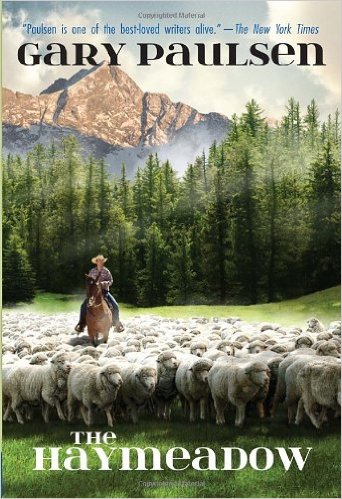
A Review of Gary Paulsen’s The Haymeadow

the-haymeadow-cover-image

I came to this novel by accident, when a student I tutor chose it for a book report. We agreed to read the first six chapters before our next meeting. He read ten pages or so, declared it two thumbs down, and chose another book. I, on the other hand, read this young adult novel in a couple of sittings. I was captivated by it.

Think of this novel as a PG-rated Brokeback Mountain. It also falls into the genre of “novels that would be about a paragraph long if the protagonist had a cell phone” – a genre I’ve been thinking about a lot recently, since another student is reading The Catcher in the Rye, which has to be the grand wizard of the NTWBAAPLIAPHACP genre. The premise is that Tink, one of the Barron family’s longtime hired workers, gets cancer and can’t spend the summer in the haymeadow with the sheep as per usual. The other hired man, Cawley, is needed back at the farm for other work, so fourteen year-old John Barron’s father decides that it is time for John to take the sheep to the haymeadow. When John protests, his father rattles off the sorts of badass things he himself used to do when he was fourteen, and for good measure he throws in some references to “the old man,” the family patriarch – John’s great-grandfather – who settled the family’s land in Montana when it was nothing but wilderness, all when he wasn’t much older than John is now. So John agrees – and the only advice he’s given is “sheep have a way of dying for no reason.”

Cawley escorts John and the dogs, sheep, and horses to the meadow, and almost immediately after he leaves the shit show starts. We’re talking coyotes. We’re talking rattlesnakes. We’re talking bears. We’re talking flash floods. We’re talking fourteen year-old boys doing emergency surgery on dogs. The majority of the novel takes place during the first two days John spends on the mountain. The writing in this section is quick, simple, and immediate – Gary Paulsen pulls off “show, don’t tell” better than any writer I’ve read in recent months. Ironically, a week before my student introduced me to this novel, I had been trying to help him understand that fast-paced scenes should be written with short, simple sentences and slower, more thoughtful scenes are best written with longer and more grammatically complex sentences. I know it’s hard for a ten year-old to internalize a principle like this one, but I usually get around this stumbling block by having them write fast-paced scenes with short sentences and then pointing out the effect after they’re finished. My student was having trouble understanding this idea even after writing his own fast-paced scene, and like any good student he was refusing to just take my word for it. This novel proved to be a perfect model of this principle – though my student did not reap the benefit of the example because he refused to read it. Kids are funny that way.

But seriously, take my word for it. This book is good. I think my 21st-century Silicon Valley student saw the notion of a father sending a son to spend three months in an isolated meadow with three hundred sheep as a step away from hobbits and dementors, but this is all the more reason for children (and adults) to read this novel. I think many children think of “the old days” as one large monolithic thing, existing only as counterpoint to “now,” and reading is one of the best ways to train a person away from this kind of thinking. When I was reading this novel, I couldn’t possibly imagine how it would end. Even with only a few short chapters to go, John was still wrangling sheep and dogs and floods on his second day in the haymeadow. But the novel does resolve, and resolve well. John has grown up fetishizing “the old man” – the great-grandfather who secured the family’s land using nothing but resolve and rugged individualism, constantly comparing himself to his ancestor and coming up short. At the end of the novel, John’s father visits. He debunks much of the mythology about the old man and about the Wild West in general, and while this is never stated I got the impression that John’s father understands that there is something a little bit cruel (empowering, yes – but also cruel) about isolating a fourteen year-old on a mountain for three months. By extension, this novel suggests that tradition and custom are no reason to continue to do things that are destructive and unkind. John’s father is a cowboy of the old school and does not verbalize these thoughts, but his visit itself and the family history he shares with John while he’s there made them clear for me.

I recommend this novel to both children and adults without hesitation – it’s a model of excellent writing in the old-fashioned show-don’t-tell, limited-omniscient style.

Posted in Authors, Fiction - Children's, Fiction - general, Fiction - literary, Fiction - Young Adult, Gary Paulsen, Reviews by Bethany, Uncategorized | 4 Comments

Yarn Along

yarn-along-10-26-16

As I’ve mentioned before, I’ve been dividing my time between two cities lately – and this means having two phone chargers, two bottles of each of my prescription medicines, and, of course, two sets of knitting projects. I’m usually in San Jose on Wednesdays, but since this week I’m in San Francisco I thought I would show you my orange cowl, which made appearances on Yarn Along many, many months (years?) ago. I lost track of it for a while but am really enjoying it now. I could cast it off today and be done, but my gut tells me to keep going; I like cowls to be really long and slouchy.

I’m reading a few books, one of which is Alan Light’s The Holy or the Broken: Leonard Cohen, Jeff Buckley, and the Unlikely Ascent of ‘Hallelujah.’ Reading about music is not something I usually do (though I have done it once before, here) but I love the song and I love Leonard Cohen, and I’m enjoying the book so far. It’s not very technical, at least not yet. I’ll let you know more once I finish it.

And no, this Yarn Along photo was not taken on the surface of the sun. It was taken on an off-white tablecloth that for some reason GLOWS NEON YELLOW under the overhead light. The days are getting shorter, and natural light for Yarn Along photos will be harder and harder to come by.

Yarn Along is hosted by Ginny on her blog, Small Things.

Posted in Uncategorized | 1 Comment

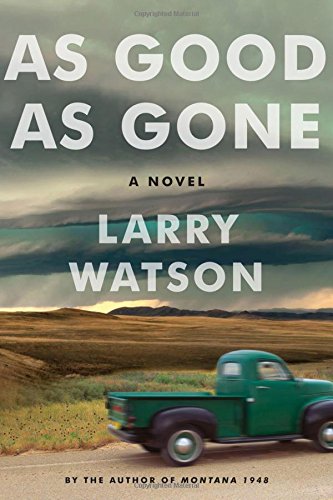
A Review of Larry Watson’s As Good as Gone

as-good-as-gone-cover-image

I was surprised to look my Yarn Along post from a few weeks ago and see that I used the word “enjoying” to describe my relationship with As Good as Gone. How much has changed. I’ll tell you a bit about the plot and characters and then describe the general souring of my opinion toward what was at first a very palatable novel.

The central premise of this novel is that Bill Sidey and his wife Marjorie have to leave their home in Gladstone, Montana for a week so Marjorie can get an elective hysterectomy at a hospital in Missoula. Against Marjorie’s wishes, Bill arranges for his estranged father, Calvin, to stay in their home and care for their children, Ann and Will. Calvin was once a respected real estate agent in Gladstone, but he left when Bill was a teenager and hasn’t been seen in town since. Shortly before he left, Calvin’s wife Pauline traveled home to France to visit her family and was killed in a car accident there, and the rumor mill in Gladstone suggests that in his rage and grief over the loss of his wife, Calvin killed a man. Ever since he left, he has worked as a ranch hand and cowboy-for-hire and lived in a Spartan trailer in the wilderness.

This novel is written in a shifting point of view, with each chapter told by a new character. In other words, it’s a gigantic 21st-century literary cliché. In the 20th century, shifting points of view was a sophisticated technique practiced by the likes of Faulkner and Joyce; nowadays it’s the go-to approach for anyone aspiring to the “From our Library to Yours” shelf at Target. (Full disclosure: I’ve done it too. I’m currently revising one novel that uses shifting points of view and drafting another. Given my current mood, that may change.) The point-of-view characters include all four members of Bill Sidey’s nuclear family, plus Calvin and a neighbor named Beverly Lodge, who is sort of like Mrs. Kravitz from Bewitched if Mrs. Kravitz from Bewitched ever took off all her clothes and hid in Samantha’s father’s bed on one of his occasional visits. But now I’m getting ahead of myself.

Of course everyone in the family has secrets from one another. Ann – known by everyone in town as a paragon of responsibility because she attends school while also holding down a job at J.C. Penney’s – has a boyfriend who scares her; the first time we see her she is running for her life, cutting through backyards in the predawn hours to evade him in his truck. Will is besieged by his friends, who are desperate for him to rig some kind of defective-curtain scenario so they can spy on Ann getting dressed. Neither Bill nor Marjorie can stop thinking about Marjorie’s own bad-boy high school romance, a boy who died young – Marjorie with longing and Bill with competitiveness and insecurity.

Ultimately what this book wants to be is a dissertation on the Cowboy Code. Calvin Sidey is a sort of Clint Eastwood-shaped cardboard cutout who inspires awe, fear, and puzzlement – and, in Beverly’s case, lust – in the people he meets. Early in the novel, he downplays the romance of the cowboy life, telling Will that he’s dug more post holes than he’s roped steers, but his actions come straight out of central casting. Once this novel’s exposition is complete (and in a not-so-well-done novel with multiple points of view, exposition takes forever), the plot seems to consist entirely of Calvin stalking out of rooms and then driving somewhere to (your choice) threaten people, beat people with hacked-off garden hoses, or get in fistfights in alleys carpeted in broken glass.

The problem is that if an author is going to write in multiple points of view, he has to actually write in multiple points of view. He has to let his characters be complex. Every character in this novel is flat. They all think about only one thing. We spend at least a quarter of the novel in Calvin Sidey’s head, but we never understand why he agreed to come back to Gladstone to take care of his grandchildren, nor do we ever enter his feelings in an authentic way – and don’t get me started on the fact that reading Catullus in the original Latin is supposed to be very meaningful and therapeutic for him. Larry Watson could have written a great novel from Calvin’s point of view (probably in first person; I am coming to understand that Watson does his best writing in first person), and I wouldn’t write off the possibility that he might have been able to write it from another character’s point of view – Ann’s, for example, or Beverly’s.

The old me would add at least a thousand more words to this review. I would tell you that Will is a caricature, that none of the backstory on Marjorie’s relationship with her sister is necessary, and that Beverly Lodge would never in a million years have used the word “prose” – and I would be right. The old me would go on and on about the improbable sex between Beverly and Calvin – and maybe the future me will do that sort of thing too. But I’m going to end this review here. This is a disappointing novel, but I haven’t lost respect for Larry Watson, an author I admire. I will continue to read his work, but I hope he returns to the complicate psychological character studies that he really is quite good at.

Posted in Authors, Fiction - general, Fiction - literary, Larry Watson, Reviews by Bethany, Uncategorized | Leave a comment

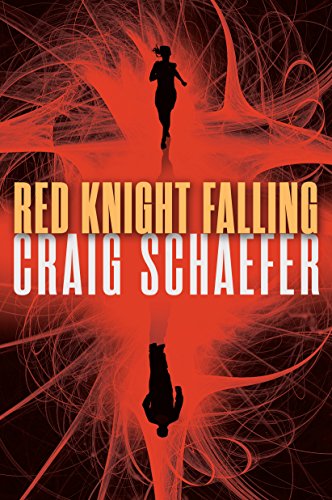
A Review of Craig Schaefer’s Harmony Black & Red Knight Falling (by Jill)


harmony-black-cover

These are Kindle Unlimited books, and OMG what a pleasant surprise. I’ll admit I’ve been missing Kim Harrison and her urban fantasy Hollows series, and sorta kinda on the hunt for a new series to replace it since Kim has moved on from Rachel and Jinx and Ivy. Harmony Black came up on Kindle Unlimited a few months ago and when I finished The Prime of Miss Jean Brodie on the plane on the way home from Atlanta in August I just picked another Kindle book to start. Harmony Black seemed like a good read for the airplane, and it was. It totally was. I kept reading it when I got home. I read it in the car that night on the way to sushi. If we hadn’t been meeting friends I would have kept reading it during dinner, and I’ve only done that once since I stopped being a kid (it was when the last Harry Potter book came out, and we were eating at The Cheesecake Factory). Generally I’ve been underwhelmed by my Kindle Unlimited subscription, and I often wonder why I keep paying $9.99 a month for it. But every once in a while I hit upon a hidden gem like Craig Schaefer. He’s got another series that I need to delve into at some point (they’re all available on Kindle Unlimited, thank god), but this new series is enough to restore my faith in Amazon’s taste in books.

I’ll admit, Harmony Black and Red Knight Falling are not literature. They are not as amazing as The Hollows series. But the first two entries in this series are better than the first two of Kim Harrison’s books. I read the first two and enjoyed them enough to keep going, but was sort of embarrassed about it. Kim hit her stride with the third book. Craig Schaefer hits the ground running here. It’s probably because this is not his first series; perhaps his Daniel Faust series starts slow. I’ll find out one of these days. But where was I? Oh yes. I’m reviewing these books together because I read them sequentially and I’m so far behind in reviews that I needed to do something to get caught up. I can’t exactly combine my reviews of A God in Ruins and I Regret Nothing, can I?

Anyway. Harmony Black is a witch and FBI agent. In this urban fantasy series, witches and demons and whatnot are not “out of the closet/coffin/parallel dimension,” so it’s not a post-apocalyptic sort of urban fantasy like The Hollows. Harmony is a solo agent who gets hooked up with a team of agents (called Vigilant Lock) who quickly become her family. She is replacing a member of the team who was killed, but maybe she needed to go anyway. (She did. We met her in the next book.) None of the others are witches, but the team’s leader, Jessie, may have some demon in her. Her father worshipped a demon and did some terrible things to his daughter when she was young. The mystery to be solved in the first novel is a baby abduction thing: every thirty years in a small town in Michigan, six children disappear, and it’s started again. The personal interest thing is that thirty years ago one of the babies was Harmony’s little sister. And the kidnapper is a demon. Shenanigans ensue. This book was a perfect plane book: fast-paced, action-packed, all that good stuff. And, I even cared about the characters. Schaefer is good at mixing action and occult and character development. Needless to say, Harmony solves the case, saves the day, and makes new friends. She even reconnects with a guy from her hometown.

red-knight-falling-cover

The second book in the series, Red Knight Falling, did not go quite as quickly for me. Probably because I didn’t have six hours of uninterrupted reading time to devote to it. It pretty much picks up where Harmony Black leaves off, with Harmony, Jessie, Keith (the tech nerd), and April (psychologist/former amazing field agent until she got put in a wheel chair on an op) heading off for another adventure. This time, Red Knight, a satellite, is falling from the sky. No one really knows why it’s up there, but apparently it’s protecting the Earth from something OUT THERE that is threatening the planet. Of course there are conspiracies lurking under the surface that Harmony and her team are just starting to unearth (setting the stage for more adventures to follow). Of course Nikki, the “dead” team member who Harmony replaced isn’t actually dead. And of course, Nikki is now a baddie who is now selling her witchy powers to the highest bidder. The Red Knight story line wasn’t amazing, and nowhere near as engaging as the mystery in Harmony Black, but the character development and the long game story are of more importance here. I’ll keep going because I want to find out what sort of trouble Harmony and friends are going to get into with the FBI and the forces lurking under the surface of Vigilant Lock. The next book comes out in February 2017, I just checked. Stay tuned….

Posted in Craig Schaefer, Fiction - Fantasy, Fiction - general, Reviews by Jill, Uncategorized | Leave a comment

A Review of Muriel Spark’s The Prime of Miss Jean Brodie (by Jill)


the-prime-of-miss-jean-brodie-cover

If my review of All My Puny Sorrows was sparse on details, it’s nothing compared to how sparse this review is going to be. I read this book on vacation with my parents. My parents go to bed really early, so I got a lot of reading done, which was nice. Goodreads says I started this book on August 13th and finished it on August 14th. That is some fast reading, if I do say so myself, even though the book was pretty short. I read this book on my Kindle, and it was one of my Kindle Unlimited books, and I’m really excited to remove it from my Kindle when I’ve published this post.

The Prime of Miss Jean Brodie was published in 1961 and takes place in and around an all-girls boarding school in the later 1920s and early 1930s. The titular Miss Jean Brodie is a teacher at said school and she takes six girls under her wing when they are ten, and she is “in her prime,” whatever that means. Miss Brodie is an aficionado of Mussolini in particular and fascism in general, which fascinates me, but then this novel takes place several years before World War II breaks out so things were kind of different back then, but it was still bizarre to read about this woman touting fascism as the future.

The six girls were pretty interchangeable while I was reading about them back in August, and they are even more so two months on. I remember one was very pretty, and one had very small eyes. Their names are Monica Douglas, Rose Stanley, Eunice Gardner, Sandy Stranger, Jenny Gray, and Mary Macgregor. Miss Brodie employs a different method of teaching than was standard back in the Twenties, or even today. She tells stories and gives advice, and that’s sort of all. I am not clear on whether or not she actually ever taught English to her students, though I know she talked about literature. Miss Jean Brodie also has two suitors, Teddy Lloyd, an artist and teacher at the school who is married, and Gordon Lowther, the school’s music teacher. There is much hullaballoo with this love triangle: Miss Brodie may love Teddy more, but she chooses Mr. Lowther because he is not married and seems to need her more, and I think he has an illness. At one point or another Miss Brodie decides that one of her girls needs to take Teddy as a lover, and that whole thing was really, really weird to me. If I could have not known about that, I would have liked this book more.

Despite this vague and miserable review, I really did like The Prime of Miss Jean Brodie. Jean Brodie is a fascinating character, though I don’t really know that I knew her very well after reading this book. She is an enigma, that Jean Brodie. The novel is also really easy to read, it’s got that “effortless prose” we are so enamored with here at PfP. I would love to discuss Miss Brodie with someone one of these days; if anyone has any interest in doing so, please just comment on my post.  Also, if anyone has seen the movie with Maggie Smith, could you please let me know if it’s worth watching?  I just love Professor McGonagall.

Posted in Fiction - general, Fiction - Historical, Fiction - literary, Muriel Spark, Reviews by Jill, Uncategorized | 2 Comments