Well, I made it before PAT CONROY MONTH!!!! was over…. A Review of Pat Conroy’s The Water is Wide (by Jill)

wateriswideConroyI started a progress report on The Water is Wide a little over a week ago, and shortly thereafter I actually started making solid progress on it and didn’t want to stop to write about it. I’ve been having my usual late summer/early fall reading malaise for the past month or so. It seems like this is the time of year when my reading goals all fall off the damn rails. This year, I blame a spotted brown and white puppy who has been keeping me on my toes since mid-July, as well as a month where my only long stretch of days off came at the very end. In addition, I’ve been fascinated with social media and internet shopping more than usual for the past few weeks. I hate it when that happens. But I digress. I’m supposed to be talking about PAT CONROY MONTH!!!!

The Water is Wide was my introduction to Pat Conroy back in early 1992 during my sophomore Honors English class. I remember loving it, for all the reasons I loved every Pat Conroy book I read in my teens. It was funny, it was hyperbolic, and something about Conroy’s prose struck a chord in my adolescent soul—so many emotions articulated in such a detailed way. And then sometime while we were reading the book, or shortly after we finished it, Pat Conroy came and spoke at my high school. It was amazing. He talked about growing up Catholic and in Catholic schools. He was hilarious, too. I wish that I had the issue of our alumni magazine that published a transcript of the talk he gave, because I would love to read it again. I haven’t reread The Water is Wide since 1992, and it seems fitting that the last of his early works that I’m rereading for PAT CONROY MONTH!!!! is the first one I ever read, which was also his first major published work. From here on out it’s Beach Music and South of Broad. It’s entirely possible that I’ll reread The Lords of Discipline again before I tackle South of Broad again….

So, here’s the deal, gang. In 1969, a young Pat Conroy decides to teach on Yamacraw Island, an island off the coast of South Carolina. He wanted to go into the Peace Corps, but plans fell through, and the next best thing that presented itself stateside was Yamacraw. (The name of the island was actually Daufuskie Island; I’m not sure why Pat decided to change the name of the island when he wrote this one, and then use the right name in future memoirs, but he did.) The kids of Yamacraw were all black, and many of them were illiterate, though they all regularly attended school. Pat, the young idealist, was appalled by this state of affairs, and immediately set out to remedy the situation. Of course, things don’t go according to plan, and Pat develops many unique methods of teaching that will capture the attention and imagination of the kids. He brings in guest lecturers from the mainland, organizes field trips, tries to make everything into a game, tries everything. He becomes their friend, their uncle. He ingratiates himself with their families. Eventually he gets fired for his efforts. I suspect that this book would be especially meaningful for a teacher, and Bethany’s review from 2012 confirms my suspicion. This book is also meaningful as a document of race relations in the South in the late 1960’s. Given the things that are still going on in our country in regards to race relations, I know we have come a long way, but I also know that we have a long way to go before there is equality amongst the races, and Conroy’s view of these things was simplistic—he thought all we needed to do was integrate the schools and things would be just fine. If he only knew back in 1972 how much would change and how much would stay the same. I’d actually love to hear his thoughts on this subject, and how they have changed with the passing of years. Here’s Conroy’s theory of how things are going to change in the South from the last two pages of The Water is Wide. You’ll find that it’s vintage Conroy, but a muted version of his modern, more florid prose. I love the simple way he looks at things here, and wish I didn’t know that the reality of race in the South (hell, the entire country) was, and will likely always be, much more complicated than the beautiful way my old friend Pat describes it here. “The town of Beaufort continues to undergo change, not revolutionary change, but gradual and slow change, like the erosion of a high bluff during spring tides. A kind of brotherhood hides beneath the shadows of columns and the mute verandahs—unspoken, inchoate, but present nevertheless. There is no widespread denunciation of the old values, but the erosion of these same values is already irreparable. For ten years I have been part of the town and have seen her grow more human and her people grow more tolerant as the past has crumbled and the old dreams burned out in a final paroxysm of sputtering paralysis and rage. The South of humanity and goodness is slowly rising out of the fallen temple of hatred and white man’s nationalism. The town retains her die-hards and nigger-haters and always will. Yet they grow older and crankier with each passing day. When Beaufort digs another four hundred holes in her plentiful graveyards, deposits there the rouged and elderly corpses, and covers them with the sandy, lowcountry soil, then another whole army of the Old South will be silenced and not heard from again. The religion of the Confederacy and apartheid will one day be subdued by the passage of years. The land will be the final arbiter of human conflict; no matter how intense the conflict, the victory of earth and grave will be undeniable and complete. The eyes of the town are turning with excruciating reluctance toward the new flow and the new era. The eyes seem a bit brighter and less clouded with hate (257-8).” I’m going to cease and desist my discussion of the topic of race as it relates to Conroy’s tenure on Yamacraw Island now, because I fear I will not be able to do it justice, and I need to move on to other important things, namely, poking fun at Pat Conroy.

As I was reading along, it occurred to me that this novel/memoir is written with a very irregular timeline—this is something I had forgotten I knew about this book the first time around. And while Conroy’s hopping about through time in his year on the island fascinated me in 1992 (and made me feel like I was reading modern, adult, complex literature), in 2015 it was driving me crazy! I wanted to say to Pat, “Could you stick with chronological order when relating anecdotes, please??” Generally, the story does move forward, but in a decidedly round about way, with lots of detours forward and backward in time. One paragraph, Conroy is writing about a trip to see the Harlem Globetrotters play in March, then in the next he’s talking about a Valentine’s Day party he and his wife threw for the kids at their house in Beaufort, and the next it’s March again, and someone’s grandmother has died. I think that the book would have ultimately flowed better if it had been written with a more straight timeline—less episodic would have worked better for me here, because it was difficult to relate events to other events temporally the way it was set up. And I actually think that the story of his run-ins with the school board and all the other administrators would have been strengthened if I had known what exactly was going on with the kids on the island simultaneously. It also would have been nice to know what became of the Yamacraw folks—the book was written only a year or two after the events, so I know this would have been difficult, though I find it hard to believe that Conroy would have just severed ties with these people who meant to much to him at the time. I wonder if there is anything about them in The Death of Santini. I know he talked about writing The Water is Wide. Hmmm. Will have to look into that.

Overall, I did really enjoy this book, but it does reek of first novel and young man idealism. I think there are stylistic things that could be changed to enhance my enjoyment, but it was quite good as it stands right now. I’ve believed for years that Pat Conroy is a far better memoirist, than a novelist, and rereading The Water is Wide further convinces me of the truth of that statement. It’s rough, it’s not Conroy’s mature voice, but it resounds with me—I loved to read Pat’s diatribes about education and morals, loved reading about his attempts to take down the school board. I hope there are still people on this earth as idealistic as twenty-four year old Pat Conroy. I hope we aren’t all cynical people.

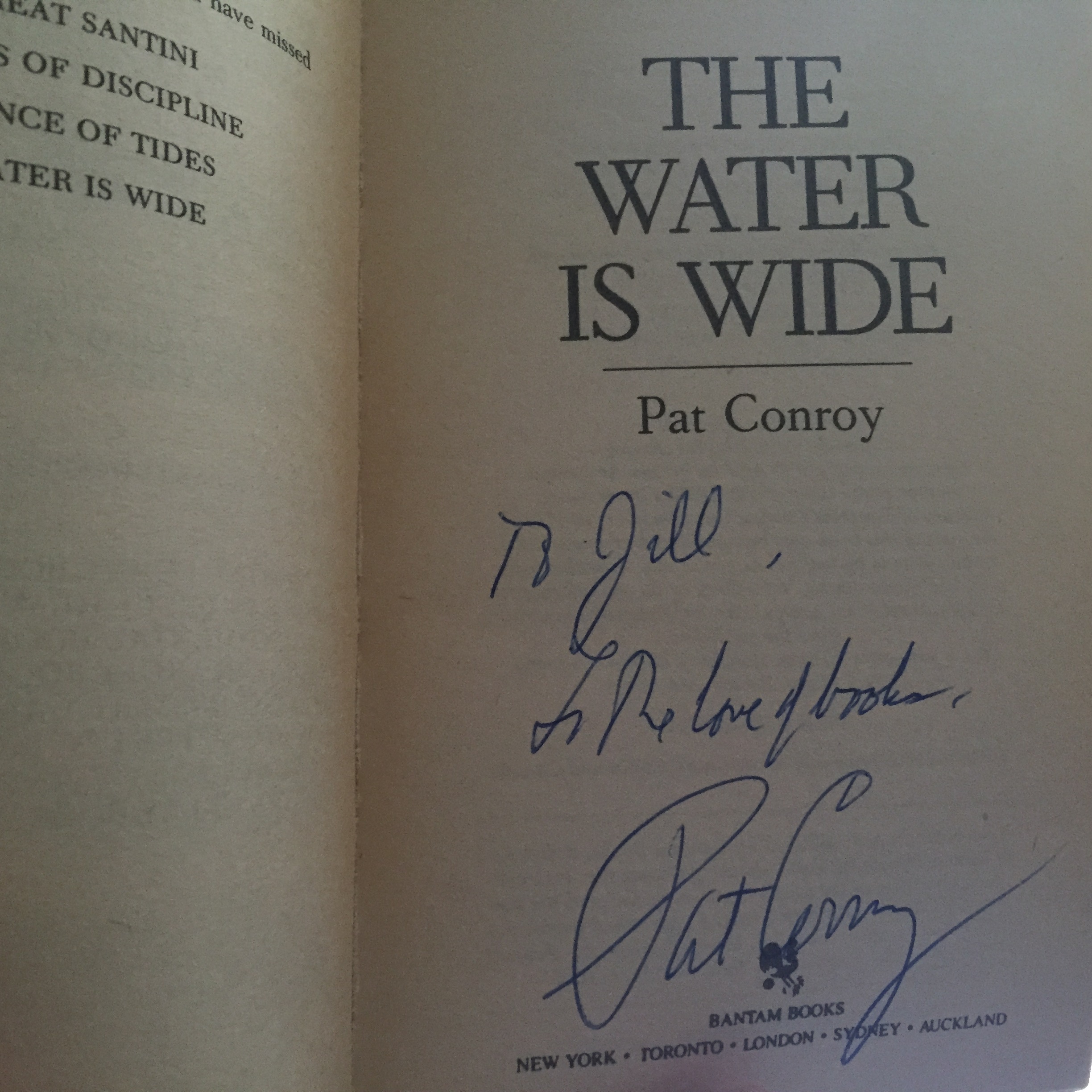
And one last thing, just for fun.  Remember how I said that Pat Conroy came and spoke at SI?  Well, I got to have him sign my copy of The Water is Wide.  Here is a picture of the autograph.  It’s just a crappy old Mass Market edition of the book, but I’ll treasure it forever.
Water is wide autograph

Posted in Nonfiction - Memoir/Biography, Pat Conroy, PAT CONROY MONTH!, Reviews by Jill | Leave a comment

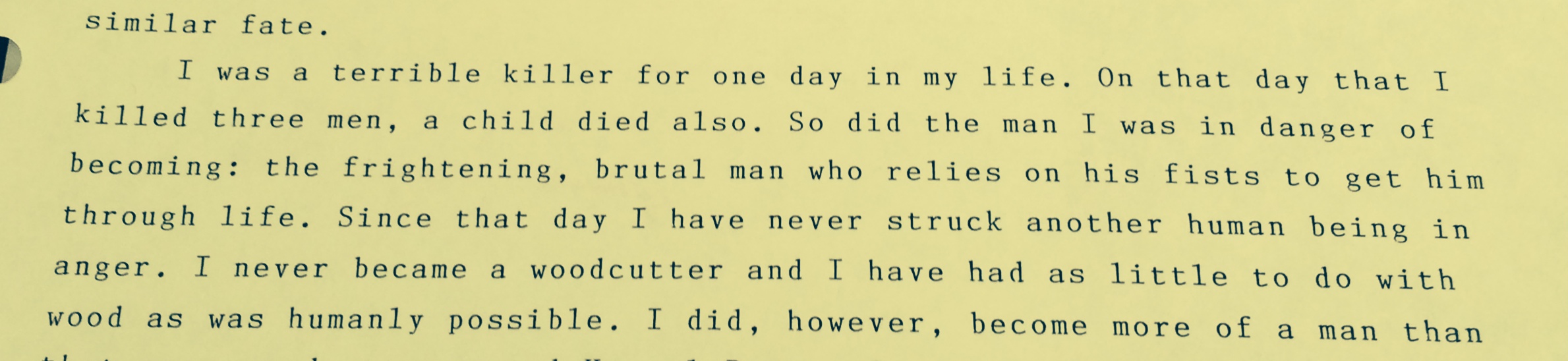
“I Never Became a Woodcutter and I Have Had as Little to Do with Wood as Was Humanly Possible”: Some PAT CONROY MONTH!!!! Silliness for Your Friday Morning, Brought to You By the Numbers 19 and 92 (by Bethany)

I may have mentioned once or twice before that, among other quirks, my high school education was marked by not one but two opportunities to imitate PAT CONROY’s writing style in exchange for a grade. This probably shouldn’t have happened, I know – there are other writers more worth imitating – but what can you do? The second such opportunity came during a creative writing class for which we had read The Lords of Discipline for summer reading and were assigned to imitate his style in the first story of the school year. That story has gone the way of the brontosaurus, I think – I’ve never been able to find it. Two years earlier, though, we were assigned to retell a well-known fairy tale in the style of any author, and since I was right smack in the middle of my PAT CONROY phase at the time, of course it was his style that I chose to mimic. Back then I generally wrote like PAT CONROY even when I wasn’t trying to – I had just absorbed so much of his style by osmosis that it took over my natural style for a while.

This is a fairly bold assignment to give high school sophomores. I have often modified it and assigned juniors to retell familiar stories in the style of a specific author that we have studied – usually Hemingway – but I would never give students the freedom to choose any writer at all. Hemingway is easy to mimic, and I always spent significant class time discussing his style. But, as I’ve noted before, my high school teachers trusted my classmates and me more than I trusted my students, at least most of the time.

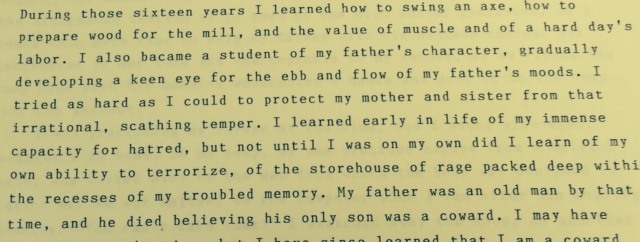
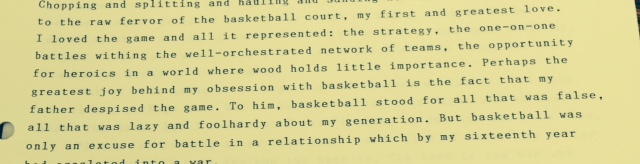
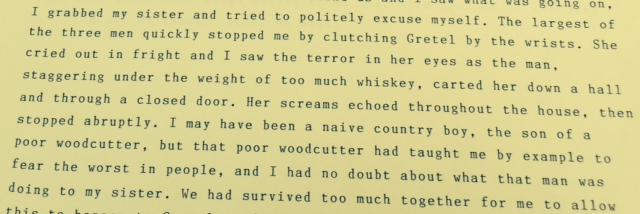
But long story short: behold some excerpts from my Conroyvian retelling of the Hansel and Gretel story. At first I meant to include the whole story, but I decided that you don’t really need to be treated to all seven pages of my way-too-pleased-with-itself adolescent prose. You’re welcome. I’ve chosen a few snippets for your entertainment:

Conroy snippet 0

Hansel Joseph Braun, Sr. was a poor woodcutter. He was also a very violent man.” I remember giggling over those opening sentences for months. And “Braun” as a last name? A nice touch, even if I do say so myself.

Conroy snippet 1

Please note that these pages were produced on a typewriter. A real honest-to-god typewriter, albeit an electric one with built-in correction fluid and various other bells and whistles. I loved that typewriter and never spent so much as a minute envying people who had computers. Two years after this was written, when I was in AP English, Fr. Murphy (remember him?) used to tease me for being the only one in the senior class who still used a typewriter. I didn’t mind the teasing, but I was surprised by it. It never occurred to me that I was so behind the times.

Conroy snippet 2

PAT CONROY’s version of the Hansel and Gretel story has basketball in it, of course. “The opportunity for heroics in a world where wood holds little importance.” Hee hee hee.

Conroy snippet 3

Another side note: I photographed these pages in excellent light and did not PhotoShop them; my essays from high school really are this yellow. Excuse me while I go buy some Christmas jewelry.

Conroy snippet 4

In 1992 I was incapable of writing a story that did not include sexual assault. I wouldn’t even have known where to start.

Conroy snippet 5

And there you go. I hope you enjoyed this little trip into the vault.

Posted in Glimpses into Real Life, Pat Conroy, PAT CONROY MONTH! | 2 Comments

Yarn Along

Yarn Along 9.23.15 

My little child-size colorblock sweater is coming along nicely. It is always refreshing to take on a small project immediately after finishing (well, almost finishing) an adult item. The light in the photo isn’t the best. The sleeve that’s still on needles is much less orange than it looks. It’s red, but more of a tomato red than a true deep red. The other sleeve is purple, the back is blue, and the front is green. It’s fun having all these nice colors around.

I’m still reading South of Broad and still mostly enjoying it, though the parts set in 1969 are far superior to the parts set in 1989. The San Francisco scenes are about to start, and I am preparing to do lots of wincing. I can feel my TMJ doing some warmup exercises already. More soon!

Yarn Along is hosted by Ginny on her blog, Small Things.

Posted in Yarn Along | Tagged , , , , , , , , , , , , | 7 Comments

Early Thoughts on South of Broad (by Bethany)

south of broad cover image

Pages read: 131 out of 512

Last year’s PAT CONROY MONTH!!! was not a high point for me as a blogger. I set out to read War and Peace, which is one of the novels Pat Conroy discusses in his book My Reading Life, but I stopped reading it after only a few hundred pages, in spite of its many amusing moments involving policemen, bears, and a vomiting tsar. I made some noise about reading South of Broad last year, and even hunted down my copy and put it on the dining room table (which is my on-deck circle for books), but I never even cracked it. Actually, correction: I did crack it. I made it about two and a half pages, until I got to this sentence, about the protagonist’s father: “A stargazer of the first order, he squealed with pleasure on the moonless nights when the stars winked at him in some mysterious, soul-stirring graffiti of ballet-footed light” (3). I’m not much of a fan of mixed metaphors (except those I mix myself) or of the pathetic fallacy or of grown adults who squeal. I put the book aside, unwilling to contemplate 509 more pages of such sentences. Sometime around January I put it back on the shelf.

This year I slogged through the ballet-scented graffiti and the paeans to Charleston and an odd chapter-long rhapsody about paperboys. Not just paperboys, mind you, but also the many life lessons that are just waiting there in metaphorical form for paperboys to inhale along with the morning dew (“I realized that tragedy was hurled freely into everyone’s life as though it were a cheap newspaper advertising porno shops and strip shows thrown into an overgrown yard” [14]). I haven’t seen a writer elevate paperboys to this level of godliness since Beverly Cleary’s Henry and Ribsy.

But pointing out South of Broad’s flaws is not what I want to do today, because the reality is that I am really enjoying re-reading it. Memory tells me that ridiculousness awaits in the novel’s second half, but I am trying not to think about that right now. Once this book gets its linguistic silliness out of its system, the prose is mostly contained and controlled. Some of the characters are well-drawn (more in a moment about the ones who are not), and as in most of Conroy’s work the protagonist is fiercely good and surrounded by a coterie of fiercely good friends. Antagonists chip away at this goodness, but they never damage its core. This quality of sainted friendship is part of what makes Pat Conroy’s novels predictable, and it is certainly part of the reason that academia generally shuns his work. I certainly wouldn’t want every book I read to be so Manichean – but every once in a while entering this fiercely-defined world hits me like a shot of Vitamin B-12. Sometimes it’s nice to trick yourself into thinking you are part of a world that makes sense, morally speaking.

The protagonist of the novel is Leopold Bloom King – and yes, he is named after that Leopold Bloom. His mother is – among other things – a Joyce scholar, and she named her first son after Stephen Dedalus and her second son after Leopold Bloom. The novel opens on Bloomsday (June 16 for the uninitiated), when Leo is supposed to treat his mother with extra-special reverence. He wakes up, completes his paper route (rhapsodies galore), goes to Mass with his parents, and then goes to eat breakfast at a restaurant called Cleo’s, where his mother gives him a list of five vocabulary words to memorize and an agenda of tasks to complete that day. His father just sort of stands around and grins.

Pat Conroy is widely known for writing about terrible fathers – from the unapologetically autobiographical portrait of his own father in The Great Santini to the mean, violent shrimper in The Prince of Tides and the mean, drunken small-town lawyer and judge in Beach Music. In South of Broad, I can almost see Conroy challenging himself to write a novel whose protagonist has a kind, gentle father. He does so, but the father he creates here – Jasper King – is so effete that he seems made of Play-Doh. I mean, there is absolutely no chance that this guy has testicles. (I’m reminded of a line in Beach Music, when one of protagonist Jack McCall’s brothers complains that their new stepfather “lacks balls,” and Jack replies, “I like it when someone marries my mother and lacks balls.” Yes, I did know that by heart. What?) When I read South of Broad the first time in 2009, I had not yet read John Updike’s novel The Centaur, and this time I find myself conflating the father in that novel with Jasper King. I don’t know if Pat Conroy thought about the myth of the centaurs when he created Jasper’s character, but with his above-the-fray demeanor, his love of stargazing, and his kind, placating, imprecise approach to all interactions, he does seem like a bit of a centaur.

Leo’s mother, on the other hand, serves the role of “bad” parent, and while she is nowhere near as awful as the fathers in Pat Conroy’s other fiction, in some ways I react to her more negatively than I do to her male counterparts. This is sexist of me, I know, but this woman – Lindsay King – is so fanatically anti-maternal that her words and actions – which are remote, clinical, and sometimes painfully frank – seem much worse than they are. She is a former nun (more on this in a moment) with a Ph.D in modern literature who is currently working as a high school principal. She is organized and focuses and pulls no punches – but she is hardly one of the violent hulking monsters that usually loom over Pat Conroy’s protagonists. But it’s true – I find her chilly demeanor deeply disturbing, and I know it’s her total absence of maternal behavior that makes me feel that way.

When the novel opens, Leo is almost eighteen. On his birthday, he will be not only a legal adult but also free from the parole officer, community service regimen, and juvenile court oversight that have followed him through his teenaged years after an older student planted half a pound of cocaine in Leo’s pocket at a party when Leo was a freshman. His paper route, daily Mass, breakfast with his parents – and yes, even the vocabulary words – are part of a mandated routine designed to keep him supervised at every moment. In addition, his court-mandated community service – which Conroy unashamedly cribbed from To Kill a Mockingbird – involves washing the feet of an elderly asshole (and also performing various other self-maintenance tasks for the aforementioned senior citizen). Through it all, Leo is patient, respectful, and attentive to all the adults who hover and hound him – which basically means he is like no teenager ever.

In addition to all of his usual daily tasks, on this particular Bloomsday Leo’s mother gives him a list of other tasks, mostly of the welcome-wagony variety. First, she assigns Leo to bake some cookies for the new neighbors, who have twins Leo’s age. Then she tells him to go to the nearby orphanage and befriend two new arrivals – siblings named Niles and Starla who are known for running away from orphanages. Third, he is expected to meet his parents at the local yacht club for lunch, where they will be having lunch with two prominent old-money Charleston families, whose teenaged children have just been kicked out of their private school for being caught with drugs and will be enrolling at Leo’s school (which is also Leo’s mother’s school, of course, and Leo’s father teaches science there as well). Finally, Lindsay instructs Leo to go to the athletic office at his high school and introduce himself to the new football coach. The previous coach – we learn along with Leo – quit when he was told that the school would be integrated that year (1969) and that he would be coaching black players. The new coach is black, and the minute he was hired many of the team’s star players announced that they were leaving the school and following the old coach to his new job at a private school. Leo is tasked with letting the new coach know that he will rally as many of the white players as possible to accept the leadership of the new coach. The coach has – you guessed it – a son Leo’s age. At the beginning of the novel we are told that prior to this Bloomsday Leo has never had a friend his own age; now in the space of a few hours he has eight: Starla and Niles from the orphanage, Sheba and Trevor from the house across the street, Chad, Molly, and Fraser from the yacht club (Chad is the “bad friend”; Pat Conroy protagonists often have one “bad friend”), and Ike Jefferson, the coach’s son. Later they are joined by a ninth friend, Betty, an African American orphan who seems to have been brought into the novel gratuitously in order to provide Ike with a same-race love interest. I’m just saying.

In the past I’ve mentioned that all the secondary material about Joyce in this novel feels tacked on and inorganic to me, but as I write I’m realizing that with his long to-do list that takes him all over the city of Charleston, Leo is in some ways like Joyce’s Leopold Bloom, decent and hapless, roaming the city and stumbling by accident, into a random, intense relationship (in Bloom’s case, as “father figure” to Stephen Dedalus) that will come to define him. Of course it’s a ridiculous coincidence that Leo makes all of these friends in the same day, and the novel would lose nothing if he met them more gradually. But whatever. The worlds that swirl around these characters are larger-than-life – Trevor and Starla’s delusional alcoholic mother and appalling psychopath of a father (Pat Conroy had to slip a psychopathic father into the novel somewhere), Niles and Starla’s horrific odyssey of abandonment and abuse, and the fantastic douchebaggery of Chad Rutledge – but the characters themselves are well drawn, real. I am enjoying spending time with them.

In addition to all of the above, Bloomsday of 1969 is also the day that Leo learns that his mother had a ten-year career as a nun before she married his father. Along with Leo, we learn early on that Jasper and Lindsay were in love with one another in high school and always planned to marry but that a new, charismatic young priest named Max Sadler convinced Lindsay to become a nun. In addition to being Bloomsday, June 16 is the day that Jasper drove Lindsay to her convent and said goodbye to her. As proof of his over-the-top saintliness, Jasper never recriminated Lindsay or Max Sadler and wrote to Lindsay every week for ten years, even though he knew that the mother superior would never let her read his letters, and every year on June 16 Jasper visited the convent, talked with the mother superior, and made a generous donation to the convent. After ten years, when the mother superior finally tells Lindsay (now Sister Norberta) about Jasper’s love for her, Lindsay/Norberta files for and eventually receives release from her vows. This is one of the plot strands in the novel that I think could probably have been cut out without damaging the novel. I think Lindsay’s “other life” as a nun serves the same function that the Marine Corps serves in Pat Conroy’s other novels: it situates the protagonist’s parent in an environment that makes him/her totally inaccessible and foreign to his/her children. Of course, having read the novel before, I know that the priest Max Sadler is one of the novel’s worst antagonists, and by integrating him not only into the King family’s present but also into its past, Conroy is preparing us for later revelations.

Pat Conroy’s novels always give middle fingers where middle fingers are due. This is one reason I like them; it is also one reason that they are, in general, morally simplistic. Over the course of just one day at the beginning of the novel, in addition to teaming up with his mother to aim a big “fuck you” at both old Charleston money and the Jim Crow south, Leo is faced with at least a dozen opportunities to be selfish or impulsive or flippant or impatient, and he accepts none of these opportunities. He is always kind and good-humored and self-deprecating and fair, and he always responds to acrimony with diffidence. Also – and this is something I have thought of during every re-read of a Pat Conroy novel that I’ve done in the past 3 ½ years – he never, ever gets tired. No Pat Conroy protagonist ever gets tired. They never retreat to dark rooms and put blankets over their heads, which is such a core element of my own life that I have trouble imagine anyone living without these little sanity breaks. I’ve read a great deal of Pat Conroy’s autobiographical writing, and the sense I get is that he is such a consummate extrovert that he truly does bounce from one high-stim environment to another, vanquishing bullshit left and right and he goes. This may be the source of some of the distance I feel between myself and Conroy’s protagonists, even when I enjoy reading about them. My God, I keep asking myself, When does he read? When does he escape from his overbearing mother and his maddeningly effete father? When does he take naps? And most of all, when does he read?

Posted in Fiction - general, Pat Conroy, PAT CONROY MONTH!, Reviews by Bethany | Tagged , , , , , , | Leave a comment

Final thoughts on Josh Weil’s The Great Glass Sea (by Jill)

the great glass seaThe Great Glass Sea sped up a bit after I wrote my last post about it. I’m not sure that my enjoyment of it increased at all, but I did manage to get through it. I finished it over the weekend, and I’ve been mulling over the ending ever since. I won’t spoil it for anyone, I promise, but I must say I was disappointed. I really thought that things were going to turn out differently for Dima and Yarik, though the way Weil chose to end things is the more realistic way, but I thought in a novel of speculative fiction about a giant greenhouse and satellites redirecting sunlight onto northern Russia might choose the less real-world ending.

And you know what? I don’t think I want to spend any more time with this book. It disappointed me on many levels. There were parts I enjoyed, but I spent a lot of time being annoyed with Dima and Yarik. They both continually make bad decisions regarding their careers (or in Dima’s case, the lack of a career) and their relationship with each other, and I kept hoping they’d figure it all out by the end, but they just didn’t. And that, too, is more like real life, but sometimes it’s nice when fiction does the right thing, not the realistic one.

The Great Glass Sea is definitely quality fiction, and I would look into other stuff written by Josh Weil, but I don’t know that I can enthusiastically recommend this book. I think it has an audience. But I’m just not that audience.

Posted in Fiction - general, Josh Weil, Reviews by Jill | Leave a comment

Yarn Along

WIN_20150915_191859 (2)

I missed you all last Wednesday. Last Tuesday, it was 107 degrees in the town where I work, and by the time I got home none of my electronic devices were working properly. Let’s just say that last Tuesday was not the happiest of days for me (and after a long day of teaching without a/c I was not exactly “working properly” myself), so I took the day off from Yarn Along. Of course by the time I woke up on Wednesday everything was functioning again and I wished I had tried harder.

This is the back of a child-sized rollneck sweater. The front, which is already finished, is green, and then each sleeve will be another color – probably red and purple.

I just bought Lauren Groff’s Fates and Furies for my Kindle, but I’m going to try not to read it until I’ve finished South of Broad. We’ll see how disciplined I can be about that.

I hope everyone is having a happy Wednesday!

Yarn Along is hosted by Ginny on her blog, Small Things.

Posted in Yarn Along | Tagged , , , , , , | 4 Comments

A Review of Jonathan Franzen’s Purity (by Bethany)

Cleo and Franzen 2

This novel is organized into seven long titled chapters. While it’s been years since I’ve thumbed through The Corrections and Freedom, I think this approach is standard for Franzen. I turned the pages of this novel readily from start to finish, yet I had trouble answering a few basic questions as I read – questions like “Who is the protagonist?” and “HIM? Why does HE get to speak in first person when the others don’t?” and so forth.

I’ll start with the first question. The “Purity” of the title is the given name of Pip Tyler, who is a likely candidate for the role of protagonist. The first chapter is called “Purity in Oakland” (Bay Area residents will recognize this as a bit of an oxymoron) and chronicles Pip’s frustrations as she deals with her crazy mother, her dead-end job, and the machinations of her housemates. The novel opens on a phone call between Pip and her mother, who complains that “[her] life is nothing but one long process of bodily betrayal” (3). This motif – of the soul raging inside the dying animal – is an ongoing one throughout the novel. Pip uses the term “moral hazard” to describe her relationship with her mother and identifies herself as “a bank too big in her mother’s economy to fail” (3). We are treated to an excruciating telephone exchange between mother and daughter, at the end of which we understand why Pip lives in Oakland in a house full of crazy squatters.

Pip’s living situation sounds horrible to me, but she seems to find a sense of comforting community with Dreyfuss, the middle-aged schizophrenic who once owned the house in which he, Pip, and others are now squatting; mentally handicapped Ramon; and married couple Stephen and Marie. It helps (and then doesn’t help) that Pip is in love with Stephen, I suppose, and when Marie decides to leave Stephen Pip takes the opportunity to get naked and beg him to sleep with her. She is humiliated, of course, so when a houseguest of Stephen’s named Annagret asks Pip to fill out a questionnaire to see if she is qualified for an internship with something called the Sunshine Project (more on that later), Pip agrees to answer the questions and, when she is offered the internship, she accepts it and moves to Bolivia.

Chapter Two, called “The Republic of Bad Taste,” brings us back in time to the late days of the East German Republic, where a character named Andreas Wolf is living in a church basement. We know from Chapter One that Andreas is the director of the Sunshine Project, but in Chapter Two Andreas is just a young man, estranged from his parents and working as a “youth counselor,” a job that involves lots of sex with teenaged girls. One of these girls is Annagret, of Chapter One fame. Andreas’ feelings toward Annagret far surpass his feelings toward the other emotionally-scarred nymphets under his care, so when she confesses to him that her stepfather – a prominent Stasi officer – rapes her, Andreas sets out to murder the stepfather. In Andreas’ mind, he and Annagret are carrying the murder out together, but really the planning, implementation, and cover-up of the killing are Andreas’ own doing. They agree that they shouldn’t see each other for a year, and during that year Andreas hopes to move the body from its temporary grave on the grounds of his own estranged parents’ vacation home. When Annagret moves to another city to live with her sister, though, she hopes never to see Andreas again.

Long story short, Communism falls and the Berlin Wall comes down. Through a series of lucky coincidences, Andreas ends up in the right place at the right time on two occasions – first, when he participates in a mob that raids the Stasi archives and manages to get his own case files, and second, when he leaves the archives and walks directly into the path of a Western newscaster, who interviews him and labels him as a “prominent East German dissident,” broadcasting his story worldwide. This is the beginning of Andreas’ career as media darling, internationally-excoriated leaker of classified documents, and fascinating sociopath, which is the status he has attained by the time Pip exchanges flirty emails with him in Chapter One.

Chapter Two ends like this: “His plastic shopping bag was visible in thousands of frames of video that day. It was firmly under his arm when, late in the afternoon, he ran home to the basement of the church. He was almost free. His only worry now was the unsecurely buried body, he was very close to having Annagret, his libido was back. He didn’t even glance at the files in the bag, just shoved them under his mattress and ran outside again. In a state of sex-mad lightness, he crossed the old border at Friedrichstrasse and made his way to the Kurfürstendamm, where he met the good American Tom Aberant” (168). At this point, we don’t know anything about Tom Aberant, nor do we know whether he really as aberrant as his name suggests (he’s not; he’s probably the least aberrant character in the novel); all we can do is file his name away until he appears again – which of course he does.

I can never keep track of all these new terms for plot devices – Easter eggs, dog whistles and such – and I don’t think any of them directly describe exactly what Franzen is doing here, but in this novel he consistently moves his plot forward via these little hints – names and details dropped that echo elsewhere in the novel. It’s a form of foreshadowing, of course, but as the novel progresses the hints also point backward in the text as well as forwards. To me, the structure of this novel is shaped like the face of a clock, if we imagine a clock with seven numerals instead of twelve. We can follow the numerals clockwise around the clock face in the usual way (and yes, the novel does begin more or less where it started, with some variations), but the hands can also serve as “shortcuts” to point out connections between the characters and events in each chapter. The presence of Tom Aberant’s name in Chapter Two, for example, provides a link into Chapter Four, in which we learn portions of the story in the first person from Tom’s point of view.

The links between various chapters in this novel don’t always take the form of the characters themselves. Certain character types recur as the novel progresses. For example, desperate characters of both sexes beg one another for affection, and domineering, poisonous mother-child relationships recur too in a feedback loop that’s as unpleasant as it sounds. Well before this book was released, I read many reviews that focused in on how misogynistic this novel is – and in some ways these reviews were right. Women are an emasculating, soul-sucking force in this novel. They’re Dementors, witches, succubi. There are certainly women like this in the world, and Pip’s mother – the worst of the bunch – reminds me a lot of a certain voice in my own head that I manage to keep silent most of the time but that is a real presence in my life nevertheless, and is no fun. I have trouble concluding that Franzen is a misogynist himself just because he’s assembled such a cavalcade of bitchery here – I like to avoid assuming that every character has to be a mouthpiece of its author. But those of you who are reading this and thinking “if it quacks like a duck…” have a point too.

And then there are the references to Great Expectations. According to her mother, Pip chose her nickname for herself shortly after her first day of answering to “Purity” in kindergarten. Franzen makes clear, though, that he intends his novel to wink occasionally in the direction of Dickens’ classic. Pip’s mother, though less violent, is as irrational as Mrs. Joe, for example, and it does turn out late in the novel that Pip has not only a benefactor but also a wounded, tragic figure like Miss Havisham who masquerades as a benefactor while at the same time manipulating the most private elements of Pip’s life as a way of exacting revenge not on Pip personally but on others. Though its circular plot is unconventional, in many ways this novel is very 19th century in structure, with mistaken identities and cryptic letters (OK, emails) and a major plot strand involving Pip’s quest to learn the identity of her father.

I found this novel compelling and recommend it highly, though I have trouble putting a finger on what exactly this novel has contributed to the literary world. I can imagine having the impetus to write a novel similar to this one – but I would have stayed away from the circular structure, which reflects the frustrating fact that most people don’t change but leaves me unsure about Franzen’s worldview. The characters in this novel are entrenched in a swamp of bullshit and mostly remain stuck there as the novel ends, though Andreas finds escape in suicide and Pip finds a way out of her financial difficulties, though her maternal difficulties will likely plague her for a long, long time.

Posted in Authors, Fiction - general, Fiction - literary, Jonathan Franzen, Reviews by Bethany | Tagged , , , , | Leave a comment

Progress Report on Josh Weil’s The Great Glass Sea (by Jill)

the great glass seaI started writing this post on Thursday night at like ten o’clock at night, when I thought I had a good two hours of functional time left in my day. I underestimated what sitting on a raft floating on the American River all day for close to twice as long as usual would do to my functional couch time, and here it is Saturday afternoon and I’m just finishing up this post. I think that the saga of my misadventures on Thursday is worth keeping, though, despite the fact that it has absolutely nothing to do with the book this post is supposed to be about.

I had such great plans for today. I was going to get up early and start working on my blog post, then I was going to go floating on the American River from 12:30 till 4:30 or so, then I was going to come home, finish my post, eat dinner, walk the dog, start laundry, double check my post for obvious spelling and grammatical errors, then post it. That is not exactly what happened.

So, true to form on my first weekend day, I slept longer than I planned on. The floating party didn’t put into the river until well after two in the afternoon because of some, let’s say, “technical difficulties” with our first launch site that involved a strong wind blowing in the wrong direction, an octagonal river floatation device, and a slow current. And let’s not forget that the sun sets at 7:30 right now. Because of the slow current and the wind, our three mile float that usually takes us three to four hours took us over five hours to finish today. So I didn’t get home until almost nine, ate dinner, and now here it is 10:15 and I’ve got just about nothing to post, except two short paragraphs about what I did all day long instead of being productive.

The Great Glass Sea was a 2014 Indiespensible selection, and I really expected to enjoy it more than I am so far. I’m about a third of the way through the book, and I keep finding other stuff that I’d rather be doing (like laundry) than reading it. This book would fall into the genre of speculative fiction, I think, because its setting is Russia, approximately present day, in a world very much like our own, but with a few notable exceptions. In this case, it seems that Russia is an oligarchy, but a capitalist one (I think), and some business tycoon has begun building a giant greenhouse in Siberia, and has sent satellites up into space in order to reflect the sun’s light around the curvature of the earth in the nighttime so the plants in the greenhouse (and everything else in the vicinity) are constantly exposed to light, so they’ll grow better, faster, bigger. There are, of course, some surprises associated with life in constant daylight. First off, the roosters don’t crow anymore, because they have no idea when to do it. All kinds of other things go on as well, but that’s the only one I can think of off the top of my head. The major characters are a pair of adult twin brothers: Yarik and Dima. They have historically been as close as any twin brothers could possibly be, but at the start of the novel things are changing between them: Yarik gets promoted to foreman at the giant greenhouse (or Oranzheria), and Dima quits his job there. The novel is told in third person limited with shifting perspectives between Dima and Yarik. There are quite a few flashbacks to Dima and Yarik’s childhood, especially back to the time where the boys stayed with their uncle Avya out by Lake Otseva while their mother was recuperating from the loss of their father/her husband in the area mental hospital.

I’m having a hard time figuring out where this novel might be going, if you want to know the truth. I’m not sure if anything is going to happen besides that Dima and Yarik are going to grow apart. If so, I’ll be a bit disappointed. Weil is spending quite a bit of time creating this alternate present day Russia, and if he doesn’t delve more into that, I think that making this world will have been for naught. Dima and Yarik’s story could take place anywhere at this point. Something has to happen that makes it unique and special. By it I guess I mean their story as well as the novel itself. The novel is well-written, and each chapter has a lovely ink line drawing by the author himself, but so far I have no idea why it was chosen to be an Indiespensible book. I suspect I’ll figure it out soon enough, if only I had time to sit and read it!

In the last few pages I’ve read, it appears that something is going to happen. Dima has taken up with some folks who are not Oranzheria employees. In fact, they hate the Oranzheria and everything it stands for. They have just had Dima meet them in a rail yard, forced him to drink hallucinogenic mushroom tea, and now they are riding on the railroad tracks on some sort of skateboard. I think Dima may end up becoming a member of some sort of resistance movement. So, hooray! Weil is going to make use of his fascinating setting to advance the plot. I knew all along that he would.

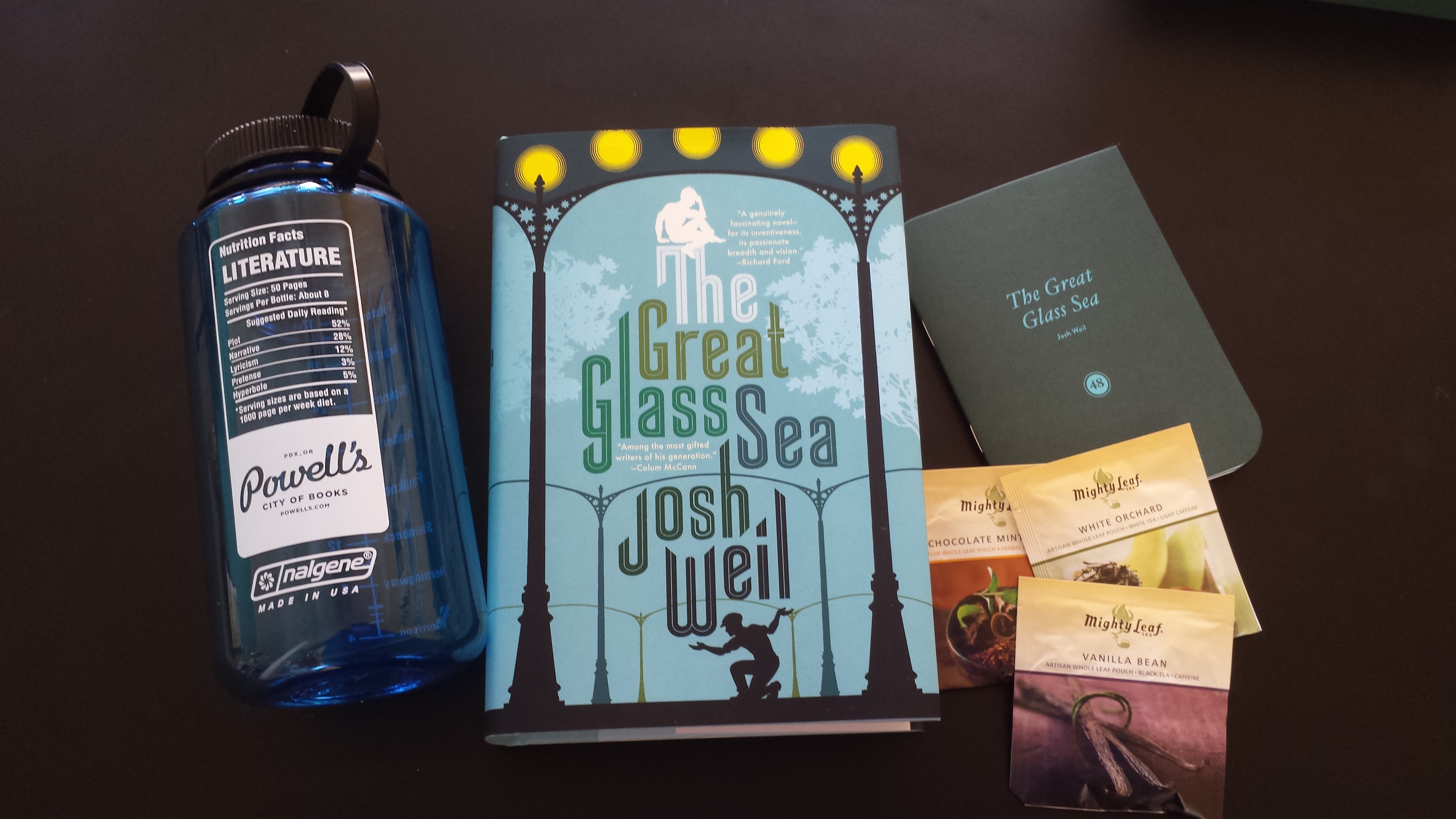
The picture above is one of all the stuff that came in the box from Powell’s when I got The Great Glass Sea last summer.  Thanks to thanksmrpostman.wordpress.com for taking the picture so I didn’t have to!

Posted in Fiction - Dystopia, Fiction - general, Fiction - literary, Josh Weil, Reviews by Jill | 1 Comment

Just Another Friday Night

Cleo and Franzen 2

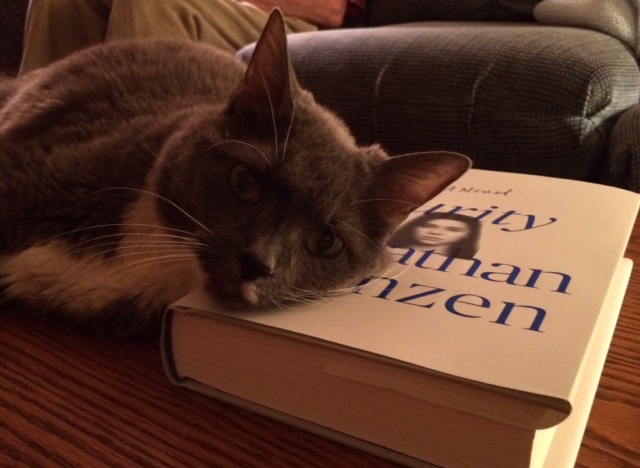
I was all set to write my initial thoughts on Jonathan Franzen’s long-awaited new novel (short version: good as usual; very much a page-turner; oddly similar in plot and characters to another novel I’m currently reading – eerily so. More on that later), but then I walked back into the living room after dinner and was confronted with THIS. Many thanks to Cleo for snuggling with Purity and giving me an excuse to call it a night. More soon!

Posted in Authors, Cat photos, Glimpses into Real Life, Jonathan Franzen | Tagged , , , | Leave a comment

Yarn Along

Yarn Along photo 9.2

Guess what – the brown sweater is off needles and ready to be pieced! I should get it done before too much longer – but not before I cast on my next project. Maybe next weekend? Or the weekend after? I’ll let you know and post photos when it’s done.

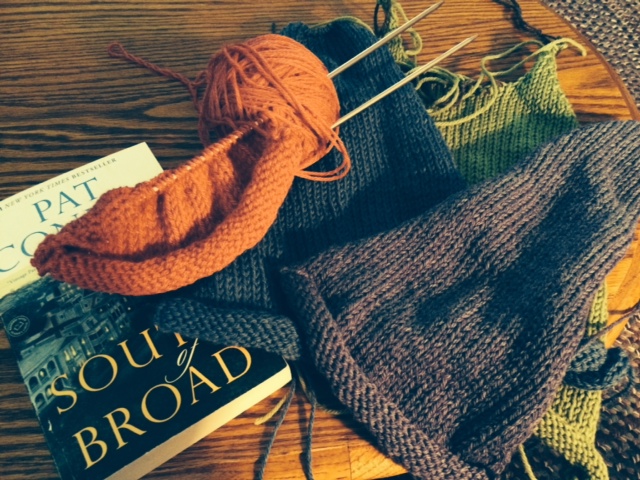
South of Broad looks so tiny on top of that huge pile of sweater parts, but don’t be fooled – it’s 512 pages long, much of it unintentionally amusing. I actually really am looking forward to reading it again, even though it’s not exactly Pat Conroy’s best. I remember a pair of characters – a dating couple – named Frasier and Niles, apparently without a shred of irony. I remember a surprise twist ending involving a man locked in a shed during a hurricane and a child-molesting priest. I remember a minor character named Macklin Tijuana Jones; when this book first came out in 2009, I vowed that if I ever had a male cat, I would name him Macklin Tijuana Jones, and if I acquired a male cat right now I would still give him that name. I believe I also remember some hackneyed San Francisco scenes, some odd attempts at James Joyce references, and a centaur-like father. And finally, I believe that, somewhere in the pages of South of Broad, mayonnaise is described in lurid detail. I will be turning the pages gingerly.

Fall is here. I’m teaching in a school again, though only on a temporary basis through the end of October, and I’ve been in a contemplative mood lately. September is a good month for knitting.

Yarn Along is hosted by Ginny on her blog, Small Things.

Posted in Yarn Along | Tagged , , , , , , , | 10 Comments