Yarn Along

Yarn Along 11.25

My short attention span for books continues, but today’s photo is of Camara Laye’s The Radiance of the King, which is really good but a little cringeworthy for all the racism and ignorance it showcases – in the first chapter at least. I do mean to finish it – but I feel that way about so many other books too. We’ll see…

I’m enjoying seeing my oatmeal English rib sweater take shape as I decrease for the sleeves on the back. I’ll be on to the front in no time.

Happy Thanksgiving, everyone!

Yarn Along is hosted by Ginny on her blog, Small Things.

Posted in Yarn Along | 12 Comments

A Review of Paula Hawkins’ The Girl on the Train

The Girl on the Train cover image

This review will be brief – I read a library copy almost two months ago, and I did take a few notes but not enough for a detailed review. But that’s OK, since this book was extremely popular and I’m sure there are many other reviews out there for you to choose from. The girl referenced in the title is Rachel; Rachel is a woman in crisis. She is a frighteningly severe alcoholic, and in the last year she has lost her husband (to divorce) and her job. She lives in a single room in her friend Cathy’s house, and she has not yet told Cathy that she lost her job, so she leaves in the morning at what used to be her usual time and then rides the train all day until it’s time to come home. There is a particular spot she is especially interested in passing on the train, and at the beginning of the novel all we know is that there is a couple whose house is near that spot whom Rachel likes to imagine as “the perfect couple.” She calls them Jason and Jess, and she has an elaborate fantasy life planned out in her imagination that is based on the little glimpses she sees of their lives, when they have cocktails on the porch in the evening or when she sees “Jason” leaving for work in the morning.

Jason and Jess are really Scott and Megan, and Megan is one of the novel’s three narrators. Rachel is another, and I’ll get to the third – Anna – in a moment. When we meet Megan, we don’t know that she is also “Jess” – that realization comes a few chapters later. We do get the sense that Megan is unmoored in some way; we know that she used to work in an art gallery but no longer does so, and we don’t know why, and we know that she recently quit a job as a childminder (that’s British English for babysitter; was I the only one who didn’t know that?) for a neighbor and is not willing to discuss her reasons for doing so. We know that her husband Scott loves her and tries to be patient, but that Megan’s unhappiness upsets him and that he sometimes storms out of the house angrily and displays his frustration in other ways which, while not abusive, are upsetting to Megan and cast doubt on their status as the perfect couple. But Rachel knows nothing of that.

Eventually it becomes clear that another reason Rachel likes to stop at this particular train stop is that she used to live on that street too. Furthermore, her ex-husband, Tom, still lives there with his new wife, Anna, and their baby. In addition, Tom and Anna’s baby is the one Megan cared for during her brief stint as a childminder. Once this connection becomes clear, this novel settles into the relatively-predictable-but-still-entertaining rhythm of the typical bestselling novel, in which we have a few pieces of the puzzle put together and our task as reader is to find the missing shards of grass, of sky, of character, of conflict, and so forth – in hopes of anticipating the novel’s resolution a moment or so before the author reveals it.

And then Megan is murdered. On the night that Megan was murdered, Rachel was walking around on their street, so drunk that in the morning the entire experience is blacked out, and when she is told by Tom that he interacted with her that night, she becomes obsessed with finding out what she had seen and experienced, convinced that her missing memory holds the answer to how Megan died. And – of course – it does, and her attempt to get her questions answered consumes the rest of the book.

This novel is engrossing, but it is also formulaic, and it never really transcends its formula. What I do find interesting, though, is that the novel seems to have a sociological point to make, which is that the loss of babies makes women crazy. With Anna and her new baby on daily parade and both Megan and Rachel increasingly miserable yet unable to stop watching Tom, Anna, and their baby, we gradually learn that an inability to have babies is areason for both Rachel’s alcoholism and depression and for Megan’s murder – and also that all three women in this novel have reasons to be obsessed with Tom. I’m not going to throw stones at anyone’s glass house when it comes to being upset about not having babies, but the reason I find this underlying message in the novel so interesting is that just a few months ago I read another novel – Vendela Vida’s The Diver’s Clothes Lie Empty – that explores exactly the same idea. That novel is not formulaic and is much more literary in its approach, but both novels resolve themselves by letting the reader know that childlessness – in two very different circumstances – is a breeding ground for self-hatred and insanity. In both novels, the protagonists respond to the trauma of not being able to bear children by subconsciously shedding their identities. In Vida’s novel, the protagonist takes on an alternate identity when her ID is stolen and then gets a job as a body double for an actress, and in this novel Rachel’s alcoholism, divorce, and job loss effectively erase much of her sense of self. Off the top of my head, I can’t think of other novels that make this kind of statement, although crazy/manipulative/smothering mothers abound. I make this point not to expound a well-developed thesis, but I wonder if this is part of a trend in how (some) women see themselves and their roles as mothers in a world that we increasingly expect we should be able to manipulate and shape to our own specifications. I recommend the book only moderately, but I did enjoy contemplating some of the questions it asks.

Posted in Authors, Fiction - general, Paula Hawkins, Uncategorized | Leave a comment

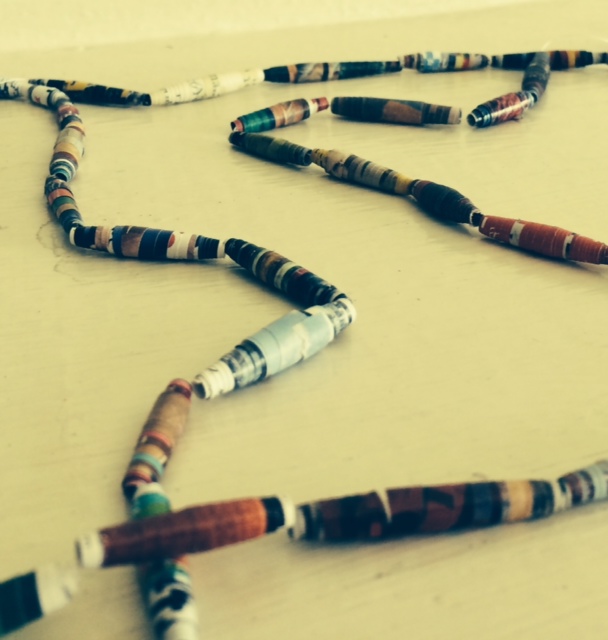
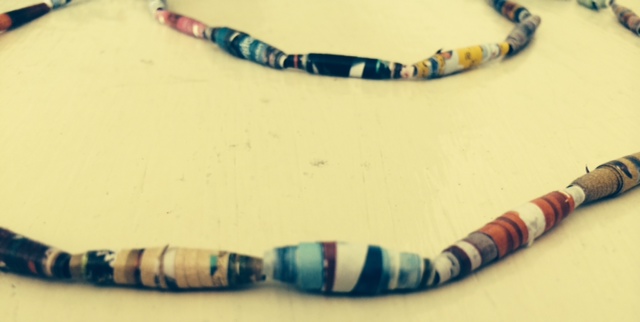
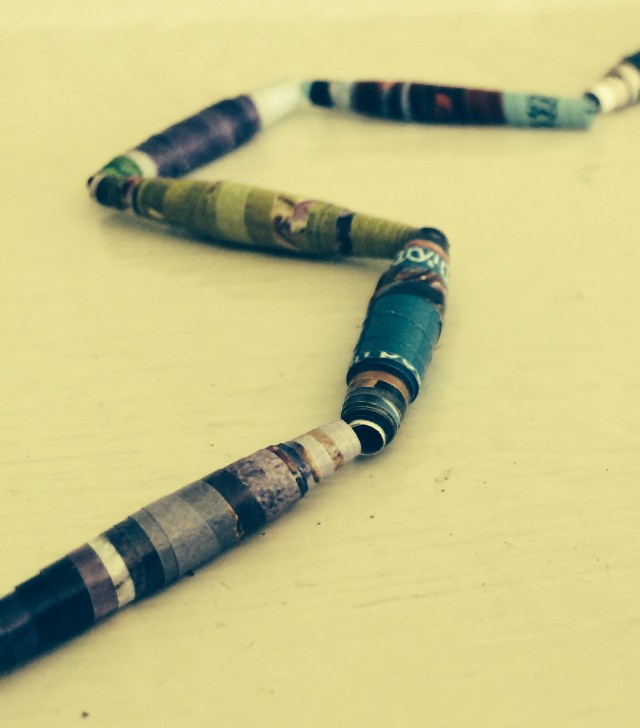
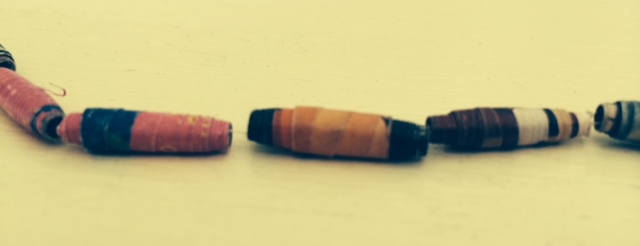
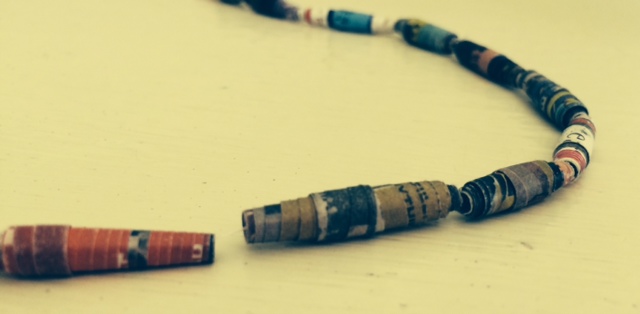
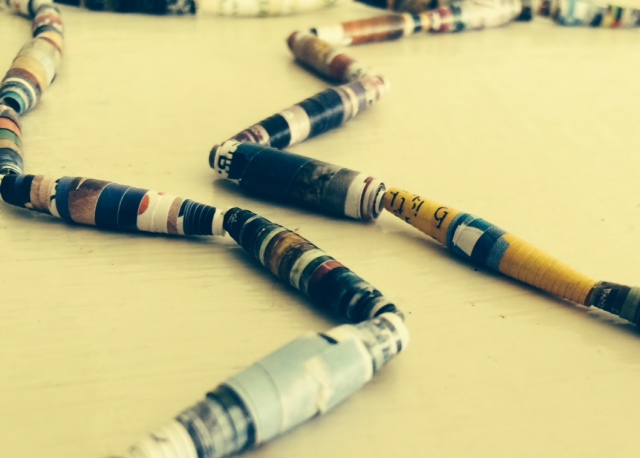
That Time I Made Hundreds of Beads and Photographed Them in the Evening Light (And Yes, Also Yarn Along)

photo 3photo 6photo 4photo 8photo 12photo 15photo 16photo 17photo 18

photo 2

Above you can see why I haven’t been knitting much lately. I needed to do a craft with second and third graders as part of a job interview, so I pulled out this old favorite. These beads are easy and almost always beautiful, and I underestimated my ability to get badly addicted to this project. To say that I made hundreds is not an exaggeration. I even have a bead-making injury: the tip of my right index finger got a callus on it, and I picked the callus off, so now I have to wait until it heals before I make more.

This is a great project for families because everyone from about 7 years old on up can participate and the end products are beautiful. Here’s how they’re made:

Materials:

Magazines and newspapers

Nails (medium-sized are best, but you can experiment)

Scissors

Glue Stick

Thread or fishing line for threading

Directions:

  1. Cut out LONG, SKINNY triangles from magazines or newspapers. You can experiment with a variety of sizes, but the base of the triangle must be SHORTER than the nail you are using. At minimum, the triangle should be about 7-8 inches long, though ideally it should be much longer. The longer the triangle is, the wider the bead will be at its middle.
  2. Align the base of the triangle with the nail. Holding the paper in place with the thumb and forefinger of one hand (this is how I got the callus), use the other thumb and forefinger to rotate the nail so the paper is gradually wrapped around the nail. The bead will grow and thickness as your wrap it around the nail.
  3. When there are about two inches left on the “point” end of the triangle, put the bead on the table and cover the remaining paper with glue. Then finish wrapping the paper around the nail, pressing the point firmly in place. Carefully slide the bead off the nail. The glue will dry quickly.

Clearly any jewelry made from these beads is not suitable for rainy days, but in other ways the beads are much sturdier than they look. On my to-do list is to stop into an art store to see if they have a fixative spray or other product that will make these beads slightly more waterproof than they currently are. If anyone has suggestions, please let me know!

Yarn Along photo 11.18

And no, I haven’t completely stopped knitting. I did some work on my English rib sweater and am almost ready to start decreasing for the sleeves. I am still finishing up both The Year of Lear and The Winter’s Tale, but I’ve also started Welcome to Braggsville and am enjoying it so far. More details to come!

Yarn Along is hosted by Ginny on her blog, Small Things.

Posted in Yarn Along | Tagged , , | 21 Comments

Thoughts on Ann Patchett’s Taft (by Jill)

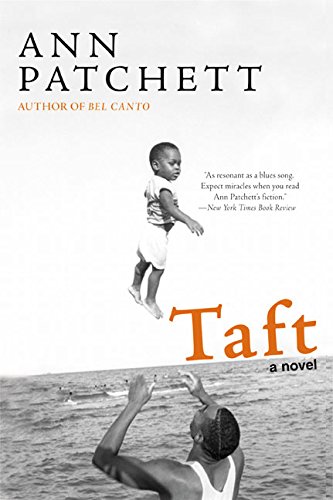
Taft cover

I have been an avid purchaser of Ann Patchett’s books for quite a while, but this is the first one I’ve actually read. According to my Goodreads account, my boss lent me this book back in the fall of 2012, which sounds like longer ago than it feels like. A brief aside: I was going to wax philosophical about all the things about my life that have changed since my boss handed me this book, but I’ve spent about four days trying to make that version of this post happen, and I’ve gotten absolutely nowhere with it. So I’m starting over, and keeping it simple.

The narrator of Taft is a middle-aged African American man named John Nickel, who manages a bar in Memphis called Muddy’s. Nickel, as he is more often called, seems like a pretty good guy, though he messed things up with the mother of his child a few years ago—Marion and his son Franklin no longer live in Memphis; they relocated to Miami when Marion got a job offer at a hospital down there (she’s a nurse). Nickel used to be a drummer in the Memphis jazz scene, and it sounds like he was a pretty good one, though he never got his big break. He gave up the musician life in order to be a more present father to his son, and now that Franklin is gone, he doesn’t have much in his life besides work and the occasional phone calls he makes to Miami. One day, a white girl named Fay Taft shows up at the bar looking for work. She says she’s twenty, but no one quite believes her. She’s new to Memphis, having relocated from a small town in east Tennessee after her father passed away (we learn that later). With her comes her brother, Carl, who ends up being more than a bit of trouble for Nickel. Somehow, Nickel gets roped into the Taft family’s life drama, and this causes him to imagine what things were like for them before their dad died.

The story alternates between present-day Memphis (in short, Nickel works, misses his son, visits Marion’s family; Fay falls in love with him; Carl gets into deeper and deeper trouble) and Nickel’s imaginings of Fay and Carl’s father. As the book goes on, we spend more time with the Taft family back in Coalfield, and it becomes unclear whether or not the events being depicted actually happened or if it’s just what Nickel imagines could have happened, or a combination of the two. I’m not sure if it’s an important distinction, though it seems like it should be. As the present-day story progresses, and Nickel gets more and more wrapped up with Fay and Carl, the flashback story gets more and more page time. I actually enjoyed both storylines equally, though the question of how much of the Coalfield story was fabricated by Nickel still digs at me, and I finished this book a week ago.

Ultimately this is a novel about love: primarily paternal love, but there are other kinds of love present in Taft, too. Nickel loves Franklin so much, and Patchett writes about it so well. I’m not sure what kind of love Nickel feels for Fay and Carl (really just Fay), and I’m not sure that he knows himself for the better part of the book. I suspect he has a fatherly sort of love for Fay, though she definitely has much stronger feelings for Nickel than that. Nickel and Marion love each other, though it doesn’t seem like they are going to end up together as more than Franklin’s parents. Marion’s parents love Nickel like a son, and they love Marion too, of course. There really were a lot of healthy relationships in this novel, and it’s too bad that Carl is such a bad seed.

I do recommend this book, though the ending is definitely not neat and tidy with all loose ends tied up. I was reading on goodreads and people who have read more of Patchett’s books say that this is definitely not as strong as Bel Canto or The Patron Saint of Liars, and since it’s only her second novel that doesn’t surprise me much. I’m glad I read it, and Patchett’s writing is lovely, even when she is describing unpleasant things, like Fay’s desperate attempts to seduce Nickel, as well as Taft’s death scene. The major issue I had with it is simply not knowing how close Nickel’s version of Taft’s life in Coalfield is to the real thing.

Posted in Ann Patchett, Fiction - general, Fiction - literary, Reviews by Jill | Leave a comment

Yarn Along

Yarn Along photo 11.11.15

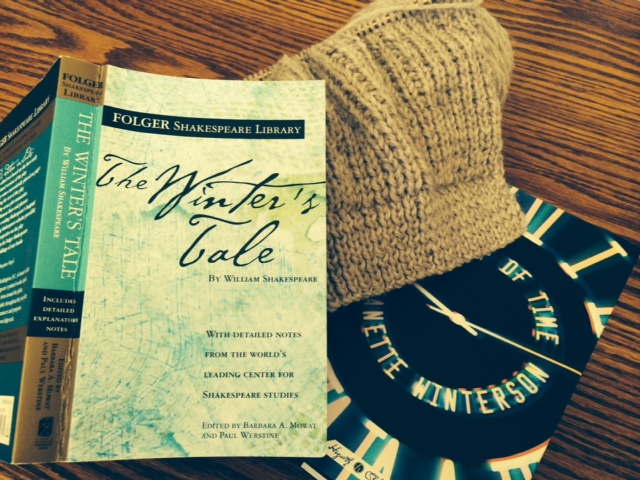
I haven’t been doing much knitting lately. I do still care about this project, but I’ve been reading more than usual and also working on another craft – beadmaking – that sucks me into its web once a decade or so. So the knitting project in the photo is nothing new, but that’s OK because I can take this time to tell you about a new reading challenge that I’m kicking off this week.

I learned via promotional email from Amazon that Hogarth Press is commissioning best-selling novelists to write modern re-tellings of all 37 of Shakespeare’s plays within the next several years (as far as I can tell there is no specific timetable published). The first novel in the series was just released: Jeannette Winterson’s A Gap of Time, a re-telling of A Winter’s Tale. I am reading A Winter’s Tale now and will start the novel once I’m finished. The next two novels in the series will be Howard Jacobson’s re-telling of The Merchant of Venice and Anne Tyler’s re-telling of The Taming of the Shrew. I am excited beyond belief about this project, which I think of as state quarters for book nerds, except the books will look better than the quarters when lined up on a shelf. And look how nice the two books look alongside my knitting!

I would LOVE it if some of our readers – or, of course, Jill – would like to read along.

Happy Wednesday!

Yarn Along is hosted by Ginny on her blog, Small Things.

Posted in Hogarth Shakespeare, William Shakespeare, Yarn Along | Tagged | 6 Comments

Final Thoughts on George R.R. Martin’s A Feast for Crows (by Bethany)

feast_for_crows

Well, I finished it – and yes, it was entertaining at times. Unlike Outlander and other series, the books in A Song of Ice and Fire don’t vary much from one another in quality or in general mood. All of them are good but highly dilute. To get through the good, one has to wade through any number of swamps. The characters in this series just spend so much time traveling from place to place and/or plotting things alone or with one other character that the actual conflicts between characters are relatively infrequent.

But here’s the good news about A Feast for Crows: WINTER FINALLY COMES. Snow fell someplace or other and now it is officially winter. Since the next installment is set on and around the Wall – where for all practical purposes it’s been winter since A Clash of Kings, I am looking forward to finally learning what happens during winter.

More good news: at the end of this novel Cersei Lannister is stripped naked and put in a prison cell. She spent this entire novel plotting the downfall of Margaery Tyrell and various other members of the Tyrell family, and she has now been exposed for the malignity she is. I didn’t enjoy the Cersei chapters one bit, although we did learn some useful information that helps explain her character. Specifically, when she was a girl she visited a fortune teller named “Maggy the Frog,” who foretold that Cersei would be queen but would later be supplanted by another, younger queen (this explains her hatred for Margaery) and that she herself would be killed by her “little brother,” which explains a great deal about her hatred of Tyrion. I enjoyed this backstory, but ultimately I don’t know if we really “needed” it to understand Cersei’s character. We’ve always known that she is vicious and power-mad and unscrupulous and narcissistic, and we really don’t learn anything new from the Maggy the Frog episode. I suppose we’re supposed to feel sorry for her because she lives in fear and because she has no real power of her own – but this novel didn’t change my attitude toward Cersei at all. I still find her horrible, but in boring ways.

Other developments in this installment: Brienne either dies and then is reborn as a “wight” or whatever OR just sustains some terrible injuries and then is taken care of by a bunch of wights, including Catelyn Stark, who became a wight after the Red Wedding and is now known as Lady Stoneheart. Jaime ends the novel at Riverrun, where he is trying to put the house in order after the Tullys lost Riverrun to the Lannisters. Jaime is also secretly training with Ser Ilyn so he can learn how to fight with his left hand. The deep shame Jaime feels after he loses his hand, as well as the way he moves through this shame to make something better out of it, is one of my favorite things about this novel. I wish R.R. characterized everyone this well.

Sam Tarly has finally made it to Oldtown, where he is going to be studying to be a maester. He is deeply conflicted because he has fallen in love with Gilly but is determined to keep his vow not to marry. During his journey from the Wall, Maester Aemon Targaryen dies, but not before he identifies Daenerys and her dragons as the fulfillment of a prophecy. He insists that Sam send a master to find Daenerys and guide her as she returns to Westeros to reclaim her family’s position. We don’t see Daenerys in action in this book – though her dragons are oft discussed – but I have a feeling she will not accept the guidance of a maester as graciously as Aemon hopes.

Sansa and Arya Stark are both in hiding. Arya is in Braavos under the pseudonym of “Cat of the Canals,” and Sansa is in the Eyrie under the pseudonym of “Alayne Stone.” R.R. gives each sister a chapter under her own name early in the novel, but their later chapters are listed under their pseudonyms. This is new – Arya has been in hiding under false names often, but never before has the novel itself called her by anything other than her given name. This is a sign that both girls have undergone permanent, identity-defining changes as a result of their experiences. Oh, and Arya is blind. She just wakes up one day and is blind.

I was generally uninterested in the chapters about the Greyjoy family and was happy when these chapters became less frequent later in the novel. However, they were replaced by chapters about the Martell family in Dorne, and these were even less interesting to me. The Martells are currently fostering Myrcella Baratheon, and a Dornish princess named Arianne is scheming to get Myrcella crowned as queen. Arianne is locked in the tower to prevent her from carrying out her plans.

So there we go. I’m happy to be done and also eager to start A Dance with Dragons, mainly because I want to be done with the whole series but also because I want to see where Tyrion is and what he’s doing. I’ll be in touch with an update soon.

Posted in Authors, Fiction - Fantasy, Fiction - general, George R.R. Martin, Reviews by Bethany | Tagged , | 3 Comments

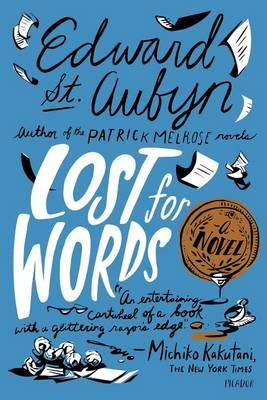
Thoughts on Edward St. Aubyn’s Lost for Words (by Jill)

lost-for-words coverApparently Edward St. Aubyn is quite famous, but I had never heard of him until I got this book from my boss a few months ago. Lost for Words details the process of selecting the Elysian Prize, a major literary award of the British Commonwealth. Essentially, it satirizes the British literary world and the Booker Prize. The prize is named for the Elysian Group, “a highly innovative but controversial agricultural company (2)” whose products include “giraffe carrots,” as well as weaponized agricultural agents, the scant details of which I will leave to your imagination. The company essentially sponsors this prize as a distraction from its more, erm, controversial activities. It’s a multiple perspective novel, with the bulk of the prize selection committee members as well as several of the nominees, and some of the authors who didn’t make the long list, taking turns as primary viewpoint characters.

I generally enjoy multiple perspective novels (I like that cast of thousands thing), but there were almost too many people taking turns here. I don’t think I figured out who was who until I had about thirty pages to go in the book, and that can be confusing. And I hate being confused.

I’ve been flipping back through the book while I’ve been writing, and Lost for Words is actually pretty funny. I wish that I had been less tired while I was reading it so I could have caught more of the subtle humor. My favorite part of the book was the descriptions of the ridiculous books that were nominated for the Elysian Prize. The goal for the committee (who is a motley crew of people who really should never have anything to do with picking the winner of anything, much less a major literary award) is to pick “accessible books,” which was also apparently the goal of the 2011 Booker Prize selection committee, and they picked some whoppers. There’s one that’s a cookbook, literally a cookbook, that was accidentally submitted for consideration, and some of the committee members convince themselves that it’s metafiction. But it’s not. The author even says that it’s a cookbook and doesn’t understand how she made the Long List, and then the Short List!

This book is definitely fun, and an easy read. If I hadn’t been so busy with work while I was reading it, I would have jammed through it in a few days. That being said, I’m one of those people who holds the winners of awards like the Elysian Prize on a pedestal, and it disappoints me a bit that there is likely to be close to as much politicking involved in who wins those prizes as is depicted in Lost for Words. Of course, as a cynical sort, I can’t say that I’m shocked. What I would like to do is reread this book eventually, not when I’m half asleep, and see if it’s funnier to me than it was this time around.

Posted in Edward St. Aubyn, Fiction - Funny, Fiction - general, Reviews by Jill | Leave a comment

Yarn Along

Yarn Along photo 11.4

When I took this photo yesterday, I was almost done with A Feast for Crows, and I was feeling the same ambivalence I’ve felt at the end of all of George R.R. Martin’s other books: so glad to be almost done and yet strangely eager to start reading the next installment right away. However, I did read the first chapter of James Shapiro’s new book The Year of Lear, and I am already loving it and will have lots to say soon.

I didn’t have much time to knit this week, so my “oatmeal” sweater is only a few rows longer than it was last week. I look forward to catching up this weekend.

Happy Wednesday, everyone!

Yarn Along is hosted by Ginny on her blog, Small Things.

Posted in Yarn Along | 6 Comments

A Review of William Maxwell’s So Long, See You Tomorrow (by Bethany)

maxwell cover image

I’ve known for some time that there is really no excuse for the fact that I had not read any of William Maxwell’s novels. I own a couple of them, though I borrowed So Long, See You Tomorrow from a co-worker. I knew that Maxwell has a reputation as one of the great masters of mid-to-late twentieth-century fiction, in league with the likes of James Salter, Richard Yates, and others who write about silent, miserable men and the women who might perhaps love them if they weren’t so silent and miserable.

This short novel – only 134 pages – begins with an extramarital affair and subsequent killing in a small Illinois town in the early 20th century. The novel opens on a first-person narrator laying out the details of the killing while also doing everything possible to distance himself from it. “I know it only by hearsay,” the narrator says of a nearby lake that boys say has no bottom. The narrator follows this up with the following odd statement: “I was very much interested in the idea that if you dug a hole straight down anywhere it would come out in China” (3). Two pages later he is more circumspect: “Without thinking I would have said that acts of violence could hardly be expected to flourish in a placed where the houses were not widely separated and never enclosed by a high wall…” (5).

At this moment and throughout the novel, the narrator is highly aware of the ways the world has changed since his childhood. As a young child, he remembers going for drives in his father’s horse and carriage, which his father sold when the narrator was six in order to buy a car. The narrator is also aware of shifts in his family’s lifestyle – moving from a farm into a house in town that is owned by his father’s second wife. Looking back, the narrator recognizes that this move into town – and the accompanying decision to hire tenant farmers instead of doing the farm work themselves – represents a change in demographics, though as a boy he was aware only of the causes and effects of socioeconomic classes, not of the classes themselves.

Figuring out the identity of the narrator is maddening. While the reader never loses touch with the “I” of the first-person narration, it is difficult to grasp who the narrator is at the time that he is telling the story and why he feels he needs to tell the story at all. The novel opens with the bare facts of a murder that took place in the narrator’s community during the narrator’s childhood, and the narrator reflects: “I very much doubt that I would have remembered for more than fifty years the murder of a tenant farmer I never laid eyes on if 1) the murderer hadn’t been the father of someone I knew, and 2) I hadn’t later on done something that I was ashamed of afterward. This memoir – if that’s the right name for it – is a roundabout, futile way of making amends” (6).

Furthermore, the narrator reports that his family experienced more than its fair share of disasters between 1909 and 1919 but that he felt removed from these tragedies because he was so young. His mother died in 1918 after the narrator’s brother was born, and the family hired a housekeeper. The narrator and his older brother were wary of her “counterfeit affection.” His father is “all but undone” by his mother’s death, though he does choose to remarry eventually. The narrator’s younger self was an avid reader with a rich imaginary life, and his sensitivity, alongside his distaste for his father’s eventual new wife, was a source of conflict between them: “We were both creatures of the period. I doubt if the heavy-businessman-father-and-the-oversensitive-artistic-son syndrome exists any more. Fathers have become sympathetic and kiss their grown sons when they feel like it, and who knows what oversensitive is, considering all there is to be sensitive to” (13). When the adult narrator looks at photos of his young father and stepmother fifty years in the future, he can’t stand the idea that his father was happy but can’t understand why these feelings are still so alive within him. He senses that his own young self is still alive inside him, living out the events of 1909-1919 (which, of course, he is).

Caught up in this nostalgic mood, the narrator searches through old newspapers to refresh his memory of a murder that took place in his community during his childhood. The murderer was Clarence Smith, the father of the narrator’s childhood friend Cletus, and the victim was Lloyd Wilson. Lloyd was having an affair with Clarence’s wife. I won’t summarize the details behind Clarence Smith’s murder of Lloyd Wilson because they are more or less what you would expect: it’s a revenge killing that, of course, leaves the killer even more angry and miserable than he was when his wife’s lover was walking through town in possession of a beating heart. What I’ll focus on instead is the #2 in the quotation above – the fact that the adult narrator connects Lloyd Wilson’s murder with an action of his own that he regrets. Several years after the murder, when his family’s rising socioeconomic status has propelled them to their new house it town, the narrator sees Cletus in the hallway of the town’s high school. Cletus and his father fled the rural community in which the murder took place after the murder of Lloyd Wilson, of course – and, with the rudimentary forensic science of the early 20th century, Clarence Smith is never formally accused of the crime, though he is questioned, harassed, and scorned by the community. When the narrator sees Cletus in school, “it was as if he had risen from the dead. He didn’t speak. I didn’t speak. We just kept on walking until we had passed each other.” This incident is the source of the guilt that provides impetus to this novel. The narrator continues: “Why didn’t I speak to him? I guess because I was so surprised. And because I didn’t know what to say. I didn’t know what was polite under the circumstances. I couldn’t say I’m sorry about the murder and all that, could I? In Greek tragedies, the Chorus never attempts to console the innocent bystander but instead, sticking to broad generalities, grieves over the fate of mankind, whose mistake was to be born in the first place.” This interior conflict feels very authentic to me. In my own life – mostly in childhood but in some cases well into adulthood – I let relationships fade into nothingness because I was confused or embarrassed about the feelings these relationships stirred up in me. When I was only eight, I cut all ties with a friend simply because her family moved out of state and the only thing I could think of to do with my sadness was to pretend it didn’t exist. The now-elderly narrator goes on to say, “If I knew where Cletus Smith is right this minute, I would go and explain. Or try to. It is not only possible but more than likely that I would also have to explain who I am. And that he would have no recollection of the moment that has troubled me all these years. He lived through things that were a good deal worse. It might turn out that I had made the effort for my sake, not his.”

A couple of years ago I ran into a former classmate at a café. We had not been friends in school, though we attended a small private school for nine years, and everyone knew everyone else fairly well, friendships aside. We chatted for about an hour and then connected on Facebook, and for a couple of months we kept up an intermittent conversation via Facebook messaging about the little slights and remarks and insecurities that we remembered from childhood. When she apologized to me for some long-ago teasing that I remembered but had long stopped resenting, the joy I felt came not from the apology but from the fact that I figured in her memories. I was known and recognized and played a role in the emotional landscape of her childhood. This was astonishing. When the narrator of Maxwell’s novel passes Cletus in the school hallway and recognizes him, this recognition is all that it needed for the narrator to be tormented for the rest of his life. It is a powerful thing, to look at another person and acknowledge that his interior life is as detailed and complex and rich as one’s own. When the narrator references Greek tragedy to explain his memory of seeing Cletus in the hallway, he invites the reader to recall that a key moment in any Greek tragedy is anagnorisis, or “recognition” – a moment when a tragic hero moves instantaneously from ignorance to a terrible kind of wisdom.

One of the most effective (and ironic) elements of this novel is the fact that the emotional weight of the narrator’s failure to acknowledge Cletus in the school hallway bears much more emotional weight than the murder of Lloyd Wilson, which is related in a matter-of-fact, anesthetized way. This is a great example of how the use of point of view can enhance both a novel’s realism and its subjectivity. The murder is abstract in the narrator’s mind because he feels no guilt (or other personal connection) to it; as the first page of the novel states, the narrator felt more emotional weight surrounding the idea of digging a hole to China than he does about the killing of Lloyd Wilson. This is one key reason that this is such a nuanced, well-executed novel. So many novelists would approach this subject matter from multiple points of view – we would learn of the events surrounding the murder from the perspectives of killer and victim, their wives and children, and a wide variety of other people in town. Cletus’ dog, who waits for Cletus after school every day, long after Clarence and Cletus have moved to town, might even get a chance to weigh in on the action. There is certainly a time and a place for novels that incorporate multiple points of view (and I am currently writing not one but two such novels, so please take my critique with a grain of salt), but sometimes I think that each novel is allotted a certain amount of emotional intensity and that shifting between multiple perspectives somehow dilutes that intensity. If everyone gets a chance to bear some of the burden for the conflicts in the novel, than no one single character has to struggle under the burden of carrying all of that weight alone – not in the way the narrator carries that weight in this novel, which could be the topic of a master class in managing point of view.

I will admit that I did not always “enjoy” this novel when I was reading it, especially at the end of the day when I was tired. There were definitely times when I would have been happy if a dwarf had showed up to crossbow his father in the chest – but that is my own philistinism, not a flaw with the novel. This novel requires its reader’s full attention, not because it is difficult but because it is magnificently subtle. I ended up reading large portions of the novel over again as I wrote this review – a luxury I can afford when a novel is only 134 pages long – and appreciated it much more the second time. This novel reminds me of Eudora Welty’s The Optimist’s Daughter, which I read at a time when I didn’t have many demands on my time. Both novels employ wonderfully subtle characterization that reveals just how subjective human emotion is, even when it comes up against conflicts that we tend to think are universal: death, coming of age, loss, fear, guilt, and an individual’s own failures of love, generosity, and courage.
Posted in Fiction - general, Fiction - literary, Reviews by Bethany, William Maxwell | Tagged , , | 2 Comments

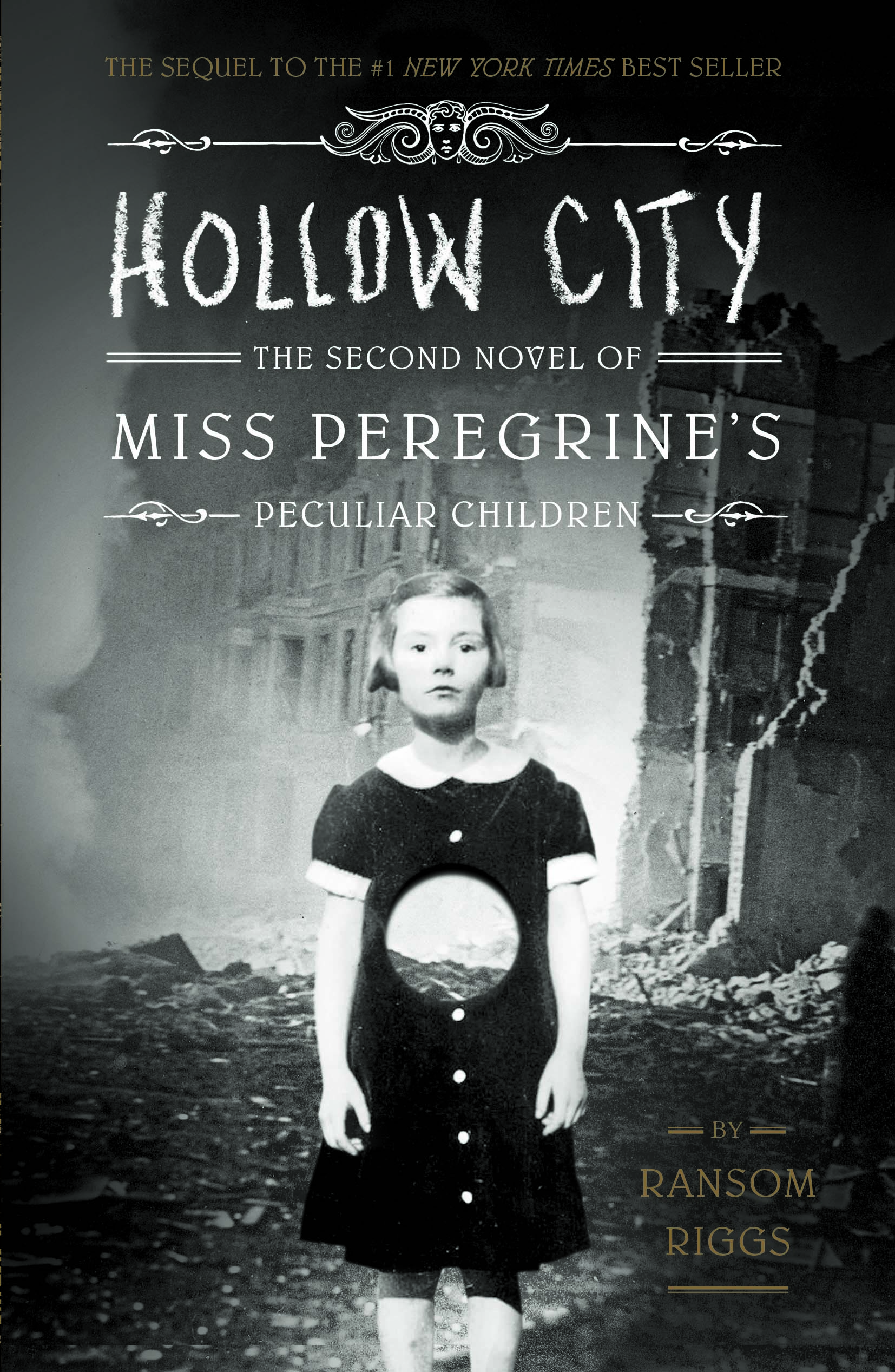
Thoughts on Ransom Riggs’ Hollow City: The Second Novel of Miss Peregrine’s Peculiar Children (by Jill)

Hollow-city cover

I’ll admit that I’ve been putting off writing my review of Hollow City. Not because I didn’t enjoy it, because I did. Mostly it’s because it’s the second book in either a trilogy or a series, and I haven’t felt like figuring out how much time to devote to summary of the first book what I thought was going to be a trilogy, but now I’m not so sure, based on some of the things I just read on Amazon.   Summarizing book one is complicated by the following: I read it in 2012 and I own a copy, but it is currently in circulation so I can’t reference it. But then I remember that it’s been fully a month since I wrote anything for the blog and I feel really guilty about that. So I’m going to just do the best I can.

If anyone knows anything about the first book in this series, Miss Peregrine’s Home for Peculiar Children, that person knows that it’s full of weird pictures. The author, Ransom Riggs, is a collector of old, bizarre pictures, and he uses them to craft his stories about these “peculiar” people, which is what he calls mutants or supes or witches. The primary protagonist is Jacob, a sixteen-year-old boy, who knows nothing of peculiardom until his grandfather is killed by a monster (which we later learn is called a hollowgast, or hollow) that only he and Jacob can see. He travels from Florida to an island off the coast of Wales with his father—I don’t remember why they go there—and ends up finding a school out in the woods filled with strange children and their teacher, Miss Peregrine. Turns out that most peculiars live in time loops to stay safe from the evil people of peculiardom, called wights, who are out to kill all “good” peculiars, especially the children. Groups of peculiar children are sequestered with protectors in time loops. The protectors are called ymbrynes—peculiar women who can manipulate time and take the form of birds. A time loop is just what it says, a constantly recycling loop of time. Miss Peregrine’s loop is in 1940, but as we learn in Hollow City, there are lots of loops in many different times. Jacob’s grandfather lived with the kids in Miss Peregrine’s loop when he was a boy, so they accept him quickly. At the end of the first novel, Miss Peregrine’s loop has been destroyed by wights, Miss Peregrine is trapped in her bird form and captured by the wights, the loop is destroyed, and the kids are on the run. They manage to get Miss Peregrine back from the wights, though she is stuck in her bird form. Jacob decides to stay with his new friends, primarily because he is in love with one of them, a girl named Emma, who can make fire with her hands, and who was in love with Jacob’s grandfather back in the day.

At the start of Hollow City, the kids are fleeing the island in boats, headed toward the mainland to seek help in London (apparently the capital of all things peculiar). They have lots of exciting adventures and eventually get to a loop where they find an ymbryne who has not been taken prisoner by the wights, Miss Wren, who is sequestered in a building covered in ice. She is able to finally return Miss Peregrine to her human form, only to find…. It was never Miss Peregrine who was travelling with them! It was her evil wight brother, named Caul. Things go sideways really quickly after Caul reveals himself, and the group of peculiar children gets separated. As the book ends, Jacob and Emma end up back in the present day, their mission to save Miss Peregrine not yet completed.

The third book in this series came out right before I started Hollow City, and I stupidly gave it to my boss to read, and now I wish I hadn’t, because I would really like to know how things turn out for Jacob and his friends. Sometimes the plot of Hollow City seemed a bit disjointed, as if Riggs tried a little too hard in this one to make the story fit with the pictures he had at his disposal at the time. I don’t remember noticing this quite as much in Miss Peregrine’s Home for Peculiar Children, and I’m concerned it will be more pronounced in the third book (called Library of Souls, to be reviewed on the blog soon!), but I still want to read it, because I’m invested in these kids. I want to know more about the wider world of peculiars than what I’ve seen so far, and see Jacob come into his own with his abilities to see hollowgasts (and also—spoiler alert—tell them what to do).

Posted in Fiction - Fantasy, Fiction - general, Fiction - Young Adult, Ransom Riggs, Reviews by Jill, TIME TRAVEL | Leave a comment