Yarn Along

yarn along 1.20.16


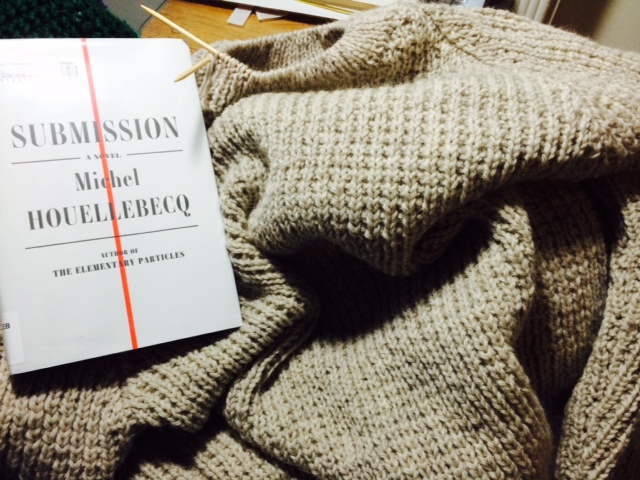
I’m still not much of a knitter these days, but my English rib sweater is almost done. I’m sure I’ll get the neckband done this weekend, and then I’ll weave in the ends maybe… in April? May? Just kidding. I really do want to wear this sweater while the weather is still cool.

Submission is picking up. I had trouble sleeping last night and read another 80 pages or so. I’ll be back to tell you about it soon.

Yarn Along is hosted by Ginny on her blog, Small Things.


Posted in Uncategorized, Yarn Along | 10 Comments

This is supposed to be a progress report on John Williams’ Augustus, but I have a feeling it’s going to turn into me feeling sorry for myself because I’m far away from home and getting a cold. (by Jill)


augustus coverHere’s the deal. I have about fifty pages to go in Augustus, and I really, really want to finish it before I write a post about it, but I need to talk about something tonight. I’ve been whining in my head a lot for the past thirty-six hours about my cold and my cough and the fact that I’m in Florida and why is it colder here than it is at home and why did I not bring my puffy North Face jacket? I’m beginning to tire of the subjects since I’ve pretty much only had myself for company since my mom left on Monday morning, and these are the topics that my mind has been spinning around and around since she left.

I doubt the bulk of our readers want to hear about the amazing talks I’ve been going to, either, though I think some of you guys are fellow veterinarians, so I guess I can blab about this conference a little. In short, the North American Veterinary Conference (NAVC) is amazing. I’ve been to a few big meetings (AVMA three times and Western in Vegas once), but this one puts them to shame. I am literally overwhelmed by all the things I can learn here. The printed proceedings (yes, they still offer printed proceedings, another reason to love NAVC in my mind) weigh almost ten pounds! And that’s just the small animal stuff. I would probably want to come to this meeting every year if it were closer to home. I am still going to want to come back soon, and all of you veterinarians who I actually speak to on a regular basis are going to hear about this meeting and how you should all go. And technicians, too: they have more tech tracks here than I’ve ever seen at a conference. And it’s good stuff!

As far as Augustus, I mentioned last week sometime that I was getting hung up on the long, annoying Roman names. And that’s still an issue, but I’ve gotten to know who is who a little better so it’s less annoying. John Williams also wrote Stoner, which I blogged about sometime last year, and also quite enjoyed. I don’t know that I like one better than the other, because the settings are so different. Augustus is definitely much more ambitious in subject matter: drawing from ancient history is always more difficult, I would imagine, than an English professor writing about another English professor, even if the story takes in a slightly earlier era than that in which the author lived.

The titular Augustus is, of course, Augustus Caesar. I don’t remember if I mentioned that before. And even though he is the main character, none of the letters or diaries or poems that make up the novel are actually written by him. Well, at least, not yet. We are learning about the Emperor of Rome from a variety of sources: towards the end of the book it’s become primarily the diaries of his daughter, Julia, who is in exile from Rome for reasons I don’t yet know, though I suspect it’s because her husband is pissed that she’s been cuckolding him for most of their marriage, and all of Rome knows it. The other voices are friends of Augustus: Marcus Agrippa, Gaius Maecenas, Quintus Horatius Flaccus, Nicolaus of Damascus, among others. Early on we hear from Marcus Antonius and Cleopatra. My favorite, by far, is Julia. I hope there really were women like her in Ancient Rome: smart, funny, beautiful, and determined to live life on her terms, despite what the men who supposedly ruled her wanted her to do. I hope she really did think something like the words Williams gives her: “I think now of the devious ways in which a woman must discover power, exert it, and enjoy it. Unlike a man, she cannot seize it by force of strength or mind or desire; nor can she glory in it with a man’s open pride, which is the reward and sustenance of power. She must contain within her such personages that will disguise her seizure and her glory. Thus I conceived within myself, and let forth upon the world, a series of personages that would deceive whoever might look too closely; the innocent girl who did not know the world, upon whom a doting father lavished a love he could not give elsewhere; the virtuous wife, whose only pleasure was in her duty toward her husband; the imperious young matron, whose whim became the public’s wish; the idle scholar, who dreamed of a virtue beyond Roman duty, and fondly pretended that philosophy might be true; the woman who, late in life, discovered pleasure, and used men’s bodies as if they were the luxurious ointments of the gods; and who herself at last was used, to the intensest pleasure she had ever known… (199).” I think she is a great character, a well-drawn woman, and it impresses me so much that in the end this book all of a sudden turns out to be about Julia almost as much as it is about Augustus Caesar. I guess that’s why it won the National Book Award.

It’s too bad that John Williams only published three books in his lifetime. It’s really too bad that I only have one left to read, and then I’ll be done with him forever. I’d almost consider rereading his books, which is something I reserve for only the most special ones.

I’m not sure if I’ll be coming back to Augustus on the blog, though I suspect I will. And now I’ll get back to my busy evening of watching Doctor Who on my laptop in my very small and quiet hotel room.

Posted in Fiction - general, Fiction - Historical, Fiction - Important Award Winners, Fiction - literary, John Williams, Reviews by Jill | Leave a comment

Early Thoughts on Michel Houellebecq’s Submission

submission cover image

I suspect that this book will go down in literary history not for its merits but for its eerie timeliness. It was published in French earlier this year, but the English translation was released just a few weeks before the ISIS attacks in Paris last year. French citizens and residents who know the larger context of Islam in France may not always pair the book with the incident as history moves forward, but I probably will. Before this book and that attack, I never thought much about troubles between Muslims and non-Muslims in France.

The protagonist of this book is François, a literature professor at a university in Paris. His specialty is the 19th-century French novelist J.K. Huysmans, and I am sorry to say that I don’t know enough about this novelist to comment on the connections between Huysmans and the novel as a whole (my hope is to change that soon). I did just enough research to know that Huysmans was known for having a difficult relationship with his own Catholicism, and that this difficult relationship echoes the religious conflicts of this novel.

François is one of those protagonists who is notable for his unwillingness to act, make decisions, or have a personality. He is the kind of protagonist Nick Carraway would have been if Gatsby had not been his next-door neighbor. Even more so, he is similar to Salim, the protagonist in Naipaul’s A Bend in the River. In Submission, we hear a lot about the routes François takes on his way home from work, the co-workers he has coffee with, and the frozen meals and take-out that he eats for dinner. We also learn about his various lukewarm affairs, usually with students, and with one affair in particular, with Myriam – and, most of all, we are with François when he realizes that fuck, he probably should have been paying more attention to politics.

My own education on French politics ended with the storming of the Bastille, so I have enjoyed learning that French presidential elections always culminate in runoffs, when the two most successful candidates in the original election go head-to-head. After one emerges the winner, the delegates from all the parties meet to put together the people who will actually conduct government – comparable to our presidential cabinet, I think. If a minority party received 35% of the vote in the runoff, then 35% of the cabinet posts will be filled with people from that party. This is how I understand it from the novel – which, of course, assumes that its readers already know how the system works. I could do research, of course, but you don’t really need to read me copying and pasting from Wikipedia, do you? I didn’t think so.

In the election in this novel, the two middle-of-the-road parties – the Socialist party and the somewhat-more-conservative or moderate party – that have dominated French politics in recent years are defeated by the more extreme parties: the National Front, about which I know something because I remember the hoopla when Jean-Marie Le Pen was elected in this party some years ago, and (drumroll) the Muslim Brotherhood.

This novel is set in 2022, so everything about the political world it depicts is speculative – though I am assuming that since the author chose to set the novel only a few years in the future the seeds of this situation have probably been planted for some time. I have read just over a third of the novel, and the runoff has not yet determined that the Muslim Brotherhood will win, though I know they will because otherwise Houellebecq would not be spending so much time directing François to track down all his friends who know about politics to tell him what to do (and also because the book jacket says so). François has a few acquaintances who know what’s what in the government, and these individuals advise François to do things like transfer his money to a non-French bank. They also warn him that his job may be at stake, since the Muslim Brotherhood does not believe in secular education and will likely mandate that all professors be Muslims.

As an American, I find all of this a little hard to swallow. I do know that democratic government is barely a blip on the radar screen of history, and I know that totalitarian regimes have come to power via democratic means. Everything Houellebecq outlines in this book is possible; but I have trouble with the idea of it happening so quickly – within weeks of an election, to hear the characters in this novel talk – and so abruptly. The French are known for dramatic regime change, God knows, but they were also well chastened by the years they spent as Patient Zero in Hitler’s quest for world domination, so I would think they would have built checks and balances into their system to prevent this for happening again. But I am far from an expert on this subject, so I intend to read and learn.

I will admit that the opening of this novel is not especially compelling. There really should be a rule against putting faculty meetings in novels. It took me a while to get invested in this book, but I’m invested now. I’ve read through the end of Part II – about 100 pages – and François has opened a foreign account and is having a lot of sex with Myriam, whose parents are moving to Israel in a panic and want her to go with them. I will be back next weekend to tell you more.

Posted in Authors, Fiction - general, Fiction - literary, Michel Houellebecq, Reviews by Bethany, Uncategorized | Leave a comment

That Time Shakespeare Woke Up One Morning and Invented Modern Narrative: Final Thoughts on The Winter’s Tale

I feel a little silly for wondering why Shakespeare titled this play The Winter’s Tale, especially since I used to devote a week or so in 10th-grade English to the way seasons are used metaphorically in poetry, including Shakespeare’s – “Shall I Compare Thee to a Summer’s Day,” and so forth. But I suppose I can be forgiven, because back in Act II I didn’t fully understand that this is a play about time. Sixteen years pass between Acts III and IV, and Act IV, scene 1 consists entirely of a single speech by Time (that’s Time the dude, not time the abstract concept). The transition between Acts III and IV is jarring and feels totally alien to my experience of Shakespeare’s world – more on this newness in a moment. In Act II, I was wondering what winter had to do with anything in this play; by Act IV, I was writing things like this in the margin:
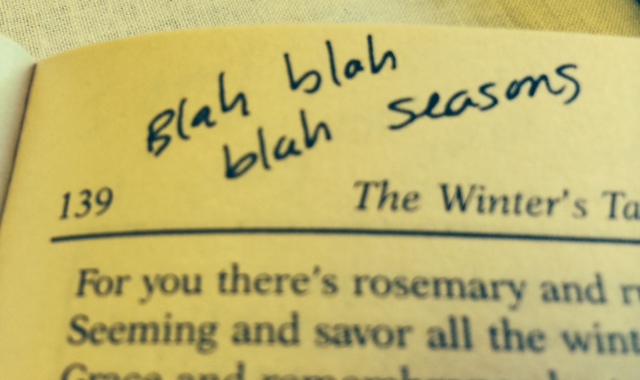
seasons

To a modern reader, a 16-year leap forward in the plot of a play or other narrative is almost de rigeur. Just about every sitcom I watched as a kid produced at least one flash-forward episode, in which the teen heartthrob character walked around with white dye in his hair and a pillow shoved down his pants, calling everyone else “sonny.” Most of the high modernists of the early 20th century found time troublesome in some way; a 16-year leap forward is nothing compared to the temporal antics of Faulkner, Joyce, Woolf, and Fitzgerald, and these writers were canonical before I was born.

Act III, which is relatively brief, focuses on the consequences of the psychotic break Leontes experiences in Act II. Hermione is tried in court for the affair with Polixenes that Leontes swears she had, and Leontes decries as fraudulent the report from the Delphic oracle that he himself commissioned. Hermione delivers several long speeches in her own defense, and Paulina delivers a Julia Sugarbaker-style rant about how every time men think they’re omnipotent, they’re wrong. And Western literature can never have too many of those.

As far as I know, the idea of jumping ahead sixteen years in a staged drama was uncommon in the seventeenth century, if not entirely unprecedented. This move violates Aristotle’s “unities,” for one thing, and plays in this era tended to be oriented around solving a specific problem. While I know – and suspect that Shakespeare did as well – that it is entirely possible to let a problem sit around and fester for sixteen years or more – this kind of procrastination isn’t exactly best practice.

When the action resumes in Act IV, a character named “Time” – who is also called “the Chorus,” suggesting that he is somehow an individual and a group at the same time – appears and rattles off some rhymed couplets. “Now take upon me, in the name of Time, / To use my wings. Impute it not a crime / To me or my swift passage that I slide / o’er sixteen years, and leave the growth untried / Of that wide gap” (IV.i.3-7), he says, indicating also that he has the power to “o’erthrow law” (IV.i.8) and “o’erwhelm custom” (IV.i.9). Unlike Joyce and T.S. Eliot and Hemingway, who burst onto the literary scene with their bold new approaches to writing fiction and poetry in the early 20th century, this speech by “Time” gives the impression that Shakespeare is shuffling around a bit, saying, “So um yeah, there’s this new thing I want to try. You’ll probably hate it, but…” But he does know that he is doing something new here, and there is wisdom in this moment too, when Time reminds us that ancient things were once fresh and new and that the things that are new now will someday be “stale” (IV.i.13). In some ways, Time is introducing himself as an antagonist in this play – someone who will steal sixteen years away from what could have been the happier lives of many characters, especially Leontes and Perdita.

After giving birth to her baby in prison, Hermione dies of “swooning” during her trial, and Leontes orders that the baby – whom he wrongly insists is not his own – be put to death. Instead of killing the baby, though, Leontes’ courtier Antigonus gives the baby to a shepherd, who passes her off to another shepherd, and somehow or other the baby – named Perdita, meaning “lost” – ends up living with ashepherd family in Bohemia, not too far from where Polixenes is king. These were some jet-setting mythical ancient shepherds.

I couldn’t get past the idea that this play seems like – among other things – a retelling of Oedipus Rex. Common elements include the two sets of kings and queens, the abandoned baby bring processed through an underground railroad of stealthy shepherds, and the decision in both plays to consult the Delphic oracle. Technically the gap of time is present in Oedipus as well, but because Sophocles begins his play after Oedipus has committed his little oopsie with his father and mother and then has the past filled in via the monologues of older characters sharing what they remember, this gap is less conspicuous in Sophocles than it is in Shakespeare. Shakespeare tends to tell his stories in chronological order, though, so if he was using Oedipus as a source (and I don’t know for sure that he was) and he reordered the events to put them in order, the gap of time would have become a narrative necessity rather than something he invented.

There are differences between these two plays as well. The central theme in Oedipus is fate and free will. Everything bad that happens to Oedipus and his family happens because they chose to ignore the warnings of the Delphic oracle and tried to circumvent fate. Baby Oedipus was given to a shepherd not because his father was afflicted by sudden-onset paranoid schizophrenia like Leontes but because his parents had been given the terrible prophecy that their son would grow up to kill his father and marry his mother. Perdita, on the other hand, was given to the shepherds because her father couldn’t stand having her around and wanted her dead. Their reunion in Act V is not an act of unavoidable fate but the end of a great deal of scheming on the part of Polixenes, his son Florizell, Perdita, and Camillo, the servant who helped Polixenes flee from Sicily to Bohemia and then stuck around for sixteen years, like you do. The ending of the play is driven by coincidence, but not by fate. These characters create their own resolution – a comic one.

After Time announces in his soliloquy that shit is about to get weird, Shakespeare manages to slow time down to an absolute crawl by giving us an Act IV, scene iv that is almost 1000 lines long. The whole thing takes place at a “sheepshearing feast” and is about as exciting as this setting suggests. This is the scene in which Florizell (Polixenes’ son and heir) and Perdita fall in love, and a mini Romeo-and-Juliet subplot ensues. The sheepshearing feast reminds me of the fairy scenes in A Midsummer Night’s Dream in the sense that the usual distinctions among characters disappear. Everyone is dressed for “rustic” endeavors, and there almost seems to be something magical in the air that brings Florizell and Perdita together. However, this magic does not affect Polixenes, who lurks around and complains that his kid is about to bang the shepherd’s daughter, acting like Carson on Downton Abbey acts when any character whatsoever does pretty much anything. For us egalitarian types, there’s a delightful parallel scene when Perdita tells her (adopted) father, the shepherd, that she and Florizell are in love and that the prince wants to ask for her hand in marriage. The shepherd makes no acknowledgement whatsoever of their difference in status but focuses instead on whether Perdita really loves Florizell and whether Florizell will take care of her in the manner to which she has become accustomed. As rank and wealth and other social distinctions become irrelevant in this scene, the primary tension is between the young and the old – which again is a reference to time.

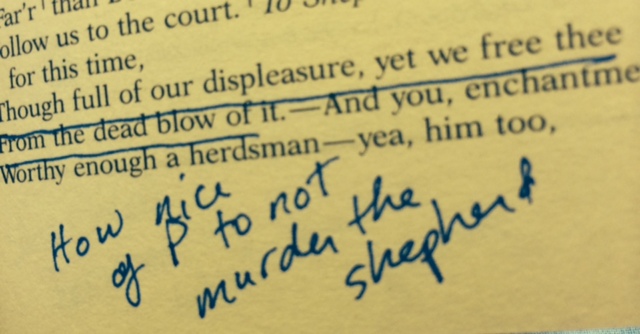
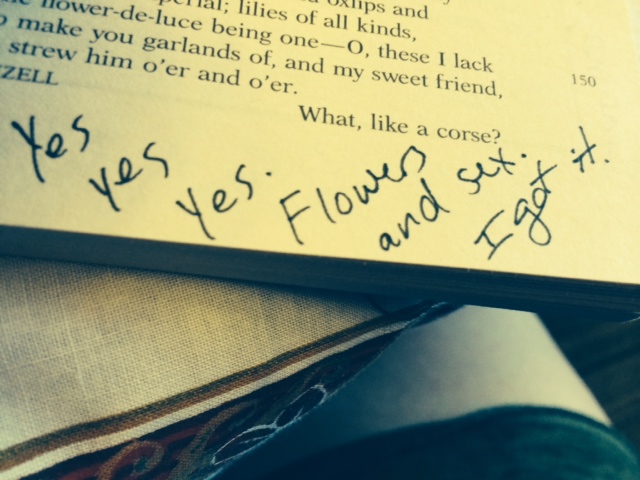
And it goes on and on and on, and I got a little punchy, entertaining myself with such marginal notes as these:
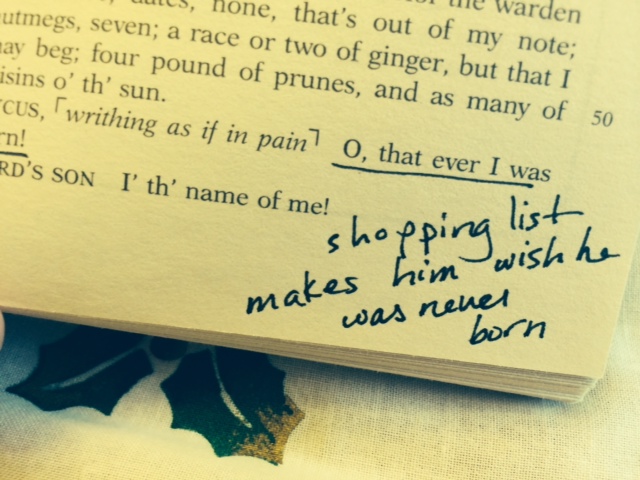
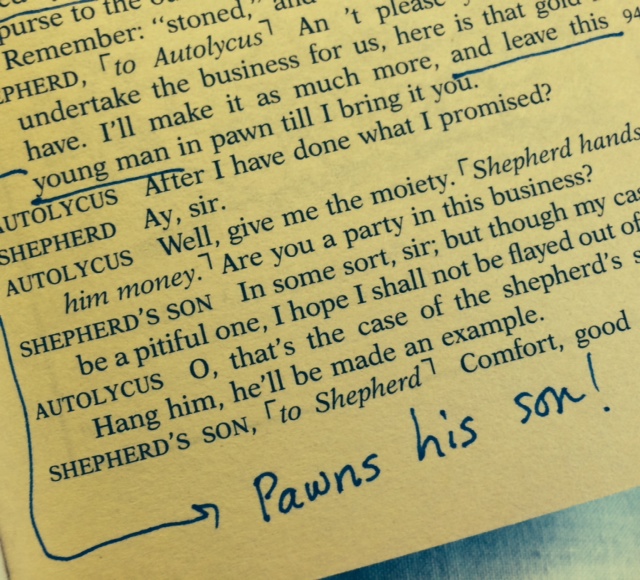
shopping list

photo 1

how nice of p to not murder the shepherd

Flowers and sex

Act V brings us back to Sicily, where Paulina seems not to have experienced the gap of time at all; she’s still ranting to the king about what an asshole scumbag he is. The fact that she tortures Leontes with constant rhapsodies of how beautiful Hermione was comes in handy when Perdita turns up. Since Hermione’s appearance is painfully fresh on everyone’s mind in spite of the gap of time, they all recognize her immediately as Hermione’s daughter – since, you know, it was a weekend and all the DNA labs were closed. Much like George W. Bush on the subject of the WMD’s in Iraq, Leontes glosses over the fact that he went stark raving mad a while ago and acts as if he knew all along that Perdita was his daughter as well as Hermione’s, in spite of the fact that when they first arrive Florizell introduces Perdita as the prince of Libya and Leontes awkwardly tells her that he hopes Poseidon didn’t rough her up too much on the journey:
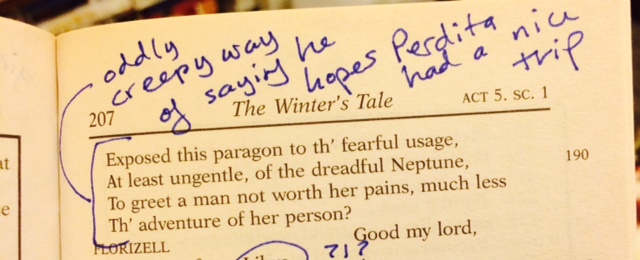
Poseidon

And then everyone sobs for about a thousand pages about how sad it is that Leontes was such an unspeakable asshole that it took sixteen years for everyone to reunite with one another, and I wrote this in the margin:
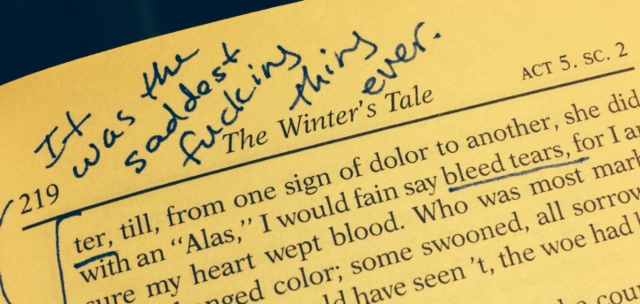
saddest fucking thing

And then it turns out that Hermione isn’t really dead but just turned to stone. Leontes sneaks in a poignant line – “I am ashamed. Does not the stone rebuke me for being more stone than it?” (V.iii.43-44), and then we find out that Paulina knew all along that the “statue” of Hermione would eventually turn back into Hermione herself, making the fact that Paulina spent sixteen years torturing Leontes about his terrible judgment all the more sadistic. By the end I even sympathized with the guy, cheering him when he finally manages a mild rebuke of Paulina:
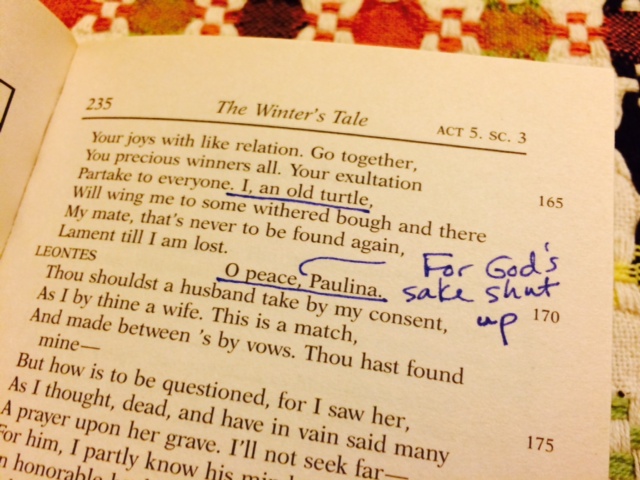
O Peace Paulina

And then Leontes mans up and apologizes to Hermione –
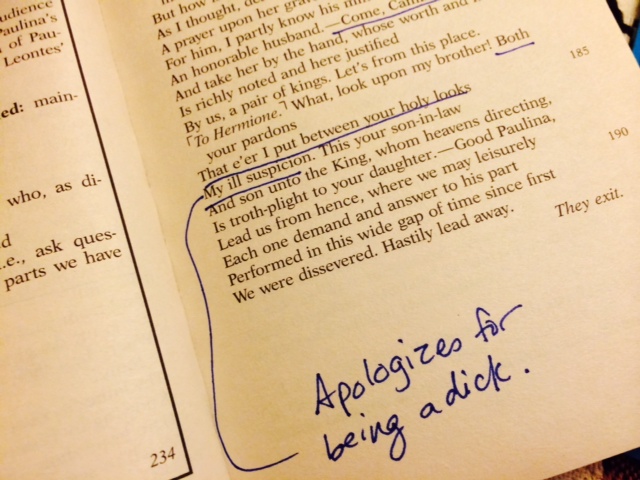
apologizes

– who has not aged in the sixteen years when she was turned to stone, meaning that not only does Leontes get his daughter back and the satisfaction of finally telling Paulina to shove it, he also gets to be a middle-aged man with a hot young wife. In other words, after straying from its traditional plot structure a bit, the play upholds society’s values, as comedies should. If this play took place today, instead of turning to stone Hermione could have just spent the last sixteen years in a luxury Botox clinic in the Berkshires.

This play made me snort a little, and Act IV, scene iv was pretty rough, but I’m glad I read it because of the levels of texture it added to my understanding of Shakespeare’s work as a whole. I think my favorite thing about Shakespeare – besides the dirty jokes – is the way all his plays talk back and forth to one another. The more of his work I read, the more I recognize them as all part of one story – a story that is about legitimacy, love, and the difficult but satisfying and supremely important work of blowing holes in bullshit.
Posted in Authors, Drama, Hogarth Shakespeare, Reviews by Bethany, Uncategorized, William Shakespeare | Leave a comment

Hello from Florida!

Well, I guess it’s 11:20 here on the east coast, but my laptop says it’s only 8:20.  Someday I’ll understand why my computer doesn’t automatically update the time when it changes time zones, but as of right now I don’t know, and I don’t care.  I mean, it changes automatically when daylight savings time starts and ends, why not when it moves across the country?  But I digress.  I’m on day two of my Orlando Disney/continuing education adventure, and I should be exhausted, but I’m not.  Or maybe I am, and I’m too amped up on adrenaline from a day running around Epcot and Disney’s Hollywood Studios to know it.   (For our West Coast readers, Disney’s Hollywood Studios is essentially Disney’s California Adventure, but only the parts that focus on Hollywood and the movies, and with some stuff from Disneyland that have to do with movies, like Star Tours.  Yes, a whole Disney park focused on one tiny part of LA.  It’s a little ridiculous.  But there are some fun rides there.  Or as they say around here, “experiences.”  Isn’t that the most PC thing ever?  And now this has turned into the longest parenthetical digression ever on PfP, so I’m going to stop.  Maybe I am tired.)

So Epcot was surprisingly cool–I really enjoyed the country exhibits more than I thought I would, and I finally made my peace with the 360 degree theater while watching a cute film made by our neighbors to the north, those cheerful Canadians.  When I was a kid, my mom used to always make me go into that theater in the round at Disneyland, and it’d always be when I was super tired and wanted to just sit.  She, of course, made me stand.  And I’ve been annoyed with her for it for the past, oh, thirty four or thirty five years.  So today, I told her all about that.  And I felt better.  She said that she told me to stand because if I sat on the floor, I wouldn’t have been able to see.  I replied that when I was five, I really didn’t care about seeing some dumb nature movie, and I was glad when that thing got taken out of Disneyland because it meant I’d never have to stand in a movie theater ever again.  I was so surprised today that she hadn’t made me stand just to be mean to her poor, tired kid.  She had wanted me to experience the movie in the best possible way.  I have no idea why that would be surprising to me.  As an adult, I totally get it, of course.  But the part of me who will always be a five or nine year old kid had been holding onto that tiny bit of resentment until today.  Goodbye to that childhood trauma, hello to a more positive relationship with my mom.  There was more stuff at Epcot than just the Canadian movie, but it’s almost midnight here, and I want to get this done.  Besides, I seriously doubt anyone wants to read a blow-by-blow about my day with Disney.

I did go to the conference for a few hours this morning, and it, too, was really cool.  The conference I’m at has been touted to be the best veterinary conference ever, by no less than my boss.  Anyone who knows her knows that this is high praise.  I learned about different indications for a few different anti-itch medications, and new treatments for demodicosis.  Oh, and I signed up to receive a free journal in the mail, and earned a free stuffed dog for my troubles.  A free stuffed dog wearing scrubs.  That’s right.  I’m a thirty-eight year old professional woman and I’ll do anything for a free stuffed dog.  Okay, not anything.  But I’ll listen to drug reps talk about pretty much anything to get one.  The exhibit hall opens tomorrow, and you know what that means….  More free junk to schlep home in my suitcase that was already only twelve pounds away from the weight limit when I left California.  And that was before I picked up my ten pounds of conference proceedings this morning.

And with that, I’ll say good night.  Thanks for reading my inane ramblings.  Now I’m going to look up directions to Universal Studios Orlando.  I suspect there will be a fee to leave the Disney compound tomorrow, but Harry Potter World awaits!


Posted in Glimpses into Real Life, Reviews by Jill | 1 Comment

Thoughts on Christopher Hitchens’ Thomas Jefferson: Author of America

Jefferson

Robert Frost has been much on my mind lately – probably because my birthday is approaching. Along with Philip Larkin, Frost is the poet that best captures for me the slow but orderly forward motion of time. At the same time – because in another cavity of my mind I am forever seventeen – I have also been spending an inordinate amount of time with the HAMILTON SOUNDTRACK lately. A few days ago, these two threads of thought merged, and I began searching my memory for the remaining lines to a short, little-known Frost poem from the nether regions of his Collected that starts “Harrison loves his country too / But wants it all made over new.” I think at first I confused “Harrison” for “Hamilton,” but I fixed that error quickly and started wondering which Harrison the poem was about. Certainly not William Henry, of skinny-dipping-in-the-cesspool fame; maybe Benjamin? Even he would have been ancient history by the time Frost wrote this poem.

But this is not a post about Frost – or about Larkin, or even about the HAMILTON SOUNDTRACK, at least insofar as any post I write this month can avoid being in some small way about said soundtrack. This is a post about Christopher Hitchens’ short biography of Thomas Jefferson. I enjoyed this book quite a bit, both for what I learned about Jefferson and for the pleasures of reading Hitchens. I’m not enough of a historian to really “review” this book, but I do have some things to say about what I learned from it and about Hitchens as a biographer.

Prior to reading this book, my impressions of Jefferson were fairly standard-issue: the Declaration of Independence, Sally Hemings and Jefferson’s troublesome non-legacy on the matter of slavery, followed by the architecture of Monticello and the University of Virginia, his broad-ranging Enlightenment interests, the Louisiana Purchase, Louis and Clark, the nickel, the two-dollar bill, the whole third-president thing, France. Fresh on my mind as it is, the HAMILTON SOUNDTRACK inclined me to think of Jefferson as loud and diplomatically aggressive – which, according to Hitchens, he was not. According to Hitchens, Jefferson was actually a lousy public speaker and often frustrated with the fact that his words didn’t come as easily to his lips as they did to his pen. So much for the cherished American tradition of getting one’s history lessons from Broadway.

Hitchens strikes me as a perfect biographer for Jefferson, in that it takes an iconoclast to appreciate an iconoclast. He dwells with just the tiniest bit of humor on some of the sillier of Jefferson’s youthful notions, such as the fact that he spent much of the 1770’s dilating on the idea that Americans were the rightful descendants of the ancient Saxons, while the British of his era were descended from the Norman invaders. In his discussion of Jefferson’s A Summary View of the Rights of British America (1774), Hitchens notes wryly that “a client who wished for an attorney who could plead on either side of a case would have done well to engage [Jefferson]” (18) and also points out the irony in the fact that Jefferson, who would soon be known as the author of the most famous words ever written on universal human rights, “grounded his fundamental case upon an essentially tribal appeal” (18). Hitchens was unclear on whether Jefferson thought the colonists were direct lineal descendants of the Saxons, but I don’t think that’s exactly what he meant. He saw the Saxons as a people who voluntarily left mainland Europe for England, only to be chased there and oppressed by the Normans in 1066, and he saw parallels to the colonists whose relatively recent ancestors had left England voluntarily and were now being harassed and oppressed by the British crown. He seems not to recognize that the colonists had left English under the auspices and protections of the same crown against which they were now revolting. (I am not being an anti-revolutionary. Perish the thought. I am just pointing out a flaw in the design of the young Jefferson’s argument.) Hitchens gets a bit of a giggle in when he reports that Jefferson was so taken with this Saxon idea that he wanted to put the “imagined likenesses” (8) of the “near-mythical English kings Hengist and Horsa” on the Great Seal of the United States – and the giggle is both well-deserved and contagious. Another unrelated giggle comes from Hitchens’ note that when Jefferson sat down to map out how he wanted to divide up the territory west of the Alleghenies – a plan that was later adopted in the formation of states like Tennessee, Kentucky, Illinois, and Indiana – he gave the territories extremely silly names like “Cherronesus, Assenenisipia, and Metropotamia” (51).

Metropotamia!

Hitchens doesn’t give Jefferson a free pass on his failure to abolish slavery, but he doesn’t dwell on the matter either. I think he probably knows that this area is well-trodden by scholars and doesn’t need to be overworked – and I think, even more so, he recognizes that a mind like Jefferson’s is always going to be characterized by contradictions. Hitchens does quote from the well-known paragraph that was cut from the Declaration of Independence against Jefferson’s vehement wishes – a paragraph that makes direct reference to the equality of both Africans (the phrase ‘African Americans’ would be anachronistic here) and Native Americans – and he also cites many other examples of times when Jefferson, a bold negotiator and able compromiser, had to act publicly in ways that violated his private beliefs. If Jefferson had been more stalwart in defending his ideals, he would likely not have been the diplomat that he was, helping to establish the United States as a respected nation on the world stage. He was a complicated guy. Hitchens also employs some 20th-century psychology to speculate that Jefferson “subconsciously sought to blame a distant authority for this alien presence, or serpent, in the American Eden” (29).

Hitchens clearly appreciates – as do I – Jefferson’s anti-clericalism and almost-atheism. Noting that Jefferson was slammed in the press in the 1800 election for being “an atheist, an abolitionist, and a sympathizer with bloody-handed Jacobism,” Hitchens muses that “the element of truth in all three accusations is retrospectively amusing, given their authors’ failure to appreciate Jefferson’s patent genius for compromise” (108). The last chapter of the book is devoted to Jefferson’s “declining years,” which he spent designing the University of Virginia (and engaging in ongoing battles to get it accredited), fine-tuning Monticello, writing, and using a razor blade to cut the Bible up in little pieces and then putting the pieces back together in a way that left out all the parts he objected to. (Good Lord – the things people had time for in the early 19th century.) The resulting volume, which Jefferson called The Philosophy of Jesus, carried the unfortunate epigraph “…for the use of the Indians, unembarrassed with matters of fact or faith beyond the level of their comprehensions” (180-181). The condescension is cringeworthy, but elsewhere it’s clear that Jefferson’s amendments to the Bible were essential to his own view of what was and wasn’t valuable in the Bible as usually printed (and which Jefferson shelved in his library at Monticello under “ancient history”) – and Hitchens also mentions that in giving the Indians this pared-down edition emphasizing the moral teachings of Jesus, Jefferson meant to give them ammunition against missionaries, who liked to confuse native peoples with some of the more esoteric later books of the New Testament. Fair enough. Hitchens also lets his own iconoclasm show when he notes that more than once he wanted to give the same razor-blade treatment to some of Jefferson’s earlier biographies – and I suppose in some ways, that’s what he’s done in writing this volume, which clocks in just under 200 pages.

Hitchens also reports that it seems as if Jefferson – while holding the office of President – personally taught Meriweather Lewis to read and write before sending him off with William Clark on their mission of exploration of the world west of the Mississippi. This detail more than anything else in this volume makes me want to give Jefferson a kiss. Hell, I want to kiss the whole 19th century. How adorable to have so much time on one’s hands, and to use that time so well.

Let’s return for a moment to that poem that I started with – the Robert Frost poem that starts “Harrison loves his country too, / But wants it all made over new.” I finally found the poem today (a Google search of those lines yielded nothing [!!]; I had to get out my hard copy to locate the title and then go back to Google) – and the title is, believe it or not, “A Case for Jefferson.” The internet is mostly silent on this poem: I found only the most oblique of references in a Mark Van Doren article mostly occupied in comparing Frost to Thomas Hardy, as well as the abstract of an article in a journal called First Principles, which identifies this poem as an example of Frost’s “essential conservatism” and states that this poem “describes the archetypal American ideological revolutionary.” This revolutionary is – I’m quoting Frost now – “Freudian Viennese by night. /** By day he’s Marxist Muscovite. / It isn’t because he’s Russian Jew. / He’s Puritan Yankee through and through” (393). The consistently end-stopped lines are profoundly distracting, though the poem’s worst sin is a strange deviation from its rhyme scheme in the final line that I suppose is supposed to represent an expectation that is established and not fulfilled, which is the sort of thing that happens when a person wants his country made over new. In other words, this poem is no “Birches.” Yet I find it unendingly interesting that this poem, which I did not know was called “A Case for Jefferson,” popped unbidden into my head while I was reading this book about Jefferson. I don’t know what Frost means in this title, exactly – maybe that Jefferson, who famously said “I like a little rebellion now and then. It’s like a storm in the atmosphere” (68), was also a master of subtlety and diplomacy. If Jefferson could handle the “case” of “Harrison” in this poem, he could perhaps induce him to continue his revolutionary thoughts without resorting to violent action (the poem’s exact words are “blowing it all to smithereens”). If so, then the entire 21st century is “a case for Jefferson.”

(**Freud pops up in a Frost poem, you ask? I know!)

Hitchens never uses this word, but the Jefferson he outlines in this book seems sublimely patient. He suffered both political and personal failures, which he handled by retreating to Monticello – not to mope but to write treatises and design porticoes and invent new kinds of plows. The image of a sitting president teaching a grown man to read suggests a patience almost unimaginable today. He was so patient that he was able to consign one of the decisions closest to his heart – that of the abolition of slavery – to the years after his death. I know that the classic response is to see Jefferson’s backing away from this issue as an act of cowardice, and on some level I share that assessment. But there is also great patience there, and a little bit of humility too, in this recognition that human lives have limits, even in the 18th and 19th centuries when time ran more slowly, and that patience and acceptance of these limits are elements of wisdom.

Posted in Christopher Hitchens, Non-fiction - History, Nonfiction - General, Nonfiction - Memoir/Biography, Reviews by Bethany, THE HAMILTON SOUNDTRACK, Uncategorized | Leave a comment

The Ugliest Radio in the West

RADIO PHOTO

So it’s 11:54 here at Postcards from Purgatory, and Jill and I have pledged to post every day this month (I’m going to lobby for every day this year, but don’t tell Jill).

But see, the thing is, my day revolved around this radio, which appeared in my home under mysterious circumstances – mysterious circumstances that also involved my mom’s ashes. And then I emailed the photo to everyone I knew, and there was laughter and tears, and then when I came home from work the radio was moved, the ashes were moved back to their rightful place (and the bathroom scale that was also part of this mystifying day was nowhere in sight), and I am dying to know the series of steps that led to this resolution of the day’s events. I do have an idea about how I can write a full post about this radio while also making it about books, so maybe I’ll tell you more soon.

But seriously – have you ever seen an uglier radio? I’ve been trying all day to decide what it looks like, but the best I could come up with is “Darth Vader’s backpack.”

Crap! I think it’s midnight! Thursday has turned into a pumpkin. Signing off.

Posted in Glimpses into Real Life, Uncategorized | 2 Comments

Yarn Along

Yarn Along 1.13.16

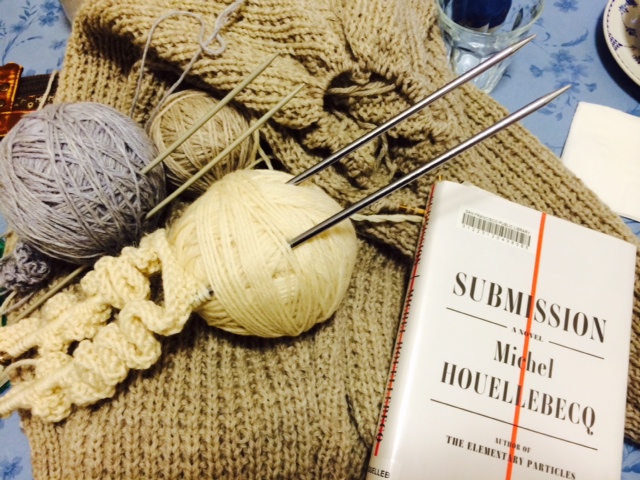
This lump of prickly paleness is my knitting life at the moment. I always knit when I am watching TV (or movies… or MOOC’s), and I have had very little interest in TV lately. Even Downton Abbey, which I usually love, has failed to interest me so far this season. For that reason, I haven’t finished my big oatmeal English rib sweater, and I haven’t made much progress on the two other projects I’ve started. One is a light blue child-sized English rib sweater, since I like that pattern so much, and one is a baby blanket. If you read my blog last week, you may remember that I started the baby blanket in light green. That light green yarn happens to be my “cursed” yarn – I’ve had it for over four years and have ended up ripping out every project I’ve started with it – for no fault of the yarn’s. I ripped out the baby blanket because the yarn was just plain too fine (and the needles were just plan too small) for me to follow the pattern without driving myself nuts. My up-close eyesight is not as good as it used to be (that’s my interpretation of the situation; according to my eye doctor, my up-close vision is just fine), and I was squinting myself into a headache every time I sat down to work. So I ripped the blanket out and cast it on again in a thicker yarn. It’s fisherman’s wool, so in reality it won’t be a baby blanket, but maybe it will work as a throw or lap blanket. Once I’ve done the pattern once, I should know it well enough to re-do it with the finer yarn. Or so I think.

I am reading a few books, including Michel Houellebecq’s Submission, which matches the color scheme of this photo. It’s OK, though a little cerebral for my tastes. When will I learn to stop reading novels about English professors?

I’m turning forty on Saturday, and that fact is very much with me emotionally this week, though not in the stereotypical sort of way. I like birthdays, including this one, but they tend to make me contemplative. Right now I can’t figure out if turning 40 feels more like falling in love or more like getting over a bad breakup – or maybe my range of emotional metaphors is too narrow? Maybe I’m emotional idiot? Maybe everything I’ve ever done in my whole life is all wrong?

You get the idea.

Yarn Along is hosted by Ginny on her blog, Small Things.

Posted in Uncategorized, Yarn Along | 5 Comments

Rather than thinking about books…

Lately I’ve been distracted by three things: internet shopping, watching TV, and thinking about my trip to Orlando.  Did you guys know that the internets have great sales after the holidays?  And on TV, there’s The Biggest Loser, and recorded episodes of The Walking Dead, and Netflix has every season of Doctor Who.  And do you guys know how much amazing stuff there is to do in Orlando?  Besides that one of the best veterinary conferences on earth is there every January, there’s also Walt Disney World!  And Epcot!  And The Wizarding World of Harry Potter!  Who has time to read when there’s all this other stuff to do?

That being said, I’m also really looking forward to being trapped on a plane for multiple hours with no internet access so I can concentrate on my favoritest hobby.  Which is, of course, reading.

Right now, though, I’ve got to stop my puppy from eating the coffee table.

Posted in Glimpses into Real Life, Reviews by Jill, Uncategorized | Leave a comment

From the Notebooks

One of my favorite parts of being a writer (besides the poverty and carpal tunnel syndrome, of course) is the fact that when it’s late and I’m tired and there’s a blog post to get done, I can open my notebooks to just about any page and find something intriguing like this:

photo 1.11

(OK, maybe not ANY page.)

Posted in Uncategorized | Leave a comment