Lack of Progress on The Bone Clocks & Saturday Night at the Movies (by Jill)

Bone clocks coverDeadpool pictureDo you guys remember those posts I wrote last year about things I was doing while I was supposed to be reading Richard Powers’ Orfeo? I have a bad feeling I’m going to be writing another series of those while I’m supposed to be reading The Bone Clocks. Tonight, in honor of the ridiculous secular tradition known as Valentine’s Day, the husband and I went and saw what was quite possibly the most violent and most hilarious comic book movie ever (and we have seen most of them). Which one do you think I’m talking about? That’s right. Deadpool. Ryan Reynolds is amazing. It’s like the role of a smart ass mercenary turned hideously disfigured revenge killer was written specifically for him. It might have been, I’m a fan of comic book movies in general and Marvel movies in particular, but I’m not a zealot. I am too much of a fantasy generalist to get wrapped up in one particular genre. Besides, right now I’m focusing on Doctor Who, and don’t have room in my short term memory for extraneous Marvel trivia.

But anyway, I read a little yesterday and the narrator of Part II of The Bone Clocks is sort of a douche-y undergraduate at Cambridge named Hugo Lamb, who spends most of the first thirty pages of his section (which takes place in 1991, also known as one of the last years in college campuses everywhere when the Internet was not a thing) being douche-y with his douche-y friends on the last night of the term before Christmas break. He meets a woman named Immaculée Constantin, who I suspect is the person who is responsible for putting another consciousness into Hugo Lamb, but I haven’t gotten that far yet, and I don’t want to fill my posts about The Bone Clocks with too many spoilers. So far, I far prefer Holly Sykes to Hugo Lamb, but I’m hoping that he grows on me. I’m not even halfway through Part II yet.

That’s it for tonight. I’m hopped up on Coke Zero from the movie and I want to use this late night caffeine buzz to get some reading done.

Posted in David Mitchell, Fiction - Fantasy, Fiction - general, Fiction - literary, Glimpses into Real Life, Reviews by Jill | Leave a comment

Final Thoughts on DeLillo’s End Zone (by Bethany)

End Zone cover image

I won’t be reading all day today, but that’s okay. Life is allowed to intrude on reading sometimes.

Reviewing a Don DeLillo novel – even a sort of embryonic, proto-DeLillo novel like End Zone – is a daunting task. For pure language he is one of my favorite writers, and has been ever since I first picked up White Noise in college. Yet overall I think his novels fail more often than they succeed. They fail brilliantly sometimes, but they do fail. In End Zone, I can’t quite figure out what DeLillo is going for in terms of plot and character. As satire, the book is sometimes brilliant. It’s about football players at the fictional Logos College in west Texas – the football capital of the universe. Logos College has only just that year decided to pour enormous amounts of money into its football program. The college president – and widow of the founder; she is known as “Mrs. Tom” – hired Emmett Creed as head coach and acquiesced to all of his demands, including a separate dorm for the football players. Some of the best scenes in the novel take place in this dorm, where protagonist and first-person narrator Gary Harkness often wanders from room to room, intruding on and participating in discussions with his teammates, the most existential football players of all time.

One of Gary’s teammates, Billy Mast, is taking a course in “the untellable.” This course provides one of the funniest running jokes in the novel. Billy is always doing some crazy homework assignment for this course, like reading poetry in languages he doesn’t speak. Here’s a snippet of dialogue:

“‘We delve into the untellable,’ [Billy said.]

‘How deep?’ Bobby Iselin said.

‘It’s hard to tell. I don’t think anybody knows how deep the untellable is. We’ve done a certain amount of delving. We plan to delve more. That’s about all I can tell you.’

‘But what do you talk about?’ Howard said. ‘There are ten of you in there and there’s some kind of instructor or professor. You must say things to each other.’

‘We shout in German a lot. There are different language exercises we take turns doing. We may go on a field trip next week. I don’t know where to.’

‘But you don’t know German. I know damn well you don’t. I’m your damn roommate. I know things about you.’

‘Unfortunately I’ve picked up a few words. I guess that’s one of the hazards in a course like this. You pick up things you’re better off without. The course is pretty experimental. It’s given by a man who may or may not have spent three and a half years in one of the camps. He doesn’t think there’ll be a final exam.’” (181)

In addition to capturing just about exactly what I’ve always thought science and business majors think goes on in college English courses, this bit of dialogue anticipates one of the most important running jokes in White Noise – the idea that the protagonist is a professor of “Hitler Studies” who doesn’t speak German – and can’t seem to learn it in spite of its best efforts. DeLillo is remarkably adept at capturing the way language is often what stands in the way between us and the things we want to understand – in spite of the fact that language is the primary medium we use to reach understanding.

The idea of “the untellable” also leads to my favorite sentence in the book: “I was forever pausing in a doorway or standing before a window, looking into rooms and out of them, waiting to be tapped on the shoulder by an impeccably dressed gentlemen whose flesh has grown over his mouth” (230). This sentence both is and isn’t classic DeLillo. The idea of moving through a building and looking through its various “holes” (doors and windows) is a fairly existential image, especially since the passage makes no reference to the idea that Gary might sometimes encounter something meaningful in one of the rooms he looks into or outside one of the windows. At the same time, my first thought when I read this sentence was that DeLillo had swallowed a big lump of F. Scott Fitzgerald and was working to digest it. “Looking into rooms” almost perfectly echoes Gatsby’s declaration that he spent the night before his reunion with Daisy walking through his mansion and “glancing into rooms,” and the idea of a character waiting around aimlessly describes Nick Carraway rather well. The “impeccably dressed gentleman whose flesh has grown over his mouth” is a bit too grotesque for Fitzgerald, but it describes Klipspringer rather well, doesn’t it? Finally, as a San Franciscan, I couldn’t help being struck by the fact that standing in a doorway is what we are supposed to do during an earthquake. Doorways are some of the safest places inside buildings. Standing before a window, on the other hand, is one of the most dangerous things a person can do during an earthquake. There is nothing on the page to suggest that DeLillo intended this interpretation, but it is the sort of thing he might intend. And while I don’t think people were ever instructed to stand in doorways in the event of nuclear war (that’s what teeny-tiny school desks were for!), my mind jumped there – partially because the novel asks it to jump there but also because, having grown up in San Francisco and participated in school drills, I automatically think of nuclear war as a kind of intense earthquake (because the truth of nuclear war is untellable, of course, and we have to rely on metaphors).

The dichotomy between football and nuclear war is less prominent than the book jacket promised, though Gary does visit a mysterious Air Force officer who lives in a motel, with whom he has fascinatingly aimless conversations about strontium-90 and the like. This Major Staley gives speeches like this: “For centuries men have tested themselves in war. War was the final test, the great experience, the privilege, the honor, the self-sacrifice or what-have-you, the absolutely ultimate determination of what kind of man you were. War was the great challenge and the great evaluator. It told you how much you were worth. But it’s different today… Today we can say that war is a test of opposing technologies. We can say this more than ever because it is more true than it ever was. Look, what would our cartoonists do if they wanted to satirize the Chinese, if we were in a period of extreme tension with the Chinese and the editorial cartoonists wanted to stir up a little patriotism? Would they draw slanted eyes and pigtails the way they drew buck teeth for the Japanese in the forties? No, no, they wouldn’t make fun of the people at all. They’d satirize the machines, the nuclear capability, the weapons and such of the Chinese. They’d draw firecrackers and kites. War has always told men what they were capable of under stress. Now it informs the machines… War brings out the best in technology” (82-84).

The running gag about “the untellable” is clearly a way to echo these statements about nuclear war. We can’t fathom the destruction. The novel also occasionally reaches back in allusions to the Holocaust – another event that the mind finds difficult to grasp. The fact that this novel was published in 1972 and that these super-smart, existential west Texas football players are one failed course away from being drafted to Vietnam, however, is never mentioned. That fact just hovers around the edges; DeLillo counts on us to figure it out. Yet at the same time, these characters throw their (never directly referenced) student exemptions around with reckless abandon. Gary Harkness, the protagonist, has dropped out or been thrown out of multiple colleges. Taft Robinson, the newly-arrived first black student at Logos College (in a novel that is not at all about race – another DeLillo gag) recently dropped out of Columbia and decides after one season at Logos that he will never play football again. The whole Taft Robinson setup is another of DeLillo’s gags. As I mentioned in my early thoughts, in the opening chapters DeLillo seems to be setting up a novel about the racial integration of a college and about race in general. As it turns out, in addition to its remarkably intellectual student body, Logos College is also a sort of live-action “It’s a Small World” ride. Not only is Taft Robinson’s race rarely mentioned after the opening chapters, but characters in this novel every so often drop to the floor and pray to Mecca without any social repercussions.

There is so much I could say. I haven’t even mentioned Gary’s obese girlfriend, his exobiology professor, or his bed-wetting roommate. I haven’t described the unspeakable violence of the long chapter that makes up Part II, in which the Logos football team gets trounced by its rival, “the Centrex Institute.” I could quote entire paragraphs – lots and lots and lots of them. If you haven’t read DeLillo and this review makes you want to, I definitely recommend starting with White Noise. That novel is his gold standard. After that, you could try End Zone, but you could just as easily try Mao II or Libra or, if you’re patient, Underworld. I would stay away from Ratner’s Star. His September 11th novel, Falling Man, has its moments, though it doesn’t come close to what I had hoped DeLillo would write about September 11th. It’s worth mentioning, though, if you’re still trying to get your head around who DeLillo is as a writer, that the first thing I thought of when I turned on the TV on September 11th and saw the World Trade Center burning was I can’t wait to see what Don DeLillo will write about this. That’s the kind of writer he is.

 

Posted in Authors, Don DeLillo, Fiction - general, Fiction - literary, Reviews by Bethany, Uncategorized | Leave a comment

Brief Update on David Mitchell’s The Bone Clocks (by Jill)


Bone clocks cover

I did not make as much progress on The Bone Clocks over the past two days as I wanted to, but I think that with this book it might be better to proceed in a slow and steady manner so as to not miss important details. I get the impression that tiny, seemingly unimportant stuff is going to have incredible impact later on in the book. I just finished Part I of the book, and where we leave Holly Sykes is fifteen and probably pregnant. The only “weirdness” that has happened so far is that Holly meets up with a couple of socialists, and goes back to their house for brunch. The couple ends up dead in the back yard, and all of a sudden there is a strange man in the house who starts asking Holly bizarre questions, like “’Which one are you? Esther Little or Yu Leon Marinus? (60)’” He also calls her a “Horologist,” and makes references to “Carnivores.” She manages to get away from him only to find herself back at the bungalow talking to the reanimated corpse of the woman whose house she was visiting, who is now someone named Marinus, which is coincidentally also the name of Holly’s childhood psychiatrist. And then, the corpse of the other person who lives in the house also starts to talk. And he makes a strange request: he asks for asylum inside of her, and promises to redact her memories of this troubling interaction and says that he will hide deep inside her consciousness, so she won’t even know he’s there. Holly surprisingly says all this is fine, and touches his forehead as directed, and then finds herself back where she ran into the socialists with no memory of ever meeting them, and no memory that there might be someone living inside her head.

Part I ends when Holly’s friend Ed Brubeck turns up at the farm to tell her that her little brother Jacko has gone missing, and people think that she took off with him, so no one is looking for him, so she needs to come home to prove that Jacko isn’t with her.  Holly loves her brother, so she heads out with Ed.  There has been mention earlier in the novel of Jacko being “different” from other kids, so I think there’s a really good chance he may have someone living inside his head, too.  But I think we’ll learn more about him later on.

And that’s the end of Part I. Part II starts with a different narrator, a guy in his early twenties who lives in Cambridge and who starts to talk to a beautiful woman in a museum and all of a sudden has lost two hours of his life. I wonder if he has a stow away in his brain now, too…  More later.

Posted in David Mitchell, Fiction - Fantasy, Fiction - literary, Reviews by Jill | Leave a comment

Yarn Along

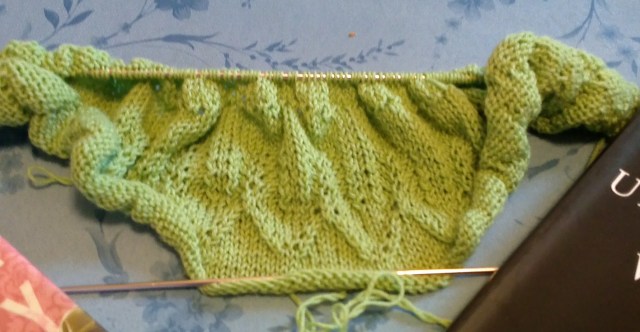
WIN_20160209_113549 (2)

Back when this blanket was in its “fancy lollipop” stage, there were a few doubters out there who couldn’t imagine how the lollipop would ever transform into a blanket. It’s still more blob than blanket, but today I made a point to spread it out a little (the books are earning their keep in this photo for a change) so you could see the pattern. In good light it is actually quite nice. Over the next few weeks, as the blanket gets longer (barring a knitting catastrophe), it will be easier to see the pattern.

I’ve read the beginnings of both of the books whose corners are visible in this photo: Shobha Rao’s An Unrestored Woman and Tessa Hadley’s The Master Bedroom. I am still finishing End Zone, but I’ll be reading these two soon.

Happy Wednesday!

Yarn Along is hosted by Ginny on her blog, Small Things.

Posted in Uncategorized, Yarn Along | 16 Comments

What I was doing tonight while I was supposed to writing a real blog post:

I’m thinking of this post as an updated version of my old “True Confessions Tuesday” series…  

  1. I stayed at work for an extra half hour working on the April DVM schedule because my boss and I were working on it and I got confused and I couldn’t go on my weekend without sorting it out.
  2. I poured a glass of wine (okay, a glass of wine was poured for me) right when I walked into the house.
  3. I stood and talked to my husband about all of the day’s adventures. Just the usual stuff like how one of my clients returned after five years of going elsewhere, and I thought it had only been two years since the last time I saw her, but actually it was five years…. Where the heck does time go?
  4. I watched the Makeover Week episode of The Biggest Loser and spent a lot of time making fun of Tim Gunn’s outfit choices for the contestants. He actually did a really good job with the guys this year.
  5. Watching last week’s episode of Elementary.
  6. Drinking more wine.
  7. I ate my Friday night special snack of one slice of Tillamook cheese and Triscuits (as many as I want! Up to twelve).
  8. And now I’m watching Doctor Who. Again.


And now for very brief thoughts on the first fifty pages of The Bone Clocks. So far, it’s going pretty well. David Mitchell is known for complex, shifting viewpoint, shifting time frame, possibly even shifting universe novels, and though I own all of his books, I’ve never read one, in part because I’m worried they’ll confuse the bejesus out of me! But it seems like the confusion may build gradually in his books. The first part of the book takes place in 1984, and our narrator is a British teenager named Holly Sykes, who gets into a huge fight with her mom and runs away from home to go live with her boyfriend, only to find him in bed with her supposed best friend. So then she takes off and goes towards the coast where she spends the night with an acquaintance from school in a church. After she leaves him the next morning, things start to get a little weird. But that’s as far as I’ve gotten. I love Holly’s voice. It’s written in her lower middle class British dialect, and she’s great. I like her and am constantly annoyed by her horrible teenagerness. I promise to have more to say about an actual book by Thursday.

Posted in Glimpses into Real Life, Reviews by Jill | 2 Comments

Some Cryptic Wisdom

reverence is bullshit photo

I jotted this note inside the front cover of my copy of The Federalist. Because the cover no longer closes all the way, this phrase peeks out at me when I am crossing the room to pick up my knitting or to go to the bathroom or to stop the cat from eating something dangerous. I don’t remember why I wrote it down – whether I was paraphrasing something “Publius” wrote or whether I was reacting to something our founding fathers were themselves revering. I’d like to think it was the latter, but who knows. All I know for sure is that I wrote it, and now it haunts me often, in weird ways.

Posted in Glimpses into Real Life, Marginalia, Uncategorized | Leave a comment

Wrenching the Last Bit of Celebration Out of Christmas of 1997: Thoughts on the First Half of Don DeLillo’s End Zone (by Bethany)

End Zone cover image

When I was a senior in college, I asked for and received all of Don DeLillo’s novels for Christmas. Underworld had just been published, so I received that one in hardback and the others in paperback. I read them all except for End Zone – because EWW, it’s about football. Never mind. But when I picked it up off my shelf the other day and read the back cover, I realized that it is about both football and nuclear war (because DUH – it’s by Don DeLillo), which is just the sort of thing I enjoy. I picked it up and started reading it and am enjoying it very much.

After I read the first few chapters, in which a white football player is asked to be a part of the process of welcoming and orienting the college’s first black football player, I was occasionally tricked into thinking I was reading a PAT CONROY novel (and if you know both Conroy and DeLillo, you know that this is probably the first time in history that the work of one was mistaken for the work of the other). It’s true that this basic plot outline resembles the sort of thing that happens in Conroy’s novels (with small deviations, it’s a plot line in The Lords of Discipline and also in South of Broad), but it soon became clear that this is most definitely a Don DeLillo football novel.

This is a novel in which football players say things like this:

“Reality is constantly being interrupted. We’re hardly even aware of it when we’re out there. We perform like things with metal claws. But there’s the other element. For lack of a better term I call it the psychomystical. That’s a phrase I coined myself.” (35-36)

And this:

“History is guilt. It’s also the placement of bodies. What men say is relevant only to the point at which language moves masses of people or a few momentous objects into significant juxtaposition. After that it becomes almost mathematical. The placements take over. It becomes some sort of historical calculus. What you and I say this evening won’t add up to much. We’ll remember only where we sat, which way our feet pointed, at what angle our realities met. Whatever importance this evening might have is based on placements, relative positions, things like that. A million pilgrims face Mecca. Think of the power behind that fact. All turning now. And bending. And praying. History is the angle at which realities meet.” (45-46).

This novel was written in 1972. Did American football players at dinky little west Texas colleges spend time in 1972 thinking about pilgrims bending toward Mecca? My thought is no – not even if they were enrolled at DeLillo’s fictional Logos College (Logos as in “In the beginning was the…”; a brilliant name for a fake Texas college if ever I heard one). Like many of DeLillo’s novels, this one feels up-to-date even when it isn’t.

And yes, these football players do also have drunken brawls and pee on the floor of their dorm common room and get killed in drunk driving accidents and all the other things that real football players do. But mostly they philosophize, and I am enjoying their pontifications immensely. More soon.

Posted in Authors, Don DeLillo, Fiction - general, Fiction - literary, Reviews by Bethany, Uncategorized | Leave a comment

A Review of Kate Atkinson’s Human Croquet (by Bethany)

Human Croquet cover image

Note: This review deals candidly with the ending of the novel. If you want to avoid “spoilers,” you should avoid reading the second half of this review.

After a very slow start, I did end up enjoying parts of Human Croquet, though I have several reservations that I will detail below. The protagonist of this novel is Isobel Fairfax, who is growing up in an eccentric family in postwar England. Her parents are Gordon and Eliza Fairfax, who met during an air raid during the war, when Gordon rescued Eliza from a burning building. Eliza dies while Isobel and her brother Charles are still children, and Gordon develops amnesia and disappears for several years. During this time, Isobel and Charles are cared for by Gordon’s mother, whose name is “the Widow,” and his sister Vinny. With the exceptions of Gordon and Eliza, the adults in this novel are stereotypes pulled from British children’s fiction. The less horrific among them are Mr. Banks from Mary Poppins; others seem like duplicates of the Dursleys from Harry Potter, Mr. Gradgrind from Hard Times, or any Roald Dahl character over the age of 17. I am not suggesting that Atkinson created these stereotypical characters unintentionally – I think she did it on purpose, but I still found it a little annoying.

The Fairfaxes live next door to the Baxters, each of whom has one character trait. Mr. Baxter is the headmaster of the local school and is known for brutally beating any person, student or otherwise, who is close enough to grab. Mrs. Baxter’s one trait is being Scottish. Audrey Baxter, who is Isobel’s age, is timid and retiring and always looks like she is about to fade into the background.

In this novel, fading into the background is a thing that sometimes happens. Every so often, Isabel looks around and notices that her house is decorated in an unfamiliar way. She stands there and watches for a while, concluding that she has briefly entered the past (on one occasion, for example, she sees her father and her aunt Vinny as children). These are the “Shakespearean time warps” promised on the book’s back cover, which are the primary reason I read the book. The only thing that makes the “time warps” “Shakespearean” is the fact that Shakespeare once lived in a house on the same land where the Fairfax’s house now stands. I don’t have much patience for who-really-wrote-Shakespeare’s-plays conspiracy theories, but I vaguely recall that there’s a Fairfax involved in some of these stories – a rich patron, maybe – and I’m sure that Atkinson was working with this as source material.

The stretch of this novel that I enjoyed the most is the 50-or-so pages in which Isobel lives the same Christmas Eve over again. In each iteration, she wakes up to see her pink party dress hanging on the back of her door, but each day she is confronted with a different series of choices. Once she ends up at a party, where she is almost raped, passes out drunk, and then goes for a drive with Malcolm Lovat, the boy she likes, who skids on ice and dies. On another day, she gets the pleasures of watching Mrs. Baxter kill Mrs. Baxter and then help Mrs. Baxter and Audrey bury him in the yard. There is also a mysterious baby around during this part of the novel. This book is weird.

I don’t mean to be condescending toward Kate Atkinson, who by now has a distinguished career, but this novel strikes me as a dress rehearsal. I know from reading the jackets of her other novels that Atkinson likes to play around with time – with segments of time playing themselves out over and over again, with certain themes recurring. I don’t this novel succeeds, but I do think it was probably necessary for Atkinson to write it while she was teaching herself to work with these sorts of experimental structures – and that’s fine. I actually think there’s a lot to be learned from reading the early works of authors who have proved themselves to be excellent, even if the early works are not excellent in themselves.

But I do have a couple of other, unrelated critiques. First, I was a little annoyed that this book uses the “but it turned out it was just a dream” plot device. Late in the novel, we learn that many of the crazy things that happen in the second half of the book, including the arrival of the mystery baby and all the antics Isobel experiences during her Christmas Eve time warp are explained by the fact that Isobel was in a coma and was having vivid dreams. While I suppose this device is consistent with the other games Atkinson plays with storytelling in this novel, I think the “dream” device is so old and overplayed that it should be off limits by now.

Second, all the flitting in and out of the present time ended up doing little for the plot. Nothing of substance ever happens to Isobel in the past, and while we are led to believe that sometimes people in the vicinity of the Fairfax house sometimes “just disappear,” this didn’t end up being part of the novel’s primary plot. For a long time, it seemed as if Eliza Fairfax had “just disappeared” when she went into the woods and disappeared, but we later learn first that Isobel and Charles found her body “with her neck all stretched out” (I immediately thought she had disappeared into the past, been hung as a witch, and then her corpse had come back into the present – but perhaps I have read too much Diana Gabaldon) and second that Gordon – Eliza’s husband and Isobel’s father – killed her. He was deeply in love with her but was upset because she hated his mother and sister so much and had become obsessed with the idea that she was having affairs, so on impulse he killed her one day in the woods while they were waiting for Vinny to come back from peeing. The fact that he killed her in this way is not the part that bothers me – and his guilt from this incident helps to explain how detached Gordon is as a character – but it seems as if Atkinson went to some length to set up the idea that sometimes people in this region just disappear, and then when a character did just disappear (or seemed to, to the protagonist) she went out of her way to give that disappearance a rational explanation. I do know that Atkinson’s time games are not TIME TRAVEL in the usual sense, and perhaps I was expecting something that this author is not inclined to deliver.

Finally, my last complaint about this novel is the fact that it has a Central Guiding Metaphor: the “human croquet” of the title. One of Mrs. Baxter’s coping devices while married to her horrible husband is to reminisce about when she was a girl and her family always played organized party games. One of those games was Human Croquet. The idea behind the game is that some players are hoops, and they stand with one other character, holding their hands up to form an arc à la London Bridge, while some participants (the “balls”) are blindfolded. A third group of players are the actual players of the game; their job is to get the “balls” lined up and then tell them to move forward until at some point they tell them to stop. The rules from that point on are the same as the rules of ordinary croquet. I do understand what Atkinson is going for here: that in some ways we are all “balls” being blindfolded and aimed by forces we don’t understand, and that perhaps we are all the playthings of gods or other large, powerful creatures. Shakespeare, who is alluded to often in this novel, says as much in King Lear. But in general I disapprove of Central Guiding Metaphors. Don’t get me wrong – I spent my college years trying to write fiction containing CGM’s (a habit that was quickly humiliated out of me when I went to grad school), which means that I’m as guilty as Atkinson is but also that I know of whence I speak. Non-Guiding Peripheral Metaphors can be great, and if Atkinson had chosen a different title (almost anything would have been better) and just woven the human croquet into the plot, where readers would have been free to notice its significance or not, the device could have worked just fine. But the minute it was placed in the title, it became a CGM and is therefore something of which I can’t approve.

I don’t exactly recommend this novel, though after the first hundred pages I did read it with quite a bit of interest. I plan to read Atkinson’s more recent novels soon, and I anticipate that I will enjoy those quite a bit more.

Posted in Authors, Fiction - Fantasy, Fiction - general, Fiction - literary, Kate Atkinson, Reviews by Bethany, Uncategorized | 2 Comments

Final Thoughts on Ransom Riggs’ Library of Souls (by Jill)

Library-of-Souls cover

The good news about Library of Souls: it got better. The bad news: now it appears the series is over. There is definitely room for additional books, I mean, it’s not like all of the characters die at the end, or anything, and though the wights are essentially defeated, if fictional history is any indicator, there will always be magical folks who will become corrupted by their power and get up to bad behavior, so I’m sure Jacob and friends will find some evil or other to rise up against.

So yes, spoiler alert! The ending of this young adult fantasy novel is generally happy, though there’s quite a bit of battling and violence that leads up to the happy ending. It’s kid fiction! I don’t think I’ve ever read a young adult novel with a one hundred percent sad ending. Now here’s an issue I hadn’t counted on with reading most of this book while also binge watching Doctor Who (hooray for Read All Day Fridays): I’m not necessarily confusing the wights and the Daleks, but I am imagining Jacob Portman as looking a heck of a lot more like the Tenth Doctor than I used to.   Enough of that, though. If I wanted a Doctor Who blog, I’d start one. And I’m sure there are plenty of those around that I don’t need to start my own.

Jacob, Emma, and Addison make their way to the wights’ stronghold on the far side of Devil’s Acre, but are unable to make it across the half broken bridge that’s guarded by a hollowgast. They eventually meet up with a peculiar adult named Bentham, who, it turns out, is Miss Peregrine’s brother, as well as Caul’s, and he wants to help the kids rescue their friends and all the ymbrynes, because he is trying to make amends for helping Caul all those years ago. Turns out he and his evil brother were working on a “Panloopticon” machine, a way to get from one loop to another much more quickly than the old fashioned way that Jacob and the other kids spent all of Hollow City doing: travelling to each one and doing trial and error until they got in. Bentham’s entire house is a Panloopticon: he found loops and then somehow via some sort of peculiar magic made new entrances to them from rooms in his house. When he and Caul had their falling out years and years ago, the Panloopticon was broken, and he is just getting it fixed. Turns out that Caul also made a Panloopticon in his fortress, and Bentham thinks that there are some loops that both his and his evil brother’s Panloopticon machines have entrances to, so all they have to do to get into the wight fortress is get the machine working and walk through one of the loops! Except the thing that they need to finish fixing it is a tamed hollowgast, which is where Jacob comes in….

Jacob’s gift for talking to/controlling the hollows expands exponentially in Library of Souls, and it’s almost too rapid progress, but if it hadn’t been, he would either have been killed, or the book would have been even longer than it already is. So I’m willing to forgive that little issue. Anyway, so the Library of Souls is a legendary loop in peculiardom that is said to contain all of the oldest of the peculiar souls, and Caul believes he has found it. But he needs Jacob—apparently his ability to see Hollows also allows him to see the containers that the souls are contained in. This connection is a bit iffy to me; either it wasn’t explained well or I wasn’t paying attention when it was. (I tend to think that the latter is somewhat more true than the former given that I was multitasking while I was reading a lot of this book, but I refuse to take all of the blame.) The point is that Jacob ends up having to go down into the catacombs with Caul and his minions, where a glorious final battle is waged, and there are beautiful descriptions of the souls in the bottles that only Jacob can see.

Ultimately, I did enjoy Library of Souls, but I do think it went on for too long, and that Riggs had to try a little too hard to fit the vintage pictures into the story this time. The first two books it wasn’t as obvious what he was up to, forming the story around the pictures, but here it wasn’t as seamless, and the early parts had too few pictures, and then the end had too many. The story itself, once it got going, was good, and I feel like all loose ends were adequately wrapped up. People who have read the first two books in the series should finish it off if they care to; it wasn’t disappointing and I’m glad Jacob came into his own as a peculiar and that the bad guys got what was coming to them. This series isn’t perfect, but it is entertaining, and a nice break from more complex “adult” stuff. And books with pictures are always nice, even when they’re weird and creepy.

And now I’m back to the world of adult fiction… I started David Mitchell’s The Bone Clocks last night. So far it’s good, and not too complicated. But I know from reading Bethany’s post about Mitchell’s Cloud Atlas back in 2013 that it probably isn’t going to stay simple for very long.

Posted in Fiction - Fantasy, Fiction - general, Fiction - Young Adult, Ransom Riggs, Reviews by Jill | 2 Comments

Read (Almost) All Day Friday

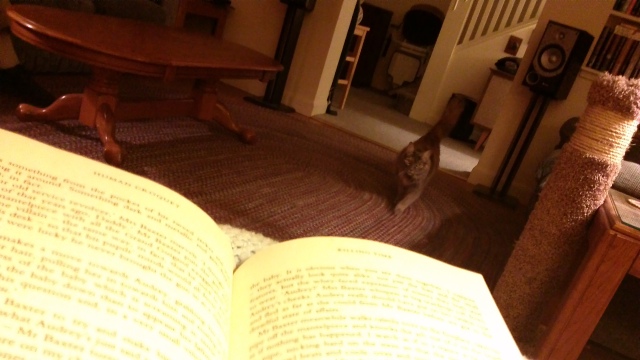
WIN_20160205_195741

This photo is called “Here Comes Trouble.”

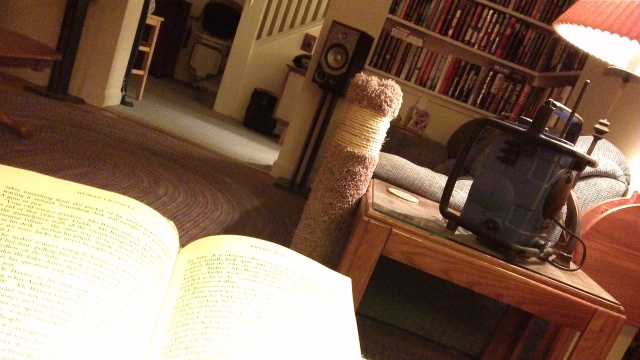
Actually, though, originally I took this RADF photo –

WIN_20160205_183359

– but I wasn’t very happy with it. Darth Vader’s radio is in it, of course – and what’s not to like about that? – but my exact words were “this photo needs a cat.” And then Emma showed up. We’re in sync like that.

I read most but not all of Human Croquet today, and I’ll be back soon to tell you about it. Have a good weekend!

Posted in Read-All-Day Friday, Uncategorized | 3 Comments