Final Thoughts on Brian Kilmeade and Don Yaeger’s Thomas Jefferson and the Tripoli Pirates: The Forgotten War That Changed American History (by Bethany)

TJ and the Tripoli pirates cover image

Once I was in a strip joint and needed to go to the bathroom. The thing is, strip joints don’t have women’s bathrooms – or this one didn’t, anyway. When I asked a staff member, he pointed me toward the strippers’ locker room. When I went inside, several strippers said hello and nodded when I asked to use the toilet, which was just sitting there in the corner of the room – not in a stall or behind a screen or anything. A minute or so later, I looked around for toilet paper and couldn’t find any. I called out to the strippers and asked if they knew where I could find toilet paper. “There isn’t any,” they said.

One of the things that happen when you’re a woman at a strip joint (I learned that night) is that strangers buy you lapdances. The first time this happened to me was just a little while after I used the bathroom in the strippers’ locker room. My first instinct was to refuse the strange men’s “gift,” but I relented because I knew that someday I would be reviewing a work of right-wing American history propaganda for my blog and would need an amusing analogy I would come home with a better story if I accepted the lapdance than if I turned it down. But I hadn’t been on the stage long when I made the connection between the lack of toilet paper in the strippers’ bathroom and the very-lightly-covered pubic area that was gyrating around a couple of inches from my nose –

And THAT is how dirty I felt when I was reading Brian Kilmeade and Don Yaeger’s Thomas Jefferson and the Tripoli Pirates: The Forgotten War that Changed American History. And also how dirty I felt when I saw one of its authors named, if only tangentially, in this story.

I know that the Barbary Wars aren’t at the top of the list of topics covered in American history classes, so I’ll summarize a bit. In the 18th century it was generally known that the Muslim states west of Egypt in North Africa (now Morocco, Algeria, Tunisia, and Libya; then Morocco, Algiers, Tunis, and Tripoli) filled their coffers by sending some of their sea vessels to stop, board, and rob foreign vessels in the Mediterranean, often also kidnapping everyone on board and taking them back to Africa as slaves. Most European powers that regularly sailed in the Mediterranean made payments to the rulers of these nations in exchange for protection from these attacks. In the first few years after the American Revolution, the United States desperately needed money and needed to build trade relationships with as many European countries as possible, both to build up its treasury and to prove to Europe that it was capable of standing alone as a nation. During these years (and earlier, during the Revolutionary War itself), many American ships were boarded and robbed by the Barbary pirates, and many American sailors were enslaved. As ambassador to France during the Revolution, Thomas Jefferson tried to negotiate with the Barbary states for the release of the American captives, but the rulers of these nations demanded exorbitant amounts of money as ransom. Jefferson and others in the new American government also frowned upon the idea of paying ransom and/or paying, as France and England did, for immunity in Barbary waters, since nothing stopped the pirates from reneging on their promises and demanding more money in the future. Jefferson and others wanted to step boldly onto the world stage, beat the pirates at their own game, and prove once and for all that one does not mess with the United States of America.

I’d say more, but I think you know the story from here. Or if you don’t, you can find it in a Toby Keith song.

I love reading about military history, and I did enjoy parts of this book. I don’t have any reason to quibble with the facts as these authors present them. But this book just drips with propaganda. The purpose of this book is clearly to rewrite our nation’s creation mythology so that an enmity with treacherous, deceitful Muslims is at its core. The Barbary pirates were treacherous and deceitful, sure, but they were pirates. All pirates are treacherous and deceitful. The rulers of Morocco, Algiers, Tunis, and Tripoli egged the pirates on because they liked the kickbacks they received – this is hardly admirable, but it was 1804. Up in Jefferson’s beloved France around this time, Marie Antoinette was squeezing herself into a corset made from the ribs of peasants, who were not allowed to stop working long hours in His Majesty’s vineyards while their ribs were being removed with a couple of sharpened fondue forks. OK, I made the last part up – but you get the idea: no one had the moral high ground in 1804. There was no such thing. There may not be any such thing today either, though I hear good things about the Scandinavian health care system.

I said a lot in my first review about why this book made me feel dirty, and all of those general statements are still true. After two hundred pages of hinting, the book finally makes clear its larger purpose a few pages from the end: “Most important, here in the twenty-first century, the broader story – the great confrontation between the United States and militant Islamic states – has a new significance” (203). These authors are determined to cast Muslims as “the other.” Of course the pirates who raided foreign ships were bad, as were the sultans, deys, and other rulers who egged them on. Jefferson was right to fight them off, and a lot of good came out of his decision to do so, above and beyond simply freeing the American prisoners and allowing American ships safe passage in the Mediterranean. The Marine Corps, with its unique combination of land and sea power (air came later) and special-forces style fighting in small teams, was essentially created to fight against the Barbary pirates – and the Marines have certainly proved themselves useful in subsequent conflicts. The U.S. Navy grew exponentially as a result of this war; the authors state that there is no way the U.S. could have defeated the British in the War of 1812 if it had not built up its navy for this war a decade earlier, and I have no doubt that is true. I also find as I review the book that a lot of the language that irritated me about it on first read actually comes from quotations from the key players in the conflict – and as late 18th-century and early-19th century personages they get a little bit of a free pass. William Eaton, the general who eventually led an armed insurgency with the goal of Reagan-in-Latin-America, Bush-in-Iraq “regime change” in Tripoli, is the culprit behind many of the most offensive statements, the worst of which is his tendency to use “Americans” and “Christians” as synonyms. I do wish Kilmeade and Yaeger had done more to distance themselves from these statements, but I can’t fault them for quoting them. Their statement that “Pope Pius VII reportedly said Decatur had done more for Christianity in an hour than the nations of Christendom ever had” (202) is a little silly (N.B. Decatur set a boat on fire) – or, more correctly, Pope Pius VII was a little silly for (reportedly) saying it, and these authors were more than a little silly for quoting it. The same authors repeatedly worked the word “Benghazi” into their text as a little dog whistle to their right-wing readers; absolutely nothing happens in Benghazi that contributes to the history related in the book.

During a rough patch in the war, Commander Edward Preble thought of a cunning way to fight back against the Tripolitans, who at that point were fighting more from land than from sea. He took a captured Tripolitan ship (renamed the Intrepid by the Americans), and packed it with gunpowder and metal (“one hundred thirteen-inch and fifty-nine-inch shells, together with iron scraps and pig iron ballast” [166]). The authors call this contraption “a floating bomb”; my own mind immediately pictured the pressure-cooker bomb the Tsarnaev brothers used to bomb the Boston Marathon.

Both of these improvised explosive devices – the ship and the pressure cooker, both equipped with explosives and shrapnel-to-be – were capable of inflicting terrible damage. Both also represent superior ingenuity, creativity, and courage. According to Kilmeade and Yaeger, the captain of the rigged ship, Richard Somers, “asked that no volunteer accompany him who would not be willing, in the event the enemy should board the Intrepid, to ‘put a match to the magazine and blow themselves and their enemies up together” (166).

Yes, that’s right – Somers asked his men to volunteer to be suicide bombers, and they agreed. Over and over and over again we hear suicide bombing condemned, always with the suggestion that it’s something only “enemies” do, from the kamikazes in World War II to the insurgents in Iraq today. As a reader myself, I loved reading about this maneuver, which I saw as a variation on the Trojan Horse scheme from the Iliad, but I hated the double standard that I knew to be at its core. As it happened, the Intrepid blew up before it ever entered Tripoli harbor; its captain and crew were killed and the mission was a failure. No one knew what set the explosives off – a sniper’s bullet, a stray spark – but the fact remains that all the men on the ship died without harming the enemy. This is disappointing, of course, but the failure of the mission makes it all the more ridiculous that these authors are lionizing American sailors with their pens and at the same time going to work at Fox News and declaring our country to be innately superior to others (these “others” aren’t always named, but you’d better believe they’re Muslim countries) because we do not engage in suicide bombing. For one thing, we don’t engage in suicide bombing because we have really, really big jets and bombs and tanks. Suicide bombing is a technique used by underdogs who don’t have massive ordnance – and it works. Just look at our frustrations in Iraq to see how well it works.

We have a strong, vigilant military, and I am grateful for the safe life I have lived as a result. But we have to get rid of the idea that our military is any more moral than the armies, navies, and insurgent mobs of other countries. We use surgical drone strikes, tiny teams of Navy SEAL’s, and massively destructive air campaigns not because these techniques emerge from our core values but because we have the strongest military force in the world and these are the sort of techniques that powerful countries have at their disposal. If were a true underdog in a fight, we would build pressure-cooker IED’s in our kitchens and strike fear into enemy civilians too – and then we would applaud ourselves and find a way to stretch and shape our core values until they began to justify our actions. No technique is “good” when we do it and “bad” when our enemies do it – morality doesn’t work like that. This book – which, as I said, is often a good read – is written at a fifth-grade level not only in terms of its sentence structure and word choice but also in terms of its moral compass. Adults who read books (and watch movies, and so forth) like this one and don’t recognize this fractured thinking are dangerous. They’re a different kind of suicide bomber.

This really isn’t the review I meant to write. I wanted to stay close to the text and break apart the sentences that bothered me in this book, maybe even throwing in some terms like “ad hominem fallacy” or some such. I ended up writing in fairly general terms, even as I critiqued the authors for doing the same. I may try to return to this book or read another by this duo (they also wrote a book together on George Washington’s spy ring in the Revolutionary War) or by a historian with a similar perspective. If I do, I’ll let you know.

Posted in Authors, Brian Kilmeade and Don Yaeger, Non-fiction - History, Nonfiction - Cringeworthy Propaganda, Nonfiction - General, Nonfiction - Military, Reviews by Bethany, Uncategorized | Leave a comment

A Sunday Evening Check-In

disturbing the peace cover image

It’s been a mellow day here at Postcards from Purgatory’s San Francisco office. Immediately upon waking I decided to abandon two books that I am reading and not enjoying (Lauren Groff’s The Monsters of Templeton and Gore Vidal’s Burr), and that decision made me feel very accomplished. Surely I deserved a full day off after all that exhausting book abandonment. I wrote a page and a half of a book review, but then I came to the part where I had to provide evidence to support my opinions, so I stopped. I will resume tomorrow, I think.

I am reading Richard Yates’ Disturbing the Peace, and it’s good.

More soon.

Posted in Abandoned Books Reports, Glimpses into Real Life, Uncategorized | Leave a comment

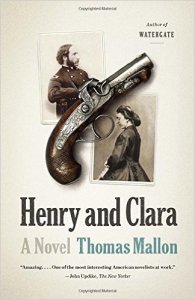
A Review of Thomas Mallon’s Henry and Clara (by Bethany)

Henry and Clara cover image

When I reported in on this book last weekend, I wasn’t sure how I felt about it. I think I felt 100% neutral about it, actually – and neutrality is unusual for me. I didn’t quite know what to do about it. By the end, though, I really liked it. The second half is much better than the first.

Here’s a little summary: Clara Harris and Henry Rathbone meet as children when Clara’s father marries Henry’s mother. Living in a blended household with their parents and five other siblings, they gradually become aware that they are in love with one another. Clara’s father, Ira Harris, is a judge, and later a senator. Henry’s mother, Pauline, is the sort of person who is attracted to power and influence. Her first husband – Henry’s father – was the mayor of Albany, NY, and one gets the impression that she married Ira not for his personal qualities but because he was also a prominent figure who could get Pauline close to powerful and exciting people. The family lives in Albany at first – where Ira is a judge – but they move to Washington, D.C. when Ira becomes a senator. They arrive in D.C. just in time for the Civil War to break out, and they spend their first few years there in a wartime city under siege conditions. First Lady Mary Todd Lincoln, not known for her equanimity, copes with wartime stress by surrounding herself with friends whose conversation she enjoys, and Clara is one of her favorite companions. The First Lady becomes very attached to Clara, much to the consternation of her stepmother, who had hoped that she would be the one invited to Mrs. Lincoln’s neverending slumber parties.

The family dynamics in the first half of the novel are plausible enough, but they’re also rather muted. I caught myself pining for certain other authors, namely Edith Wharton and Henry James, who I thought could have written this novel better than Thomas Mallon did. That’s a harsh thing to say, I know, but it wasn’t something I devised just to be nasty. These thoughts just appeared fully-formed: This novel would be SO much better if Edith Wharton wrote it, and so forth (this is, of course, true of most novels). The subject matter is tailor-made for either Wharton or James, and I think both of these writers would have sharpened the dialogue and heightened the irony in the first half of the novel in a way that would have improved the overall reading experience. However, Mallon really comes into his own as a novelist in the second half of the book, and by the end I really appreciated the novel for what it was and stopped wishing it could be something else.

Lots of factors complicate the burgeoning romance between Henry and Clara. First, the community as a whole thinks of them as siblings. Even when they remind people that they are only step-siblings and not blood relatives at all, they still get a lot of sidelong glances from their community. Second, Ira Harris doesn’t like Henry very much. Ira is the consummate politician, and he is always scheming behind the scenes to get cushy gigs for everyone in the family, including Henry, and Ira is always annoyed that Henry is not appreciative enough of his help and doesn’t work hard enough. Ira constantly compares Henry to his own overachieving son, Will. Pauline doesn’t like Clara much either, though for less precise reasons. Henry is her favorite child, and she seems not to think any woman will be quite good enough for him – and of course she is jealous of Clara, whose witty conversation makes her much more popular in society than Pauline is. For a long time both Pauline and Ira refuse even to consider giving Henry and Clara their permission to get married.

Then the Civil War begins. Clara spends the war keeping the FLOTUS entertained. Ira does his best to secure a desirable post for Henry, but Henry seems to have terrible luck and always ends up right in the middle of various bloodbaths. When he comes home, he continues to profess his love for Clara, but overall he is surly and unpleasant. He rarely wants to talk to anyone besides his mother, and he starts accusing Clara of flirting with other men whenever her gregarious personality attracts notice.

At the end of the war, Ira and Pauline finally consent to the engagement of Henry and Clara – both of whom are in their early thirties by this point. Clara has turned down many other suitors by this point – she’s almost a Penelope figure in her willingness to wait for Henry – including several who directly entreat her not to marry Henry because of the darker sides of his personality that emerge during and after the war. Henry and Clara are engaged – not yet married – when Ulysses S. Grant and his wife have to cancel a theatre date with President and Mrs. Lincoln at the last minute and the Lincolns offer the tickets to the young couple. After John Wilkes Booth shoots Lincoln, he stabs Henry brutally down the entire length of his arm. In the chaos that ensues, a doctor takes Henry home and tends his injured arm, and at Mrs. Lincoln’s request Clara follows the president to the house across the street where he spends the last night of his life.

Henry’s injury takes a long time to heal, and of course both Henry and Clara are traumatized by what happened at Ford’s Theatre. As rumors spread and the public continue to rehash what happened on the night Lincoln was shot, gossip starts to settle on Henry. Because he wasn’t stabbed until after Lincoln was shot – and because he was the only other male in the box besides Lincoln and an experienced soldier – people start to say that he should have defended Lincoln from Booth’s attack – or, at the very least, that he should have attacked Booth after the president was shot. Clara, Pauline, and others in the family shelter him from these rumors as much as possible, but he never loses his awareness of what the public thinks of him. As soon as he is recovered from his injury, Henry and Clara finally marry. Henry inherits a large sum of money from his father, and he uses the money to travel to Europe with Clara as much as he possibly can. They don’t settle in one place – they just dart from place to place for as long as a year at a stretch. This routine becomes tiresome to Clara quickly, and her annoyance with Henry’s itinerant lifestyle becomes intolerable after they have three children in quick succession.

Lincoln’s assassination takes place right at the midpoint of the book. The second half consists of journal entries and letters written by Clara interspersed with troubling domestic scenes – all of which make clear that Henry’s mental health is deteriorating. He seems to suffer from severe post-traumatic stress – from both the war and the assassination – and as time passes he even seems to have a dissociative disorder. Sometimes he doesn’t recognize people. Elsewhere he gets confused about what year it is, thinking he’s still a young man before the war. He becomes obsessed with history in general and in particular with destroying Lincoln’s reputation. He locks himself up in his study writing a neverending treatise on history that no one is allowed to read, and he subjects his children to daily lectures on history that sometimes go on for hours. If Clara were alive today, we would call her a classically enabling spouse, protecting Henry when his poor behavior draws public notice and allowing the family to withdraw into its own private misery. This second half of the novel really is quite good. Both Henry and Clara are sympathetic as characters even when they make poor choices. I’m not going to summarize any more of the novel because the second half really is quite suspenseful, and I think you might be annoyed with me if I discuss the ending.

I’ve wanted to read this book for a long time. It is the first in Mallon’s long series of historical novels, and I definitely plan to read the rest of the series. Mallon is a historian first and a novelist second, though I felt his prowess as a fiction writer growing as this novel progressed. The sense I get is that this novel is extremely well-researched and true to fact. At the same time, it feels entirely new. I recommend it and look forward to the next in the series.

Posted in Authors, Fiction - general, Fiction - Historical, Reviews by Bethany, Thomas Mallon, Uncategorized | Leave a comment

A Rain Check

9780805095852_LitUp_JK.indd

I hope you’ll all forgive me for not posting a review today. The thing is, I didn’t get started with Read-All-Day Friday until about 6:00, and then once I started I could hardly stop. And besides, we’re having a wonderfully audible storm here – rain and wind – and audibly stormy nights are meant for reading, not blogging (she says, conjuring a wise maxim out of momentary laziness). I will be back soon to tell you about Thomas Jefferson and the Tripoli Pirates and Henry and Clara and some other books too.

My copy of David Denby’s LIt Up arrived today, and I am excited to start reading it. It’s about teaching  life-changing literature to high school students. I have a feeling I will be either agreeing or disagreeing with Denby wildly; either way will make for some good blogging.

Happy reading this weekend!

Posted in Glimpses into Real Life, Read-All-Day Friday, Uncategorized | Leave a comment

A Brief Introduction to Amy Tan’s The Valley of Amazement (by Jill)


the Valley of Amazement cover

My first thought when I picked up Amy Tan’s latest novel (her first since 2005 and was published in 2013, yes, yes, I’m way behind on my “high priority” pile) off the top of the pile a few days ago, was “This seems much heavier than her other books. I hope Amy Tan’s editors aren’t afraid of her and that his book needs to be almost six hundred pages long.” My second thought was, “Maybe I should pick a shorter book.” My third was, “Shit, just read the fucking book. You love Amy Tan. And this book has been sitting way too long.”

I haven’t gotten very far into The Valley of Amazement yet, for all the usual reasons. Work’s busy, I’m tired, I’m trying to work out more, so on and so forth. So far all I know about this book is what the dust jacket says: historical fiction, takes place in China and America, tells the story of three generations of mothers and daughters, two of which were courtesans in Shanghai at the turn of the twentieth century. So with the exception of the courtesan aspect, it’s basically a standard Amy Tan book, though she usually tells more contemporary stories than this one. So far, I’ve only read about thirty-five pages, and I’ve met Violet, who is currently eight years old, and living in the courtesan house, Hidden Jade Path, that her mother, Lulu Mimi Minturn, runs in Shanghai in 1905. Violet is a confused and spoiled girl, and I’m not sure how I feel about her yet. The story is told in first person with Violet as our narrator, though there were a couple of pages that were told by Lulu, for no apparent reason that I could determine, though I was reading it right before bed and I was falling asleep, so perhaps there was more sense in it than I realized at the time. And that’s basically all I know so far. When I paused in my reading this morning, Violet had just thrown a terrible temper tantrum because it was her birthday and her mother left the room to get dressed to take her out to lunch, and she did not return. Lulu’s second in command at the house, Golden Dove, is scolding Violet for being an ungrateful brat, and Violet is just so sad because her mother seems to want to spend more time with her clients than she does with Violet.

I have a long history with Amy Tan—I read The Joy Luck Club when I was in high school; it was one of the first adult novels I read as a teenager, and I loved it. It was about mothers and daughters and it took place partially in San Francisco. I think I bought my copy used at Green Apple on Clement Street, though I think the purchase predates my adventures there with Bethany. This book was a huge thing in high school—it was the first main stream novel written by an Asian-American woman about Asian-American characters that I’d ever read or even heard of. My Asian friends loved it, and I loved it in solidarity, and also because it was a really good book. I’ve read all of Amy Tan’s novels, and she is an author I’m allowed to buy in hardcover, but quite honestly the only one I remember well is The Joy Luck Club, maybe because I’ve seen the movie a whole bunch, or maybe because it’s the best of them.

I’m going to keep plugging along with The Valley of Amazement, and hope that it sucks me in better than it has been doing now that I’m more well-rested. I just don’t want to spend a month on it!

Posted in Amy Tan, Fiction - general, Fiction - Historical, Reviews by Jill | Leave a comment

Yarn Along

Yarn Along 3.9.16

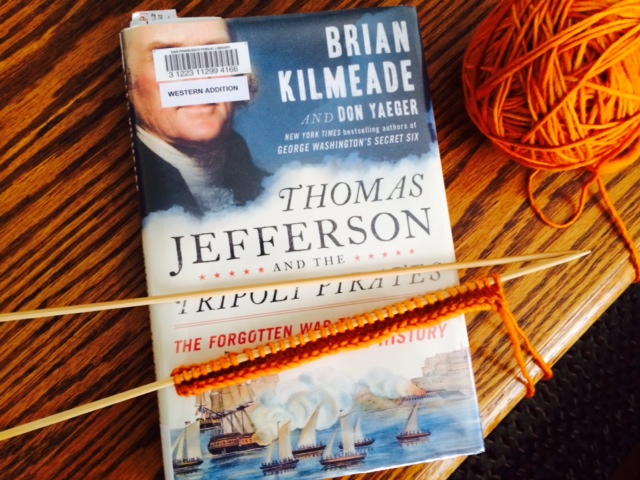
Last week the front panel of my sweater was only a few rows long, and today the first sleeve is just barely half an inch long. I’ve been knitting a lot lately thanks to my favorite televised sport: politics. I’m still loving the color and texture of this yarn.

I think it’s amusing that the library put the bar code sticker over Jefferson’s eyes. It seems symbolic of something.

Have a great Wednesday!

Yarn Along is hosted by Ginny on her blog, Small Things.


Posted in Uncategorized, Yarn Along | 4 Comments

Review of Lev Grossman’s Codex, part 2 (by Jill)


Codex cover

Where was I on Thursday before Pat Conroy had to die and throw a wrench in my blogging plans? Oh yes, I was complaining about Codex. I felt bad about that after I posted it, but the good news for Lev Grossman is that his book provoked strong feelings in me, and that’s a good thing no matter what the feelings are, right? And the other good news is that overall I did enjoy Codex. It wasn’t the best book I’ve ever read, but it was a fun, quick read that kept me happily occupied for a few days, and that did not put me to sleep while I was reading in the car. I suspect that my memories of the plot are going to fade quickly, because they already are. I finished it last Wednesday and I can’t remember the main character’s name. Wait. It’s Edward. Andrew. No, Edward. See? That’s bad.

The plot of Codex is definitely compelling and fast-moving. But the problem as I see it is that the subplots that Grossman tries to weave into the main plot of the missing codex just don’t quite fit in. Like the MOMUS game subplot—I really thought that it was going to somehow help Edward find the codex, but it ends up just being a red herring. It was cool and everything, but just didn’t end up where it seemed like it was going to. The other thing was Edward himself. In what universe would a type A investment banker become a gamer zombie obsessed with finding an ancient manuscript in less than two weeks unless there was some deep disconnect between Edward’s outer life and his inner life? I would have liked to have learned more about his past. Grossman give a couple snippets, but I think that would have been helpful to explain why Edward did the things that he did.

I guess that’s kind of all I have to say about Codex. It’s so plot-driven that to say much more would probably ruin the book for any potential readers. I don’t think that Codex was poorly written by any means, I just think Grossman needed to work on his plotting a little bit. I’m sure he’s much better at it now. What I’m trying to say, in a very disjointed manner, is that Codex was not without its faults, but I enjoyed it more than it annoyed me (except the ending. The ending annoyed me so much that it almost ruined the rest of the book for me). If you are feeling nostalgic for The DaVinci Code or Angels and Demons, then this is the book for you to read on your next vacation. Also, it’s a Kindle Unlimited book, so you can read it for “free”!

Posted in Fiction - general, Fiction - Inspired by The Da Vinci Code, Fiction - Mystery, Lev Grossman, Reviews by Jill, Uncategorized | 1 Comment

Goodbye

Pat Conroy

From My Losing Season:

“The next morning, [Coach] Mel Thompson, who had never offered me a compliment in my whole life, said in the News and Courier: ‘Pat Conroy gave another great performance. That kid gets more mileage out of his talent than any player I have ever coached.’

Children, heirs of mine.

You may put those words of Mel Thompson’s on my tombstone, and I will smile in joy for all eternity. I take those words to the writing desk every day of my life. When I cannot write or find the words cunning in their refusal to present themselves to me or bend to my will, I read his words again. I say, ‘Mel Thompson, my Ahab, my demanding and melancholy coach, one of the hardest, most authoritarian men I have ever met. The hardest taskmaster, the demon-driven coach of my college days, the dark icon of madness told the world that I got more mileage out of his talent than any player he has ever coached.’

I took Mel’s words and applied them to my future life. I used them as talisman and mantra and omen for what I wanted to become. I took those words of praise and applied them to the writing life I had dreamed about since childhood. I took Mel’s words as metaphor. I soared upon them, gathered strength from then as I stormed out to my life as a writer who wanted to create winged and roaring sentences, the kind that would set the language free and make people come to my house and sit on my knee and listen to the song I was born to sing.”

– Pat Conroy (1945-2016)


Posted in Pat Conroy, Uncategorized | Leave a comment

Thoughts on the First Half of Brian Kilmeade and Don Yaeger’s Thomas Jefferson and the Tripoli Pirates: The Forgotten War that Changed American History

TJ and the Tripoli pirates cover image

I read almost nothing this weekend – just a few chapters of Henry and Clara and a few chapters of the book named above, which I’ve been reading off and on for about a week. I don’t have much to say except that it is too bad that the narrative history in this volume is so thoroughly drowned out by its authors’ ideology.

I’ll explain. First, it doesn’t take a literary scholar to look at the cover of this book and tell that it’s no peer-reviewed history treatise. This is definitely a history book for the masses. I had only read a few pages when a little voice in the back of my head started wondering exactly who these two authors are. I don’t remember what prompted this question exactly, but certainly the authors’ determination to portray Islam as a violent religion played a role, as did the authors’ frequent willingness to slap labels like “disgraceful” and “shameful” and “intrepid” on historical personages after considering their actions for a paragraph or two. Long story short, these authors are Fox News anchors. Maybe you knew that, but I did not.

I feel a little dirty now, but I’m not going to stop reading the book. I really am enjoying the history, and I have a decent enough grasp of the events of Jefferson’s presidency to know when I’m being played. I roll my eyes at the editing errors – most of which are simple typos but a few of which are fairly hilarious, like “ceiling wax” on page 56 (How OLD are these guys? I asked, glancing at the photo on the book jacket again. They look my age or a little younger. What’s the cutoff date for knowing what sealing wax is – maybe a date of birth around 1980? 82? I don’t know). And what exactly is the correlation between ideological extremism and poor editing? Surely someone has written a dissertation or two on the subject.

What ideological extremism, you ask? The purpose of this book, however roundabout the delivery, is to make clear to readers that the first enemies of the United States – after Great Britain, that is – were Muslims. And OK, historically this is true. At first I grumbled at the word “forgotten” in the title, but then I realized that I think I did get through school thinking the War of 1812 was the United States’ first war as a sovereign nation. I’m not sure when I learned about the Barbary Wars – probably from something I read at some point between June of 1994 and a few months ago. It’s true what they say about reading: you learn stuff.

And I’m learning stuff from reading this book too. Namely, I’m learning how pervasive anti-Muslim propaganda has become in this country, even just in the last six months. How is it that American authors can write about our ancestors fighting the British in the Revolutionary War and in the War of 1812 without in any way maligning Great Britain as it exists today, but we can’t compartmentalize the Barbary pirates in the same way? We even manage to be gracious toward the Germans, whose terrible war crimes took place less than a century ago. The pirates themselves aren’t even the worst part, since the very fact that they are pirates is an indication that some of their behavior might be a bit violent and anti-social. Every single Muslim leader is depicted as a variation on Jabba the Hutt, and the Americans who served as consuls and ambassadors in these nations (today’s Morocco, Algeria, and Libya) seem to have textbook cases of Stockholm Syndrome.

I know I’ve been fairly grand and sweeping in my indictment of this book’s underlying purpose, often without providing much evidence. I will try to be a little more specific next time, with quotations and page references and outside research and also possibly an elaborate analogy involving a strip joint. I am still juggling a number of books, but I will finish this one soon, partly because I want to tell my strip joint story but mostly because it’s already a couple of days overdue at the library and this book is definitely not fineworthy. And I can’t renew it because hundreds of people have placed it on hold. Of COURSE hundreds of people have placed it on hold.

See you soon.

Posted in Authors, Brian Kilmeade and Don Yaeger, Non-fiction - History, Nonfiction - Cringeworthy Propaganda, Nonfiction - General, Nonfiction - Military, Reviews by Bethany, Uncategorized | 4 Comments

In which PfP says goodbye to Pat Conroy, 1945 – 2016

1119_pat-conroy

How does one eulogize a writer whose work you have adored for more than half your life?   I don’t even know where to begin, and I sort of wish I’d just elected to write the second half of my post about Codex, but now I’m committed and I’ll press on. Forgive me if I am repeating myself at any point—I’m sure I will, because we spend a lot of time writing about Pat Conroy on Postcards from Purgatory, if you didn’t already know that….

The first time I heard of Pat Conroy in any concrete way was my sophomore year of high school when we read The Water is Wide in Mr. Barmore’s honors English class. Then Pat Conroy came and spoke at my high school and my class got to go and see him speak. I did not have to ditch class like some of my high school friends did. And it was so funny. So funny. My high school’s alumni magazine published a transcript of the talk, and I wish to God that I still had that issue right now. Somewhere along the line Bethany and I, our friendship still in its infancy, started talking about Pat Conroy and books, and well, twenty-four years later, here we are.

I have read every book Pat Conroy has written, with the exception of that mayonnaise-encrusted cookbook he co-wrote a few years ago, and also, shamefully, I have not read The Boo, his first book. I tried to read it maybe twenty years ago, and just couldn’t do it. It lacked Conroy’s characteristic “Conroyvianness.” Now, of course, I’m going to have to try again, probably during PAT CONROY MONTH!!!!

I am never going to be able to sum up my feelings about Pat Conroy in a brief blog post. Bethany and I have been trying to explain to the Internet for the past four years how Pat Conroy shaped our lives and our reading habits and our friendship and how we think about memory and our pasts. I don’t know that I could do any better to eulogize him than to tell everyone on earth to go into our archives and read everything we’ve written about him since we started this blog.

But here’s another idea.

Dear Pat Conroy,

You died on Friday, March 4th, 2016. You were seventy-one years old, which doesn’t seem old enough to die.  But cancer is an asshole, and can do whatever the hell it wants.  Let’s pretend that it’s the twenty-fourth anniversary of the time you came to speak at my high school in San Francisco, or the twenty-fourth anniversary of the first time I read one of your books. It would be poetical if it were, and I’m in the mood for poeticalness today. Bethany and I had this English teacher named Father Murphy—you’ll know about him if you’ve read our blog, and I’m sure you have, because it’s all about you—and he once said to us, during his famous graduation speech, that you need to be sure to thank the important people in your life. So, thank you from the bottom of my heart, for writing all of those amazing, overwrought, southern novels. Thank you for sharing so much of yourself with your readers. Thank you for not being afraid to tell the truth about your life, over and over again. Thank you for Will McLean, for Tom Wingo, for Ben Meecham, for Bull Meecham, for Lillian Meecham, even for Susan Lowenstein and Annie Kate Gervais. I don’t remember the names of the characters in South of Broad or Beach Music because it’s been a long time since I’ve read them, and I’m sorry about that, but thank you for all of those versions of yourself and your family, and for your amazing, wonderful memoirs. I will never forget you, and I will do everything in my power as a very important book-blogger to keep your memory alive so present and future fifteen year old girls can read The Lords of Discipline and fall in love with its first words and the paragraphs that follow: “I wear the ring.”

Jill


Posted in Glimpses into Real Life, Pat Conroy, Reviews by Jill | Leave a comment