Thoughts on Jack Thorne’s Harry Potter and the Cursed Child

Harry_Potter_and_the_Cursed_Child_Special_Rehearsal_Edition_Book_Cover

Believe it or not, this review contains few true “spoilers.” I do provide many details from the play, and if you’re a purist who doesn’t want to know ANYTHING about the play before you read it, you should stay away from this post. However, I never actually reveal how the play ends.

I’ve already mentioned that this book got me through a night when I was up with an upset stomach, and I didn’t mean that to be as dismissive as it perhaps seems. This book is an enjoyable enough read, and because I did not need to get used to new characters and a new fictional world, I moved through it at a good clip. This book is perfect for a flight from, say, Chicago to New York.

As I assume most of the literate world knows by now, this play begins with the scene that ends Harry Potter and the Deathly Hallows – the one in which Harry gives his son, Albus Severus, a talking-to about the Sorting Hat just before young Albus boards the Hogwarts Express. In this play, that pep talk does not achieve its intended purpose. Albus departs for Hogwarts feeling unloved by his father (who in a flashback makes the significant oopsie of telling Albus that he wishes Albus were more like his siblings) and impossibly isolated from his peers. He is sorted into Slytherin, to his horror, and his only friend there is young Scorpius Malfoy, who is studious and gentle, sort of the Hermione Granger of his generation. Several years pass, via some fancy lighting and special effects, and Albus and Scorpius are in their third or fourth year at Hogwarts and at the height of their adolescent angst. On the Hogwarts Express, Albus tells Scorpius that he overheard his father talking to Amos Diggory, who is old and senile and now devotes his life to pleading with people to go back in time and stop Cedric from dying in the Triwizard Tournament. Time turners like the one Hermione uses in Prisoner of Azkaban are illegal in this play – yet of course Hermione, who is now Minister of Magic, happens to have one. Albus and Scorpius escape from the Hogwarts Express and use Polyjuice Potion – which just sort of appears in their hands when they need it – to break into Hermione’s office and steal the time turner. With the help of an individual named Delphi – who is supposedly Amos Diggory’s niece but turns out to be someone quite different – Albus and Scorpius travel back in time to intervene in the Triwizard Tournament in hopes of saving Cedric.

Up until this point I enjoyed the play well enough. A certain J.K. Rowling je ne sais quoi was missing, but overall I was happy to be along for the ride. I wasn’t expecting TIME TRAVEL in this play, and unexpected TIME TRAVEL is often the best kind. But after the boys’ first foray into the past at the end of Act I, the plot of this play devolves into a Back to the Future-inspired shit show. This first go-round, the non-death of Cedric does little more than rewire the marriages and careers of the key players. No longer Minister of Magic, Hermione is now a nasty, sarcastic professor at Hogwarts. Ron is married to Padma instead of to Hermione, and Albus’ cousins Hugo and Rose do not exist. Albus is in Gryffindor instead of Slytherin. Harry, who uses the Marauder’s Map to facilitate his helicopter parenting (and, admit it, that’s kind of hilarious), notices that Albus and Scorpius are often seen together. These are the alternate-reality Albus and Scorpius, who are plotting round two of their TIME TRAVEL adventure, but Harry doesn’t know that. He teams up with Draco Malfoy to barge in on Professor McGonagall and demand that their sons not be allowed to spend time together.

This is where the plot begins to unravel. A second trip to the past resurrects Voldemort, and Scorpius is elevated to a high position (that he doesn’t want) because of his heritage, and they begin hearing references to someone called the Auguery, who works closely with Voldemort. At some point, Harry, Ginny, Ron, Hermione, and Draco figure out that their kids are time traveling and do a variety of ridiculous things to get them back. No one seems able to apparate, resulting in a lot of messy floo powder nonsense. Draco and Harry have a wand fight in the kitchen. Cedric Diggory, who was portrayed as relatively ordinary in the novels, talks like something out of an Arthurian romance (“Are you also a task? An obstacle? Speak! Do I have to defeat you too?). The Hogwarts staircases move around practically nonstop. Harry’s scar starts to hurt again. At one point Voldemort starts speaking, though nowhere – NOWHERE – did the stage directions say “Enter Voldemort.” Ron tells Hermione – while eating oatmeal – that he wants to renew their marriage vows. Harry yells cathartically at a portrait of Dumbledore in what appears to be a deleted scene from Ordinary People. A blankie is vandalized. Revelations include the fact that Voldemort did the nasty with Bellatrix Lestrange, that Godric’s Hollow is now a suburban shopping district, and that Moaning Myrtle’s full name is “Myrtle Elizabeth Warren.” And then everyone almost has sex with their own parents at the Enchantment Under the Sea dance, and the next thing you know Biff is washing Marty McFly’s father’s car in an abominable velour track suit.

I don’t know what to make of all this nonsense. Imagine being J.K. Rowling, in possession of one of the most valuable pieces of intellectual property of all time, still in her prime as a writer, knowing she can write her name on just about anything and be guaranteed an immediate worldwide audience. And then imagine her doing this. I know she didn’t write it, but her name is on the cover in large, bold type – it’s clear she has no wish to disown this confusing oddity. Who is “Jack Thorne,” anyway, and what is this weird power he holds over this beloved author? Was the Imperius curse involved?

It did occur to me that Harry Potter and the Cursed Child might be meant as satire. Rowling is playful and gutsy enough to put her name on a satire, I think – but with occasional exceptions, I just don’t see the intelligence I expect in satire. Good satires can usually be identified by their endings, and the ending of this play is pure schmaltz, straight out of a circa-1985 Afterschool Special. This play is like a mudpie or a too-wet sandcastle – devoid of form and structure. It’s as if Thorne took the huge Breughel painting that is the Harry Potter series, mixed up all the component parts, and then cranked out a Jackson Pollock. I can’t imagine that this play will be well received in theatres, though of course tickets will sell out. It’s also hard to imagine the play’s intended audience. It’s certainly not for children, who might enjoy the over-the-top pyrotechnics of the special effects but would likely be mystified by the plot line, and I also don’t see the crossover appeal to adults that the series is famous for. There is no doubt that Rowling will bounce back from this odd moment in literary history, and I’ll always look forward to reading her work. I might stay away from Jack Thorne’s canon, though.

Posted in Authors, Drama, Evidence that Beloved Authors May Have Early-Onset Alzheimer's, J.K. Rowling, Jack Thorne, Reviews by Bethany, TIME TRAVEL, Uncategorized | Leave a comment

Yarn Along

Yarn Along 8.3.16

Every time I make one of these tank sweaters, I have to re-learn how to do a technique called “purl through front and back of each stitch.” This is the technique that creates the gathered, draping look of the front of the sweater. In this photo, you can see if you look closely that I’ve just ripped out one attempt. Don’t worry – I have several YouTube videos to help me, and I’ve re-learned this task so many times that I have no doubt I’ll be able to do it again.

I read half of Harry Potter and the Cursed Child when I was up with stomach trouble last night, and it was nice to have an easy, comfortable story to keep me occupied when I was feeling miserable. But that is not to say that this newly-released play is without flaws. This is an odd story, involving Harry Potter and Draco Malfoy as helicopter parents, a crusade to resurrect Cedric Diggory (via TIME TRAVEL) for various obscure reasons, and a series of PTSD dreams on the part of Harry, who is afraid that Voldemort is returning yet again. Jack Thorne is no J.K. Rowling, though, and none of the characters really feel like “themselves.” I will have more to say when I review the book in a day or two. I’m engaged with the story, but this play is a very odd move in the trajectory of the Potter franchise. I have another 80 pages or so to read and will review it soon.

Yarn Along is hosted by Ginny on her blog, Small Things.

Posted in Uncategorized, Yarn Along | 4 Comments

A Review of The Year of the Gadfly, by Jennifer Miller (by Jill)

the year of the gadfly cover


Bethany reviewed this book in 2015 (see her review here), and I remember thinking it seemed like an interesting read. When it turned up on Kindle Unlimited, I added it to my queue, and when I was bored in a pizza parlor alone back in April or so I started reading it. And when I was camping in June I figured I’d read it since I’d already read a few pages. I have intense feelings of ambivalence about The Year of the Gadfly. On the one hand, it was a quick read, and didn’t require me to think a whole lot, and when one is way the hell behind (thanks to a tome called Voyager and a very busy work life) on reading for the year one appreciates these things about books. On the other hand, the characters are sort of caricatures. There’s the angry redhead, and the nerdy little kid with the slightly less nerdy and less little twin brother, and the albino with the requisite sunburn story, and then there’s poor Iris whose only friend (besides the ghost of Edward R. Murrow, of course) killed herself last year. Don’t worry, I’ll back up a bit.

The novel opens with Iris as our narrator, in August of 2012. She has been relocated to Nye, Massachusetts from Boston by her parents at the recommendation of her therapist, Dr. Patrick, after her BFF Dalia kills herself. She is set to start at Mariana Academy, an elite private high school. They are living in the house of the former headmaster, who is friends with Iris’ parents, while he and his wife are out of the country. There is a new biology teacher at the school, Jonah Kaplan, who Iris notices at a welcome back to school event.

We also have a “historical” story line that takes place in 1999-2000 and focuses on Lily, the albino daughter of the headmaster of Mariana, and coincidentally the same headmaster whose house Iris and her family are currently living in. Also coincidentally, Jonah Kaplan’s dead twin brother Justin was Lily’s boyfriend back in 1999-2000. There are just too many coincidences here. I guess double narratives have to rely on a small number of coincidences to justify the conceit of putting them in the same novel, but I don’t know. The more I think about this book the less I think it holds up to scrutiny. I should probably hurry up and finish this post so I don’t get more pissed off all the “coincidences.” And can I just say that it horrifies me a little that 1999 was so long ago that someone who was a high school junior then is able to teach high school (with a PhD, no less) in 2012. And for that matter why in the hell would Jonah Kaplan, who is has a doctorate, and is a minor genius in his field, give up a post-doc at a university to teach high school freshman biology?? There. Rant accomplished.

Iris’ passion is investigative journalism, hence her imaginary friend Edward R. Murrow. She joins the staff of the school paper and is given horrible assignments. Somehow she learns that there is an alleged secret society at Mariana, called Prisom’s Party, named after the founder of the school, supposedly by the founder of the school, over a hundred years ago. Is this like Dumbledore’s Army? It is, if the D.A. engaged in pornographic vandalism and blackmail, which I am pretty sure it didn’t. Turns out, Jonah has a vested interest in Prisom’s Party as well. He holds the group responsible for the death of his brother, and wants to figure out the puzzle of Prisom’s Party. As well as himself, but mostly them. Or mostly him. Things get a bit convoluted as the parallel narratives reach their climaxes, and let’s just say that the poor albino gets her pubic hair dyed black (which I’m shocked Bethany didn’t mention in her post, as is she).

I guess the point I’m trying to make about The Year of the Gadfly is that it’s essentially harmless and superficially enjoyable for those of us who like mystery/suspense/high school angst/parallel narratives. But don’t think too much, or you’ll start getting irritated with the whole thing. Except for Iris. I was really rooting for her the whole time.

Posted in Albinos, Non-Evil, Fiction - general, Fiction - Mystery, fiction - thriller, Jennifer Miller, Reviews by Jill, Uncategorized | Leave a comment

Yarn Along

Yarn Along photo 7.27.16

With two nominating conventions and an upcoming summer Olympics, I thought it was time to start a somewhat-complex knitting project. This tank sweater isn’t hard to make (if you’ve been reading our blog for a while you’ve probably seen me make several), but it takes a while because the yard is very fine. I’m enjoying the yarn and the pattern as much as ever. I’m also enjoying Larry Watson’s Laura, and I’ll be back soon with a review. Happy Wednesday!

Yarn Along is hosted by Ginny on her blog, Small Things.


Posted in Uncategorized, Yarn Along | 4 Comments

Final Thoughts on Jonathan Lyons’ The House of Wisdom: How the Arabs Transformed Western Civilization

review_of_house_of_wisdom_1

The anti-intellectualism of early Christianity makes me genuinely angry. This anger dates back to my reading of Charles Freeman’s The Closing of the Western Mind: The Rise of Faith and the Fall of Reason in the winter of 2012, but it was reawakened by The House of Wisdom, which, in spite of my anger, I enjoyed. If your medieval theology is rusty, the short version of the story is that the early Christians were influenced by neo-Platonism, which said that everything we can observe in the physical world is just a pale shadow of the “real” and “eternal” world of forms. In 1 Corinthians, Paul promises to “destroy the wisdom of the wise,” and a couple hundred years later Augustine watched his city sacked by “barbarians” while writing his own treatise against the physical world and in favor of the eternal. If you believe that the world you see around you is corrupt and that your own senses are unable to lead you to truth, I suppose it makes sense that you would not want to study the physical world – but still. It’s true that our senses are imperfect and that sensory perception can lead to misunderstandings, but our senses are what we have. The idea of faith as something separate and distinct from – not to mention superior to – the senses makes absolutely no sense to me.

For example, the medieval Christian determination to resist studying the physical world is the brains behind this little operation, known by scholars as the T-O map:

c5933

c5933

The T-O map is what passed for world geography in early medieval Europe.  The “T” shape is the Mediterranean, and if you imagine that you’re in Gibraltar and facing east, you’ll see that Europe, Africa, and Asia are in approximately the correct positions relative to one another. But seriously, they didn’t know that Italy was a peninsula? That England existed and was an island? This map was the brainchild of Isidore of Seville, who lived in the 6th century A.D. Norse sailors were crossing the Atlantic in the 6th century. The collapse of the Roman empire and the hegemony of rival “barbarian” kingdoms made overland travel so unsafe that most people stayed put. As someone who’s afraid to cross the desert on I-10 when it’s windy, I can’t exactly quibble with this form of self-preservation. But the deep distrust of established learning (and refusal to use the senses to observe the physical world) that accompanied this temporary hiatus in overland travel was deeply destructive to European culture.

Jonathan Lyons’ The House of Wisdom: How the Arabs Transformed Western Civilization is about what happened east of Greece and Turkey during these same years. Lyons’ primary emphasis is the Abbasid Empire, which was based in Baghdad beginning in the 8th century, a period known as the Golden Age of Islam. The book also covers the Umayyid Empire, which was based in Spain during the same period of time, and its central thesis has to do with the importance of a small handful of Europeans who reached out to the Islamic empires in hopes of re-igniting the ancient Greek knowledge that their own ancestors had abandoned. Lyons spends time on such figures as Adelard of Bath, King Roger II of Sicily, Gerbert d’Aurillac (who later became Pope Sylvester II), Siger of Brabant, and others.

Just as an aversion to the physical world was implicit in early Christian teachings (though NOT in the teachings of Christ), some aspects of Islam made the Arabs of this era especially attuned to science. While Christianity saw disease as a divine punishment meant to be stoically endured and urged believers to welcome death as a chance to escape the physical world, the Koran emphasizes the duty of all people to heal the sick and prescribes hygiene practices that – even in the absence of germ theory – led to a high quality of public health unheard of in Europe in this era. The Arabs also recognized that skills like celestial navigation and technologies like sundials had to be adjusted based on one’s position on the globe. When sundials did make it to Europe, Europeans dismissed them as useless because they were calibrated to tell time at a widely different latitude. Similarly, when Adelard of Bath and other travelers brought Arab farming techniques back to Europe, these techniques failed because Europeans did not know that agricultural methods must vary based on location and climate. Lyons also lists many discoveries that the Arabs made using what we would call the scientific method – a mode of thinking that requires skepticism and an attention to detail that Europeans wouldn’t rediscover until the late 17th century.

This book is full of other Arab developments from this era: the astrolabe, algebra, and the literary technique known as the framed tale (which later gained fame in Europe as the narrative device of Chaucer’s Canterbury Tales and Boccaccio’s Decameron). Avicenna’s canon of medicine; the philosophical and mathematical advances of Averroes. The Arabs of this era performed cataract surgery and invented deodorant. They brought Arabic numerals to Europe. (Think that’s no big deal? Try doing higher mathematics using Roman numerals.) The Arabs also spent serious time considering “the eternity of the world,” which is basically the idea – grounds for excommunication in medieval Europe – that the world has always existed and will continue to exist forever.

But enough. I seem to be writing a summary – and an emotionally charged one at that – instead of a review. With a little help from the confirmation bias, I enjoyed this book. And I hope you will too.

Posted in Authors, Jonathan Lyons, Non-fiction - History, Nonfiction - General, Nonfiction - Science, Reviews by Bethany, Uncategorized | 3 Comments

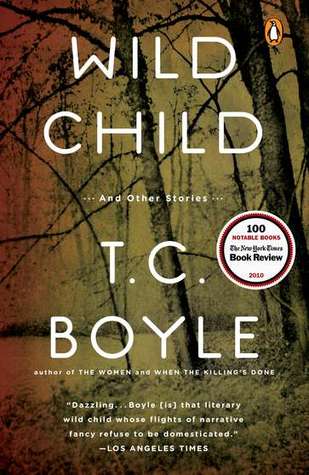
Thoughts on T.C. Boyle’s Wild Child and Other Stories (by Jill)


Wild Child Cover

I’ve read a few of T.C. Boyle’s short stories before, but never a whole collection of them. Wild Child and Other Stories was amazing. Each story, no matter how short, was a self-contained little universe. I wish I’d had time when I was reading this book to write about each and every story, but I didn’t. It’s too bad, really, because they all deserve equal attention, and I’m just going to mention a few of them.

Where to begin? I suppose I should begin at the beginning. The first story is called “Balto,” and is not about a wolf-dog rescuing children from a diphtheria epidemic in Alaska (I had to google that—I have actually never seen Balto), though the movie is mentioned briefly. In “Balto,” a man with two children has a wife who is out of town and a girlfriend who is in town. He forgets he’s supposed to pick the kids up from school one day and gets roaringly drunk with his girlfriend. It appears that he is often this drunk, but not on days he has to pick up his kids from school. The story opens with the dad’s attorney counseling the older daughter, Angelle, about how there are “two kinds of truths, good truths and hurtful ones (1).” Over the pages of the story it’s revealed that when the father gets to school and he asks Angelle to drive the rest of the way home. She’s not old enough to drive, but is old enough to read Faulkner for school and instant message her friends, so I’d put her at late middle school, though I don’t think Angelle’s age is ever made exactly known. Anyway, there’s some sort of minor accident involving someone on a bicycle while she’s driving. The lawyer tries to convince Angelle to say that her dad was driving when the kid on the bicycle got hit, and explains that if she admits to being the one who was driving her dad will be in even more trouble than he already was. Angelle ends up telling the truth, and that’s where the story ends. That’s the problem with short stories sometimes—you don’t get every detail. But Boyle does an excellent job of building suspense and leaving us wondering why in the heck Angelle’s mom is in France and not at home with her family during all this business, and wondering what’s going to happen to the kids after Angelle does the right thing (or was it the right thing? We’ll never know) on the stand. The father, who I think doesn’t ever get a name, is obviously an alcoholic, and Boyle also describes his addiction and cravings really well too. But that’s all I’m going to say about that one. There are thirteen more to talk about, after all.

Next up is “La Conchita.” Told in first person by an organ currier, you know, like the guys who transport organs for transplantation, when there’s an avalanche on the road in the town of La Conchita, a small beach town in southern California. I just googled the town, and found that there actually was a terrible landslide here in 2005. So I guess this story takes place then. Anyway, the transporter (in my mind he looks a little bit like Jason Statham) is trying to get a liver to a hospital in Santa Barbara when the road is suddenly covered in mud and rocks, as is a good portion of the town. The liver gets to where it needs to go, I think, and the transporter gets roped into helping a woman try to dig her family up out of the mud. Good suspense and all that business here too.

“Question 62” was maybe my least favorite of the collection. It’s about two sisters, Anita, who lives in Wisconsin, and Mae, who lives in Southern California. Anita meets a man named Todd who is weird, and Mae meets a loose tiger who eventually gets shot. I never did quite get the purpose of this story, though it moved along fine. I was also very concerned both sisters would end up dead. Because Todd may have been a psychopath, and the tiger is, well, a tiger.

“Sin Dolor” is about a kid who doesn’t feel pain and the local doctor who tries to experiment on him. Enjoyable, but kind of depressing.

“Bulletproof” was kind of awesome. It is about a small town that’s having a creationism vs. evolution controversy and a man who meets a woman on the opposite side of the debate. I wanted to ridicule the creationism characters, but I found their reasoning fascinating, and I think their God is a good one.

“Hands On” was creepy, but as interesting me as “Bulletproof.” An unnamed woman goes to a plastic surgeon for Botox, and then gets kind of obsessed with her surgeon as well as plastic surgery and looking better. I’m not a believer in body modification of this type (both because I lack the financial means to invest in it and also because maybe it’s okay to just look the way the good Lord and genetics intended you to as long as you get some exercise and don’t eat junk all the time), but I can see how things can spiral out of control. And this poor woman is lonely and just needs a friend to tell her she doesn’t need to do all this stuff to be happy.

Next up was “The Lie.” Now this guy. This guy needs to grow the heck up. Lonnie is married to Clover, and they have a baby daughter. Lonnie is having a hard time accepting adult responsibilities and starts telling lies to get out of work. Eventually his coworkers think the baby is dead and they’ve given him a bucket of money. Obviously this is not going to end well for anyone.

“The Unlucky Mother of Aquiles Maldonado” takes place in Venezuela, a different locale for T.C. Boyle, but it deals with the juxtaposition of two different cultures, which he actually does quite often. Aquiles Maldonado is a pitcher for the Baltimore Orioles, and he’s been making the local folks angry with his flaunting of his American wealth. They decide to kidnap his mother, who ends up taking good care of the boys who kidnap her. I really enjoyed this story, though I can’t put my finger on why, besides that it dealt with something different than First World Problems, and that’s what a lot of the stories in this collection deal with. I’m not trying to make light of First World Problems. I have shit tons of First World Problems. But sometimes it’s nice to think about something else besides how I’m going to charge my iPad and my iPhone at the same time, you know?

I loved “Admiral,” too, probably because it was about a dog. Admiral is a cloned dog. Talk about First World Problems. The Strikers lost their beloved Afghan hound, and paid a lot of money to have him cloned. They hire back their old dog-sitter, Gretchen, recently graduated from college and without a job, because they want to have Admiral #2’s upbringing be as close as possible to Admiral #1’s, so their personalities develop in the same way. It’s sensible, because genotype doesn’t always determine phenotype, and Gretchen agrees because she needs money and these ridiculous people offered to pay her $25 an hour to dog sit, with medical and dental benefits. A European journalist, Erhard, tries to convince Gretchen to help him steal Admiral, but things don’t go quite as planned. Suffice it to say that Admiral is fine at the end of the story. Because I don’t like stories about dogs with sad endings.

“Ash Monday” is another juxtaposition of cultures story, this time poor Americans and well-off Japanese, living in the hills above LA. This one has a fire in it, and the ending is somewhat ambiguous.

“Thirteen Hundred Rats” is about a lonely widower named Gerard Loomis who decides to get a pet after his wife passes away. I’ve never been a huge fan of caged mammals as pets, and this story confirms that for me. I’m going to leave it at that. But I did enjoy the macabre tone of this story.

“Anacapa” reminded me of Boyle’s novel Till the Killing’s Done, because this one also takes place in/around the Channel Islands. Damian and Hunter are old college roommates who occasionally still get together, despite the fact that Damian kind of annoys Hunter. They take a fishing charter boat out but Hunter is hung over the whole day from the prior evening’s escapades. Not much happens in this story, though some fish are caught, and more alcohol is drank, and there’s a pretty girl named Julie who helps clean the fish and who kind of likes Hunter. Or maybe she likes Damian. It’s never made clear.

“Three Quarters of the Way to Hell” is not contemporary and doesn’t take place anywhere in California. It takes place in what feels like the fifties, in a recording studio in New York. There’s a booze and pot-addled singer named Johnny, and a woman, also a singer, named Darlene Delmar, and they are contracted to sing a Christmas carol. They end up hiding out in the bathroom for a while getting high, and then sing a lot of songs together. They think they sound amazing. I’m not sure if they actually do, but what matters is that these two lonely souls have someone to be with for a couple of hours. “She didn’t know what time it was, didn’t know when Harvey and the A&R man deserted the booth, didn’t know anything but the power of two voices entwined. She knew this only—that she was in a confined space, walls and floor and ceiling, but that didn’t make any sense to her, because it felt as if it opened up forever (238).” Isn’t that lovely?

The last story in the collection is “Wild Child,” and it’s actually more of a novella since it’s close to seventy pages. This one takes place in France in the eighteenth century, and is about a real person, Victor of Aveyron, who was a “wild child,” abandoned by his family as a small boy, and left to go feral in the woods. He’s eventually “rescued,” and Boyle’s story chronicles the attempts to civilize him, which are only minimally successful. The primary character, besides Victor, is Jean-Marc Gaspard Itard, a doctor who takes it upon himself to teach Victor how to communicate. Victor ended up at a school for deaf-mutes, despite the fact that is was not deaf, and mute may be an over-statement. This story was so well-done, and just made me think about what the right thing to do with this boy was. Would it have been better to just leave him be in the woods? Because “civilizing” him didn’t really succeed. Would more modern methods have worked better? Or were there other factors at play—was he autistic or did he have a history of head trauma or something?

I’ve always liked T.C. Boyle, but this collection of stories showed me how broad his range really is. Look at all the different lives and stories he tells here. This book is just over three hundred pages long and I found more to say about it than I’ve found to say about books that are almost twice that. I will definitely be digging up more of his short stories in the used book stores down the line.

Posted in Fiction - general, Fiction - literary, Fiction - short story collections, Reviews by Jill, T.C. Boyle, Uncategorized | Leave a comment

A Review of Ian Caldwell’s The Fifth Gospel

the fifth gospel cover image

Fact #1 that I learned from Ian Caldwell’s The Fifth Gospel: some Catholic priests can get married. The protagonist of this book is Alex Andreou, an Eastern Catholic priest who lives in the Vatican with his five-year-old son. As an Eastern Catholic, he says the liturgy in Greek and is culturally similar to Greek Orthodox Christians, but he obeys the pope. His father was also an Eastern Catholic, and Alex and his brother Simon were born and raised inside the Vatican. His father died when Alex and Simon were teenagers, and their mother died shortly later. The adult Alex lives a life similar to the lives of single parents everywhere: he cares for his young son, Peter, while also relying on a host of neighbors and a nun named Sister Helena to fill in the gaps when he needs to work, which isn’t very often. Alex teaches the gospels at a pre-seminary, which is sort of like a high school, I think. But in spite of the fact that school is in session during the events of the novel, Alex never goes to work, or calls anyone to explain why he is not coming to work. I was always under the impression that priests had, I don’t know, shit to do – especially priests that are also teachers. This little failure of verisimilitude bothered me here and there while I was reading, but it didn’t stop me from enjoying the book.

Fact #2 that I learned from The Fifth Gospel: the Vatican has its own supermarkets. It’s a country, of course, and an entire country without supermarkets would be an inconvenient place to live. Having lived in the Vatican his whole life, Alex knows it intimately. The plot of this fast-paced novel darts in and out of the Vatican’s pharmacies and supermarkets, parking garages and gardens, and I enjoyed the lesson in the day-to-day operations of the smallest country in the world.

Like all countries, the Vatican also has a State Department, which is called the “Secretariat.” Alex’s brother Simon, a Roman Catholic priest, works for the Secretariat and spends most of his time in Turkey. Simon returns to the Vatican frequently to report in on his diplomatic work and also to maintain a relationship with Alex and Peter. At the beginning of the novel, Alex and Peter are awaiting such a visit. Along with the rest of the Vatican, they are also waiting eagerly for the opening of a new exhibit in the Vatican museum, an exhibit curated by a friend of Simon’s named Ugo Nogara. On the night Simon is expected to arrive, he calls Alex and insists that he meet him at a secluded piece of church-owned property called Castel Gandolfo. When Alex arrives, his brother in covered in blood and kneels beside Ugo Nogara’s dead body.

If you’re making a connection between this opening scene and another, more famous novel that begins with the murder of a museum curator, you are on to something. This novel is very much in the spirit of The Da Vinci Code – and, even more so, thanks to the Vatican setting, the Angels and Demons. If you’re a stickler for realistic, subtly written literary fiction, there is no need for you to read this book. I do love a good race-against-the-clock-because-all-of-Western-culture-hangs-in-the-balance plot line every once and a while, and I was in the mood for this one when I first picked it up a couple of weeks ago. If you do read The Fifth Gospel, you’ll find it much better written than Dan Brown’s novels, and you’ll also find it refreshingly free of the Harvard-professor-meets-beautiful-brunette-underling dynamic that seems so essential to Brown’s work. Alex does have a love interest of sorts in this book: his own wife, Mona, who suffered a psychotic break when Peter was a year old and then left the Vatican without a trace. For four years, Alex has mourned the loss of Mona, whom he still loves, and just when this novel starts rocking and rolling with its Brown-esque plot – which, yes, involves a missing ancient manuscript that will change the way the world looks at the Catholic Church forever – Mona reappears. On the one hand, neither Mona nor Peter really needs to be in this novel. Alex and Simon could chase around looking for manuscripts and relics just fine without Mona’s lingering guilt and Peter’s childish fears. However, their presence humanizes Alex. When Alex fights to save Simon, he is doing so on some level for Peter. When Alex begins to invite Mona back into his life, he is aware not only of the possibility of his own pain and loss if she leaves again, bot also of Peter’s. And then Alex has to renege on a promise to Peter that they will call Mona, the high stakes – Peter’s anger and feelings of betrayal – are clear.

I’m going to hold off on summarizing the plot any further. It involves Ugo Nogara’s exhibit and a newly rediscovered manuscript called the Diatesseron, and it involves the Fourth Crusade and the Catholic-Orthodox split and the Shroud of Turin and the differences between the Gospel of John, which emphasizes Jesus’ divinity, and those of Matthew, Mark, and Luke, which emphasize Jesus’s humanity. I did learn a good deal about early Christianity, and I enjoyed that learning process a great deal. The plot also involves the reappearance of a figure from Alex’s and Simon’s past, plus any number of Alex’s friends from his Vatican childhood, plus the reasons behind his father’s death and the fact that Pope John Paul II secretly made Simon a bishop and granted him a mission of key importance to the dying John Paul.

And finally, Fact #3 about The Fifth Gospel: Ian Caldwell can write. While Dan Brown’s terrible sentences are uniformly mocked, Caldwell’s prose is transparent most of the time, occasionally punctuated by sentences that are truly beautiful. I regret that I didn’t keep a list of sentences that I especially admired, and such sentences are always hard to find in hindsight. But I’ll share a couple. First, when Alex is contemplating his reunion with Mona and the way he has kept his apartment identical to the way it was when she lived there, Caldwell writes, “Like all good Romans, Peter and I have built our roads around our ruins” (170). And later, when Alex and Simon are waiting for the results of Simon’s trial (he’s accused of murdering Ugo), Caldwell writes, “Lick by lick, the candles on the table hollow themselves out” (421). Hell, this sentence is so good that I forgot to be annoyed that it’s in present tense.

Don’t read this book if the genre of The Da Vinci Code makes you cringe; there’s probably too much overlap for someone who truly loathes far-fetched European literary/theological thrillers. But if you enjoy the genre and want to read a novel that manages this kind of plot while also featuring well-drawn characters, a contemplative tone, and highly competent prose, The Fifth Gospel may be just the book for you.

Posted in Fiction - general, Fiction - Inspired by The Da Vinci Code, Ian Caldwell, Reviews by Bethany, Uncategorized | Leave a comment

Yarn Along: The Return

Yarn Along 7.20.16

In honor of this week’s Republican convention, I’m reading Sinclair Lewis’ It Can’t Happen Here. The “it” of the title is basically totalitarianism. The novel was published in 1935 – so presumably written mostly in the years just before 1935 – and set during the presidential election of 1936. In real life, this was FDR’s reelection to his second term, but in the novel there appears to be no FDR figure – though there is some disgruntlement about some policies that resemble the New Deal – and the election is between left-winger Berzelius Windrip and his as-yet-unnamed Republican opponent. Since the enemy of choice in this era was Communism, which is a leftist ideology, the conservatives are generally thought of as the reasonable option, in spite of the fact that they occasionally praise Hitler and Mussolini.

I can’t say that this book is especially riveting. I’ve read 48 pages and have barely made it into the plot – when Sinclair Lewis does exposition, he really does exposition. The prose is rewarding in an Edith Whartonish sort of way, with little social-criticism zingers like this: “The DAR (reflected the cynic, Doremus Jessup, that evening) is a somewhat confusing organization – as confusing as Theosophy, Relativity, or the Hindu Vanishing Boy Trick, all three of which it resembles. It is composed of females who spend one half of their waking hours boasting of being descended from the seditious American colonists of 1776, and the other and more ardent half in attacking all contemporaries who believe in precisely the principles for which these ancestors struggled” (4).

I started the cowl in the photo above when I was watching Season 6 of Game of Thrones at a friend’s house last week. Its grays and tans and steel blues suited the mood of that series. I love the colors and think I’ll enjoy the cowl, though of course it will never be cold enough around here to justify a cowl.

More on the novel soon. Happy Wednesday!

Yarn Along is hosted by Ginny on her blog, Small Things.


Posted in Yarn Along | Leave a comment

Thoughts on Jerome Groopman’s How Doctors Think (by Jill)


how doctors think cover

I started a post on this book about a week ago and it seems to have vanished off my hard drive. That’s fine with me, actually, because it was going nowhere fast, and I’m hoping I can do a better job this time.

Jerome Groopman, M.D. is a writer for The New Yorker (and has published several full-length books) as well as an oncologist. This book, like Being Mortal, was handed to me by my boss Cathy, and told I had to read it sooner than I read most of the other books she gives me (as everyone here knows, I’ve been averaging about four years between her giving me a book and me actually getting around to reading it lately), because EVERYONE, i.e. all of the veterinarians in our practice, needs to read this one. How Doctors Think was similar to Being Mortal in the sense that both are about how doctors and patients can do better at their jobs, but How Doctors Think honed in on the specifics of how doctors can screw up sometimes, and not because of how you’d think they would. It’s all about errors in cognition, and the mindsets we all get into about misreading patients, focusing too much on one set of diagnostic results over another, and things like that. It was not exactly easy reading, and it made me think hard about how I practice medicine, and made me second guess a lot of things I did while I was reading it, as well as since I read it. Which is good, I admit, but made me feel pretty angsty for a few days.

Because I finished this book over a month ago, I’m beginning to lose many of the details, and since I want to actually post something today, I’m not going to go digging through the text. Sorry, gang. It’s going to be a quick post. Groopman interviewed quite a few physicians from multiple different specialties for this book, and talked to them about cases where they felt they could have done better. The early chapters dealt specifically with the different cognition errors that medical folks can have, such as the “availability heuristic,” in which one makes a diagnosis because a case is similar to others that he or she has seen recently; “confirmation bias,” in which one selectively ignores or focuses on certain diagnostic information; and “anchoring,” in which one picks a diagnosis and sticks with it, even if additional data make the initial diagnosis seem less likely. Groopman goes through multiple specialties, discussing how each type of physician can make each sort of error, and there are quite a few medical anecdotes to keep things interesting.

Groopman intends this book to be for both doctors and patients, and makes recommendations how patients can help their doctors avoid these cognitive errors. Overall I really did think this book was IMPORTANT, and that people should read it, but it wasn’t always easy reading. Some of the stories were heart-wrenching in and of themselves, and others brought up memories of cases I’ve had that haven’t gone so well. I guess my recommendation is that people read this book, but that they read it when they are not in delicate frames of mind.

Posted in Jerome Groopman, Nonfiction - General, Nonfiction - Science, Nonfiction - Self-Help, Reviews by Jill, Uncategorized | 1 Comment

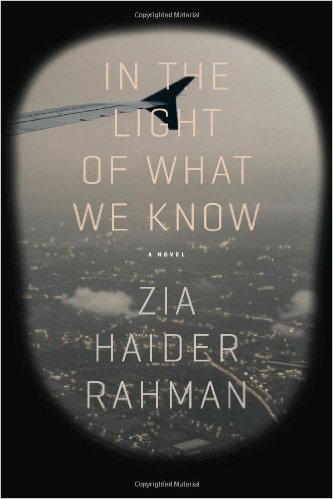
A Review of Zia Haider Rahman’s In the Light of What We Know

in the light of what we know cover image

I’m not sure why, but I expected this book to be similar to The Kite Runner – and it would be, I suppose, if The Kite Runner were written by Joseph Conrad.

This novel is about two friends: grown men of Central Asian heritage, one of whom is more privileged than the other. The more privileged one is the narrator; his friend is an enigma whose complicated past is revealed bit by bit over the course of the novel. This, though, is where the similarities to Khaled Hosseini’s novel end. In the Light of What We Know is about marriage and mathematics, finance and failure, history and imperialism and religion and violence and the literary canon. I very much enjoyed it, but this is not the kind of novel that pulls a reader along effortlessly. This is a novel with which one has to wrestle.

The protagonist is an unnamed investment banker who, in 2008, is suspended from his firm for his role in persuading the firm to invest heavily in CDO’s (watch The Big Short before you read this novel to save yourself some Googling). At the beginning we don’t know the details about why the narrator is at home mid-week surrounded by an aura of doom – those details are revealed bit by bit over the course of the novel. Because he is suspended, though, he is at home when a filthy, grubby visitor – who ends up being his old friend Zafar – knocks at his door and references Gödel’s Incompleteness Theorem, which I promise I will not try to explain to you. Try as you might, you will end up Googling something by the time this novel is over.

The narrator and Zafar met at Oxford, where they were both math majors (or, more correctly and much more adorably, they both “read maths”). Later they lived in New York for some time and got in the habit of taking long walks together and talking about math, life, and whatever else one talks about when one is a character in a novel that should be by Joseph Conrad, but isn’t. The narrator comes from a very wealthy Pakistani family; Zafar was conceived during the war in which Bangladesh seceded from Pakistan in 1971, when Pakistani soldiers systematically raped as many Bangladeshi women as they could find. The sullen couple who raised Zafar in a tiny apartment in London are not his biological parents.

But let’s pull away from the plot for a moment. No review will ever capture everything that is in this book, and it would be stupid to try. So instead I’ll dance around the plot a little and tell you about some of the structural elements that scaffold the plot, like the comically-ubiquitous epigraphs and the lengthy footnotes, and maybe I’ll quote a few passages and tell you why they moved me – and this novel did move me, quite a lot.

Every chapter in this novel has at least two epigraphs, and the novel as a whole is introduced by a passage about history from W.G. Sebald’s Austerlitz, a novel I have long felt guilty for never having read. Chapter One’s epigraphs are by Edward Said, Herman Melville, and (you guessed it) Joseph Conrad: in other words, they come from two of the 20th century’s most distinguished thinkers on postcolonialism and empire, alongside the author of one of the most well-known novels about pursuing a fated quarry to the ends of the earth. Interesting stuff.

Chapter 2 gives us two passages about the British Raj. Chapter 3 offers two news articles on the Bangladeshi secession; 4 begins with Ecclesiastes, A.E. Housman, and a philosopher named Saul Smilanksy, noted for his work on free will. T.S. Eliot and John LaCarré make appearances, as does Einstein, and then something intriguing starts to happen. In the novel, the narrator welcomes a filthy, discombobulated Zafar into his home after several years of no contact from his friend, and Zafar begins a long story to explain the complicated, painful turn his life has taken. In addition to telling his story, Zafar gives the protagonist a pile of his journals so his friend can read some of the parts of the story Zafar doesn’t want to retell. In these journals, the protagonist finds an entry in which Zafar muses that any statement can be legitimized by attributing it to Winston Churchill. It’s true, of course: Churchill is the post-WW2 Western’s world’s red rubber stamp of approval. I basked for a moment in this truth I had not previously considered – but then I said WAIT a minute and flipped back a few pages to reread an epigraph I had only skimmed – an epigraph attributed to Churchill. By the time I finished it I was sure the words were not Churchill’s. I went nuts. I flipped ahead in the book, finding and reading every epigraph. I Googled “Saul Smilansky”; is he even real? (He is.) The end result of all this page-flipping is the same idea that always seemed to hide at the heart of every book I read for my undergraduate English major: subjectivity. There’s no center and no margin. The truths we’re taught are inviolate are only stories. Zafar at the protagonist’s kitchen table is no different from Marlow on the deck of the Nellie. This novel is about novels (I was taught in college that all novels are about novels, all poetry about poetry) – it’s about the received canon and about the power of language to tell new stories. “You know what a metaphor is?” The protagonist remembers his father once saying. “A story sent through the super distillation of imagination. You know what a story is? An extended metaphor. We live in them. We live in this swirling mass of stories written by scribes hidden in some forgotten room up there in the towers. The day someone thought of calling pigeons flying rats was the day the fate of pigeons was sealed. Does anyone who hears them called flying rats stop to ask if pigeons actually carry disease? Or Plato’s cave. If a fellow knows nothing else about the man, he knows something about a cave and shadows” (271). In other words, we may think we use language to describe the world as it is, but really we use language to exclude thousands if not millions of alternate realities that are not consistent with what we see through our own pair of eyes. Look at the cover of the book – that airplane window. That’s us, proud of ourselves for traveling, thinking we’re seeing the world.

Which brings us to the title of the novel. The phrase In the Light of What We Know draws attention to this subjectivity. It’s like a disclaimer stamped on every sentence of this novel: I can only speak of what I have seen and heard and experienced. That’s how I interpreted the phrase at the beginning of the novel, and I still think it is the title’s primary meaning. But the title takes on a different meaning if it is read without irony. It becomes a statement of arrogance, of a diseased faith in the centrality of one’s own story. In literature, light has long been associated with truth. This association, this metaphor, is at the heart of the primary meaning of the title. But it can also be read as the bedazzled statement of someone who truly believes his knowledge is uncorrupted by his own life experience, educated, and heritage. When we occupy a place in the world in which our own experiences and perspectives are legitimized by the larger culture, it is easy to forget the initial cautious connotation of the title and assume the self-deluded perspective of a Kipling or a Somerset Maugham, both of whom are referenced in this novel. And let’s be honest: you feel it sometimes, don’t you. You feel right. You feel you have an access to truth others don’t have. You feel as if you were born in a 19th-century British empire upon which the sun never sets – even if you’re not the slightest bit British, not imperious even over your dog.

And to think I started out wanting to tell you about the part where Zafar is almost killed in a train accident. Just read the book, OK?

Posted in Authors, Fiction - general, Fiction - literary, Reviews by Bethany, Uncategorized, Zia Haider Rahman | 2 Comments