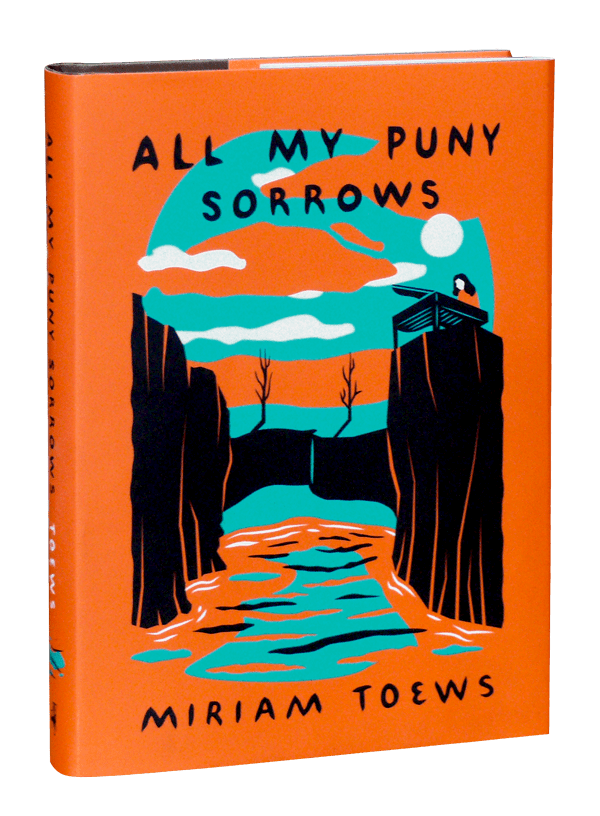
A Review of Miriam Toew’s All My Puny Sorrows (by Jill)


all my puny sorrows cover.png

This one was Indiespensible #50 from Powell’s back in November of 2014. I read it over the summer, mostly while I was travelling to and from Georgia to visit my aunt with my parents. It was probably one of my favorite surprises of the Indiespensible books I’ve read—I wasn’t excited to read it but I ended up really enjoying it, despite the heavy subject matter.

The novel is narrated by Yolandi, a writer of “rodeo novels,” and a lapsed Mennonite, who travels home to Winnipeg from Toronto to be with her sister Elfrieda who has tried to kill herself. Again. Elfreida is a pianist, and a very famous and accomplished one. Her reasons for continuing to attempt suicide are never quite defined other than that she wants to not be alive anymore. This novel is not especially plot-driven; it’s more about Yoli figuring out her somewhat messed up life (she is getting divorced, drinks too much, has a fairly successful career writing books that mean very little to her, has two teenaged children who seem like good kids, but she definitely isn’t happy) and coming to terms with finally losing the person who means the most to her.

One regret I have about this book is that I didn’t get a chance to research Mennonites as well as I would have normally while I was reading since I read so much of it on planes, or in bed, where I have a fairly strict no devices before going to sleep policy. (For myself only–I think my husband may be on Facebook and Reddit while he’s sleeping.) I know that Mennonites are Christians, and that they’re sort of like the Amish but not really. I just did some Wikipedia reading really fast and the faith is, of course, more complicated than my initial impression. There are several different orders of Mennonites, some of which are very “Amish-like,” and some of which are more moderate. Yoli and Elf’s family is moderate, but it seems like they might be more liberal than the rest of their community. By the time the action of the novel takes place, Yoli, Elf, and the rest of their family are pretty much lapsed Mennonites, but are still shaped by their sort-of former religion.

I really enjoyed this book; Toews’ prose is beautiful, and I wish I had some examples to share, but the one passage I flagged is so long I’m not going to include it. Yoli is a well-drawn and reliable narrator, and Elfrieda is horribly flawed. I wish we could have seen in her head a little, to get behind her reasoning behind all the suicide attempts. All of the supporting characters were lovely, as well. I whole-heartedly recommend this book and wish I had blogged about it sooner so my review could be more detailed, but 2016 has not been my year for putting out detailed book reviews, and for that I apologize. Hopefully 2017 will be better!


Posted in Fiction - literary, Miriam Toews, Reviews by Jill, Uncategorized | 2 Comments

A Review of Stephen F. Knott and Tony Williams’ Washington & Hamilton: The Alliance that Forged America

washington-and-hamilton-cover-image

I came to this book because of my obsession with Hamilton, of course; I was interested to read a book that focused entirely on the relationship between Hamilton and Washington, and I was also interested to learn about the years that aren’t covered in much detail in the musical. This book is readable, and I did learn some more details about this alliance, including the fact that Washington sent Hamilton a “wine cooler” as a show of support when the Reynolds scandal broke. I’m presuming this gift was some kind of contraption that would keep wine cold in the pre-electric years, but I prefer to think of Washington showing up on the former treasury secretary’s doorstep with a four-pack of Bartles & Jaymes.

wine-coolers

I enjoyed the chapter on “Partisanship, Fear, and Loathing,” in which we learn that John Adams publicly complained of Hamilton’s “superabundance of secretions” and declared that all the honors heaped upon George Washington were the consequence of his “handsome face” and “elegant form.” The authors are decidedly pro-Hamilton and pro-Washington, defending their subjects by characterizing Adams as paranoid and shrewish and claiming that he tended “to consider everyone he knew to be a potential foe instead of a potential ally” (224). As the book progressed, the bias grated on me a little. I wanted the authors to dig into Washington and Hamilton’s relationship and unearth connections that previously went unnoticed, when what they do most often is skate over the surface. In the book’s final chapter, Knott and Williams abandon all trace of objectivity in what is obviously a defense of Hamilton himself and of Washington’s confidence in Hamilton. They praise his encyclopedic mind and his caution, noting that “there would be times when statesmanship would require the president to resist the wishes of the people” (248). They also acknowledge that Hamilton “was a horrible politician, but as a nation-builder and strategic thinker, he was without parallel” (249).

I found this book very readable and generally enjoyed it, but ultimately it never quite transcends its sources. Almost every time I found a point intriguing, I checked the bibliography and found that it came from Ron Chernow – either from his biography of Washington or his biography of Hamilton, the former of which was also Lin-Manuel Miranda’s inspiration and key source for the musical. I suppose this book is ideal for readers who are caught up in Founding Father Fever but aren’t quite ready to commit to reading both of Chernow’s massive biographies. I haven’t read either one yet, but I definitely intend to – so maybe I am not the ideal reader for Knott and Williams’ book, which is more a synthesis of other biographies than a work of scholarship in its own right.

Posted in Authors, Non-fiction - History, Nonfiction - General, Nonfiction - Memoir/Biography, Reviews by Bethany, Stephen F. Knott and Tony Williams, Uncategorized | Leave a comment

A Review of Brad Watson’s Miss Jane

miss-jane-cover-image

Fair warning: this book is not about Jane Austen. I learned to make this disclaimer when I was reading the book, and everyone who saw the title said, “Oh! Jane Austen!” And then I had the pleasure of replying, “No! Mangled genitalia!”

This novel is about Jane Chisolm, who is born with a vaguely-defined defect of her urinary anatomy. We’re never told exactly what’s wrong, but we know that his first glimpse of his daughter’s genitalia led Mr. Chisolm to say, “Good Lord… what trouble have we gone and brought into this world now?” We also know that her doctor is concerned about fecal contamination of Jane’s vagina and urinary tract and tells her father in vague terms that her various tubes and passageways are “mixed up.” As someone who writes fiction, I see the wisdom of keeping things minimalist in this regard, but as a reader, I was a little annoyed. I wanted to know exactly what was wrong with Jane’s girl parts. What I visualized was a sort of baseball-shaped cavity into which Jane’s rectum, urethra, and vagina all emptied like three underground rivers feeding into an open cave. I am pretty sure this is not accurate, and it bothered me that I kept visualizing this layout throughout the novel.

(Layout. Underground rivers. Baseball-shaped cavity. Various tubes and passageways. Girl parts. Urinary anatomy. Has a more awkward paragraph ever appeared in a book review? I promise I won’t go on like this forever. Actually, never mind – I’m not sure I can promise that.)

A couple more facts about Jane: first, she suffers from both urinary and bowel incontinence throughout her life, and second, her reproductive system is mostly functional, in that she menstruates and has all of the organs necessary to conceive children. Her doctor assumes that she would be unable to carry a baby to term, for reasons involving the possibly-erroneous baseball-shaped cavity, but Jane never tests his theory.

Jane is born in 1915 into a miserably unhappy family. Her father, Sylvester, is a good, well-intentioned man but an unregenerate drunk who pays Jane’s doctor in moonshine. Her deeply unhappy mother blames her husband for Jane’s deformities, viewing Jane’s birth defects as divine retribution for the fact that Sylvester had sex with her when she was on a serious dose of laudanum for her anxiety and grief over the death of her young son. In addition to the son they lost, the family has two adult sons who have left home and are rarely mentioned and a sour daughter in her early teens named Grace. In the incapacitating depression that takes over Mrs. Chisolm after Jane’s birth, Grace essentially raises Jane, passing along her own stoicism and independence. From early childhood, Jane learns to clean her (here we go again) secret passageways and manage her incontinence without help.

Dr. Thompson – the small-town family doctor who delivers Jane – keeps in close touch with the Chisolm family and corresponds with a friend who practices urology at Johns Hopkins, determined to find a way to “fix” Jane. The doctor is a bit of an enigma. His wife leaves him early in the novel, when he refuses to sell his medical practice and move to a city. The doctor is a philosophical type, musing over the crowd of sick, wounded, and disfigured adults that crowd his porch while he is out delivering Jane, “And to think all these came out of the womb fully formed.” The doctor intervenes in non-philosophical ways as well, such as taking Jane to Memphis to be examined by specialists, giving Jane a detailed sex talk when she starts to menstruate, and – wrenchingly – intervening when a local boy seem to be falling in love with her, telling him outright that Jane can’t have children and hinting at the problem with her (this again) safety-deposit box, giving him just enough information to scare him off. Early on, I thought Dr. Thompson was gay and that the friend he consults at Johns Hopkins is a former lover. Their letters contains little glimmers of flirtation and allusions to a memorable past, and it would make sense if an uninterested husband, rather than a host of scary patients, were the real reason for Mrs. Thompson’s departure, but the friendship between the two doctors fades as the novel progresses. The point of this characterization seems to be to establish that the doctor – like most of the other characters in his novel – has his own baseball-shaped chamber to torment him, though in the doctor’s case the emptiness is in his heart.

The novel lingers in Jane’s adolescence but does eventually bring us to middle age. Jane inherits her family’s land and is Dr. Thompson’s beneficiary as well, and when a surgical procedure to fix her (and again!) miswired radio becomes available, she declines the offer to be operated on pro bono. By this point she is comfortable in the solitude and routines of her rural life, and she’s also insulted by the reminder that there are and always have been doctors out there who know about her case and have been striving for decades to “fix” her condition. In the novel’s closing pages, I heard echoes of the ending of The Scarlet Letter, when Hester – who by this point can go anywhere she wants – chooses to come back to Boston, pin on her scarlet letter, and move into the cottage by the sea where she had lived in isolation with her daughter. Both Jane and Hester (and Hester’s daughter Pearl) are set apart from their society. Hester is punished for her “sin,” which any reader with a brain can recognize as no sin at all but an act of pride. Similarly, Jane isolates herself not because of her (not this again) inverted teacup but because of her own sin, which is also pride (look at the cover – peacocks!).

After all this, I suppose I should mention that Brad Watson’s prose is beautiful. “One day in July,” he writes, “she stood beside the tomato row in a mild state of wonder, watching a doomed tomato worm eat her best plant. The worm’s fat, segmented body was studded with the rows of pure white cocoons that had grown from wasp eggs laid under its skin. They looked like embedded teardrop pearls or beautiful tiny onion bulbs growing from its bright green skin. Inside the cocoons, wasp larvae sucked away the worm’s soft tissue as casually as a child drawing malt through a straw. The worm seemed entirely unperturbed. No doubt a tomato work is born expecting this particular method of slow death, a part of the pattern of its making somehow, something its brain or nerve center, whichever it has, is naturally conditioned to recognize and accept. Just as a person hardly registers, until near the end, the long slow decadence of death” (248). Sure, you could argue that agriculture/fertility metaphors are overdone, but to my ear Watson hits exactly the right note here. Jane is tending her private garden – a walled garden, if we’re going to think in medieval cult-of-virginity terms, and of course we are – and the narrative voice here is characterizing Jane and her own slow acceptance (and cultivation) of the limits of her life. We are all limited by our bodies, of course, but Jane learned to accept this reality earlier than most. At the same time, Watson alludes to natural selection, to the slow ways that creatures adapt to their surroundings and pass these adaptations along to their children. Because of her birth defect, Jane is exempted from all of this. Sex drives natural selection forward, and Jane will never have sex or be a mother – and there is a sad, ironic freedom in that.
Posted in Authors, Brad Watson, Fiction - general, Fiction - literary, Reviews by Bethany, Uncategorized | Leave a comment

Yarn Along

yarn-along-10-19-16

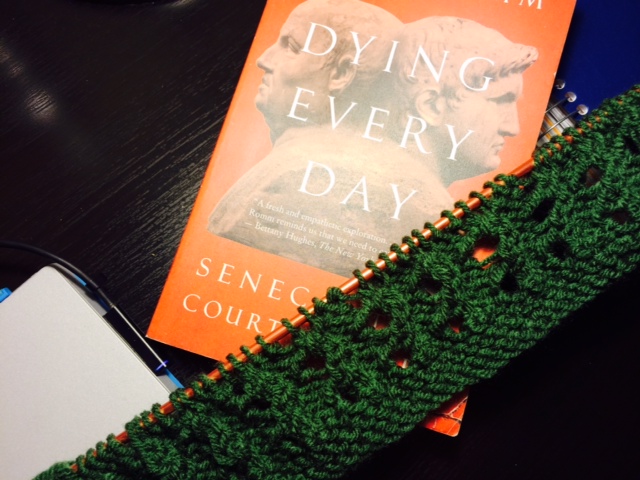
I’ve started a new project – a patchwork afghan using the stitch pattern that I call the “forgiving scarf” pattern. This is the beginning of the first square. This project will give me endless opportunities for mindless knitting when I need to do something simple, though I do think the final product will be nice looking when it’s done. It will give me a great opportunity to use up the scraps in my stash.

For those who are interested, the forgiving scarf pattern is no secret. I adapted it from a sock pattern a long time ago and don’t remember the publisher of the original pattern; if I did, I would credit it. Here’s the pattern:

Row 1: (K2tog, YO, P2) – repeat to end of row

Row 2: (K2, P2) – repeat to end of row

Row 3: (YO, K2tog, P2) – repeat to end of row

Row 4: (K2, P2) – repeat to end of row

And that’s it! I put a four-stitch garter stitch boundary on either end and a four-row garter stitch boundary on the top and bottom of each square (or scarf). I started calling this pattern “Forgiving Scarf” when I found that it is possible to make almost any mistake without it looking too conspicuous. If you mess up the adding and subtracting of stitches on the odd rows, there is sort of a built-in error correction mechanism on the odd rows, so you can easily get the pattern back on track. If you know to look for it, you’ll see a little “wiggle” in the pattern in the spot where you made the mistake. I once told a Silicon Valley business type about this pattern, and she said, “But you’re not going to CALL it that, right? You’re not going to TELL people that the scarf is full of mistakes, are you?” I replied with something along the lines of “Ummm…” There is a reason that some of us are Silicon Valley business types and some of us are yarn bloggers.

I’m reading many books, including James Romm’s Dying Every Day: Seneca at the Court of Nero. I like the way Romm focuses in on the relationship between Seneca and Nero while also giving a sweeping sense of the world they lived in. I also feel as if I’m re-reading the first two volumes of the Game of Thrones series, with all the incest and murder and evil mothers and teenaged psychopaths.

Yarn Along is hosted by Ginny on her blog, Small Things.


Posted in Uncategorized | 10 Comments

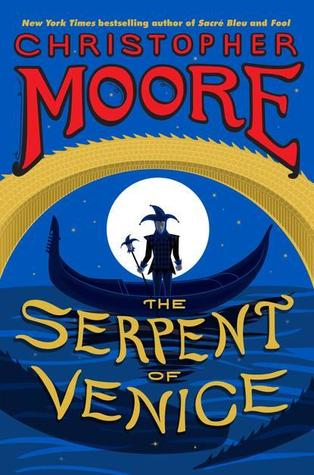
A Review of Christopher Moore’s The Serpent of Venice (by Jill)

the-serpent-of-venice-christopher-moore


It’s a testament to how far behind I am on my blogging right now that I had to look in my 2016 reading list on the blog to remind myself which book I read after Ripper. And when I saw that The Serpent of Venice was the next book I had finished, I was so happy. I love Christopher Moore, and have read quite a few of his books. I doubt I’ll be able to do this book justice, especially because I’m really out of practice, but I’ll try.

The Serpent of Venice is a sequel to Fool, which came out back in 2010, and is an homage to Shakespeare, albeit an irreverent one. Loosely based on King Lear, the main character is Pocket, the Fool, and there are also references to Macbeth, amongst other plays. At the end, Pocket married Cordelia, Lear’s youngest daughter. The Serpent of Venice opens after Cordelia is killed while Pocket is acting as her emissary in Venice. This new book combines The Merchant of Venice (of course), Othello, and Edgar Allan Poe’s “The Cask of Amontillado.” I enjoyed this book so much more than Fool, which made me glad, because I was actually disappointed in Fool, and that had never happened to me with a Christopher Moore book before. I think the reason why I enjoyed the newer one more is because Moore does such a good job of weaving the source material together into one (fairly) cohesive narrative, albeit an absurd one.

And what is the gist of this narrative, you ask? Well, it starts when some Venetians brick Pocket into a wall in one of their basements by tempting him down there with a cask of Amontillado. He is rescued by a creature who has weird reptilian sex with him (hey, it’s still a Christopher Moore book) and then starts killing his enemies. While Pocket is trapped in the wall, we learn that he made friends with Othello and helped set him up with the lovely Desdemona. When he escapes from the wall he hides out in the Jewish district of Venice and makes friends with Shylock’s daughter, Jessica. Honestly I read this one back in July so my memories of all the plot details are getting pretty dim, so I’m going to keep it brief. Suffice it to say that Moore does a great job of intertwining Othello and The Merchant of Venice, but not so well that it isn’t a bit ridiculous (but that’s the whole point of reading his books—to experience the ridiculous). The “The Cask of Amontillado” section is brief, and is only makes up the first maybe twenty pages, though that part of the novel gives us a reason why the serpent of the title is loyal to Pocket, and why she is responsible for causing many of the deaths from the plays that are the major source material.

I’m not going to toil on this blog for any longer—the longer it takes me to write, the less I remember about this book. It’s too bad, too, because it was hilarious. I’m not sure that it would be as enjoyable if you are not simultaneously a lover of Shakespeare, Edgar Allen Poe, and Christopher Moore’s unique brand of irreverent, yet completely respectful to the folks he’s poking fun at, humor. Fortunately for me, I love all three of these fellows, so The Serpent of Venice was completely in my wheelhouse. I keep trying to make up my mind if I think Bethany would like it, and I think she would, though maybe The Fool from Hamlet’s affair with Jessica from The Merchant of Venice might be a bit too much for her. But you know what? After I typed that out I decided Bethany would love that part. It’s just so absurd. Actually, I’m calling a spontaneous reading challenge on Bethany: I want you to read a Christopher Moore book sometime! (Sidebar: Bethany, I think we should do this all the time!!) And with that most absurd breaking of the blogging fourth wall ever, I’ll say goodnight. If you enjoy good-hearted mockery of classic literature, this book is for you.

Posted in Christopher Moore, Fiction - Funny, Fiction - general, Fiction - Historical, Fiction - Spoofs of Classic Literature, Uncategorized | Leave a comment

Yarn Along

yarn-along-10-12-16

I find it interesting how the early-morning light muted the color of my scarf, which is not nearly as Obnoxiously Orange in this photo as it is in real life. I finally got some good work on it done this weekend. I’m back to reading a few books at once, one of which is Miss Jane, a novel about a girl with deformed genitalia that will forever go down in history as the book I was reading during the week of “grab her by the pussy.” For a few days after Friday’s release of “that” video, I stayed away from this book. I finally dove back in yesterday and am enjoying it.

Yarn Along is hosted by Ginny on her blog, Small Things.

Posted in Uncategorized, Yarn Along | 9 Comments

Yarn Along

yarn-along-10-5-16

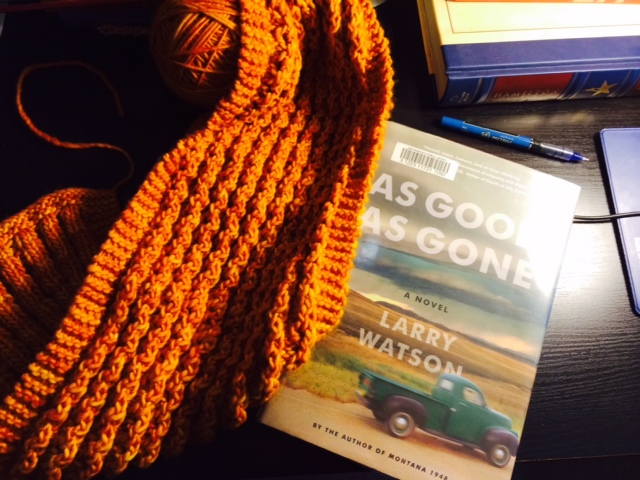
Instead of this Yarn Along photo, I probably should have taken a picture of this copy of Larry Watson’s As Good as Gone alongside today’s newspaper and sent it to the San Francisco Public Library as an assurance that this book is still alive and will soon be returned. I haven’t starved it or forced it to publicly repudiate its native land. Instead, I’ve treated it like an honored guest, letting it sleep in my own bedroom. I won’t even demand a release of prisoners in return, and a certain amount of cash will be remitted to the library along with the book. What a deal.

Anyway, I am enjoying As Good as Gone, though it’s less gritty than Watson’s other novels. More domesticated. It reads, to be honest, like an Anne Tyler novel that occasionally flashes us a glimpse of its Y chromosome. I’m enjoying it, though something very implausible just happened in the plot and I’m waiting to see how things play out before I tell you what I think. I’ll finish it soon and let you know.

Yep, it’s the Obnoxiously Orange scarf again. I worked on it last night during the VP debate, and I’m sure my needles will get a workout on Sunday for the presidential debate as well. My knitting life moves slowly lately, but that’s OK. In other areas I’m doing just fine.

Yarn Along is hosted by Ginny on her blog, Small Things.

Posted in Yarn Along | 4 Comments

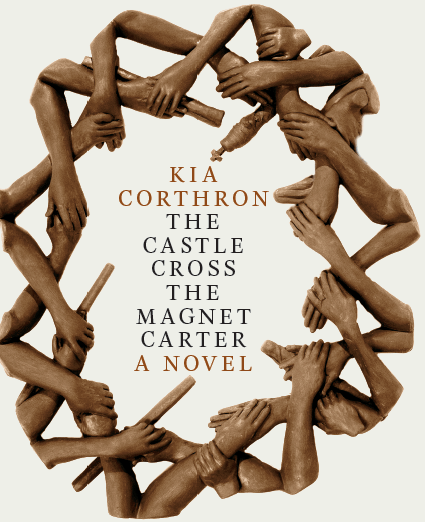
Final Thoughts on Kia Corthron’s The Castle Cross the Magnet Carter

manget_carter cover image

This novel has transcended everything I wrote about it in my earlier review. It’s still a novel about two sets of brothers, though both families grow estranged, and the brothers are separated (in one case, permanently – by a death) from one another for most of their adult lives. The first set is B.J. and Randall Evans of Prayer Ridge, Alabama. In the novel’s opening chapters, Randall uses a library book to teach B.J., who is deaf, the rudiments of sign language. Young Randall also participates in a debate tournament, serves as his eighth-grade class valedictorian, and finally convinces his father to let him go to high school instead of going to work in the local sawmill with most of the other men in his town. Randall’s life – in the opening chapters as well as throughout the novel – is overshadowed by the racism of his community and by the KKK, membership in which is deemed by most adults in town as a clear marker of responsible citizenship.

When we next encounter Randall, he is in his late twenties and working at the very sawmill he evaded when he was thirteen. Since this novel is written entirely in scene and with only occasional exposition, I did not at first know that the narrator of the third part of the novel was Randall. His voice is different – it’s coarser, more cynical, less energetic. I thought I was meeting a new character, a character whose every thought is paranoid and defensive, who would never had the young Randall’s confidence. What happened is that shortly after Randall’s eighth grade graduation, his father died. The family needed the income that Randall and B.J. would bring in, so they both signed on to work at the mill. There is nothing extraordinary about this, yet the change in Randall shocked me.

From here on out I was aware that this is a novel about – among other things – the power of education. The fourteen year-old Randall Evans who had been praised and validated by his teachers, who publicly prophesied his brilliant future, is barely recognizable in the man trapped in the narrow space formed by his unhappy marriage, his dreary job, and his stultifying community, barely able to move in such a cramped, awkward triangle. I am a little embarrassed about how much I grieved for Randall’s lost vigor and energy and confidence.

Eliot Campbell, who is seven years old when he first appears in Part 2 of the novel, is the one who grows up to be the lawyer Randall once thought he could become. In Part 2, Eliot is a crazed bouncy-ball of enthusiasm, constantly screeching around corners (I’m imagining the sound effects) and peppering us with narration like “I love fish sticks! I love pig’s feet! My teacher like me! She nice!” If Urkel mind-melded with Punky Brewster, the result would resemble my image of young Eliot. A little of this narration goes a long way, but I rarely find a novel in which children are presented realistically, and I was largely impressed by Corthron’s work here.

Much of young Eliot’s attention in Part 2 is devoted to his cat, Parker. Eliot isn’t allowed to keep the cat at home, so he persuades a neighbor who owns many cats to let Parker move in with her. All of Eliot’s affections are extreme, but his love for Parker transcends hyperbole. His older brother, Dwight, is much more restrained, not likely to share his own strong emotions publicly, though when he narrates a chapter we are certainly treated to his thoughts and to his quieter enthusiasms. His friends are Roof and Carl, both white. Roof is from a large poor family; he and Dwight entertain themselves by building sculptures out of all the junk in Roof’s backyard, and when Roof finishes elementary school he immediately begins working in a mine alongside his father. He and Dwight stop playing together because Roof is too exhausted when he comes home to do anything more than eat, bathe, and fall asleep. Carl, on the other hand, is from an educated white liberal family that moves onto the Campbells’ street. They think it’s great that Carl has a black friend, an enthusiasm that is just as well-intended and awkward as you might imagine. Carl and Roof detest each other, and the social acrobatics Dwight performs to maintain both friendships are impressive. The second section of the novel ends abruptly when Carl – inexplicably and intentionally – kills Eliot’s cat, Parker. This incident tears Eliot and Dwight’s relationship in two, and its violence reverberates through the entire novel.

The novel proceeds like this, its lens shifting from one narrator to the next, always microscopically, always entirely in scene, always – at least at first – resisting interpretation. Each chapter in this novel is like a window outside which some kind of human struggle – large or small – is taking place. It is easy to walk past one of these tableaux without really seeing it, especially if you are used to reading modern fiction that spoon-feeds you an interpretation of itself even as its chapters speed by. The scope of the novel is impressive – over its nearly 800 pages we’re treated to courtroom dramas, love stories, and horrific violence. Families fracture, reunite, and fracture again. Even minor characters are remarkably round and compelling. The novel is not perfect, of course: it abandons several plot lines that were worth developing, it asks us to take seriously a character named April May June, and it never really earns its kooky title, which alludes to the misunderstandings that are at the novel’s core but is ultimately a turnoff. It makes the novel seem silly, which it most definitely is not.

I mentioned earlier that I thought Corthron was working with some allusions to Faulkner, and it may be that she was. However, as the novel progressed I thought less of Faulkner and more of Tolstoy. The encyclopedic scope of Corthron’s novel is balanced against the minutiae of individual relationships in a way that resembles Anna Karenina, and the novel’s final tragedy, hidden in plain sight in its earliest pages, suggests a vision similar to Tolstoy’s. I recommend this novel highly, though it’s not for the faint-hearted, and I will certainly be watching for this author’s work in the future.

Posted in Authors, Fiction - general, Kia Corthron, Reviews by Bethany, Uncategorized | Leave a comment

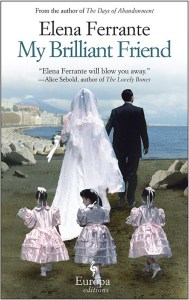
A Review of Elena Ferrante’s My Brilliant Friend

my-brilliant-friend

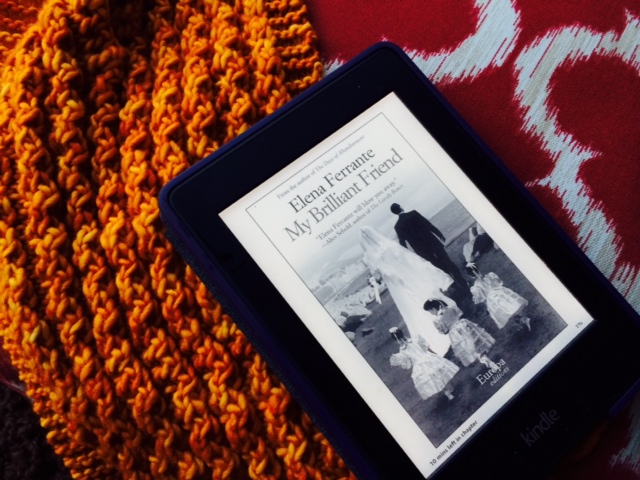
Earlier this week when I took my Yarn Along photo, I had read about 90% of My Brilliant Friend. I had already started to warm to it after feeling disappointed with the first half of the novel. When I scrolled back to find the cover photo that I used in my Yarn Along photo, I found that this novel features a character list prior to Chapter 1. One of my main complaints during the first half of the novel was the fact that many of the characters seemed interchangeable. This problem disappeared later, but I think I would have enjoyed the book much more if I had known the character list was there. I suppose this is an occupational hazard for those of us who (sometimes) read on Kindles. Kindle books generally open on page 1, and it does not always occur to me to scroll back to look at epigraphs or at other material, like this character list.

To me this series of four novels, called Ferrante’s Neapolitan novels, has been almost obnoxiously hyped over the last year or so, and I was surprised when two friends who read said they had never heard of them. I thought about it and realized that I couldn’t remember when or how I learned about these books. At the library? Maybe. Promotional email from Amazon? This is always possible, but I can’t say I remember for sure. The only thing I could say for sure is that I had never talked to a single real person who had read them. I guess this is how reading recommendations happen in the Age of the Algorithm; books just show up in your brain, fully marketed and cued to the beginning of Chapter 1.

Almost immediately I recognized a connection between this novel and the stories of Alice Munro. Munro often writes about the world of her Great-Depression childhood on her father’s perennially-failing fox farm. The setting of My Brilliant Friend is more prosaic – a working-class neighborhood in Naples in the decades following World War II. In Munro’s stories about life on the fox farm, two specters cast shade over the protagonist: poverty and the possibility of parental rejection. This same darkness is present in My Brilliant Friend, though it took me a while to place it. “Our world was like that, full of words that killed: croup, tetanus, typhus, gas, war, lathe, rubble, work, bombardment, bomb, tuberculosis, infection,” Ferrante writes. “With these words and those years I bring back the many fears that accompanied me all my life.” Notice how the vocabulary of childhood illnesses, industrial accidents, and 20th-century warfare mingle in this list in no particular order. While Munro’s child protagonists are terrorized by eventualities, Ferrante’s live under the shadow of past atrocities: namely, of Mussolini’s Italy.

When I was frustrated with the first half of this novel, it was because its characters felt opaque. Its protagonist, named Elena like her creator, is clearly defined enough. I wasn’t bothered by young Elena’s narration – in fact, it was this narration that first made me think of Munro. Elena’s friend Lila – whom I assumed until very close to the end was the “brilliant friend” of the title – is also well drawn. But the rest of their friends, who get a lot of page time, seemed interchangeable. Pasquale, Enzo, Stefano, Antonio, and Alfredo all blended into one another, and the intensity of Elena’s friendship with Lila left me somewhat baffled about why there had to be any more female characters in the novel at all; surely Elena and Lila provided enough “Venus” energy to power the novel through to its end. The Solara brothers stand out a bit because they are wealthy and ostentatious and aggressive. Throughout the first half of the novel I was just baffled: why introduce so many characters, give them so much time on the page, and develop them so little?

Then I started to get it. Early in the novel we’re introduced to a character named Don Achille. At first I thought he was a Boo Radley figure; the children in town were taught never to go anywhere near him but also never to be disrespectful to him. “We didn’t know the origin of that fear-rancor-hatred-meekness that our parents displayed toward the Caraccis (Don Achille’s family) and transmitted to us,” Ferrante writes, “but it was there, it was a fact, like the neighborhood, its dirty-white houses, the fetid odor of the landings.” Shortly after he is introduced, Don Achille is killed, and the father of one of Elena’s friends is sent to prison for murder. As a reader, I was just as baffled as Elena was (which was the point – duh!), and my own understanding of Don Achille’s relationship with others in the town kept pace with hers.

Elena’s neighborhood is not a place in which education (and its perceived corollary: truth) is valued. Lila is the smartest child in her elementary school, but her parents take her out of school after the fifth grade to help around the house and around her father’s shoemaking shop. We’re aware that her household becomes violent at times – but this too is opaque. Elena’s parents – after some grumbling – allow her to go to middle school and then on to high school, which is regarded as at best a luxury and at worst a sinister place rivaling the tree in the Garden of Eden as a locus of treasonous knowledge. The fact is that the adults in Elena’s neighborhood are afraid of truth. The social structure of this time and place is oriented around ignoring and burying truths about what the occupants of the neighborhood did to survive the war. When the truth does start to come to light, Lila cries out, “Who are the Nazi Fascists? Who are the monarchists? What’s the black market?” Later, Elena reflects that the adults in her community “thought that what had happened before was past and, in order to live quietly, they placed a stone on top of it, and so, without knowing it, they continued it.” At this point in the novel, Lila’s family’s distaste for the wealthy Solaras starts to make more sense, as does the killing of Don Achille.

I do think I would have enjoyed this first half of this novel more if the characters surrounding Elena and Lila were more fully developed, but I think I understand why Ferrante wrote this book in the way she did. Elena’s neighbors are just as opaque to her as they are to me – and since she is a child immersed in her familiar surroundings, it makes sense that this should be so. In some way, the plot of this novel emerges out of Elena’s ongoing struggle to understand the invisible forces that drive her community. The novel’s characterization deepens as Elena ages – and of course there is nothing wrong with that. It’s the result of a rigorous use of the first person narration. And even more so: it’s something Alice Munro would do.

Posted in Elena Ferrante, Fiction - general, Fiction - literary, Reviews by Bethany, Uncategorized | Leave a comment

Yarn Along

yarn-along-9-28-16

I’ve been reading Elena Ferrante’s My Brilliant Friend on my Kindle for the last week or so and am almost done. At first I was surprised not to like it much. It reminded me of an extended Alice Munro story but with all the “meat” taken out. Lots of poverty and opaque parents and grudges held for the better part of lifetimes, in other words, without the sort of insight that Munro always brings to her work.. I am slowly changing my mind as the book proceeds, but I’m still not sure if my review will fall on the “mostly positive” or “mostly negative” side. We’ll find out.

I am also still working on the Obnoxiously Orange scarf. I got some good work done on it this weekend. My life is busy these days, mostly in good ways. I’m feeling inspired and challenged and creative and – well – tired. Once, when I was still teaching full-time, I told a counselor that I was so frustrated because when I got home at the end of the day I didn’t have energy for anything but crashing on the couch in front of the TV. I’ll never forget the counselor’s reaction. She looked at me like I was stupid for a moment and then said, “You do realize you’re describing the average American’s perfect life, right? A job that pays the bills and nothing to do at the end of the day but watch TV.” I didn’t think she was right (and still don’t), but who knows? If there’s one thing this election season is teaching me, it’s that the average American is a strange and elusive beast.

Yarn Along is hosted by Ginny on her blog, Small Things

Posted in Uncategorized | 4 Comments