Yarn Along

Yarn Along photo 7.1.15

Yep, it’s the brown sweater again. And yep, I’m still reading A Storm of Swords. You can scroll back (and you won’t have to scroll very far back) and find me admitting these same basic truths every Wednesday for the last few weeks. I did knit and read last weekend, but without any real progress. It was like I was on a giant knitting and reading treadmill. Last night, though, I came up with an idea for a sweater I really want to design and knit – and of course I think about reading. I think about it all the time. Sharing space with the brown sweater today is Morris Dickstein’s memoir Why Not Say What Happened, which is another book I want to read soon – whenever this thing we call “reading” re-enters my life.

But all is well, I promise. All is quite well.

Yarn Along is hosted by Ginny on her blog, Small Things.

Posted in Uncategorized | 5 Comments

A Review of Lisa Lutz’s The Last Word: Spellman Document 6 (by Jill)

the-last-word cover

It appears to be my week to read and write about books that wrap up a series I’ve been reading for years but have never talked about on the blog. This is a confusing and somewhat annoying experience. The Last Word: A Spellman Novel is the (probably) last book in a series of mystery novels written by Lisa Lutz. They are about the Spellmans, a family of private investigators living in San Francisco. I’ve been reading these books for a few years, but the last one I read was in 2012, about two months before we started the blog. This last book was released in hardcover in the summer of 2013 and I obviously jumped right on reading it. But now is not the time for self-flagellation regarding my reading schedule.

These novels are told in the first person; Isabel “Izzy” Spellman is our narrator. In this novel she is thirty-five years old; when the series started she was twenty-eight. Her narrative voice is sarcastic and hilarious and overall just something I enjoy reading. The Spellman family consists of parents Olivia and Albert, and three children: David, a successful lawyer; Izzy, a not-so-successful PI/retired juvenile delinquent; and Rae, who is twenty-two in this novel, and has just graduated from UC Berkeley and is trying to make up her mind about her future. Her options are graduate school, law school, or a career in “conflict resolution”/extortion. Rae is possibly Lisa Lutz’s most well-developed character in the series. It could also be Izzy, but the thing with Rae is that I never knew what she was going to do next. Izzy was much more predictable, but that could just be because I was in her head, not Rae’s. There are many supporting characters who I am not going to get into; suffice it to say that they are all well-drawn and fairly likeable, except the ones who are really, really unlikeable.

The Spellmans are a very odd family. No one trusts anyone else, and everyone is always spying on everyone else, often with hilarious results. There are fewer shenanigans in this last novel than in prior ones; in fact, this novel deals with more serious family matters than the others did, at least as far as I can remember. At the end of the fifth book in the series, Izzy staged a slightly hostile takeover of Spellman Investigations. Her parents fired her because she had disobeyed orders to cease and desist an investigation; she, in turn, went ahead and bought out her brother and sister’s shares in the company, becoming the majority partner, and let’s just say things went to her head a bit. Her parents retaliated by coming to work in pajamas, or not at all. (The office is in their house, so the pajama thing is sort of reasonable.) At the opening of The Last Word, Izzy is barely speaking to “the unit,” which is how she and her siblings refer to their parents, and the company is barely afloat. If it weren’t for the cases that Izzy is catching from her financial backer Edward Slayter (who helped her buy out Rae and David and was the subject of the investigation that cost her her job in the first place), I don’t think they would have much income at all. Edward Slayter is actually a pretty important supporting character. He is the CEO of a venture capital firm, and takes a shine to Izzy, for reasons unknown to all, especially him. They initially meet in book five, Trail of the Spellmans, when Izzy is surveiling him on behalf of his wife, who wanted to keep tabs on him so she could engage in an affair without being caught. When Izzy discovers the reason why Mrs. Slayter hired Spellman Investigations, she contacts Edward and lets him know what his wife is up to. Her parents did not want her to do this, but she does it anyway. I don’t remember the details of their reasoning, but Izzy felt strongly that she needed to do it, and she and Edward are bonded because of it. Turns out that Edward has early-onset Alzheimer’s, a fact he is trying to keep concealed for as long as possible because he fears he will lose his company when it becomes public. The major mystery in The Last Word revolves around corporate espionage and embezzlement, with someone trying to frame Izzy while also attempting to make Edward appear that he is losing his marbles. I won’t disclose more than that—this is a plot-driven mystery novel, and I don’t want to do spoilers today.

There is also Spellman family drama, but more of the actual illness variety than the typical spy vs. spy thing, though there are amusing interludes with David’s toddler daughter who thinks she is a princess and is a tiny tyrant in a pink dress. It appears that this will be the last Spellman family novel, at least for the time being, and it does make me sad. I enjoy spending time with these wacky people, and it doesn’t hurt that Lutz knows her San Francisco geography and landmarks. Izzy drinks at The Philosopher’s Club in West Portal, which is a real dive bar; she takes a date to Pancho Villa burritos at 16th and Mission, which I’ve heard is amazing though I’ve never been there myself (we were an El Faro Burrito family back in the day); she tails a subject on the Bay Bridge and 880 South. Each book is like a little trip home for me.

This book is probably the most serious of the entire series; overall they are pretty light-hearted, with decent mysteries at their core. The family dynamics are completely not based in reality, but they do love one another deep down. I’ve enjoyed reading Lisa Lutz and I have her other two books ready and waiting to devour. I don’t want to read them too soon, though. I want to look forward to them for a while longer. I’ve never read any Sue Grafton or Janet Evanovich, but I think that people who like those books will enjoy this series, as well as anyone who likes reading novels that take place in San Francisco that were written by authors who know The City really well.

PS: This book was sort of renamed to Spellman 6: The Next Generation when it came out in paperback.  I found this irritating and confusing when it first happened, and wanted to mention it in case anyone came here wondering if the two books were different.  They are not.

Posted in Fiction - Funny, Fiction - general, Fiction - Mystery, Lisa Lutz, Reviews by Jill | Leave a comment

Final Thoughts on Margaret Atwood’s MaddAddam (by Jill)

Maddaddam coverI would have finished MaddAddam a lot faster if I hadn’t been camping last week. That’s okay. I didn’t mind spending more time with Margaret Atwood and her version of the future. I’m not sure that I’m going to end up having a whole lot to say about this book because there’s a lot more going on than I feel capable of/qualified to delve into from a literary criticism standpoint. There’s just so much social commentary and probably religious symbolism and that sort of thing that I don’t really know where to begin to truly write an educated-sounding review. But that’s not really my thing on PfP, that’s Bethany’s. So I’ll just tell you a bit about what I thought while I was reading it.

It was somehow appropriate that I read a good chunk of this book while I was miles away from cell phone reception, “roughing it” at a beautiful campground on the Sonoma-Mendocino coast. I felt pretty far away from civilization, though not as far away as the characters in MaddAddam are. The novel is told in a combination of flashbacks to the days before “the waterless flood,” as well as present-day action. I wish I knew what years all this stuff is supposed to happen in, because it seems like sort of the not too far distant future; I’d guess fifty years or so, maybe less. The more I read, the more creeped out I got because I could see hints of the present day evolving into this awfulness. In Atwood’s future, the gap between the rich and poor is even wider than it is now, and the middle class has essentially ceased to exist. The rich live in compounds owned by the giant corporations, and all their needs are taken care of inside the wall of the corporation (or corps) compounds (I feel like this is already starting to happen with Google and some of the other Silicon Valley companies), while the people who aren’t employed by the corps are relegated to the “pleeblands” outside, which sound like the worst possible slums. There’s also been loss of coastal land because of global warming (I assume): Santa Monica and New York are essentially underwater, along with other coastal cities. Many religions are “sponsored” by the corps, like Zeb and Adam’s father’s church, the Church of PetrOleum. They worship St. Peter, as well as oil….

In the present-day of the novel, the major conflict is between the remaining humans—the remnants of the MaddAddamites (they were the hackers on the front lines of the resistance against the status quo before the plague) and the God’s Gardeners (an anti-technology, back to the Earth, hippie-dippy cult led by a fellow known as Adam One. His half-brother, Zeb, is the leader of the MaddAddamites. They were on the same side in the struggle, though they had different ways of approaching the problem. Adam was for peace and harmony, while Zeb had a more aggressive philosophy. The brothers completely lose track of each other during the plague days, and Zeb deeply hopes that he will be able to locate Adam) are trying to protect themselves against the two remaining PainBallers on the loose, as well as those pigoons, who keep trying to break into their community and steal the vegetables. PainBall was a reality TV show in which prison inmates found guilty of violent crimes have to battle to the death. The reward for winning is a somewhat shortened sentence, and some prisoners elected to play in multiple “seasons” in order to further lessen their terms. It’s said that anyone who wins PainBall more than once has lost their sense of right and wrong and most of their humanity. They are cold-blooded killers, in essence, and they are gunning for our heroes. They also begin killing pigoon young, which causes the pigoons to want to form an alliance with the humans. Interestingly, the Crakers, or genetically engineered people who were immune to the plague, among other interesting attributes, including being able to live on an entirely herbivorous diet like a cow, and communicate telepathically with the pigoons, are instrumental in this alliance formation. The decisive battle reunites Zeb and Adam, which is a lovely scene of brotherly affection. The battle itself is not drawn out like some of the battles in The Last Town, the last book in the Wayward Pines trilogy, but then this is Margaret Atwood! She’s won the freaking Booker Prize. She doesn’t need to spend a hundred pages describing violence and death. I wouldn’t have minded a few more pages, though. Of course this fight scene is hardly crucial to the plot of the novel except it does give the reason for the pigoons, Crakers, and humans to begin to work together. But that fact is more important to everything that follows than the outcome of the fight.

I haven’t even mentioned Toby or Katrina WooWoo or Swift Fox or Ren…. There’s a lot that happens in this book, and the best part is that it all seems to make sense to me, as opposed to the events of the first book in this trilogy. I would love to go back and read all three of the books one right after the other and see if I enjoy Oryx & Crake more. I think I probably would. I would recommend the whole series to people who enjoy dystopian fiction, but not to people who didn’t enjoy The Handmaid’s Tale, or who aren’t fans of Margaret Atwood, because this is very much an Atwood series of novels. I am, of course, an Atwood fan from way back, since my old roommate Lauren first recommended I read The Handmaid’s Tale back in 1995 or 1996, so this book (and the entire trilogy, in fact) was right up my alley.

Next up for me is another “High Priority” hardcover purchase from the fall of 2013. What can I say? I’ve been busy….

Posted in Fiction - Dystopia, Fiction - general, Fiction - literary, Reviews by Jill | Leave a comment

Yarn Along

Yarn Along photo 6.24.15

I think my knitting (and maybe also my reading, though I hope not) will slow to a crawl this summer. I started a new job on Monday, and both Monday and Tuesday I was in bed by 8:00 – reading, not sleeping, but still. My English rib sweater is progressing slowly but nicely, and I’m still reading A Storm of Swords, but I just couldn’t give you a repeat of last week’s picture – especially when I haven’t posted a single review since last Wednesday. So I’ve photographed the very beginning of the sweater’s front panel side by side with a book that arrived in the mail today: Cynthia Ozick’s The Puttermesser Papers. I want to read it soon, but I feel the same about Moby Dick, so who knows?

After I took this photo in the fading evening light, I turned around and saw my cat Cleo standing on the coffee table with the shadows of the Venetian blinds criss-crossing her body. This photo captured the moment perfectly. It looks as if she’s wearing striped pants or at least has some very dramatic lower-body markings – but no, she’s actually a solid grey everywhere except her belly, her feet, and a couple of spots on her face and under her chin. The rest is just sunlight, two evenings after the solstice.

Cleo photo 6.24.15

I’ll be back soon with some book reviews, I promise.

Yarn Along is hosted by Ginny on her blog, Small Things.

Posted in Uncategorized | 7 Comments

Yarn Along

Yarn Along photo 6.17

I don’t have much news to report – I’m still reading A Storm of Swords, and I’m almost done with the back panel of my English rib sweater. The photos show the sweater’s two textures: ribbing on the “right side” and an interesting nubby texture on the “wrong side.” Every time I make this sweater I always think about piecing it together “inside out” because I love that interior texture so much. Maybe next time.

Yarn Along is hosted by Ginny on her blog, Small Things

Posted in Yarn Along | 11 Comments

Thoughts on the First Half of George R.R. Martin’s A Storm of Swords (by Bethany)

storm of swords cover image

 I am now officially reading this book “full-time.” Reading it only at night was working well until I skipped a few nights and then forgot that a major character had had his hand chopped off. That’s not the sort of thing one is supposed to forget when one is a bookblogger.

A Storm of Swords is supposed to be the best volume in this series – and I agree, but only marginally. As far as I can tell, all three (OK, 2.5) books I’ve read so far are identical in tone. Each one picks up right after the previous book left off, so what we have here is one long, multi-volume narrative. I’m often tempted to compare Martin’s series to Diana Gabaldon’s Outlander, and in this area the two series are very different. Each of Gabaldon’s books has its own energy, its own feeling, its own set of dominant tensions. Martin’s books, on the other hand, make up one long never-ending sine curve, like a little heartbeat running through each novel. Crest, trough, crest, trough – forever. And while I do admit to being an inattentive reader sometimes, I think this hypnotic rhythm is part of the reason that I tend to miss important events. Nothing happens to the language surrounding the important events; nothing distinguishes it from the passages that just describe Arya eating pigeons or Joffrey being a dick or Daenerys yelling at some sketchy desert-dwellers or Brienne of Tarth telling Jaime Lannister again not to call her “wench.” This rhythm is embedded in the language as well as in the events of the plot. If there’s another literary work that this novel most resembles in this sense, it would be Wordsworth’s The Prelude: a gazillion-page iambic pentameter epic poem about going for walks in the mountains.

In this book, Jaime Lannister is one of the point-of-view characters for the first time, and the great surprise is that he is (mostly) not a jerk. It’s true that he’s arrogant, though that arrogance is a factor of his birth and upbringing, mostly. In the first two books in the series, Jaime is treated like a ticking time bomb whose release (from captivity at Riverrun, which is where he spends all of A Clash of Kings) would mean total annihilation for the good guys (if in fact there are any good guys in these novels, which is up for debate). In this novel, he’s much more sympathetic. Foremost on his mind is his sister (and lover) Cersei, whom he genuinely adores. He also feels great sympathy for Tyrion, who would likely to be surprised at how fondly Jaime thinks of him. It’s also clear now that Jaime is not especially proud of the fact that he killed King Aerys Targaryen. He bristles at the sobriquet “Kingslayer” and still feels deeply conflicted that he violated his oath to protect the king.

The other point-of-view character who is new in this installment is Samwell Tarly. Sam is basically Piggy from Lord of the Flies, uprooted and replanted in Westeros. He is fat and enjoys girly things like reading and taking care of birds and not going on endless death-marches in the snow. However, Sam is also the one who figures out that the “Others” can be killed with obsidian (which is not at all how it worked in Lost, but I digress). Some of the other men in the Knight’s Watch have started calling Sam “Slayer,” which Sam doesn’t like much – but nevertheless, he is carving a niche for himself among the Black Brothers. In the chapter I read most recently, Sam is present when Craster dies and is in the process of figuring out what he will be able to do to help Craster’s veritable army of his wives/daughters. They’re a versatile bunch.

In each book, certain characters’ chapters are more interesting than others. In this book, I look forward to the chapters about Jaime, Tyrion, Sansa, and Daenerys, and just a few chapters ago there was a Davos chapter that was really interesting. Bran’s chapters are a snooze in this book, as are Catelyn’s, and so far the “Narnia” sections of the book (which is what I call the chapters about Jon Snow and Sam Tarly) don’t interest me very much, in spite of the fact that social media assures me that Jon is a character one is supposed to care about a great deal. In A Clash of Kings, I could barely stay awake through the Daenerys chapters, but now she is busy buying an army of castrated warriors who are so inured to pain that one can cut their nipples off without eliciting a response (just like what’s-his-face on Mad Men!), and her chapters can’t come around fast enough.

I am definitely engaged and invested in this book, which is more than I could say about A Clash of Kings when I was at its midpoint. I’m looking forward to reading more.

Posted in Authors, Fiction - Fantasy, Fiction - general, George R.R. Martin, Reviews by Bethany | Tagged | Leave a comment

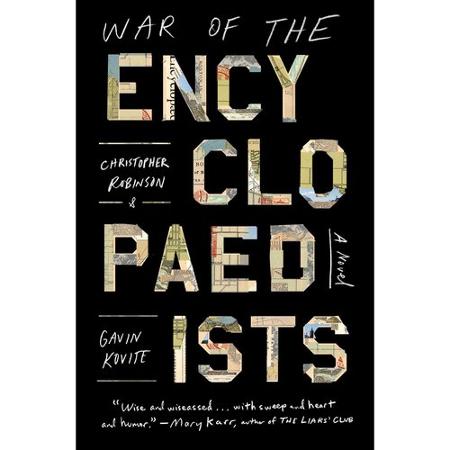
A Review of Christopher Robinson and Gavin Kovite’s War of the Encyclopaedists (by Bethany)

cover image of war of the encyclopaedists

I know – a novel written by a duo doesn’t sound very appealing, does it? That’s what I thought at first too, although I also remembered that I have enjoyed the work of co-authors before: Ian Caldwell and Dustin Thomason’s The Rule of Four and Annie Barrows and Mary Ann Shaffer’s The Guernsey Literary and Potato Peel Pie Society come to mind immediately, and over the years I’m sure I’ve read others. In the case of this novel, each co-author corresponds with one of the primary characters. The plot of this novel revolves around the friendship of its two protagonists, Halifax Corderoy and Mickey Montauk, and it seems as if the real-life friendship of its two authors was the impetus for the novel. This is just one of many ways that this novel plays around with metafiction and the shifting lines between fact and fiction, truth and lies.

While their names suggest that they have recently escaped from a Dashiell Hammett novel, in fact Corderoy and Montauk are mid-twentysomethings who met while studying abroad in Rome and cemented their friendship by calling themselves “the Encyclopaedists” and hosting a series of artsy parties. The novel opens just before one of these parties, when Corderoy’s girlfriend Mani is ejected from the apartment where she has been staying with an acquaintance. This scene is fairly comic, as the theme of that night’s party is “Conspiracy Theories,” and Corderoy and Mani are dressed as George W. Bush and “sexy bin Laden.” All is not well between Corderoy and Mani, however. With Mani homeless (again), Corderoy feels pressured to invite her to live with him, but he can’t bring himself to ask her. On the one hand, he lives with his parents. On the other hand, he is going to be leaving Seattle soon to go to graduate school in Boston. More important than either of these considerations, though, is the fact that Corderoy just can’t seem to bring himself to cohabitate with Mani. He’s a bit of a passive guy, as the novel hints in this scene and reveals later. Corderoy makes no move toward finding Mani a new place to live, and when he wakes up in the wee hours of the morning after having fallen asleep at the party, he lets Montauk, who was hosting the party, talk him into just leaving – ditching Mani, who is still sleeping soundly, and walking away. Please note that Montauk doesn’t have to work too hard to talk him into it.

So Corderoy leaves, and Mani wakes up and finds no sign of him. She is upset, of course, and so she grabs her things and runs out into the street, where she is hit by a car. Montauk sleeps through the ensuing ambulance sirens and related commotion, but when he does wake up, he gets in touch with Corderoy and suggests that they both go visit Mani in the hospital. (Montauk is somewhat more responsible than Corderoy, though not much.)

Time to make a long story short: soon after this party, Montauk’s National Guard unit is called up to go to Iraq (the novel is set in 2004, incidentally, with routine references to the Bush-Kerry election and the beginnings of the insurgency in Iraq). Prior to receiving this news, Montauk had been planning to go to Boston along with Corderoy, also to attend graduate school. Corderoy is angry with Montauk for all kinds of reasons: for participating in an unjust war, for leaving him in Boston in search of housing and a roommate, for being in the National Guard in the first place. But life happens, and the friends go their separate ways, but on one of their last nights in Seattle they decide to create a Wikipedia entry for the “Encyclopaedists” – in other words, themselves.

My first thought after reading this scene was that I should text Jill and say OMG WE NEED A WIKIPEDIA ENTRY FOR POSTCARDS FROM PURGATORY. WE NEED ONE RIGHT NOW. I never did so, but I also never stopped thinking about the fact that our blog serves the same sort of function in our lives as the Wikipedia entry does in Montauk’s and Corderoy’s. More on this in a little while.

Corderoy leaves first, and in between his departure and Montauk’s some key events take place. First, Montauk lets Mani move in with him after she is released from the hospital. She is badly injured and can’t walk at first, so Montauk carries her around, waits on her, and develops an affection for her that blends sexual attraction with the way one might feel about a wounded puppy that appeared one day on one’s front porch. He worries about her, knowing that she still isn’t fully capable of self-care and that she still doesn’t have a place to live and is semi-estranged from her parents, who live in the Boston area. A week before he leaves, Montauk suggests that he and Mani get married. That way, he will be entitled to a larger housing allowance from the government, some/most of which she could use to find a new place to live and continue to recover. They are married by a judge shortly before Montauk leaves town. It’s worth mentioning that while Mani and Montauk share some tender moments in bed and on Montauk’s couch, their relationship is not sexual. It’s not always clear what Montauk feels for Mani. He clearly wants to take care of her – and he has known her for some time as his friend’s girlfriend (and seemed not to like her too much in that role, by the way) – but staying away from sexual intimacy isn’t especially hard for him to do. Saying that he feels “like an older brother” to her isn’t right either. The best I can say is that with his life about to change monumentally as he heads to Iraq to command his own platoon, he seems to want some kind of tangible symbol of his newfound responsibility – and Mani is conveniently placed to become that symbol.

As Montauk’s level of responsibility rises, Corderoy’s declines. The Corderoy that we meet in Boston does not seem like the Corderoy we met in Seattle – and at first I thought this was a real flaw in the novel. In Seattle, Montauk and Corderoy seem like intellectual equals, trading one-liners and collaborating as partners in planning and executing the Encyclopaedist parties. It’s true that Corderoy doesn’t come off well in the Mani incident – but he didn’t fall in my estimation until he moved to Boston.

First of all, in his first graduate course in literary theory, he proves himself implausibly naïve. The professor structures his first lecture around the Star Wars trilogy, asking the class to analyze the films from several different perspectives. Now, it’s true that not all undergraduates emerge from college with backgrounds in semiotics, but anyone who graduates with a liberal arts degree in any field (especially in the early ‘00’s, when someone like Corderoy would have grown up not only with the original trilogy but with the newer films out in theatres) can make some basic noises about Joseph Campbell’s mythic archetype as it applies to Luke Skywalker & Co. This topic was part of the 10th grade religion curriculum at my high school, for God’s sake. If it weren’t for Joseph Campbell and Star Wars, what would I have talked about at three in the morning to my crazy hallmate with the overactive thyroid in my freshman dorm? While memory may fail me just a bit, I remember college conversations falling into three general categories: 1) You wouldn’t believe how drunk I was last night, 2) Scooby Doo is secretly about marijuana, and 3) Joseph Campbell and Star Wars.

And yes, I’m definitely making too much out of this Star Wars business. What happens to Corderoy in Boston – aside from embarrassing himself in his first graduate class – is that he becomes depressed. The D word is not used explicitly, but the diagnosis is pretty clear. He feels overwhelmed in his classes. He misses Montauk. He worries about money when his parents tell him that they can’t support him anymore. He’s lonely, never really connecting well with his overachieving, angst-ridden roommate and humiliating himself when the object of what seems to be an online romance turns out to be a con artist. He self-medicates with alcohol and eventually stops going to his classes altogether.

Throughout the rest of the novel, which follows Corderoy in Boston and Montauk in Iraq, giving some air time to Mani and to Corderoy’s roommate Tricia as well, Corderoy and Montauk keep in touch via their Wikipedia page. When one has something he wants to say to the other, he edits the Wikipedia page accordingly, adding more subheadings, external links, and so forth. Being artsy-fartsy hipsters, they don’t just say what they have to say, however. Instead, they are oblique and roundabout, using academic jargon, obscure references, and other forms of “code” to communicate with one another. While Corderoy is in over his head in his literary theory class, the authors who created him have clearly done their homework and have lots to say about art, literature, and truth. Over and over again, this novel gives us human behaviors that mimic what Corderoy and Montauk do on their Wikipedia page – continually returning to their conceptions of themselves and editing away unwanted material. The characters in this novel – major and minor – are relentless liars. Some lies are malevolent, but most are not. Most of the lies in this novel seem to be attempts at self-expression – and also sometimes attempts to cover up other attempts at self-expression or accidental moments of self-disclosure.

Of all the debut works of fiction I’ve read in the last year or so, I’ve read others (Redeployment, We Are Not Ourselves) that hold together better than this one does. This novel’s structural integrity is not great (example: near the end, Corderoy joins a sleep study, and for 20 pages or so the novel feels as if it’s been hijacked by George Saunders). However, none of these other novels affected me on a personal level the way this one did. I was actively engrossed in this novel from start to finish, which is especially notable given that I had a number of pressing distractions in my own life that week. I made a running list of its flaws (any novel this ambitious is bound to have flaws) and I’ve shared a few of them with you here, but there’s no reason to be nitpicky. This novel captures its characters well, and, even more so, it taps into the 2004 zeitgeist at least as well as two of my favorite works of recent fiction: Ben Fountain’s Billy Lynn’s Halftime Walk and Norman Rush’s Subtle Bodies. This novel is worth your time and I recommend it highly.
Posted in Authors, Christopher Robinson and Gavin Kovite, Fiction - general, Fiction - literary, Reviews by Bethany | 9 Comments

Margaret Atwood’s MaddAddam, an introduction (by Jill)

Maddaddam cover

Surprisingly, I haven’t read a single Margaret Atwood book in the entire three years we’ve had our blog. She is a long-time favorite of mine, ever since I read The Handmaid’s Tale in the mid-nineties. And by rights I should have read MaddAddam, the final book in her dystopian trilogy which started with Oryx and Crake and continued with The Year of the Flood. The first book was published in 2003, which was actually kind of a long time ago even though it doesn’t seem like it. I remember that I thought Oryx and Crake was pretty weird, but liked The Year of the Flood much better. And I remember that the books take place in the same time period but the same story is told from different points of view. Oryx and Crake’s point of view characters were possibly not one hundred percent mentally stable, which is why it seemed so weird to me at the time. The novels take place in some non-specific fairly recent future and there’s been some sort of plague that has wiped out the bulk of humanity. In this future time there are hybrid animals like mockingjays and trackerjackers—wait, wrong dystopian trilogy. The hybrid animals in this trilogy are things like liobams and bobkittens and wolvogs. There are also pigoons, pigs who were used to grow human organ transplant tissue, including human brain tissue, and as such are pretty smart and are sort of stalking the survivors of the plague. There are also genetically modified humans created by the titular Crake, who was a genetic engineer. These modified people are called “Crakers,” and they can live on leaves, and their genitalia turn blue when they are ready to mate. They are completely peaceful, innocent people, and are kind of annoying to the people who have to “take care” of them.

I’m only about seventy five pages in, and I’m still trying to find my footing in this world I have barely thought about in the five years it’s been since I read The Year of the Flood. I’m grateful that Atwood put a brief summary of the two previous books at the start of MaddAddam, because I really needed it. I know that she left out probably more than half of the important details that I’ll need to make sense of this novel and how it relates to its two predecessors, but it was better than nothing.

So far, I’m enjoying this book. The trilogy up to this point has not been my favorite of Atwood’s work; I prefer her historical fiction (i.e. The Blind Assassin) to her future dystopian stuff, which is funny because I do tend to enjoy dystopian fiction in general, but I think Atwood does other genres a bit better.  I’m hoping that this book ties everything together with the trilogy and makes the weirdness of Oryx and Crake worthwhile.

That’s all I’ve got to say tonight. I suspect I’m going to have to get out the first two books in the trilogy to put things together, but I haven’t gotten to that point yet. I probably will have by the next time you hear from me, though.

Posted in Fiction - Dystopia, Fiction - general, Fiction - literary, Margaret Atwood, Reviews by Jill | Leave a comment

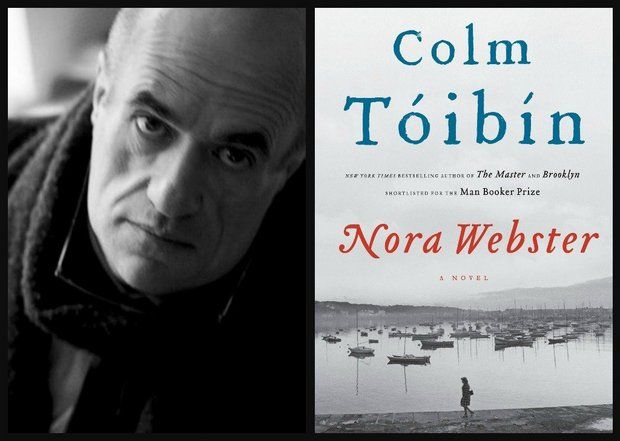
Thoughts on Colm Tóibín’s Nora Webster (by Jill)

Nora Webster coverI didn’t think I was going to finish Nora Webster today, but I am pleased to report that I did. I started the morning with forty percent still to go (I read it on my boss’s Kindle), and managed to not nap the day away like I did yesterday. The Venti iced coffee from Starbucks helped. A character-driven book like this was just what I needed after reading the plot-heavy Wayward Pines trilogy. Despite the sadness inherent in the story of a middle-aged woman mourning the death of her husband, I was able to find humor and hope in its pages as well.

The novel takes place in the late sixties/early seventies in a small town in Ireland. Nora’s husband Maurice has passed away from some long illness, and it sounds like his death is drawn out and painful for all concerned. They have four children: Fiona, Aine, Donal, and Conor. Fiona and Aine are both away at school but seem to come home often, and Nora is at home with the two boys. The entire novel is told from Nora’s perspective, and Nora is many things, but objective she is not. She imagines what everyone else is thinking, usually unfavorable things about her parenting, her job, or the manner in which she is mourning her husband, but never asks anyone their thoughts or opinions, and assumes that it isn’t her right to ask. She even thinks she should leave her kids alone, because when she was young her own mother butted in too much in her life and she hated it and assumes her kids will too. I get the feeling that her kids not only would like it, but that some of them actually need it.

The things that happen in this novel are just the little things that make up a life. Nora sells the family vacation home at the beach in Cush because she can’t bear to see it again after losing Maurice, as well as the fact that they have no income. She goes back to work at the place where she worked before she married twenty years ago and finds that a woman who worked there when she was there before is now the office manager and still holds some resentment towards Nora for something that happened when they were girls. The scene in which Nora finally stands up to this woman is awesome. The workers at Gibney’s decide to unionize. There’s a bunch of stuff going on in Northern Ireland that people talk about all the time. Nora takes her family on vacation but three of the four kids ditch out and go home. This vacation takes place during one of the moon landings, and Donal is practically obsessed with watching coverage on television and taking pictures with his camera. Tóibín inserts quite a bit of Irish history from this period, but only half tells things, assuming that his readers will be able to infer the rest because they actually lived through the events or learned about them in school/at home. And that’s okay, but I know that the author used these events to help place the Websters in a historical context, and I didn’t get that information because I lack knowledge about Irish history. Kind of a bummer, you know?

By the end of the novel, about three years have passed since Maurice Webster passed away, and Nora has been seeming to do okay: Donal has gone off to boarding school, paid for by Maurice’s sister, who is very close to the family; Fiona has finished school and moved home to work as a teacher; Nora has joined a music society in town, and she has been taking singing lessons. She even redecorates her sitting room. But you know what she hasn’t done? Gotten rid of Maurice’s clothes. By the end of the novel, Nora has developed horrible insomnia, probably from three years of repressing her grief. The good news is that her family finally realizes that she’s not doing as well as she has made it seem, and they force help upon her so strongly that she has to accept it. It’s actually a nice way for the story to end.

Tóibín is a writer who doesn’t come on very strong: he eases his readers into his world and then all of a sudden you are completely wrapped up in it and you have no idea how it happened. I remember the same thing happening when I read his Brooklyn a few years ago. I was just going along, and realized I’d been reading the book almost nonstop for several days. He just has that effect on me. Nora isn’t always a very likeable character, but she an actual person, and one I will remember for a long time. I couldn’t even remember Ethan Burke’s last name while I was actually reading the Wayward Pines books, much less in six months or ten years. I know I will remember Nora Webster for at least that long.

Posted in Colm Toibin, Fiction - general, Fiction - Historical, Fiction - literary, Reviews by Jill | 2 Comments

Yarn Along

Yarn Along 6.10.15

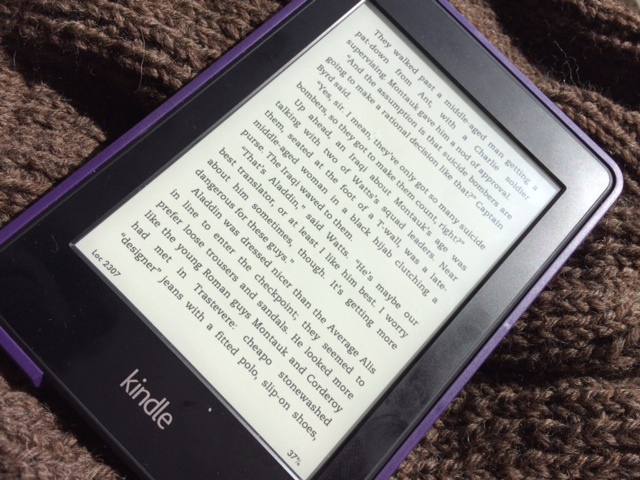
I haven’t made much progress on my sweater this week thanks to the whirlwind cross-country trip I took this past weekend, but I am reading a very good book: War of the Encyclopaedists by Christopher Robinson and Gavin Kovite. This book is so good that I didn’t even buy a single book at the awesome used book store in the Milwaukee airport. I’m reading it on my Kindle, so here’s a photo of the Kindle alongside a close-up of my English rib sweater that really shows off its texture. A sleek image of modernity overpowering the contours of tradition, and so forth.

Yarn Along is hosted by Ginny on her blog, Small Things.

Posted in Yarn Along | 3 Comments