Yarn Along

Yarn Along photo 10.28.15 - 1

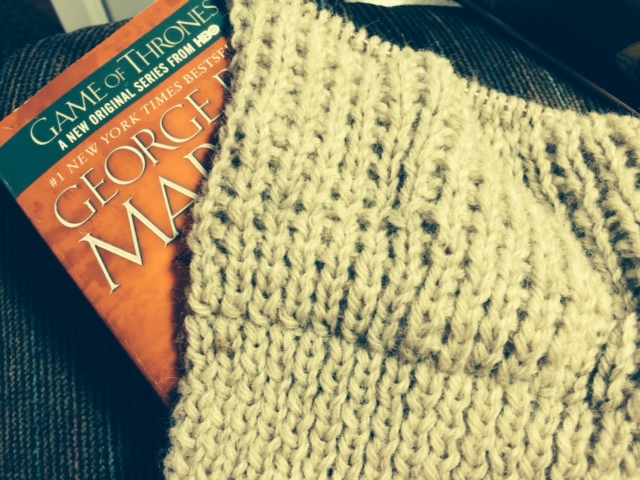
If you are kind enough to visit our blog on Yarn Along days regularly, you may have noticed that I sometimes like to knit the same pattern over and over. Case in point: as soon as I finished the brown English rib sweater (photos below), I immediately cast another one on in “oatmeal” fisherman’s yarn. This sweater fits me perfectly, which is not something I say often about my knits, and it is satisfying to knit and not especially challenging. And since winter is coming (as both weather.com and George R.R. Martin keep insisting), I will enjoy having another big, warm, blanketlike project in my lap. I love fisherman’s wool.

And yes, George R.R. Martin. His world is officially too large and too unwieldy. Many of the individual chapters are still very well structured and suspenseful, but he is following so many plot lines that a cliffhanger in one plot line might not be addressed until 500 or 600 pages down the road. The characterization in these novels, while often good, is not good enough to sustain this kind of tortuous plot. But I will persevere. I will finish this series, though I can’t quite see myself reading anything else by this author once this series is done.

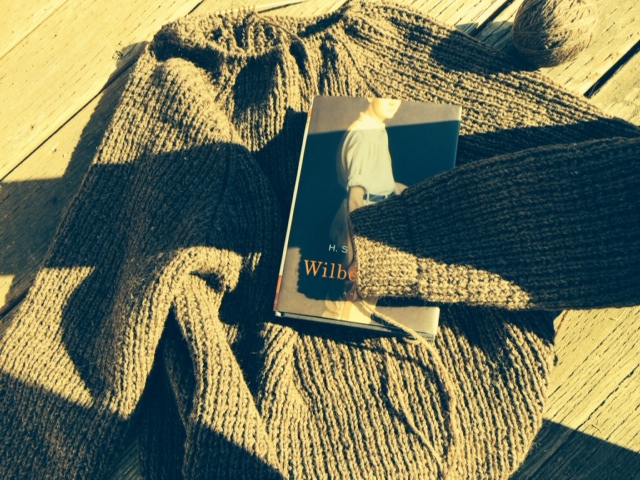
And here is a full-length shot of the brown sweater, which did not enjoy its time on that hanger. Doesn’t it look just like the shy kid at a party, one shoulder higher than the other, ankles crossed, wishing it could blink its eyes and magically be at home?

Yarn Along photo 10.28.15 - 2


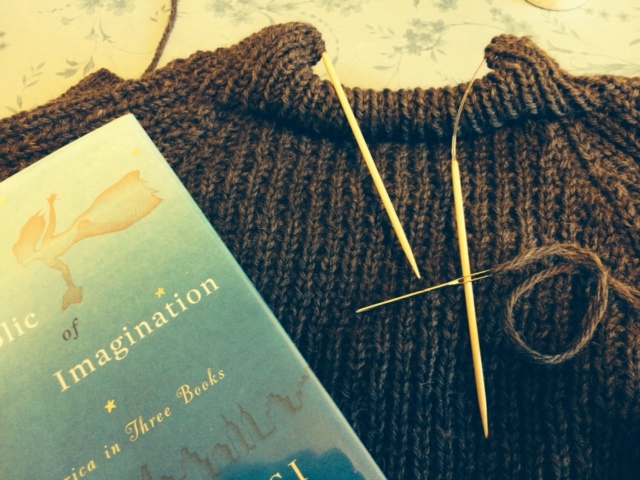
And here’s a close-up of the neck and shoulder detail.

Yarn Along photo 10.28.15

Thanks as always for reading! Yarn Along is hosted by Ginny on her blog, Small Things.

Posted in Yarn Along | 6 Comments

The Poetics of George R.R. Martin: Further Thoughts on A Feast for Crows (by Bethany)

feast_for_crows

Pages read: 414 out of 978

I put this book aside a couple of months ago and have been reading other things, but this week I picked it up again and – big surprise! – it was just as violent and humorless as ever. This installment concerns itself with a few central issues: cleaning up (physically, emotionally, interpersonally) after the shitshow of violence that erupted at the end of A Storm of Swords, crowning and marrying off the preadolescent King Tommen, and torturing the reader by withholding Tyrion from this installment, thereby depriving us of the only real light of creativity, humor, and goodness in the series. This novel also asks way too much of the reader when it comes to caring about the antics of the Viking-like Greyjoy family. I’ll elaborate.

This is the first novel in the series that asks us to put up with Cersei Lannister as a point-of-view character, and her chapters are almost unendurable. From the outside, Cersei has always seemed scheming and dishonest but also kind of pathetic, since as the daughter, wife, and mother of powerful men she has very little real power of her own. This is true enough, but after reading just a few pages of the novel from her perspective and learning just how evil and petulant her thoughts are, I lost all sympathy for her. When Jaime Lannister was first used as a point-of-view character in A Storm of Swords, hearing his thoughts helped me to like him more; not so with Cersei. Similarly, the one-trick-pony that is Brienne of Tarth has long stopped being interesting, and Sansa (now called Alayne and living as Petyr Baelish’s “bastard daughter”) and Arya are interesting when they appear, but the novel hasn’t focused on them much. Sam Tarly is in a potentially-interesting situation, in that Jon (the new Lord Commander of the Night’s Watch) has sent him to “the Citadel” (you know, just like PAT CONROY!) to become a “maester,” and he faces an imminent reunion with his father (who has promised to kill him if he ever sees him again; also like PAT CONROY!) and is also dealing with the complexities of his feelings for Gilly (one of Craster’s “wives”; see my review of A Storm of Swords) and the fact that Jon Snow switched Gilly’s baby with the baby of Mance Rayder, who is “the king beyond the wall,” because Stannis Baratheon’s creepy priestess woman has a tendency to steal the babies of kings and use their blood in her potions. But like Sansa and Arya, Sam doesn’t get to take center stage often enough for this situation to play itself out.

This novel also features some chapters from the point of view of other families and “houses” that have not been well developed in the earlier novels. First there’s the Greyjoys, whose name fits them perfectly. The Greyjoys remind me of the Kings of Stormhold in Stardust (actually, never mind – everyone in this series reminds me of the Kings of Stormhold in Stardust). Balon has recently died, and his brothers and children are butting heads to decide who will rule next, and as of the last chapter I read, the “Ironmen” have thrown their support behind Asha, Balon’s daughter who is also a naval commander and warrior. Balon has three creepy brothers who also want in on the action: the warlike Victarion and Eulon and Aeron, the priest of the CPR religion. Unfortunately we have seen little more of the CPR religion ever since it was introduced early in the novel.

The Martells are also making an appearance in this novel, though not as prominently as the Greyjoys. The Martells are from Dorne, which is in the southern part of Westeros, and they have weird habits like thinking it is OK for women to inherit thrones and royal titles from their fathers. The Martells currently have possession of Myrcella Baratheon, who is supposed to marry some Dornish prince once she “flowers,” but the Dornish folks are scheming to use Myrcella’s bloodline to capture control of the Iron Throne. In other words, the Game of Thrones goes on.

Other than the summary above, I only have one item of substance to relate about this novel, and it’s something I’ve noticed ever since the beginning of the series but have hesitated to mention it because it is really a very nerdy observation, and “Maker of the Single Nerdiest Remark Ever Made About Game of Thrones” is not a title that I covet. But here goes. I’ve mentioned before that the language in this series never changes register. Whether Martin is writing about children snuggling with direwolf puppies of dwarves crossbowing their fathers in the chest while pooping (the fathers are pooping, not the dwarves – and yes, FINE – there is only one dwarf that does this. And he has only one father), the language of the novel remains static. I’ve taken to calling it “normal sinus”: ba-BUM, ba-BUM, ba-BUM, ba-BUM, ba-Bum,” onward and forever, over and out. Since in literal terms normal sinus is the primary sign of life – and since this novel so often concerns characters trying desperately to hold onto their lives against terrible odds, there is a strange appropriateness to this rhythm. At the same time, this rhythm is what makes these novels such long slogs. Diana Gabaldon’s novels are as long as Martin’s or longer and at times are painfully overwritten, but even when she is devoting way too much time to a boring minor character, Gabaldon’s language never falls into such a predictable rhythm.

George R.R. Martin’s language, on the other hand, is highly iambic. The English language is highly iambic too, of course, although English prose doesn’t usually fall into a strict iambic meter nearly as often as Martin’s does. I wrote and studied a LOT of blank verse in my college and grad school years, and I am attuned to iambic pentameter lines and often notice them in writing and in speech. However, I am not used to finding several of them back to back in a single paragraph the way I do in Martin’s work. Here’s an example:

The going was much slower in the woods. Brienne plodded her mare through the green gloom, weaving in and out amongst the trees. It would be very easy to get lost here, she realized. Every way she looked appeared the same. The very air seemed gray and green and still. Pine boughs scratched against her arms and scraped noisily against her newly painted shield” (409).

In this passage of 64 words, Martin’s language falls into four separate perfectly iambic sentences or phrases. In addition, the last sentence could easily be part of a blank verse poem, presuming one is comfortable with a little enjambment and a truncated iamb in the first position of the first line (“Pine”) and a dactylic substitution in the first position of the second line (“noisily against”).

Think it’s a coincidence? Here’s another one:

The sound grew louder as she neared the cliffs. It was the sea, she realized suddenly. The waves had eaten holes in the cliffs below and were rumbling through caves and tunnels beneath the earthThe castle was built of old, unmortared stones, no two the same. Moss grew thick in clefts between the rocks” (412).

There are a few metrical variations here – truncated iamb in the second and sixth lines, anapest in the fourth positon in the third, trochaic substitution in the first position of the fourth (What?? I told you this was going to be nerdy.), but for the most part this is a paragraph of prose in which only six words do not fit nearly into a pattern close enough to iambic pentameter to be noteworthy.

I’ve often heard it said that iambic pentameter is the most “natural” rhythm because it mimics the heartbeat, and while the suggestion that poetics are connected to us in a physical way is fascinating, this idea has always seemed a little Anglocentric to me because all people have heartbeats but not all languages fall naturally into an iambic rhythm. For me in this novel, though, the meter of Martin’s language does mimic the heartbeat and does have a sort of symbolic connection to the plot and characters of the series. Does Martin write his sentences this way on purpose? Who knows? I do wish he would scale back on the iambic-pentameter sentences and clauses when his characters are not actually slogging along through literal or figurative mud. I wish he were more willing to play with different sentence lengths and structures, including intentional fragments, which are extremely effective in describing fast, impulsive action. When Arya is thwarted yet again in her attempt to find her family, when Sansa/Alayne lies awake in bed terrified of what Petyr Baelish will do next, and when Brienne has to deal again with strange men who like to make jokes about raping her – then the heartbeat can come back.

Posted in Fiction - Fantasy, Fiction - general, George R.R. Martin, Reviews by Bethany | Tagged , | Leave a comment

Yarn Along

Yarn Along Photo 10.21.15

I am SO close to finishing my brown sweater – I am currently working on taking the neck off needles and lashing each stitch to the inside of the neckline with an upholstery needle – but I couldn’t quite clear my schedule well enough to get it finished in time to photograph this week. So here you go. I tried to focus in on the neck so you can see how the shape is looking.

I truly went into withdrawal when I finished reading Wilberforce. I feel as if I’ve been dumped or abandoned. I think I used to feel this way at the end of books when I was younger (with great embarrassment, I’ll admit to feeling that way at the end of Beach Music when I was nineteen), but I’ve been way too jaded for those sorts of feelings for some time now. Or so I thought. It feels wrong to commit to another book right now, though I have made some inroads into A Feast for Crows, which has been sitting around unread for a while, and I suspect that when I feel a little better I expect that I will enjoy Azar Nafisi’s The Republic of Imagination, which is the book in this photo.

Any opinions on PfP’s new look?

Yarn Along is hosted by Ginny on her wonderful blog, Small Things.

Posted in Yarn Along | Tagged | 7 Comments

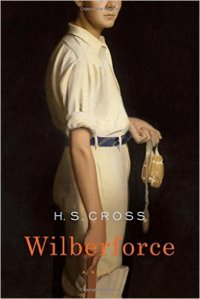
A Review of H.S. Cross’ Wilberforce (by Bethany)

wilberforce cover image

I’ve already complained about the cold, impersonal way I became aware of this new novel: I had to encounter it on a shelf in Barnes and Noble, of all places. This is in spite of the fact that I subscribe to the newsletters of every conceivable publisher and check the New Releases section on Amazon at least once a week. It’s true that I don’t read the New York Times Book Review as often as I did when I held a job at which the TBR was often lying around on Monday, but this is no excuse. I am not happy, Farrar, Straus, and Giroux. Consider yourself warned.

This is a boarding school novel, which means that I approached it with impossible standards, standards that it met and largely exceeded (more in a moment on the novel’s very odd ending). The year is 1926, and Morgan Wilberforce is in the fifth form at a British boarding school called St. Stephen’s Academy (equivalent to being a junior in an American high school). The novel opens in the school’s infirmary (called “the Tower”), where Wilberforce is receiving treatment for a dislocated shoulder after he made an ill-advised tackle of a student named Spaulding during a rugby match. No one can understand why he attempted such a suicidal tackle, and at first Wilberforce is at a loss to explain it.

In a fiction class I’m currently taking, we are discussing a technique the instructor calls “embedded questions.” These are brief moments in the action of a novel when a detail is dropped (but not addressed at all in the moment) that plants a question in the reader’s mind (think of the polar bear in Lost). They’re a form of foreshadowing, of course, except that other forms of foreshadowing, if they’re done well, are often not apparent to the reader on a first read, while embedded questions have to be apparent in order to work, as they are part of a novel’s suspense. Wilberforce is a model of how to use these questions well. As the opening chapters unfold, we learn that Wilberforce’s mother died during his first year at boarding school. We learn that even before her death Wilberforce was babied by his three older sisters, who also liked to tell him ghost stories that scared him and also made him ashamed of his fear (this becomes relevant when Wilberforce senses a “shadow” of some kind in the Tower). We are introduced to Silk Bradley, an older student whose role in Wilberforce’s first year in Boarding school is way too complicated to explain here (note the way I’m using an embedded question to explain how the author uses embedded questions). We overhear Wilberforce lecturing himself to forget the past: “He had to stop getting confused. He had to imagine that the past was the present. When something had a name and a date, it was history. The Glorious Revolution (1688), the Council of Nicaea (325), the Wreck of the Medusa (1816), the Gallowhill Ghastliness (1923), the Confirmation Catastrophe (1923). Now the Spaulding Smashup (1926). These events could be enclosed in parentheses” (10). We learn what the last three items of this list are, of course, and we also learn that these three items are not even the slightest bit “contained” in Wilberforce’s personal history.

In these opening pages, we also meet Grieves, a history instructor who shares the third-person limited point of view with Wilberforce. At first it is unclear why Grieves merits this role. Immediately following the short paragraph I quoted above, we get this: “These events had no business assaulting him in the Tower, reminding him, for instance, of the way Mr. Grieves had looked at him after finding the skull. [The skull? What skull?] Trembling, he’d asked if Morgan had done it, stolen the skull and the photograph of Gallowhill, put one inside the other and buried them in the archaeology pit to be discovered during the dig; purposely desecrated the memory of Gordon Gallowhill, Grieves’ predecessor, beloved history master and Old Boy” (10 – the bracketed interjection is my own). These sentences contain several embedded questions; they are also a pretty damn good model of what stream-of-consciousness can look like when it’s not being beaten to death by Faulkner or Joyce. The two 1923 events from the list above, plus the Spaulding Smashup and any number of other incidents, impact this novel at regular intervals without ever being perfectly summarized or explained. We know that Grieves and Wilberforce are linked to one another by something involving a skull and a photograph and an archaeology pit, and this incident figures often in the narration of the novel, both the parts from Wilberforce’s point of view and those from Grieves’.

Central to this novel is an idea that also gets quite a bit of air time on this blog: the idea that the past is never dead. Lining up the momentous occasions from Wilberforce’s school career does not prove, as Wilberforce hoped, that events in the past can stay dead; what it proves is that the past always has the ability to reach its clammy hands into the present. Never once in this novel, as far as I can recall, does Wilberforce contemplate a career prospect, consider which university he might like to go to, or even look forward to graduation and to the freedoms of adulthood; his entire being is focused on the present and the past. Similarly, Grieves does contemplate leaving St. Stephens and at one point does actually resign, but once he does so he seems unable to plot a future other than the one he originally intended.

Wilberforce is connected to Grieves not only by the “Gallowhill Ghastliness” but also by a few chance encounters in the first third of the novel. Grieves lives not on campus but in a nearby town – a town to which Wilberforce and his friends Nathan and Laurie like to escape once or twice a week late at night for some beer and flirting in a pub called the Cross Keys. One night, early in the novel, Wilberforce goes there alone, without his friends, and meets Grieves. Wilberforce finds this coincidence supremely unsettling (Teachers go to bars???), and this incident is one of many that causes Grieves to take an interest in Wilberforce, whom he sees as secretive and, in particular, secretly unhappy. Later in the first third of the novel, Wilberforce decides to run away (this is an exception to what I wrote above, I guess, about Wilberforce never contemplating leaving school – but his mental conception of what he will do after he runs away suggests that he is not running “toward” anything, just “away from” St. Stephen’s. This time, Wilberforce takes refuge in a garden that turns out to be adjacent to the rooming house where Grieves lives. Grieves sees Wilberforce and invites him inside, and they drink tea and talk well into the night before Grieves lends Wilberforce his bicycle for the ride back to school. This evening connects them even more closely, not only because of the confidences they shared over tea but also because the next morning they discover that they have missed an incident that the school is calling “the Fags’ Rebellion.”

I should mention that the author behind this novel’s wonderful verisimilitude is neither male nor British nor old enough to have been alive in 1926. She appears to be from a demographic similar to my own, which is to say that she is an American boarding school teacher somewhere in the neighborhood of forty years old. She may have spent time in England or have family connections there – who knows – but one of her most impressive feats in the novel is how unflinchingly she manages her use of the word “fag.” I’m assuming that my readers know that “fag” in this sense means a first-year student who is assigned as a personal servant of sorts to a senior student. I have heard multiple explanations of how and why “fag” (which can also refer to cigarettes, of course) took on its current meaning as a derogatory term for a gay man and I don’t know which source to trust, but it is generally understood that the servitude asked of “fags” was sometimes sexual in nature.

So anyway, the Fags’ Rebellion. Wilberforce’s friend Nathan has a younger brother in the first-year class named Alex, and at the outset of the novel Wilberforce, Nathan, and Laurie feel that it is their personal responsibility to “sort out” Alex. “Sort out” in this sense means to harass, haze, intimidate, or torture someone until they stop doing whatever behavior the sorter finds objectionable (I’ve caught myself using this expression a few times since I started reading this novel – a couple of times with regard to the cat, but also with regard to the mildew in the shower, an endless flood of difficulties involving Turnitin.com, and my dad’s defective hearing aids from the VA). Their attitude toward Alex is not entirely malevolent, though their actions sometimes are. Wilberforce has spent some summers with Nathan’s family and sees Alex as a younger brother of sorts, and he seems to have a sense of blind faith that failing to “sort out” Alex’s various behavioral issues would be a form of neglect. Fast forward a bit, and on the night Wilberforce spends in Grieves’ kitchen, Alex and a few other first-year students explode something in the chemistry lab, use melted wax to seal off all the locks on campus, and then take the school’s entire collection of disciplinary canes and burn them in a giant bonfire. Wilberforce and Grieves return in the morning to a school in chaos, as the adults in charge are threatening various things and classes are cancelled so all adult manpower can be devoted to “sorting out” the Fags’ Rebellion.

Wilberforce, having recently come to the realization that the reason he tackled Spaulding so insanely hard during the rugby match is that he would like to have sex with Spaulding, uses the down time after the Fags’ Rebellion to pursue said aim. Classes resume, but the administration continues to use student messengers to call students out of class to be interrogated, so Wilberforce and Spaulding start posing as messengers to pull each other out of class and have assignations in a place called “the Hermes Balcony” (which reminds me of a closed-off balcony at a school where I once taught, which went by the less-classically-inspired name of “JFK’s secret brothel,” but I digress). Their infatuation for each other develops rapidly, and Wilberforce and Spaulding soon start to plot to scare off Rees, another boy who is in love with Spaulding. Rees threatens suicide and then follows up with a note indicating that he has left campus to hang himself in an abandoned barn that is sometimes used for trysts. Unable to stay away, Spaulding insists on going to the barn and stopping Rees’ suicide, and Wilberforce comes along to supervise and assist.

Reluctantly, I am going to stop summarizing for a bit. The aftermath of Rees’ suicide attempt marks the end of the first of three parts of this novel. The parts are roughly equal in length. Parts 1 and 2 both begin with Wilberforce nursing an injury and end in a dramatic event at the abandoned barn, and even though this is a literary novel and extremely character- and language-driven, it is also a suspenseful novel and I don’t want to tell you everything that happens. What I want to do instead is jump ahead to Part 3, in which the novel kind of goes rogue. Parts 1 and 2 are so symmetrical; in the hands of many authors they would have been too symmetrical, predictably so, though in this case Cross builds these sections up with so much detail and insight into the characters’ interior lives that the symmetry becomes the least of one’s focal points as one reads. At the end of Part 2, a new headmaster has been hired at St. Stephen’s, and John Grieves is having a series of conniption fits because the new headmaster is a Person From His Past (Grieves refers to him only as “the person” and effectively stops functioning once he realizes that “the person” is present on campus). Since we have dipped into Grieves’ past quite generously during Parts 1 and 2, we know that Grieves spent long stretches of his childhood at the home of “the Bishop” and was raised nearly side by side with the Bishop’s son Jamie. These memories are generally characterized as positive in nature – though we know that Grieves became a Quaker as an adult and had to put distance between himself and the religious authorities of his childhood. We do eventually learn that the new headmaster is Jamie, the son of the bishop, though we never learn why Grieves is so deeply ashamed and horrified to see him. Since Grieves’ story often echoes Wilberforce’s story, my best guess is that Grieves and Jamie may have had a tryst of some kind and that it ended badly, but this is truly only a guess.

Grieves’ consternation makes more sense once we begin Part 3 and it becomes clear that Jamie is an asshole (a deep, deep asshole, in the words of a former professor of mine). His first act as headmaster is to remove Wilberforce from campus after Incident-in-the-Barn #2 and deposit him at the home of Jamie’s own father, “the Bishop” of Grieves’ memories. The headmaster promptly leaves, and Wilberforce has no idea if he has been expelled from school or disowned by his father or enrolled in a religious education program or what. He assumes that he has been brought to the Bishop’s house for a punishment of some kind and that the fact that no one mentions this punishment or arrives to inflict it is meant as an additional torment. Part 3 is fascinating (and I will tell you more about it in a moment), but it is also baffling, because in this section the narration largely stops swooping into the past. I am not going to claim that there is no reference at all to the Gallowhill Ghastliness or to other events of Wilberforce’s past, and Wilberforce definitely does think about Spaulding and others from school, but the notion that “the past is not dead; in fact, it’s not even past” largely goes away. Part 3 is rooted in the present. Wilberforce is drafted to help the children at a local orphanage prepare for a cricket match, and he finds he loves the kids and the experience of coaching. He goes for long, pleasurable, cleansing runs in the countryside. He reads. He verbally spars with the Bishop’s adult daughters and has a brief (and disastrous) tryst with one of the Bishop’s servants, and he also has long talks with the Bishop about who he is and where he is going in life – talks that sometimes send him into fits of guilt and shame but that also seem to help him to understand himself and free him from the pain of acting without understanding his motivations. But get this: after everything Cross does in Parts 1 and 2 to establish the fact that Wilberforce and Grieves are connected to one another through a series of coincidentally shared experiences and to establish the fact that something terrible happened to sever what had once been a pleasant relationship between Grieves and Jamie, Grieves is almost never mentioned in Part 3. There is one moment when Cross summarizes the things Wilberforce talks about with the Bishop, and the summary includes a statement that they talked about Grieves, but there seems to be no reference to the fact that the Bishop and Grieves once knew each other well. I can imagine that a stately figure like the Bishop might want to keep his own family’s personal history out of his counseling sessions with Wilberforce, but I can’t imagine why Cross chose not to follow through on a plot line that seemed so important at the end of Part 2. I did notice that the bio of Cross on the book jacket does say that “she is working on a second book set at St. Stephen’s Academy,” so perhaps a sequel is in the works that will answer some of these questions. But even books in series generally answer most of their central questions by the end – and then establish or hint at new questions that will need to be answered in the next book – and I was just stunned that this book did not do so. My estimation of the novel hasn’t gone down as a result, though I felt a little silly as I desperately read the last few pages, convinced even with only a few pages left that all the questions about Grieves’ backstory with Jamie and the Bishop would somehow be answered.

Before I move on to some final thoughts about the larger ideas in the novel, I want to say a bit about its language. I’m not sure if I have ever read another novel as dense with meaning as this one. If I have, it was probably one of Faulkner’s. There are hundreds of individual sentences in this novel that are entire short stories (or poems) in themselves, packed with layers of connotation and meaning: “The tide was turning, dangling before him a glorious opportunity to do for Spaulding what Spaulding could not do for himself in the life-giving radiance of Eddystone – the voice exhorted him to untangle his metaphor and reattach his brain” (154). Untangle his metaphor and reattach his brain. I don’t know what it means, but I doubt if there is a seventeen year-old in the world who would not be well-advised to take this advice. Then there is this rant of John Grieves’, delivered during a break in a day-long cricket match between current students and alumni on the day Jamie arrives at the school: “He might be a lowly undermaster, but he was still a freeborn Englishman with all the rights due him. Those rights included not being saddled with noxious Old Boys; not being issued directives (sort out the cricket) without why or wherefore; not having to bowl unaided for hours while an inebriated side fielded like a flock of mental defectives; and it included the right not to have pestilence from the past thrust up his nose at lunch sans explanation of any kind” (242). During the same cricket match, Wilberforce faces down his own former child molester, Silk Bradley (Playing cricket against his former child molester! This novel is SO good!), and when his bat connects with the ball, Cross writes that “his hands tingled like the time he had stuck a finger in one of Uncle Charles’ electrical sockets” (244). This last simile may be fairly average in and of itself, but what makes it great is that we already know that Spaulding’s first name is Charles but that Wilberforce doesn’t like to call him by his first name because it reminds him of his uncle – so in this one moment of bat connecting with ball we have the tormentor of Wilberforce’s past, the lover of his recent past, the perceived sexlessness of Wilberforce’s uncle, and the feeling of electricity running through everything. On the school’s departing headmaster, Grieves remarks, “Burton never had qualms about taking a set of verbal steak knives to whomever he chose” (274), and then there’s Wilberforce on Romantic poetry: “He didn’t know as much as he supposed he ought about Wordsworth; he knew that the man went stiff over daffodils and the French Revolution but otherwise spent his time mooning over fey, abstract subjects with other opium-eating characters like Shelley (a girl if ever there was one), Byron (a crackbrain and a rake), and Keats (also a girl, and a hypochondriac too)” (326). This rant on Wordsworth becomes even more entertaining when one realizes that it triggered by the Bishop telling Wilberforce to read “Batter My Heart, Three-Personed God,” which is a poem by John Donne that Wilberforce mistakes for a poem of Wordsworth’s. Then there’s John Grieves preparing himself to say goodbye to Jamie: “John spoke firmly to himself: this would pass. The person would presently depart. If forced to shake the person’s hand, he could allow his hand to be shaken. The person could say what he wished, but John need not respond. He need not, strictly, be present. His body was required, but not his essential self. That could adjourn into the evening sky, which the wind had scraped bare of clouds, making space for the sun to beat down” (248). That last passage should give you a sense of why I was so startled when the history between Grieves and Jamie was not developed in Part 3.

But now for some final thoughts. Part 3 of the novel does not do much of what I expected it to do – but it is nevertheless very compelling and does seem to have a moral or message of some kind. The Bishop is one of those wise, enigmatic adults that are always so appealing in coming-of-age narratives: the Robin Williams character in Good Will Hunting, Obi-Wan Kenobi in the original Star Wars trilogy, various characters in the Harry Potter series (Dumbledore sometimes, when he steps outside of his headmaster role, but more often Sirius Black and the other adults who mentor Harry without holding official authority), and so forth. I’ll admit to a bit of envy, since in a way the Bishop has my dream job. He lives on a country estate with servants and a huge library, and every so often someone shows up on his doorstep with a Troubled Young Person whom he talks to and listens to and disarms, and through a long circuitous series of events this mentor figure manages to convince the young person that he/she is just right the way he/she is – that in spite of the years and years that we spend being told to listen to authority there are also times in life when the right course of action is to stop listening and just act, that they are correct in their perception that the world is full of bullshit.

For most of Part 3, the Bishop seems to be trying to move Wilberforce from Kohlberg’s stage 1 – in which a person is motivated by fear of punishment – into Kohlberg’s stage 5 or 6, in which we act out of principled conscience and a respect for the social contract. (Stages 2, 3, and 4 involve acting out of desire for a reward, desire for social acceptance, and/or respect for the human constructs of law and order, for those who missed that day in AP Psych.) I never stopped eagerly turning pages, but I did spend parts of Part 3 jockeying between cheering on the Bishop and wondering if this lesson in adolescent psychology was the best way to conclude such a rich, multi-faceted novel. And then something ABSOLUTELY BAFFLING happens – and now I don’t know what I think, and I really, really, really want to talk about this book with someone who has read it.

Someone? Anyone? Please?

Posted in Authors, Fiction - general, Fiction - literary, H.S. Cross, Reviews by Bethany | Tagged , | 3 Comments

Yarn Along

Yarn Along photo 10.14

My brown sweater is all pieced and almost done. I’ve just started the neck, which looks awfully wide in this photo. I’ve made this sweater before and don’t remember the neck being this wide. We’ll see how things go. I picture this sweater as perfect for camping – it’s roomy, waterproof, tough, and can fit over multiple layers.

I’m reading H.S. Cross’s Wilberforce, which has not been well publicized. I say that because I receive every conceivable promotional email from book publishers and am constantly checking out the new releases on Amazon, in the NYRB, and elsewhere. This is a new novel by a new author, and I had to find out about it by walking past it on a shelf at Barnes and Noble on the way to the music section. This is not the sort of treatment I am accustomed to. The plus side is that it is totally engrossing, and not at the expense of being light or frivolous. I’ve been a little annoyed by my reading choices lately and have been wanting up my intellectual ante a bit, and I am just savoring the things this novel is asking me to think about.

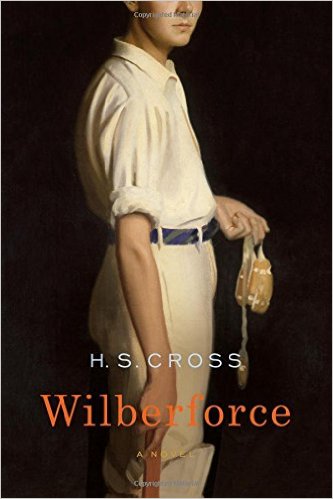
And if the folded-over sleeve conceals the fact that the cover image depicts a teenaged boy getting ready to flog someone, so much the better.

Happy Wednesday!

Yarn Along is hosted by Ginny on her blog, Small Things.

Posted in Yarn Along | Tagged , , | 6 Comments

A Review of Celeste Ng’s Everything I Never Told You (by Bethany)

Everything+I+Never+Told+You+-+Celeste+Ng

This is a strange little book – ubiquitous in the circles I walk in (i.e. circles made up of Amazon, Barnes and Noble, Green Apple, and a half a dozen small local bookstores) and appearing often on shelves devoted to “staff picks.” I’ve been intrigued but ultimately rejected it five or six times, only caving when I passed right by it in the school library and figured that checking it out would be a low-risk way of testing its waters. Though readable enough, this novel is noteworthy in the fact that all of its characters seem made of cardboard. In addition, the author’s odd choice of a very wide-ranging omniscient point of view undermines the suspense that the author seems to be trying hard to create. And this book manages all of the above without actually sucking. Intrigued? Read on.

This novel is about the Lee family: James, lonely son of Chinese immigrants, history professor, desperate to fit into American society; Marilyn, James’ Caucasian wife and frustrated housewife; Nath, their personality-free teenaged son; Lydia, their daughter, who – as the novel’s first sentence tells us – is dead; and oft-ignored youngest daughter Hannah, who knows everything. The novel is about the changes wrought upon the Lees when Lydia dies, although because so much of the novel takes place in backstory it is also about the past experiences of the five family members – the early lives of James and Marilyn and the lives their children have led at school that they have concealed from their parents.

At the outset, we are told that Lydia is dead, but all James and Marilyn know is that she is missing. They call the police and an investigation begins. We are told early on that Marilyn “disappeared” herself once, ten years ago, and that James, Marilyn, and Nath are all thinking (but not speaking) of that event as the search for Lydia begins. As we bounce between the inner lives of all of the key characters, including Lydia, we learn that Marilyn was the daughter of a home ec teacher and that she grew up determined not to be a housewife. She enrolled at Radcliffe, where she was studying to become a doctor but, on a lark, took a course on the cowboy (the lonely, solitary, long-suffering cowboy) in American history and culture, taught by a new Harvard instructor named James Lee. They kiss, fall in love, and get married, and when Harvard denies James tenure they move to a suburban Ohio town, where, as a multiracial family, they qualify as the local freakshow. Marilyn gets pregnant and does not resume her pre-med studies. Soon Nath is born, and Lydia arrives a year later.

I forgot to mention that this novel takes place in the seventies – making the domestic-heartache plot more plausible than it would have been otherwise. The problem is that it never feels like the seventies. Every so often bell bottoms are mentioned, and each time I stopped and said, “What??” At the same time, the novel doesn’t feel contemporary either, nor does it feel targeted to any other decade in recent history. This novel is separate from time, bare-bones, generic. This could be a deliberate move on the part of the author – an attempt to make the book seem timeless – and I have no doubt that it will work. However, the side effect of this technique is that the novel seems sterile, as if its characters are acting out their familial tableau on another planet somewhere.

Marilyn never loses her desire to be a doctor, and when her mother dies and she spends a week sorting through all of her possessions, she decides to abandon her husband and two children. With the money from the sale of her mother’s house, she rents an apartment in Toledo (of all places!) and enrolls in science classes at a community college. She never contacts James or the children, and James for his part never calls the police or takes definitive moves to locate Marilyn. This is how James operates: he’s a burrower. As a child he dealt with the embarrassment of being the only Asian student at his school and also the son of the school’s janitor by putting his head down and becoming a superior student, and he deals with Marilyn’s departure in the same way. At the same time, he parks the children in front of the TV full-time and keeps their routine in a holding pattern, as if he doesn’t feel qualified or ready to impose order on their lives without Marilyn. When Marilyn does return, all of the members of the family treat her return with the same blasé acceptance that they treated her departure. Well – all of them except for Lydia.

Lydia makes a silent promise on the day her mother returns: she will do every single thing her mother ever wants her to do. She develops almost a superstition about her fear of displeasing her mother. So for the next ten years, she puts up with the fact that her mother – who has now given up hope of being a doctor herself – is determined to make sure Lydia becomes a doctor. Lydia does everything she is told, but she secretly hates science and math and often has to cheat in order to get the grades her mother wants to see. After Lydia disappears, her mother’s slow excavation of Lydia’s room, which parallels Marilyn’s earlier excavation of her mother’s house, reveals all the hidden evidence that Lydia hated science and longed for a different kind of life.

This book puts its author in a difficult conundrum. The usual rule in writing fiction is “show, don’t tell.” But what does one do if one’s characters are the type who never, ever tell anyone anything? “Show, don’t tell” doesn’t work in this novel, so the author was forced into long passages of backstory that made me feel as if I was being preached to a little bit. Yes, get it, I kept thinking. Given the limitations of the challenge Celeste Ng set up for herself, though, I think this novel succeeds relatively well. I never lost interest in the novel, though I was disappointed by the ending (think Edna Pontellier in bell bottoms) and was glad when it was over. I haven’t told you much here about Nath (who is boring) and Hannah (who is not boring – if any character could have functioned as a first-person or third-limited narrator for the novel, it is Hannah – but who gets limited stage time, unfortunately. This novel is harmless and engaging and fluffy enough for a plane trip or beach vacation.

Posted in Authors, Celeste Ng, Fiction - general, Reviews by Bethany | Tagged , , , , | 2 Comments

Yarn Along

Yarn Along photo 10.6

It has reached the point where I can’t count on having high-quality daylight when I get home in the evenings, so this photo doesn’t do a great job of showing off the colors in this photo, but who cares – it’s done! This sweater was simple and fun to make, and I’m happy with the sweater if not with the photo. The right sleeve is red, not orange as it appears, and the left sleeve is purple, not blue. Yay for unintentional camera tricks. When I was a kid, I liked a Willy Wonka candy called Rinky Dinks, which came in red, purple, and green, and I have been calling this my Rinky Dinks sweater because it reminds me of those colors.

I am also working on piecing and finishing the adult-sized brown sweater that I worked on all summer. I hope to be able to show that one off next Wednesday.

For fun, I’m reading Paula Hawkins’ The Girl on the Train (and by “fun” I mean “trying to finish it quickly so I can start Geraldine Brooks’ The Secret Chord or H.S. Cross’ Wilberforce — or anything, really, with the possible exception of Paradise Lost”).

Yarn Along is hosted by Ginny on her blog, Small Things.

Posted in Yarn Along | Tagged , , , , | 12 Comments

Thoughts on James B. Woulfe’s Into the Crucible: Making Marines for the 21st Century (by Bethany)

Into the Crucible cover image

This isn’t the sort of book that I can in good conscience “review.” I read it because a brief but important scene in the novel I’m writing takes place during the Marine Corps training exercise called “the Crucible,” and I needed a detailed factual account of how this exercise works in order to write the scene well. This book is not very well written, but I didn’t expect it to be, and I did get the information I needed and more – so overall this was a successful research experience.

The Crucible training exercise is (in my words, not the author’s) basically a cross between a ropes course and the Stations of the Cross, except with the added component of near-starvation. This is a 2.5-day event designed to simulate the pressures of combat. In 54 hours, the recruits get only eight hours sleep and very little food, and at intervals along their hike they participate in various physical and mental challenges. Each challenge is named after a Marine who was awarded the Congressional Medal of Honor, and each event simulates the combat incident that led to that Marine’s heroism. At the beginning of each challenge, the drill instructor speaks to the recruits not only about the challenge they will be undertaking but also about the Marine the challenge is named after and about the larger context of his/her heroic acts (and yes, a couple of the Marines represented in the Crucible exercise are women). I really did learn a lot about American military history while I was reading this book. My knowledge of the Pacific Theatre in World War II has always been weak, and this book filled in a lot of the holes in my knowledge.

If you have been part of an even-remotely-progressive school any time in the last thirty years, you will likely recognize the sort of challenges the Marines engage in during the Crucible exercise. In one event, a rope is strung across the trail at about the recruits’ head level, and the challenge requires the recruits to get every member of their squad over the rope without touching the rope at any time. The activity was meant to simulate a situation in which Marines had to entire a building through a broken window. While I was reading, I remembered the time my elementary school class did this same activity. We made a human pyramid of some kind, and a few strong, athletic students used the pyramid to boost themselves up and then jump over the rope. When about half of the class was on the other side, the group still on the original side boosted the lighter members of the class as best they could and the stronger students on the other side helped them over the rope. Finally, the student with the most gymnastic experience stayed on the original side until everyone else was over the rope and then backed up, got a running start, and did some kind of back handspring-thingy to get herself over the rope without touching it. The purpose of the activity is to force the group to contemplate everyone’s strengths and weaknesses and use each person to the best of his/her abilities without judgment, knowing that an individual who is not helpful on one event is likely to have the right skill set for an upcoming event. This kind of training is now common during new student orientations and leadership training at schools and colleges and during team-building events at many workplaces, though I am more than happy to concede that the Marines likely invented it first. Even the ever-popular “trust fall” makes an appearance.

In general, this book was enjoyable to read while the author was covering military history and narrating the strategies the recruits used to approach each exercise. After each exercise was complete, though, the author indulged in a page or so of preachiness about teamwork and self-sacrifice and taking control of one’s destiny and the like, and I enjoyed these passages much less. I felt as if I were ten years old and sitting in a folding chair on a YMCA or Boys’ and Girls’ Club gym listening to a presentation on how the military can lift me out of poverty and give me a chance at success. I did not enjoy these passages, but I did read them and did my best to internalize them, partly for research purposes but mostly because I do think that books deserve to be taken on their own terms. I did find the stories about the Congressional Medal of Honor recipients inspiring, and I did learn what I needed to learn for my book. I do worry, though, that if my book is published I will read reviews that say things like, “This book is good and all, but I wish the author had taken the time to do some actual research on Marine training instead of just repurposing what she learned in seventh grade Outdoor Ed.” But I did do my research, and I do feel confident in moving forward with my novel, which was the point of reading this book in the first place, so I suppose I can learn to tune those voices out.

Posted in James B. Woulfe, Non-fiction - History, Nonfiction - Education, Nonfiction - General, Nonfiction - Military, Reviews by Bethany | Tagged , , , , | Leave a comment

Another PAT CONROY MONTH!!!! Bites the Dust: Final Thoughts on South of Broad (by Bethany)

south of broad cover image

If it weren’t for this blog and its tradition of celebrating PAT CONROY every September, I would never have reread South of Broad. When I read it for the first time in 2009, I was highly attuned to its flaws. These flaws haven’t gone away – and I’ll outline a few of them below – but this time I thoroughly enjoyed my escape into Pat Conroy’s Charleston, where light dances off the river at sunrise, where good and bad are sharply delineated, and where the characters say one another’s names with every single line of dialogue. This isn’t an especially artful book, but I didn’t mind.

A vein of goodness and a vein of evil pulse under the surface of this novel, and by PAT CONROY’s standards these channels are managed fairly subtly. Evil takes the form of Trevor and Sheba Poe’s murderous psychopath father (who is not subtle at all, but he only appears on the page occasionally), the insidious racism and elitism of Chad Rutledge’s family, and the ongoing presence of Father Max Sadler, a priest and trusted family confidant whose abuse of Leo King’s brother Stephen led to Stephen’s suicide when he and Leo were only children. I remember that when I read this novel the first time, the discovery of a videotape of this abuse at the end of the novel seemed to come out of nowhere, but when I reread it I realized that it does not come out of nowhere at all but is instead clearly foreshadowed from the beginning when Max tells eighteen year-old Leo, in reference to his mother’s love for James Joyce, that “one must always forgive another’s passion” (20) and again a page later, more darkly, when Leo receives communion from Father Max and contemplates his lifelong relationship with Catholic mysticism. Note what Conroy does with pronouns here, especially with “he” and “him”: “When the priest called for water, I provided him with water. When he needed to cleanse his hands for the coming mystery, I emptied cruets over his fingers. When he called for wine, I supplied him with wine in the gold shine of chalices. At the moment of consecration, when he turned the wine into the blood of Christ and the bread into the body of the same God, I rang the bells that had been sounded beneath altars for two thousand years. When I opened my mouth and received the unleavened bread from the consecrated finger and thumb of the priest, I felt the touch of God on my tongue, His taste in my palate, His bloodstream mingling in my own. I had come back to Him, after a full-fledged embittered retreat, after He stole my brother from my bedroom and killed him in my bathtub” (21).

Do you see that? The narration is saying that capital-H He – God – took Leo’s brother Stephen, because that is what Leo thinks at this point in the novel. When I reread this passage having already read the ending, I recognize, of course, that “he” should be in lower case, as it is the priest, and not God, who pushed Stephen to suicide. I don’t mean to sound condescending, but I almost feel proud of PAT CONROY here. This subtlety goes above and beyond what I usually expect from him.

The vein of good in the novel, however, is not handled quite as shrewdly. The “good” characters in the novel practically pulse with heavenly light. The central figure in this league of extraordinary gentlemen is Leo himself, who bounces around from place to place waging war against hate, prejudice, violence, and pretension. He endures his mother’s grim frigidity with good humor, takes a years-long punishment for a crime he did not commit, puts himself in harm’s way confronting Trevor and Sheba’s father, single-handedly stops his high school from breaking out into a race war, punctures the pretensions of Chad Rutledge and his family, cleans up the pee and poo and vomit of an elderly man for whom he does court-ordered community service, and marries Starla Whitehead even though he knows she is too emotionally damaged to do anything but hurt him in return. It is true that Leo is damaged himself – we are told that he spends three years in a state psychiatric hospital after his brother’s suicide – and that people who are damaged and recover reasonably well can sometimes develop a precocious level of empathy and compassion for the suffering of others. But in Leo’s case, he seems to have recovered too well. Leo is the novel’s first-person narrator, and we should have access not only to his observations and experiences but also to his patterns of thought, the trajectories of his feelings, yet nowhere in the narration is there the kind of intensity I would expect from a protagonist with Leo’s psychiatric history. He doesn’t feel like someone who is conversant with darkness and demons, in spite of the fact that the narration continually insists that he has this kind of history.

This novel’s greatest flaw, though, is its tendency to disguise exposition as dialogue. If an author is going to write a novel about a group of friends who have known one another for years, are the godparents to one another’s kids, and have keys to one another’s houses, that author can’t write dialogue like “I envy you, Leo… You’ve got a wife who’s never there, and you write a gossip column that ruins someone’s life every six days” (177) and “Molly, you’re married to one of the most successful lawyers in the city. He’s from one of the oldest, most distinguished families in Charleston. You were destined to marry Chad Rutledge the day you were born” (168). While long-winded people certainly exist, most dialogue among adults takes place in a sort of shorthand. Even if people don’t know each other well, they skim over backstory and facts (consider the prevalence of idioms like ‘long story short’), and if they do know each other well, every conversation is a continuation of one that began in 1983 and has contained hiatuses of years or decades without losing integrity and momentum. This is the kind of relationship Conroy is trying to capture here, and in other aspects of his characterization he succeeds, but overall the dialogue in this novel is a disaster. Dialogue among intimates is hard to replicate on the page because its center keeps shifting from speaker to speaker, the heart of the conversation appearing and disappearing like so many fireflies. I sympathize with writers who can’t make plausible dialogue work, and I admire those who can. If I could magically make one thing in this novel better, it would be the dialogue.

But enough. During the ten days or so that I was reading this novel, I craved it on my drive home and wrapped myself up in it like sweatpants and a soft old blanket when I got home. Even if it’s true (and it is) that this isn’t one of PAT CONROY’s best novels, Leo King contains so much of each of Conroy’s earlier protagonists that I could almost trick myself into thinking I was reading The Lords of Discipline or The Great Santini or The Water is Wide. I don’t know if PAT CONROY “can’t” write about different sorts of protagonists or if he has just chosen to continue to explore the familiar, and ultimately it doesn’t matter. I love Pat Conroy’s protagonists: their vulnerability, their humor, their loyalty, their tirelessness, their kindness and decency born of suffering, their ability to seek out and destroy bullshit. I will keep reading no matter what.

Posted in Fiction - general, Pat Conroy, PAT CONROY MONTH!, Reviews by Bethany | Tagged , , , , , | Leave a comment

Yarn Along

Yarn Along 9.30.15

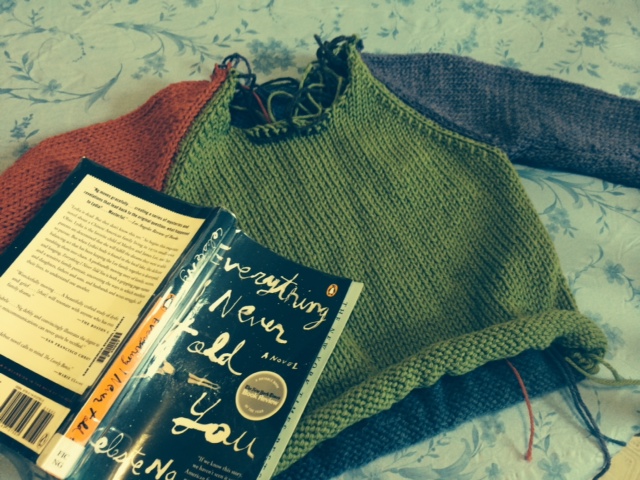
I pieced the colorblock rollneck sweater this weekend, and now all I need to do is knit the neck. This photo doesn’t really do the colors justice, but I’ll take some outdoor photos once the sweater is finished.

I’m reading Everything I Never Told You, which is a prime example of the genre I like to call the airplane novel. Airplane novels are 300 pages long, give or take a few – long enough to read on a mid-length flight without being long-winded or tiring. They concern a few key characters and explore those characters’ inner and outer lives in detail, but we’re not expected to keep track of extensive backstory. You can read these books when you’re tired. I will explore this subgenre in more detail sometime soon.

Yarn Along is hosted by Ginny on her blog, Small Things.

Posted in Airplane Novels, Yarn Along | Tagged , , , , , | 10 Comments