Thoughts on Ta-Nehisi Coates’ Between the World and Me (by Bethany)

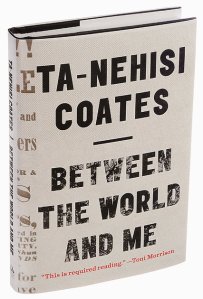
between the world and me cover image

I read this book in spite of its popularity, not because of it. I read it in a day and can’t quite imagine doing otherwise – this isn’t the sort of volume from which one can be easily distracted. In writing incisively about matters that are highly timely – the Black Lives Matter movement and the series of assaults on black men by white police officers that brought it about – Coates frames the book as a letter to his son Samori, whom Coates saw leave the room in tears when he learned that Darren Wilson would not be punished for the killing of Michael Brown. Coates, who is exactly my age, grew up in a stable family within a dangerous Baltimore neighborhood. He was well cared for (though sometimes punished violently; his analysis of the role of parental fear in family violence is excellent) and educated, though his treatment of public schools that emphasized rote learning and obedience is scathing, and he enrolled at Howard University, which he calls “the Mecca” and where he learned that black skin did not have to be synonymous with poverty, gang violence, and fear-driven ways of thinking. He portrays Howard as a deeply intellectual and creative place where he experienced a life-altering awakening to his own intellectual potential – but he also portrays it as a bit of a fairy land, a place that in his experience did not reflect or even acknowledge the realities of race relations in this country. Samori was born into somewhat precarious circumstances, in that his parents were unmarried and still undergraduates – but both Coates and his then-partner were responsible and came from responsible and supportive families, and Coates dropped out of Howard before he graduated to train himself as a freelance journalist, becoming over time one of the most well-respected writers on the contemporary African-American experience. As a result, he and the other adults in Samori’s life have largely been able to protect Samori, and the boy’s initiation into the widely-publicized incidents of white-on-black police violence shocked Coates out of his parental (though not personal) complacency just as much as it shocked Samori.

The central message of the long letter to Samori that comprises this book is that black people in the United States do not own their bodies. Clearly this is a legacy – probably the primary legacy – of slavery. When the economic spine of a democratic nation is built around the hypocrisy of slavery, the cognitive dissonance required of its leaders – and in some level this includes all whites, who take advantage of the safety of their skin color even if their lives contain few other privileges – is unfathomable to me. I started to consider this question on my own for the first time about eight or nine years ago when I picked apart Narrative of the Life of Frederick Douglass in order to teach it in an 11th-grade English class. Like most new-ish teachers, I started with the obvious effects of the slave system: the breaking up of black families, the pattern of enforced illiteracy and ignorance, a deeply-bred distrust among slaves of everyone except a trusted few. Once I started, though, it was hard to stop. I saw the systematic way that young white people were taught to blind themselves to the full humanity of slaves, even when their untrained eyes inclined themselves to recognize and even embrace it. I saw the legacy of slavery in the culture of the rural south, obsessed both then and now with the paranoid (and armed) protection of one’s property, not only because of fear of theft but because of repressed guilt, which bred a need to keep the realities of what exactly happened on these plantations a fiercely-guarded secret. I made the connection between the “well-regulated militia” of the second amendment and the constant fear among whites of a slave rebellion. Douglass is subtle on this point, but he does allude to the constant triangular tension between wealthy slave-holding whites – their own bodies gone somewhat to seed by their easy lives – the poorer whites who often worked as overseers, working in some cases as many hours per day as their slaves but almost always distinguishing themselves by spectacular cruelty, and a much more numerous slave population strong in body yet constantly on the verge of exhaustion and starvation, their lives lived at the very bottom of Maslow’s hierarchy of needs yet still a nonstop perceived threat to their overlords. This dynamic laid out in Douglass’ Narrative is the same one played out in the ongoing episodes of police (and other) violence in recent years that have given rise to the Black Lives Matter movement. The Darren Wilsons and George Zimmermans in these equations are the equivalent of the poor white overseers – placed in positions of authority in spite of what may be generations of deeply-repressed, poorly-understood fear. The legal context of today’s violence has changed – though not as thoroughly as it should have – as have the setting and details of the incidents, but this central idea that Coates returns to again and again – that African Americans have never regained sovereignty over their bodies after the legal end of slavery – is true.

I know, I know – this review of Coates’ book is not really supposed to be an essay about me. I didn’t set out with the intention of writing so much about my own growing understanding of my country’s deep racial dysfunction. But I suppose I lingered so long here because I want to say that I get it. Like everyone else, I was born into a time, place, and body that I did not choose. As a white woman, I think I fear for my body a bit more than white men do – but I’ve also been convinced over and over and over again – by Frederick Douglass, by Richard Wright, by Ralph Ellison, by James Baldwin, by Toni Morrison, and now by Ta-Nehisi Coates – that the physical helplessness of African American men and women exceeds anything I have experienced personally. My understanding of this helplessness came mostly from reading – and from being pushed by very intelligent students to articulate what I saw in the books I read (this is one of the greatest benefits of teaching – you know, aside from the free T-shirts and the constant migraines) – so I empathized with Samori, who encountered the repressed dysfunction of his comfortable world on TV and online.

In spite of the fact that I did have some background in the subject matter, I had to do more Googling while I read this book than I am comfortable admitting, and I left this book with a rich and enticing reading list. The sections devoted to Coates’ intellectual coming-of-age at Howard are a treasure map of black scholarship in history, anthropology, literature, and other fields, consisting mostly of authors and titles that are new to me. While Coates’ book fits securely in the tradition of DuBois, Ellison, Baldwin, Malcolm X, and other black intellectuals who are part of the canon as I studied it, Coates actually spends little time discussing these authors directly. He assumes we know their work already – or at least that we know where the nearest library is if we don’t. I like it when authors take their readers seriously in that way – even if I was humbled by all the Googling I had to do.

This book is already a phenomenon on 2015’s literary scene, but I do encourage you to read it if you haven’t done so. You won’t feel preached at. This is a consequence of Coates’ choice to structure the book as a letter to Samori, I think. A reader with a little congenital defensiveness is allowed to sit on the sidelines if he chooses, focusing on the intimacy of the communication between father and son rather than the larger implications of Coates’ message for all Americans. Most will eventually allow themselves to be invited in, I think. Coates is wise and honest, and he is not afraid to mine his own vulnerability as he probes the deeply dysfunctional social system that is woven into our social systems, our constitution, and our assumptions and emotions as individual citizens of our complicated, wounded country.

Posted in Authors, Nonfiction - Anthropology, Nonfiction - Education, Nonfiction - General, Nonfiction - Memoir/Biography, Nonfiction - Politics/Current Events, Reviews by Bethany, Ta-Nehisi Coates, Uncategorized | 3 Comments

To Stave Off That Feeling of Helplessness (And, OK, Also Because HAMILTON SOUNDTRACK)

Federalist photo.jpg

When I started reading The Federalist a couple of nights ago, I didn’t know that it was about to become a blog challenge. I just thought I was expressing my abiding love for THE HAMILTON SOUNDTRACK in a characteristically nerdy way. But as I read through the first several essays – most by Jay so far – I find myself thinking about the upcoming primary season. It’s a little ironic that in the months leading up to our national elections, we showcase our most idiosyncratic regional behavior. So between now and whenever I finish it, I plan to check in here once a week or so, on no particular schedule, to comment on the connections I see between the essays I’m reading and the ever-entertaining horror show playing itself out on CNN. If anyone would like to join me, feel free!

Posted in Glimpses into Real Life, Nonfiction - Essays, Nonfiction - General, Nonfiction - Politics/Current Events, THE HAMILTON SOUNDTRACK, Uncategorized | Leave a comment

Final Thoughts on Michel Houellebecq’s Submission (by Bethany)

submission cover image

This really isn’t the sort of book that lends itself to worries about “spoilers,” but you should know that I do clearly state the novel’s ending in the second-to-last paragraph. Please avoid this paragraph if you would like to be surprised.

The last time I posted on this novel, my jury was very much still out. I was intrigued by the premise (though no more or less so than I was after reading the book jacket) but not at all impressed by the plot or characters. That has changed. This is a fantastic novel in spite of its slow start – and since the last time I posted I’ve learned from a more experienced Houellebecq reader that this is his usual formula: slow start, lots of emphasis on the mundane, lots of not-especially-good sex, some disquisitions on beauty, then the sudden introduction of some really fascinating and charismatic secondary characters, one of whom gives a super-inspiring monologue on all of history, and then the end. Which is what happens in Submission, and I was thoroughly charmed.

Before the election that propels the Muslim Brotherhood into power, protagonist François decides to take a trip outside of Paris. He has never left Paris since he moved there as a young adult (!), but he does have a car. He suspects that violence may be about to break out in Paris, so he heads for the countryside. Along the way, he stops for gas and finds all of the gas station employees murdered and the pumps drained of gas. This profoundly upsets him – though not so much that he doesn’t step over the cashier’s bleeding body in order to steal some stuff. At this point, I was worried that the novel was going to devolve into a stereotypical pasty-white-man-having-gun-battle-with-jihadis plot line, but – to Houellebecq’s credit – this is the last violent incident in the novel. Later, at a hotel, François learns that there were coordinated episodes of violence throughout France, targeting polling places. The government reschedules the election for another day a week later and sends the military to supervise the election and maintain voter safety. Watching TV in his hotel later that night, François muses that “the idea that political history could play any part in my own life was still disconcerting, and slightly repellant. All the same, I realized – I’d known for years – that the widening gap, now a chasm, between the people and those who claimed to speak for them, the politicians and journalists, would necessarily lead to a situation that was chaotic, violent, and unpredictable. For a long time France, like all of the other countries in Western Europe, had been drifting toward civil war. That much was obvious. But until a few days before, I was still convinced that the vast majority of French people would always be resigned and apathetic – no doubt because I was more or less resigned and apathetic myself. I’d been wrong” (92).

In other words, to quote Trotsky, “You may not be interested in war – but war is interested in you.”

François waits this part of the novel out at a hotel in a small town called Martel that is also the site of a medieval Catholic shrine that was important to Joris-Karl Huysmans, the 19th-century author on whom François is an expert. Having never visited the shrine before (Houellebecq makes it clear that we should see this as an indictment of François’s nonexistent curiosity), François is captivated by it, as was I. As medieval Christian art is wont to do, the shrine at Martel prompts François to think about suffering and redemption. He both inhabits the spiritual awakening Huysmans went through at this shrine and (sort of) has a spiritual awakening of his own. “When all the prophecies had been fulfilled and Christ had come again,” he muses, “it was the entire Christian people who rose together from the tomb, resurrected in one glorious body, to make their way to paradise. Moral judgment, individual judgment, individuality itself, were not clear ideas in the mind of Romanesque man, and I felt my own individuality dissolving the longer I sat in my reverie before the Virgin of Rocamadour” (134). In other words, François is starting to feel a sense of submission – important both because it’s the title of the book and also because it is the usual English translation of the word “Islam.” We’re not told, but I get the impression that this is the first time François has felt anything like this erasing of distinctions between self and other.

François runs into some acquaintances at the shrine, and they remind one another of the history of the town, which was named after Charles Martel, who defeated the Arabs at Poitiers in 732, ending Muslim expansion into Europe. After a variety of skirmishes throughout the region, the Arabs finally left nine years later, and Martel erected the shrine to thank God for the hard-won victory.

This episode makes a few things clear: the first and most valuable (at least for a new reader of this author’s work) is that everything important that happens in this novel happens through dialogue. On his own, François drifts in his own inertia; however, he is surprisingly susceptible to the grand pronouncements of others. The novel never says, but in light of this susceptibility, along with the fact that François seems to care very little about his academic career, I wonder if François entered academia because he loves listening to really smart people talk. I have some experience in this area, since my own interest in going back to grad school is motivated by a similar tendency to romanticize the pleasures of sharing meals and faculty-room debates with smart, passionate people. I sympathized with François’ excitement when his smart, well-informed colleagues and friends entered the scene. I don’t think François wants to be alone with himself any more than I want to spend too much time in his head as a reader.

This scene is also important for the way it begins the process of integrating the historical, political, religious, and personal elements of this novel. The second half of this novel seems determined to find a “theory of everything,” and I pinpoint this scene as the place where this intellectual questing (Houellebacq’s and the reader’s, not François’) begins. François’ friend Tanneur begins the subtle transition that makes this an intellectual narrative (all transitions in this novel are subtle) by referring to Europe’s history of fighting Muslims in the Crusades and by quoting Napoleon’s statement that “war is human nature” (120). None of this is earth-shattering – but again, the transition is subtle, and this moment prefigures the fact that Submission is very quickly becoming a novel of ideas.

Similarly subtle is the transition to Muslim rule. A man named Mohammed Ben Abbes is the new prime minister, and he is suave, charismatic, and – on the surface, anyway – inclusive. The scene in the gas station seemed to suggest that the novel would devolve into door-to-door warfare, and I am so grateful to Houellebecq for not going in that direction (I will trust him more next time). The election of Ben Abbes precipitated the arrival of a veritable army of Saudi millionaires, who are placed almost immediately into the highest positions in Parisian life (most importantly for François, in the administration of the Sorbonne, where he works). These men are cultured and sophisticated, though they are often followed around by their teenaged wives. François receives notice from the university that he will be required either to convert to Islam or retire with his full pension. At first he chooses to retire. Soon, a publishing company asks him to edit a new edition of Huysmans’ work, and François thinks he has found a perfect way to remain active in academia without being forced to convert. In a fury of intellect he writes an essay on Huysmans that represents the best work of his life. However, he soon learns that the editor who asked him to edit the series is a friend of Rediger, the university’s new president, and the two academics have been scheming to seduce François back into the university. Rediger is profoundly charismatic and persuasive; François is intrigued by him, and they have several conversations. It soon becomes clear that Rediger’s aim is to convert François to Islam.

One of the most important conclusions I drew from this part of the novel is something that is never mentioned on the page. How did all these Saudi oil barons get to Paris so quickly? By the time François returns from his trip, these men are all well-ensconced in their new roles. The answer I came to was a little chilling: they likely had been preparing for this relocation for a long time. Much of made of the fact that Ben Annas is a political genius, and he must have had all of these men waiting in the wings – possibly for years – to assume their new positions. This is plausible but also a little scary. In a way, just as we know that countries and nations have learned to weaponize chemicals and biological agents and economic systems and airlines and the internet, Ben Abbas seems to have weaponized democracy. When I studied martial arts, we were always taught to “use our environment” in a conflict situation; in a democratic nation, it makes sense for someone looking to stage a takeover to use democracy to achieve his ends. Of course, in weaponizing democracy in this way, the fictional Ben Abbas echoes the strategy of another figure whose name is never mentioned on the page: Adolf Hitler. Let me be clear: I am NOT comparing Muslims to Hitler in any way at all besides the fact that the historical Hitler and the fictional Ben Abbas came to power in the same way. I do think it’s important to mention Hitler in connection with this book because, of course, the Nazi occupation of France is such a painful part of that country’s recent history and is highly relevant to this novel. I thought about it nonstop, and I think Houellebecq counts on his readers to do so. Very close to the end of the novel, the word “collaboration” is used in italics – “Many people still considered it slightly shameful to bow down to the new Saudi regime, as if it were an act of collaboration” (235) – and of course this particular word, in italics in a French novel, means only one thing.

The last quarter of the book consists of the development of several patterns. First, François feels very little pain at the loss of his most frequent sex partner, Myriam, who moved with her family to Tel Aviv along with many/most of France’s Jews as soon as the election of Ben Abbas became imminent. Second, Francois becomes more and more intrigued by the possibility of having multiple wives. Third, Rediger begins actively proselytizing, and he and François have some fascinating conversations about Nietzsche and science and how the unfathomable size of the universe is a sign of man’s insignificance that should compel us to humble ourselves and submit before God. At the same time, François finds himself thinking more and more about polygamy, noting crassly that Muslim women are “trained” in the domestic and sexual arts (he gets this information from Rediger, who happily encourages him to think about the pleasures of polygamy) and imagining a future free of take-out. The justification Rediger provides for polygamy involves natural selection and is, honestly, pretty damn convincing. François never clearly states the reason for his final decision to convert – the infinite sublime of creation vs. the possibility of some fifteen year-old pussy – but in this ending I do see why Houellebecq felt the need to dilate on François’ pre-conversion lifestyle so extensively at the beginning. I also think the fact that the one of the possible reasons for the protagonist’s conversion is so lofty and intellectual while the other is so crass is essential to the complexity and brilliance of the novel. We are our bodies, minds, and spirits, and neither holds sway over the others, at least for long.

If it is true that Houellebecq’s novels always follow the formula that I related above, it is possible that I will lose some respect for him over time. I don’t have much use for formulaic writing, even if it yields good work. However, for now I am a fan. This novel engaged me on a variety of levels, posing an entire spectrum of questions and answering only a few of them.


Posted in Authors, Fiction - general, Fiction - literary, Michel Houellebecq, Reviews by Bethany, Uncategorized | Leave a comment

A Review of Shilpi Somaya Gowda’s Secret Daughter (by Bethany)

I have a love-hate relationship with book clubs. Officially I am a member of several (oh, all right – about twenty. I am a serial book-club joiner) – I cruise Craigslist and Meetup fairly often and love learning about new clubs in the area that will help me get acquainted with new books and new people. There have been a few book clubs that were really wonderful forces in my life at one time or another, and through which I’ve made some lasting friends. Overall, though, book clubs are mostly something that I complain about. There is usually at least one person in every club who is painfully annoying – who has a long list of topics she absolutely refuses to read about or who unfavorably compares every book to Twilight or who thinks she’s better than everyone else because she’s a college professor. And a surprising number of book clubs are run by dictators – a couple of times, I’ve more or less had to audition to be in a book club. Once I had to meet a panel of members at a café and discuss a book with them before I was allowed to meet the larger group. Another time, the leader disbanded the club by email on the day of a meeting that was scheduled to be at my home. I had already bought food and moved furniture when an email arrived said that “too many people were backing out” and that the club was a bad idea in the first place and that the whole thing was off. I emailed the club back to say that I was prepared to host and would love to have anyone who could make it come over (there were at least four or five people who had said they could attend), but everyone replied sheepishly to the effect that Miriam was the boss and it would be best if we all just did what she said. It was like sixth grade at a girls’ school all over again.

I could write a book about book clubs.

One of the clubs I am in is called “Indian Fiction and Indian Food” – and what could be better than that combination, right? I don’t have a ton of experience with Indian fiction – although I love Rohinton Mistry and Thrity Umrigar and Jhumpa Lahiri (who is Indian-American) and V.S. Naipaul (who is Trinidadian, but with Indian heritage) – but I love Indian food. I have been a member of this group for a good long while, receiving their monthly emails and sometimes buying or checking out the books and reading them, but I’ve never made it to a meeting. Recently I decided that I really should try to go to this club’s meetings – the people seem nice in their emails, and even if the people or the books weren’t much, it is hard to go wrong with Indian food. Fish masala, I thought. Chicken saag. Mango lassis. GARLIC NAAN. I went to the Meetup website and RSVP’ed YES.

But, unfortunately, all of this happened during the month that this club was reading Shilpi Somaya Gowda’s Secret Daughter. This book shows every sign of being a quick read – it’s written in contemporary language with very little in the way of descriptive or explanatory passages that could slow a plot down, and the chapters are short. There was no reason in the world that I shouldn’t have been able to read this book in a couple of days. Except one: this book is very, very bad.

Let me be clear about what I mean by “bad”: there is nothing in this book’s premise to suggest that it shouldn’t be good. The premise is this: Kavita and Jasu are an Indian couple. They come from a rural village and still follow traditional customs like arranged marriages. They are poor, and it is common in their village for families either to practice selective abortion to avoid having daughters or to kill or abandon baby girls when they are born because girls are considered an expense: their parents will have to support them until they are married and then save an enormous amount of money for their dowries and then rarely see them again after they are married. I get the sense that Gowda expects her readers to be highly shocked and upset to learn that these practices were going on in rural India in the 1980’s. Look, lady – I mentally shouted at the book more than once – I’m thirty-six, I’m educated, and the Oprah Empire has existed for my entire adolescent and adult life. You’re going to have to do better than this if you want to shock me, OK?

Jasu takes Kavita’s first baby girl away shortly after she is born and has his cousin kill it. A couple of year later, when Kavita has a second baby, she arranges for her sister to help her and the two of them sneak away the day after her daughter is born and deliver her to an orphanage in Bombay. A couple of years later, they finally have a baby boy, and when their son is five they move to the city (now Mumbai) in hopes of making more money than they make in their village.

Meanwhile, another plot is unfolding in California. Somer has recently learned that she cannot get pregnant, and some verbiage is tossed around about how her fundamental purpose as a woman will never be fulfilled if she can’t have children. (Let me clarify: the purpose of my sarcasm is not to mock the idea that being a mother is a supremely important purpose for a woman. I actually have an enormous amount of sympathy for women who can’t conceive. What I am criticizing is Gowda’s characterization of Somer – whom I don’t believe for one second has any true desire to be a mother and, later, after she adopts, is characterized as extremely cold and distant toward her daughter). Her husband, Krishnan, is the son of a wealthy Mumbai family who emigrated to the United States for medical school, where he met Somer. His family recommends that they seek an adoption in India, and – you’ve figured it out, right? – the baby they adopt is Jasu and Kavita’s daughter, the one Kavita took to the orphanage the day after she was born.

From here, the novel proceeds through a series of alternating viewpoints – all of the characters named above serve as the narrators of some chapters, as does Somer and Krishnan’s daughter Asha, Krishnan’s mother Sarla, and a few others. Long story short, Asha grows up to develop an interest in journalism and, as a junior at Brown, earns a fellowship to go to India to make a documentary. Her secondary goal, of course, is to track down her birth parents. Lots of predictable things ensue from there.

As I briefly mentioned above, there is nothing fundamentally wrong with the premise of this novel. Generational conflict, identity, poverty, relationships between men and women – we will never stop needing more literature and other art that deals with these subjects. When I started reading it, I may have slightly suspected that I would dislike it – since I know I have an extremely low tolerance for emotionally manipulative treatment of “women’s issues,” but I did not AT ALL think it would be as bad as it is.

Let me lay out a few reasons:

• Gowda consistently and egregiously breaks two important rules of fiction writing. These two rule violations are related to each other, I think, and each one exacerbates the other. One is the longstanding writing cliché of “show, don’t tell.” I don’t much enjoy spending time talking about this problem, since I am as bored by clichés as any serious reader and since this rule is so elementary as to barely be worth discussing in detail. Ultimately, it seems to me as if Gowda wanted to tell her readers that there are many difficulties and challenges involved in being a woman. True enough, but if that is her message, she would be better off writing articles or working for an international women’s rights foundation or producing a documentary or somehow wrangling her way into a guest appearance on Oprah. If her goal is to write fiction, then she needs to get rid of this smarmy moral-of-the-story and put her characters into real and individual action.

• The second rule that Gowda breaks is much more offensive to me than the first. She writes as if her readers are stupid. I hate being talked down to – by novelists or by real people in real life. Again, this novel feels like a lesson in sociology – and that’s a bad thing – but it is in Gowda’s creation of the character of Asha that her sermonizing-as-storytelling becomes most egregious. It seems to me that Asha is supposed to be a stand-in for the reader as Gowda envisions that reader to be. Asha is a stupid, naïve, wide-eyed innocent American. Now, wide-eyed innocent Americans exist – there is nothing fundamentally implausible about creating a character like this. However, Asha as Gowda portrays her would never have the drive or assertiveness or chutzpah to a) be accepted to a university like Brown, b) be granted a prestigious fellowship for year-long study abroad, or c) have the courage to enter the Mumbai slums as Asha does for her work as a journalist. Gowda goes to extremes to construct Asha as passive, ignorant, and happily naïve – and then she has her do things that no passive or ignorant person would ever do. Again, I see her as a stand-in for the reader; Gowda assumes that we do not know that women are still subjected to arranged marriages and that children in India still languish in orphanages in slums even at the end of the twentieth century, and Asha’s shock and disbelief when she learns about these injustices is supposed to mirror the reader’s. But Asha is supposed to be well educated; as a child, she attends a private school that is obviously modeled on the Harker School in San Jose, where she would have been exposed to basic matters of social justice, and in spite of the fact that her mother is perhaps the least inquisitive character ever created in fiction (Somer, by the way, also shows no sign of actually having the advanced education that Gowda tells us she has received), Asha was, after all, raised by one Indian parent. I don’t mean to suggest that an author can’t create complacent characters; of course she can – but she then has to give them the kinds of lives that actual complacent people live. And these lives don’t include prestigious international journalism fellowships.

• Gowda takes absolutely no risks as a storyteller. If she had backed up and looked at her material through anything other than her stubbornly female lens, she might have seen that there is great potential in the character of Jasu. Early on, he is portrayed as a villain, when he comes into his wife’s room after she gives birth and takes his baby daughter away to be killed. Since their marriage was arranged, Kavita knows very little about Jasu at this point and thinks that he very well might be a true villain – but later we learn that Jasu was being an obedient son, turning his daughter over to a cousin to be killed because that was what his parents and his culture expected him to do. After the birth of their son, when Jasu decides to take his wife and son to Mumbai, where they live in deplorable conditions in a slum and where he starts out doing terrible degrading and dangerous factory work, badly injures his arm, and slowly gains a small amount of prestige at work and is able to move his family out of the slum only to slowly and painfully recognize that his son – for whose eventual existence Jasu and his wife sacrificed two daughters – is a scoundrel and a criminal. If the definition of a protagonist is the character who most profoundly grows and changes as a result of the novel’s plot, then Jasu has much greater potential to serve as protagonist than any of the female characters. Given a little more creativity on Gowda’s part, Jasu’s point of view could have been a very compelling vehicle for the material in this novel.

• Finally, this novel strikes me as “diluted.” By that, part of what I mean is that it’s too long. But if you know me well or have read a lot of my other reviews, you know that length is not something I ever complain about in novels. If novels are good, I want them to be long – if I am invested in a fictional world, I want to stay there for a while – and if they are bad, I complain about whatever qualities make them bad, not specifically about the length, although reading a long, bad novel is certainly not something I enjoy. And at 339 pages of light, contemporary prose, Secret Daughter is certainly not excessively long in any kind of objective sense. But it’s diluted – as if someone poured a whole lot of water into the content of the novel, filling up the extra space between the plot elements that should be taken up with subtle characterization, interior monologue (which is not the same as a summary of a character’s thoughts, by the way), and evocative imagery. As I think about how I wish this novel had been written differently, I keep coming back to the idea of the collection of linked short stories. This is a genre that I respect and that I think is extremely difficult to do well. When collections of linked stories succeed, the empty spaces between stories become extremely significant. One story immerses us in a single point of view in a single place at a single moment – and then when that story is over, we get a chance to catch our breath before being immersed in a voice that is intentionally very different from the first one. Because these intermissions exist, collections of linked stories can afford to be extremely intense – even painfully so; they are concentrated, which is the opposite of diluted. Gowda seems to be striving for this effect, but even though she rotates between several different points of view, she does not do much to create a series of distinct voices. The whole novel operates in her reality – the author’s – and never really enters that of any of the characters.

I haven’t yet mentioned that in the novel’s final scene, Asha and her biological mother, Kavita, are in the same place – a Hindu temple in Mumbai. Gowda’s foreshadowing that this convergence will occur is painfully overdone, and I spent about half of the novel dreading the kind of sappy, sentimental – and totally implausible – reunion scene that she seemed to be setting up. Gowda, however, chooses not to make her characters aware of each other’s presence; both women are in the crowded temple and both are thinking of the other (Kavita has never stopped thinking about the daughter she left at the Mumbai orphanage), but they don’t actually meet each other. In some ways, this was a good choice on Gowda’s part, since a chance meeting in one of the world’s most populous cities between a mother and daughter who were separated the day after the child was born would be highly improbable, but I can’t for the life of me understand why Gowda spent so much time foreshadowing a reunion that wasn’t going to happen. But the main reason that I’m spending so much time on the final scene is that I think it could potentially make an interesting setting for a play – again, I continue to think about things that Gowda could do to make her novel less diluted. If she wrote a play, she could use the temple as the setting, and all of her characters – Kavita and Jasu and their delinquent son Vijay, Kavita’s sister Rupa, Somer, Krishnan, Asha, Sarla – could make a series of entrances and exits, engaged in their own little sagas and with their own very distinct priorities (Vijay could be there to rob people, for example; Asha could initially visit the temple to get footage for her documentary but could then return, having come to see it as a spiritual space, etc.). Backstory could be provided as needed in the form of monologues (which are acceptable in plays in a way that they often aren’t in fiction). In the play version that I’m imagining, I still don’t think a moment of recognition – in which Kamila knows that she is seeing her biological daughter and Asha knows that she is seeing her biological mother – would be a good idea, but they could meet as anonymous people in the temple, and the reader or audience would know the significance of the moment even though the characters do not.

Obviously this question of genre is moot – this novel is written and published and done with – and if you’re thinking that I’ve spent more hours of my life in creative writing workshops than could possibly be good for any human being, you could well be right. But all of this is a long way of saying that while I did not enjoy this novel one bit, I do want to treat its characters and situation with respect and try to shape them into a viable piece of art – not because I think Gowda is actually going to take my advice but because that’s the kind of reviewer I want to be. I want to be an honest reviewer and a tough one – I don’t want to offer praise unless I mean it – and I also want to use the process of reviewing to grow as a writer myself and to show my love and respect for the extremely difficult craft of writing.

So there we go. This was a lousy novel, and I don’t recommend it at all. I am also sorry to say that since I disliked this novel so much I read it rather slowly – and therefore I didn’t finish it in time to attend my book club meeting. All that trouble, all that frustration, all that banging the book against the recliner armrest and scaring the cat, and I didn’t even get my garlic naan.

The world is full of injustice when one is a poor bookblogger.
Posted in Authors, Fiction - general, Reviews by Bethany, Shilpi Somaya Gowda | Leave a comment

Thoughts on Ray Bradbury’s Fahrenheit 451, with Digressions (by Bethany)

I think most lifelong readers must have mental lists of the gaps in their reading experience – the books that everyone else has read but that they haven’t. Fahrenheit 451 has been on my list for years – and, actually, so has Bradbury’s entire oeuvre. That’s right – until last week, I hadn’t read anything by Ray Bradbury at all – as far as I can remember, not even a short story. Seems strange, doesn’t it?

So I picked up Fahrenheit 451 and started reading. I already knew the premise, of course: the setting is a futuristic, dystopian United States in which it is a crime to read books, and the protagonist, Guy Montag, is a “fireman” whose job is to burn down houses in which people are reading. The atmosphere of this novel is similar to that of other twentieth- and twenty-first century dystopian novels like 1984, Brave New World, The Giver, and The Hunger Games. Common elements of all of these novels is that a centralized government uses fear, the media, and/or drugs to provide a physically safe but contrived and controlled life for a portion of humanity, who consider themselves privileged to live within the confines of a city or other controlled space. Outside this space – the protagonist always eventually learns – are people who live in poverty and danger but retain the intellectual and moral freedom that the city dwellers have surrendered.

I wasn’t very impressed with Bradbury’s novel, although I understand why it’s a classic and think it’s a worthwhile introduction to the genre of dystopian fiction for young readers. I like all of the novels that I listed above better. Guy Montag isn’t much as a protagonist: while I recognize that it is difficult to fully characterize someone who has given up much of his individuality and submitted to the control of the government, all of the writers of the books above do a better job of fleshing out their protagonists than Bradbury does. Some of the technological innovations he creates for this novel are amusing: the robotic “hounds” that seek out and then euthanize offenders who evade capture (to which Suzanne Collins probably owes a bit of a debt for the creation of her hybrid creatures in The Hunger Games) and the idea of installing entire rooms made of TV screens (Montag’s wife complains that he has only bought her three “walls” – basically wall-sized flatscreens – on which she can watch TV; he is saving his money to install the fourth wall when the novel begins – not a bad bit of prescience on Bradbury’s part back in 1953, no?). But I always know that I’m not enjoying a novel much if I’m more interested in the gadgets than in the human beings.

Obviously this is a “message” novel. It exists not to provide beautiful specimens of characterization but as a warning that we always live on the verge of sacrificing our freedom to think for ourselves, and this is both old news and supremely relevant. Montag’s transformation begins when he encounters a teenage girl, Clarisse McClellan, one night on his way home from work. Clarisse is sort of traipsing around on her tiptoes in the middle of the night, rhapsodizing about how much she loves good conversation. She reminds me of a younger version of those women who are always floating around ethereally on beaches in the J. Jill catalog. Later in the novel Clarisse appears to have been vaporized or otherwise removed from society in some way because of the threat she represents to the status quo. On the basis of his interaction with Clarisse, Montag begins to recognize how vapid his wife Mildred is, and he questions the pastimes that he has been acculturated to enjoy.

An interesting thing happens when Montag arrives home on the night he meets Clarisse. It turns out that his wife Mildred has committed suicide. He calls his community’s emergency number, and a what appears to be a team of plumbers arrives and begins to very efficiently pump her stomach, empty her body of blood, and then pump it full of new blood. They assure Montag that when Mildred awakes she will be very hungry and will remember nothing of what happened or of why she wanted to commit suicide. Shortly thereafter, Montag is summoned to burn a woman’s book collection and is struck by the fact that she would rather die with her books than live without them. Each of these experiences enhances the discontent that is building within Montag until he decides to squirrel a few books home with him, leading to a life of rebellion and, eventually, exile.

The plot is such an old, old story. It’s the journal in 1984, the encounter with John the Savage in Brave New World. It seems to be a modern obsession that we Post-Industrials have traded our freedom for safety and convenience – or it’s a matter of “freedom from” versus “freedom for,” and we’ve traded our intellectual and creative liberty in exchange for freedom from war, disease, and violence. Books like Fahrenheit 451 exaggerate, of course: they use hyperbole to draw attention to an undercurrent of conformity that is operating on us (even as we are creating and reinforcing it) in ways that are much subtler than anything that happens in this book. A few months ago I was at the checkout counter in a Barnes and Noble next to a woman and her daughter, who was about eight or nine. The woman was in the process of paying for a stack of children’s classics (Heidi, The Secret Garden, that sort of thing) when she noticed that the books she was buying were “children’s editions,” meaning that they had been edited and abridged. The woman reacted in horror (“I can’t buy these!”) and asked the clerk to check if the store had the full, unedited editions in stock. And people, IT DIDN’T. She had the clerk void the transaction and left the store, explaining to her child in clear and forceful terms why she should never read edited editions of classic books. I’m not usually one for talking to strangers, but before she left I looked at her and – making sure the Barnes and Noble staff could hear me – said, “Good for you.” She just nodded. She got it. Most people don’t. The Barnes and Noble employees certainly didn’t – they looked at both of us as if they needed something else by way of explanation, but neither of us obliged. If you don’t already understand, nothing I can say will make a difference, I imagine we were both thinking.

I know that book burning is a real thing that sometimes happens. But occasions like the one above, in which someone with a title or a degree or some kind of official authority (in this case, the editors of the children’s classics) prevents us from accessing books by placing some kind of filter between the reader and the book, are much more common. Most of the time, people are grateful for the intercession of these experts: they happily buy the edited book or the Spark Notes or the movie adaptation and are thankful that they live in the twenty-first century when the world provides them with so many conveniences and choices. And THAT is what Fahrenheit 451 “means”: the purpose of Bradbury’s hyperbole in this novel is to draw attention to the ways in which we participate in the making of our own prisons and the limiting of our own vistas.

I’ve already said that I didn’t enjoy this book too much as a reader, so while I was reading it my mind did a lot of wandering. I kept returning to the question of how I managed to get through my childhood and adolescence without ever reading Fahrenheit 451 or any other of Bradbury’s work. I know that I was aware of this book – I just never read it. And what I kept coming back to was this: any time there is a book that everyone reads in childhood but that I didn’t read, there is probably one simple explanation for the omission.

Most likely, at some point in my childhood, a librarian recommended it.

I loved to read as a child. I read young, I read above my level, and I read everything – or at least, I read everything except what people who claimed to be experts in children’s literature told me to read. I liked libraries, but I can’t remember a time in my childhood when my heart was not hardened against librarians.

I realize that I am voicing a controversial opinion. I’m a teacher, for God’s sake – I am supposed to become positively euphoric by the thought of conducting orderly lines of children in the direction of libraries. I imagine that some of you might be wondering how I can say such a thing. But here’s the deal: mention an aversion to librarians to adults or teenagers who grew up loving to read, and you will find that this idea is not controversial or idiosyncratic at all. On the contrary, it’s almost universal.

To someone who dislikes reading or feels neutral about it, a librarian is an expedient. This person is seeking a book as a means to an end – to complete a school or work assignment, to learn something he wants to know about, or maybe to find an entertaining book to kill time on a beach vacation or plane trip. This person wants to complete his transaction as soon as possible and get the hell out of the library and back to real life, and the librarian is the expert who can help make this happen for him. Fine. But to a person who loves books and reading – especially a child – a librarian is a troll guarding the treasure.

Now, this troll doesn’t want to stop the child from reading. This troll wants something far more insidious: he wants the child to read and enjoy reading – but only on the troll’s own terms. The librarian wants nothing less than perfect obedience. The editor of a series of children’s classics examines The Secret Garden and says, “I want you to read this, but let’s make the old man a little less creepy and maybe the girl doesn’t have to be an orphan – her parents survived cholera just fine and are resting in the mountains – and you definitely aren’t ready for the part where the boy dies.” A librarian manages the same task by steering the child toward a different shelf. In my childhood, librarians were as aggressive as cage fighters about this. They had studied child development and they sized you up the moment that you walked in the door and they knew exactly what you were “ready for” – both in terms of your reading level and your ability to handle sensitive issues.

It was during my teaching career that I learned how universal this experience is for kids who love to read. I could always figure out pretty quickly which of my students really loved books, and I noticed the things that they said and the looks on their faces at the mention of libraries. A friend of mine remembers that when she was eight the staff at her town’s public library “staged an intervention” because they thought she was reading too many Agatha Christie novels and that these books were over her head.

Sometimes what children are ready for is reading something that they are not ready for. It’s how growth happens – you do something that is hard for you, and your mind stretches and expands around the new challenge. Emotional growth works this way too – reading introduces us to the infinite variety of ways that our feelings can be stretched and defied and manipulated and tested, and then when something happens in real life that attacks our own feelings in these ways, our emotions are exercised and ready for the battle. I don’t have my own children, but I have many children and teenagers in my life that I care about, and what I want for all of them is this: a real life that is safe, and a reading life that is anything but.

Books are one of the few representations of the adult world that consistently refuse to talk down to children. Books are what they are: they don’t change their mode of discourse to appeal to different readers. They don’t watch their language or smile condescendingly or knock their voices up a couple of octaves and suggest that maybe the child would like to play outside while the grownups talk. Most importantly, books know that NO ONE has the right to tell any human being what he or she is “ready for.”

Now, I don’t hate librarians any more, although I still have very close access to what it felt like when I did. In one of life’s great ironies, I have even considered becoming a librarian. And I also know that my own profession is known as one that drives wedges between kids and books – in the case of English teachers, we have a reputation for building walls of obtuseness around books and then suggesting that the only way that these walls can be breached is with keys that we possess. I resist this model of teaching with all my heart, but I am sure that without meaning to I have sometimes increased the distance between my students and their books – made them feel that there was something magical and mystical about books and that they could only be trusted to the care of experts.

There is nothing magic about books. Fahrenheit 451 ends when Montag meets up with a group of exiles who remain on the fringes of society and consider themselves to be the repositories of the books that their government has burned: “we’re nothing more than dust jackets for books… Some of us live in small towns. Chapter One of Thoreau’s Walden in Green River, Chapter Two in Willow Farm, Maine… And when the war’s over someday, some year, the books can be written again, the people will be called in, one by one, to recite what they know and we’ll set it up in type until another Dark Age, when we might have to do the whole damn thing over again” (153). I like this idea because I think that books are very much like people: as Fahrenheit 451 and many other similar novels reveal, they are vulnerable to destruction and misunderstanding just like people are.

So that’s what I was thinking about when I read this novel. I didn’t hate it (at moments the prose is wonderful), and I do want to read some more Bradbury to round out this particular corner of my education. But I’ll admit – I spent most of the time when I was reading this book thinking about myself and becoming angry all over again at every person who has ever tried to stop me from reading something.

It’s funny, really.

Posted in Authors, Fiction - general, Fiction - literary, Fiction - Young Adult, Ray Bradbury, Reviews by Bethany | 4 Comments

A Review of Brian Morton’s Florence Gordon (by Bethany)

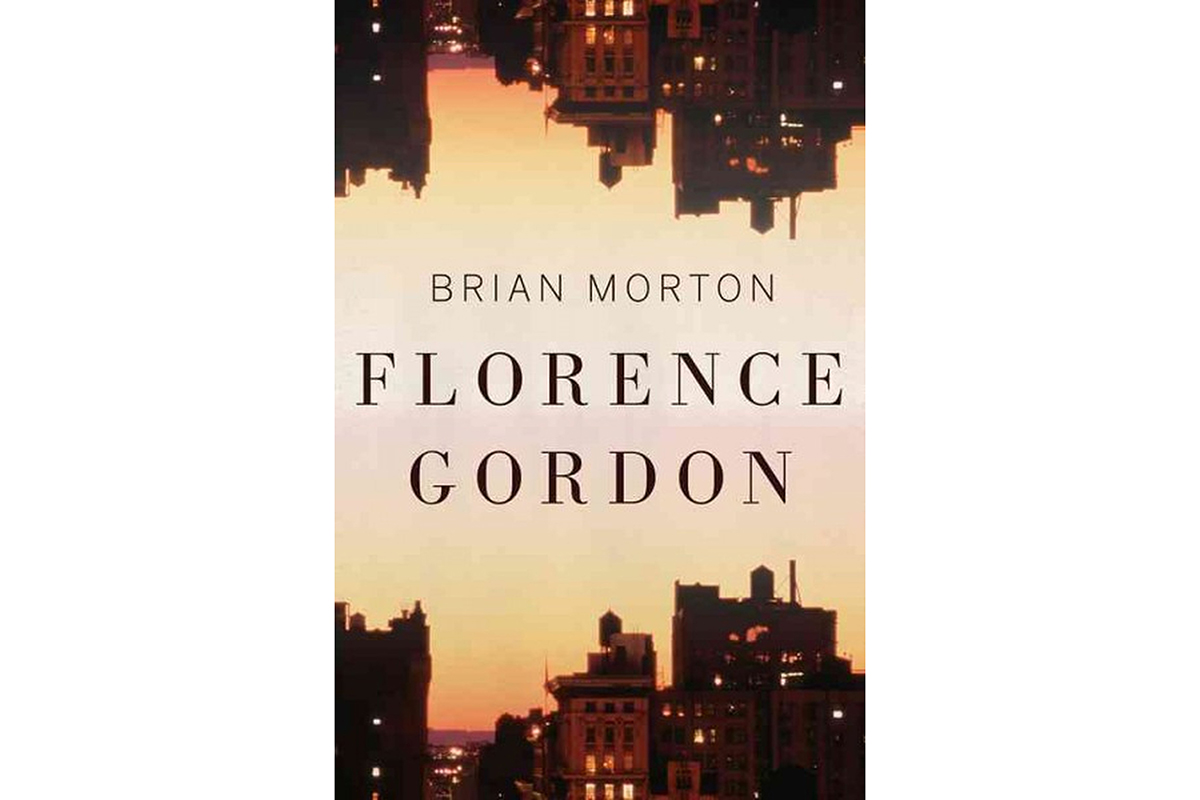
elle-brian-morton-florence-gordon-

First thing’s first: why would anyone give a novel a title that rhymes with his name? Seriously – try saying it five times fast: Brian Morton Florence Gordon. See the problem? What does that even mean, psychologically speaking? Is it some kind of Echo and Narcissus complex? Or is the brain-space surrounding his name so finely tuned that he didn’t even recognize that the rhyme was there? This is one of the many annoyances that kept me busy while I was reading this novel.

First, the good things: this novel is a quick, easy read. The chapters are always short and sometimes almost microscopic – not quite “My mother is a fish,” but almost. If you read this novel, you will not have to worry your pretty little head about pesky things like characterization and description. You will be thrust into the presence of a variety of characters, and then you will be told some things that they say and do, and you will be told what you should feel about them. There may be some readers out there who would enjoy not having to figure out the characters for themselves – but don’t those sorts of readers usually just watch TV?

I would also like to share with you the one sentence in the novel that I liked: “‘Jewish women,’ he said, ‘are all that stand between us and the death of the publishing industry.” The “he” in question is the title character’s new editor. I like this sentence not because I have any strongly-held feelings about the reading habits of Jewish women but because it is one of the few sentences in this novel in which it is suggested, however obliquely, that a character might possibly have a personality. Unfortunately, the new editor is only on the page for a chapter or two.

I read this book because it was the inaugural selection of a new book club I recently joined. After I read the first thirty pages or so of the book, I decided that I didn’t want to finish it and that maybe I would reconsider being part of the book club. But the online chatting that went on among the book club members made them seem like very interesting people, and two days before the first meeting I picked the book up and kept reading. I wasn’t done yet when I went to the meeting this past Thursday, and I was pleased that many of the other members were turned off by the book for all of the same reasons I was, and they did in fact prove to be interesting people, so I can’t resent this novel too much, although I’ve tried.

What more can I tell you? This is a novel about an elderly feminist and her circle of family members and friends. (An aside: I am also reading another novel about an elderly feminist and her circle of family members and friends – Margaret Drabble’s The Witch of Exmoor – and I am finding that novel a little tedious too, although for different reasons. That novel is packed with characterization and description and backstory, while this novel has almost none. I look forward to comparing the two in a future post.) Florence Gordon is the elderly feminist, and she has an ex-husband named Saul, an adult son named Daniel, a daughter-in-law named Janine, and two grandchildren – Mark, who never once appears in the novel, and Emily, a nineteen year-old taking a break from college who persuades her grandmother to let her be her research assistant. Florence also has a circle of elderly feminist friends, an old (i.e. retired) editor and a new editor, and a doctor named Noah. Florence is in the early stages of working on her memoir when a New York Times reviewer writes a retrospective about all of Florence’s books and publishes it as the cover story on the Times Book Review. All of this is very exciting to everyone in Florence’s circle. Her ex-husband begs her to get him a job at the university where she once taught. Her granddaughter Emily keeps asking her what she will do differently now that she has been identified as a major literary figure. And her daughter-in-law, who most of the time treats Florence with worshipful reserve, pays no attention to Florence’s newfound fame because she is busy flirting and considering having an affair with her colleague, Lev.

Note that I say considering an affair. This novel is about people considering things. It’s about Florence considering her memoir and Saul considering his failed career and Janine considering having an affair and Daniel considering what to do about the fact that he knows she is considering having an affair (but she doesn’t know that he knows she is considering an affair, so she is not considering what to do about his considerations, thank goodness). Emily considers snooping through Florence’s papers, Janine considers snooping through Daniel’s papers, and Noah the doctor considers Florence’s lab results, which are pointing toward a neurological disorder and a hastened, miserable death. No one else is considering said hastened, miserable death, however, because Florence doesn’t tell anyone.

This novel pulses with clichés and with colloquialisms that are just the tiniest bit off – the kind that make me wonder if the author has one of those learning disabilities that make a person unable to detect the nuances of colloquial speech. It’s small stuff, mostly: a teenager referring to “text messaging” (what teenager wouldn’t say “texting”?). Various octogenarians tossing around the colloquial use of “rock star,” referring to someone who is good at what he or she does. An injunction to “slow fucking down,” when clearly the correct usage is “slow the fuck down.” The UN-ironic use of the phrase “sex, drugs, and rock’n’roll” – over and over and over again. And then there are the terrible sentences, the ones that should never have gotten past an editor, sentences like this: “Both of them radiated testosteronely confidence.”

I tried. I really did. I assumed the author knew something I didn’t about testosterone and/or about the English language that would make this sentence make sense. But it just doesn’t. Testosterone is a noun, and can be used as an adjective only with certain nouns, such as “Today I have to take my ferret to get some testosterone injections.” Confidence isn’t one of those words that pair up with testosterone easily, although testosterone confidence could be a thing, maybe. Maybe testosterone confidence is the phenomenon that explains why teenage boys think it’s a good idea to spray themselves with so much Axe Body Spray before school dances.

But even so – even if testosterone confidence might be a thing, testosteronely confidence is definitely not a thing. Because confidence is definitely a noun in this sentence, and testosteronely is definitely an attempt at an adverb, and adverbs (or attempts thereof) just can’t modify nouns. It doesn’t work that way. And how can I take a book seriously when its author and any number of other educated professionals – editors and so forth – let such an appalling sentence fly by? And who is Brian Morton, anyway? Does he really have the kind of clout that he can draw a line in the sand about these sorts of things? “Testosteronely confidence stays, or I walk,” he must have said. “Screw you, Houghton Mifflin. I’m packing up my awkward adverbs and taking my business over to Random House.”

This book is laughable. It is worse than bad. Between the one good sentence, which I quoted above, and the one absolutely horrible one I expounded on at some length, stroll many, many other forgettable ones, laced with clichés and ambiguous pronouns and a lot of sloppy, superficial thinking about human beings. The characters in this novel shouldn’t be simplistic, but they are. The sentences shouldn’t be facile, but they are. I can’t imagine what the genesis of this novel was, since Morton seems barely to care about his characters or take them seriously – which makes it hard to take him seriously as a writer as well.

Posted in Authors, Brian Morton, Fiction - general, Fiction - Tedious novels about elderly feminists, Reviews by Bethany | Leave a comment

Thoughts on James Agee’s A Death in the Family (by Bethany)

A Death in the Family cover image

A while ago, I posted about something called the Countdown to Concision challenge. For the first year and a half we had this blog, my posts typically ran in the 3500-4000-word range, and I wanted to coax myself to get to my points more quickly. That challenge never got off the ground the way I wanted it to, but I never stopped wanting to try it. There are 26 books involved in the challenge, all novels. I went through my book spreadsheet, sorted it by author’s last name, and then chose one book for each letter of the alphabet. The only other rule I followed is that each book had to be one that I had owned for a while and had a strong desire to read. In that sense, it’s like the Numbers challenge, except that for the Numbers challenge I chose classics and for the Countdown to Concision challenge I chose contemporary novels.

But then something funny happened: my posts started getting shorter on their own. Over the last few months my posts have shrunk on their own accord to about 1500 words. Recently a reader described one of my reviews as “succinct,” and at first I snorted at that, but then I reread the post and realized that it was succinct – and, at the same time, I realized that the review was complete as it was. I didn’t want to add anything else to it. This is unusual for me – I have always seemed to use more words than others to say what I want to say, and I’ve always felt a little embarrassed about that.

But the fact remains that I want to do the Countdown to Concision challenge. In some ways it will be even more interesting now that I am comfortably writing shorter reviews. The first book on the list is James Agee’s A Death in the Family, and I have wanted to read it for years. So I read it, and the thing is – I don’t think I could write 4000 words about this novel if I tried. I could include a lot of quotations, of course, but this is not a novel in which certain passages stand out, so I would be at a loss in terms of what to quote. So I’ve decided to write a regular (or perhaps even shorter than average) review of A Death in the Family and then add another book by an author whose last name starts with A, and that novel will be the one that gets a 4000-word review. I’ve chosen Martin Amis’s The Pregnant Widow. I’ve wanted to read this novel ever since it was published, and knowing Martin Amis I will have lots to say. Of course I will not be reading this novel right away, since I have the same huge on-deck circle of books that I always have. But time runs slowly in Purgatory; “soon” sometimes means six months or a year where reading is concerned. And when the time comes, I’ll tell you how it goes.

***

When will I stop taking the praise on book jackets seriously? In other areas of my life, I am a shrewd consumer. I assume out of hand that all TV commercials are full of lies, and when I see items on sale in the supermarket I scrutinize them for fishy smells and moldy spots. I rarely pay full price for clothes and would never dream of going anywhere near a mall on Black Friday – and don’t even get me started about the marketing of pharmaceuticals. But when it comes to books I am a supremely gullible consumer. For some reason I forget that bookselling is a consumer industry just like any other, and the words of praise plastered on the cover are just another iteration of the cute kids in TV cereal commercials. There are definitely some authors that I have permanently stricken from my list because of poor performance in their previous novels, but if an author is new to me or if I’ve rated his previous books at least somewhere above average, I can be very easily swayed by blurbs.

Now, A Death in the Family is as aggressively advertised as most other books, but it has something else going for it too: it won the Pulitzer Prize in 1958. I consider the Pulitzer to be one of the most reliable literary prizes. With the exceptions of Tinkers and The Goldfinch, I don’t think I’ve read a single Pulitzer winner that I didn’t think deserved the prize. Until now, that is.

This novel’s greatest strength is also its greatest weakness: it is written in meticulous, minute detail and its plot is largely internal. The death referred to in the title is that of Jay Follet. Jay receives a call late at night from his drunken brother Ralph, who informs him that his father is dying. Jay gets dressed, promises his wife he will call in the morning, and sets off in his “tin Lizzie.” We last see him disembarking from a ferry. Later, his wife Mary gets a call from a stranger who reports that Jay has been involved in an accident. The stranger refuses to actually state that Jay is dead but asks Mary to send a male relative as soon as possible. Her brother Andrew agrees to go, and he returns with the information that Jay’s car overturned on a muddy road and that he died instantly, the only mark on his body being a small bruise on his chin. The irony of all this is that Jay ‘s father was not dying after all. Drunken Brother Ralph misread some signals and jumped the gun.

As you have probably already guessed, there are all kinds of levels of unreliability going on here. The stranger doesn’t want Mary to get the news from a stranger when she is all alone, and Andrew wants to comfort her by assuring her that Jay died instantly and didn’t suffer. Mary’s family slowly assembles at her house in the early hours: her elderly parents, her sister Hannah, Andrew, and a family friend named Walter who drives Mary’s parents over. Asleep upstairs are Jay and Mary’s children, Rufus and Catherine. The novel is told in the omniscient point of view, and most of the characters I’ve already mentioned take one or more turns to tell the story from their perspectives, but young Rufus Follet gets the microphone for longer than the others. Rufus is about seven – old enough to understand what death is but not old enough to understand all the layers of euphemism and innuendo adults use to talk about death – and he is baffled most of the time. The novel also contains a few italicized interludes (I call them ‘interludes’ because they are not numbered as the other chapters are) that are told from Rufus’s point of view. The tone of these interludes is nostalgic, and it seems clear to me that in the italicized sections we are being spoken to by the adult Rufus who is looking back on his childhood. We aren’t really told that in so many words, although a few references are made to the fact that the Tennessee of this novel is a “vanished” world. The opening section, which is italicized and which struck me at first as a “prologue” of some kind (I didn’t know at the time that there would be more of these italicized sections), is a lyrical meditation on what it was like to walk around in the evenings and see all the men of the town watering their lawns, still in the suits they wore to work. This section – which reminded me of the nauseating sentimentality of the first chapter of Dandelion Wine; said nauseating sentimentality is the reason I have never read the second chapter of Dandelion Wine – is dated 1915, and of course the fact that World War I (which was underway in Europe by 1915 but wouldn’t impact the daily lives of Americans until 1917) represents an abrupt transition in the lives of ordinary people, and the first decade and a half of the twentieth century tend to be treated as some kind of idyllic utopia that was abruptly destroyed by the war (and then by the influenza, and then by the dissolution and drunkenness and organized crime of the Prohibition years, and then by the Depression, and then by the second world war, and then by the Cold War, and then by George W. Bush. I might have missed a few links in that chain, but you get the idea). In college I took a course on British literature of the 1930’s that spent at least 2/3 of its time on this idea; the torpor and apathy that defined the post-WWI years has been written about beautifully by Orwell, by Auden, by Virginia Woolf, by Hemingway, by Fitzgerald, and by many others, and A Death of the Family does not add anything new to this body of literature. Another reader might not mind the clichés so much, but I’ve read so widely in the literature of this era that I was annoyed to have to slog through such familiar ideas again.

I do think, though, that Agee intends us to see the death of Jay Follet as more than just the death of Jay Follet. The novel was published in 1958, and its audience knew about everything that would happen after Jay’s funeral. The influenza might have carried off the comically hard-of-hearing grandmother, for example, and the war might have taken Andrew. Rufus and Catherine will be young adults when the stock market crashes in 1929, and Rufus will be of draftable age when Pearl Harbor launches the United States into the Second World War. It’s a form of dramatic irony: taking advantage of the knowledge of history that the readers have but that the characters do not. While the “family” in the title refers primarily to the Follets, but it also refers to all of the people who lived a comfortable, idyllic middle-class life in the United States before the First World War. Like the men who protect Mary from knowing the truth about how her husband died (we learn the truth from a cruel schoolmate of Rufus’s: Jay was pinned under the car and stuck there for over an hour before he was found, still alive but just barely), Americans would find ways (patriotism, etc.) to whitewash and euphemize what they suffered between 1917 and 1945. The truth will come out in little ways, of course. The town bully is always right around the next corner, wanting to see the look on your face when you find out what really happened.

This novel is overwritten – which should be no surprise, since it is often compared to the work of Thomas Wolfe – and given to paragraphs of more than a page long: interminable passages of internal monologue and description. I won’t torture you with examples. The writing isn’t all bad – at times it is actually quite moving – but it’s too stagnant. The whole novel takes place in and around the Follet’s house and left me feeling claustrophobic. This was likely Agee’s intent, and if so he pulled the effect off well, but as a reader I did not enjoy it.

I’ve read that James Agee is a perfectionist, and I know that the written work of perfectionists is often overly worked-over, edited into sterility. This is certainly the case with this novel, and while the thoughts and feelings of these characters are well rendered and even moving at times, this novel is not enjoyable to read. It was a chore and a headache, in spite of the passages that I enjoyed. These were just too few and far between.

Posted in Authors, Fiction - general, Fiction - literary, James Agee, Reviews by Bethany | Leave a comment

‘And Don’t Have Any Kids Yourself’: Philip Larkin, Charles Darwin, and the Biology of Choice

larkin1_1680661c

In graduate school I loved Larkin’s poem “This Be the Verse” – who doesn’t? – but I was determined to find it somehow ironic. I’d like to say that I had read enough of Larkin’s to know that much of it is grounded in irony, but what’s closer to the truth is that I wanted the poem to conform to my own presumptions of adulthood and childbirth and parenting. If there’s one thing I didn’t like when I was in grad school, it was literature that challenged me to rethink my worldview. Total downer, man.

I did some research on Larkin, confident that I would find that he was a family man with twelve kids, a rotund but happy wife, and a bunch of sheepdogs. What I found, of course, was that Philip Larkin was just as unhappy and misogynistic as his poems make him seem. His bleak view of the human race could not be explained away with terms like “persona” and “transferred epithet” and “sympathetic fallacy.” He was a depressed librarian who looked like a toad and lived in near-solitude during England’s bleakest  years of postwar austerity. I began the process of slowly accepting the idea that Larkin meant every word of “This Be the Verse” as straightforward truth. This possibility led me to another troubling idea: it seemed for a while as if, without irony, “This Be the Verse” actually wasn’t a very good poem – not much more than schoolboy doggerel, its rhyme and meter existing only as a pretty frame around the F-word, which is the center of the poem’s energy. I had trouble understanding how this poem could be both good and earnest at the same time.

Around that time, a good friend of mine was expecting her first child, and I joked with her that I would cross-stitch a sampler of “This Be the Verse” to hang over her baby’s crib. She loved the idea (N.B: Writer friends are awesome!), and we shared some good laughs at the idea, but of course I never stitched the sampler. Hanging mid-twentieth century English poems with the F-word in them on the wall of an infant’s bedroom is one of those things one talks about but never does. It was only years later (about a year ago, actually, when I was briefly considering opening a Larkin-themed Etsy store. Long story.) that it occurred to me that a sampler of “This Be the Verse,” all neatly stitched up in blue thread and featuring rocking horses and teddy bears in its margins would finally give the poem the irony I desperately thought it needed.

Is the first line of “This Be the Verse” the most famous opening line in English-language poetry? It probably hasn’t overtaken “Two roads diverged in a yellow wood” or “Shall I compare thee to a summer’s day?” quite yet, but only because so few people read poetry once they’re finished with high school English, and most high school teachers (I generalize) are not comfortable heading out into the minefield of “This Be the Verse.” If every ninth grader in the country read this poem, they would remember it – by heart – forever. It’s not the kind of poem that leaves you.

If you don’t mind, I’d like to take a few liberties with the poem’s opening stanza; in particular, I want to do some playing around with the phrase “to fuck up.” We all know what it means, of course – to cause trouble, to damage, to destroy – and I find it interesting that we’ve chosen to use a sexual term to describe acts of blundering and incompetence (we do the same thing, by the way, with the more family-friendly “to screw up”). It’s true that sexuality can create and destroy in nearly equal measure: sex creates children, of course, and can also engender closeness and intimacy, but it can also destroy families, relationships, and individual happiness, confidence, and dignity. I find it interesting to compare “to fuck up” with other verb phrases that contain the preposition “up”: “Hey, Nellie,” an imaginary man named Harold says, “Why don’t you whip up a batch of cookies? I’ll go to the garden and dig up some potatoes for dinner, and then we can go into the bedroom and fuck up some kids.”

I am not at all suggesting that Larkin meant this double meaning; I have no reason to think he did. But I do think that when “fuck up” is compared to similar constructions like “whip up” and “dig up,” it conjures up images of the casual, devil-may-care manner in which most animals – and a stray human being here and there – reproduce. For millennia, animal reproduction was governed by instinct. Eggs were laid, estrus cycles were obeyed, females were mounted and half-ridden around pastures, mates were consumed with relish shortly after coitus.

At some point in our development as a species, human beings became distinct from these instincts to a certain degree. We remained biologically inclined to reproduce, but as our brains grew and developed higher-order thinking skills, we developed several cultures of reproduction that includes such factors as marriage, notions of adolescence and adulthood, puberty rites, religious taboos, polygamy and harems, rules and customs concerning clothing; the science-fiction writer Robert S. Heinlein wrote, “Everything that we call ‘civilization’ began as a way to protect pregnant women and small children.” Still, for centuries and centuries, human reproduction more or less blundered along. People knew what they were supposed to do, and they knew why (they needed heirs and farmhands, and daughters to marry off to other people’s heirs and farmhands), but as centuries passed and lives grew easier, human beings had more time to think and plan, and their attitudes toward sex and reproduction grew more complex and conflicted.

Over and over again, I hear statements like these:

“I don’t want to have a baby because there’s too much mental illness in my     family.”

“Overpopulation is one of the worst problems the earth faces today. It’s irresponsible to have more than one child.”

“Women should put their careers first and have children later in life.”

“We face such an uncertain future – I can’t bear the thought of bringing children into the world just to suffer.”

“My parents weren’t good role models. I worry that I won’t be a good parent.”

“I’m over 35 – won’t my children be at a higher risk for Down’s Syndrome?”

“My partner is over 50 – won’t our children be at a higher risk for autism?”

“It’s unethical to have children until you know for sure you’ll be able to pay for their education.”

“I have an autoimmune disorder, and I’ve heard people say that pregnancy sometimes cures my disorder. I wasn’t sure I was going to have kids before, but now I’m thinking I might want to try it.”

“What if I have a baby and something awful happens? What if my child dies, or grows up to be a criminal? I don’t think I could bear it.”

“But I want one. Babies smell good, and they wrap an entire hand around your thumb and just lie there, dozing and holding onto your thumb.”

People who make statements like the ones above – like the speaker of “This Be the Verse” (which, by the way, I have finally accepted as an earnest sentiment not fundamentally couched in irony) – are often thoughtful to a fault. Their attitudes toward their bodies are cognitive, not physical. They’re likely to be educated and self-disciplined, and they see the world as a place dominated by human beings (even if they make noises about carbon footprints and the earth being on loan to them by their children). When and if they are swept away by circumstances, they feel ashamed of their failure to troubleshoot. Many of these people, of course, eventually have children: their first at 32, their second at 35, the optional third at 38. Others, though, get trapped in loops of circular reasoning and worry and despair and the thought that if they become parents, there is a chance that they might not be perfect at it.

It’s almost as if, by discovering the idea of natural selection (thanks, Darwin), we human beings have changed the game. The more we understand how the system works, the more paralyzed we become. And if it was in part our ability to plan and reason that led to our growth as a species, and the most thoughtful members of our species are the most conflicted about the thought of reproducing, there is no reason to suspect that our evolutionary process will continue to follow an upward trend. The final stanza of “This Be the Verse” portrays human misery (and, specifically, the misery that is passed from parents to children) in geological terms, as “a coastal shelf” build up by endless tiny deposits of shame and sadness. The last two lines – “Get out as early as you can / And don’t have any kids yourself” – are ambiguous because they beg the question Get out of what? Get out of one’s parents’ house? Is Larkin telling his readers to break the cycle of reproduction? Move out, stock up on condoms, don’t participate in the danger and anguish and fear that children can bring about? This is Darwin’s theory of natural selection in reverse, isn’t it? – for a species to grow in cognitive and mechanical prowess over countless centuries, only to find out that the sexual behavior that has always happened via a combination of instinct and a series of well-honed social precepts is actually a small part of a larger biological process through which species change and sometimes go extinct. It’s almost as if Larkin is suggesting that human beings should go on evolutionary strike. Stop playing along with the game, he is saying. Now that we understand it, we can escape it. We can’t change it, necessarily, but we can opt out. But opting out means not the slow perfecting of our species (as natural selection is usually understood) but an immediate screeching of its brakes. Can we do this? And why would Philip Larkin want us to? And most important, have these implications always existed unstated inside this little 12-line poem? Perhaps the reason Larkin begins with the F word is to distract his more frivolous readers from the dark speculations of his final stanza, to keep us snickering and happy when we first encounter this poem in high school or college or grad school, only to stun us with the final stanza when we turn 38 and its meaning comes clear.

A long time ago a professor told me that “This Be the Verse” should always be read side by side with Larkin’s “The Trees.” Both poems are written in the same form: three four-line stanzas of iambic tetrameter. Both poems rhyme, though their rhyme schemes are slightly different. I believe the professor meant that “The Trees” explores the same central question – of what to do about the fact that we are highly aware of our mortality, in spite of the fact that our biology drives us to live a more cyclical existence – as “This Be the Verse,” but in a more optimistic fashion. The word “seem” in line 11 suggests that we can’t know whether it is ever possible to “begin afresh, afresh, afresh” (12), though I suspect that Larkin does not mean this poem to be quite as optimistic as it seems.

To me, the poem that more effectively answers the questions posed by “This Be the Verse” is Larkin’s “Born Yesterday.” Larkin wrote the poem for Kingsley Amis’ daughter Sally on the day after her birth, and the argument of the poem is an almost iconoclastic refusal to say any of the bromides one usually associates with birth. Instead, the nucleus of the poem is in the line “May you be ordinary” (12) and in the lines that follow, in which Larkin wishes that Sally will grow up disinclined to question her surroundings and gifted at the art of balance. In short, he wants her to be average. I have always been terrified of being average, but in this poem, Larkin almost convinces me that the middle of the road is the place to live one’s life. He wishes Sally “nothing uncustomary, / To throw [her] off [her] balance” (16-17) and later even ventures to say “May you be dull” (20). “Dull” can mean either “boring” or “stupid,” and while the first definition seems more consistent with the rest of Larkin’s poem, I’m more intrigued by the second. A person whose mind is “dull” can function reasonably well, hold jobs, and even marry and have children, but you won’t see a dull person questioning whether it is ethical to bring a child into an overpopulated world or scanning through the rolls of online sperm donors, looking for the right blend of athleticism, good looks, and mental health to balance out one’s own questionable genes. In other words, he wants Sally to live a pre-Darwin life: to act, not to think.

Larkin is one of the greatest poets of self-hatred the English language has ever produced. Each of his poems – even the ones that aren’t that great – has a knife hidden in it somewhere, and his poems are driven by the tension between the controlled beauty of his language and the devastating wielding of these knives. I’ve speculated a good bit about some of the implications of his poems, but I can’t help thinking that his own cognitive process is the antagonist in many of his poems. Now that I’ve finished writing this post (which has been in process a LONG time), I think the original question of whether or not “This Be the Verse” is ironic is profoundly beside the point – although I do think this may be the most complex poem without irony that I’ve ever studied.

Posted in Authors, Essays about literature, Philip Larkin, Poetry - General, Poetry - Lyric/Narrative, Reviews by Bethany | Leave a comment

Read-For-Maybe-Two-Hours Friday (by Bethany)

I was all set to start a new tradition today: Read-All-Day Friday. Friday is the only day each week that I predictably don’t have any work commitments, and since I’ve been feeling a little short on high-quality me time lately, I decided to try as often as possible to make these my intensive reading days. In place of a book review, I would then post some pictures of what I was reading and of whatever cats, coffee mugs, and pajama pants were assisting me toward my goal. But the thing is, yesterday turned out to be Migraine-All-Day Thursday (Some advance notice about these things, people? Sheesh!), so I have a couple of looming deadlines that I ignored yesterday and have no choice but to address today. However, I’m still setting aside some quality time with Andrus Kivirähk’s The Man Who Spoke Snakish, a book that is apparently so popular in its native Estonia that it has been adapted into a top-selling board game. I also took some time this morning to take some pictures of birds standing around being birds while the Pacific Ocean was going batshit crazy in the background. For context, Ocean Beach – where these photos were taken – is usually, as it name suggests, a beach – the ocean is not actually supposed to crest the seawall and lap at one’s feet in the parking lot.

If I have time, I’ll be back later today. I really do want to tell you more about Submission, which turned out to be fantastic. Happy Friday, everyone. May you maintain the equanimity of these seagulls during whatever storms, meteorological or otherwise, you face this weekend.

bird 2

bird 3

(Guarding the Tomb of the Unknown Seagull)

bird in flight

(I’m pretty sure wings-at-5:50 is seagull semaphore for “Holy fuck, that’s some scary ocean.”)

the man who spoke snakish cover image


Posted in Glimpses into Real Life, Read-All-Day Friday, Uncategorized | Leave a comment

Final thoughts on John Williams’ Augustus (by Jill)

augustus cover

Remember how on Tuesday I said that we never get to have Augustus’ voice tell us anything in the novel? Well, guess what Part III of the book is? That’s right, it’s Augustus Caesar’s final letter, written to his friend Nicolaus of Damascus, as he sails to Capri and then Benevento. He travels to Capri to watch a youth gymnastics competition, where he is to be the guest of honor, and he travels on to Benevento because his wife is making him go as a show of support for his stepson Tiberius, who is to succeed him as Emperor of Rome. In this letter he reflects on his life and the events we’ve learned about via everyone else. What surprised me about this section was how well it seems that his close friends, advisors, and family actually did know him, because nothing much that he says comes as a surprise. It seems that this supreme being actually was just like everyone thought he was. And isn’t that a nice surprise in this day and age?

I definitely enjoyed Augustus, even though the first thirty to fifty pages were a little tough as I got acquainted with all of the characters, and got used to their long, long names. I think that if you can get past the names and the epistolary format (which actually didn’t bother me at all, but I know some people don’t like it much), this book is really quite good, and presents ancient Rome in a much more approachable manner than I’ve read before (i.e. The Aeneid and its ilk).

I am not going to say much else, because it’s late here in Florida, but I’m leaving tomorrow, and in the next twelve hours I have to pack and figure out how to fit all the stuff I’ve acquired over the past week into my suitcase. The good news is that it wasn’t full when I left California, so I should be fine, but there is the matter of the Minnie Mouse pillow pet that I got from Care Credit to take into account. At least it’s pretty compressible. Those giant proceedings, though…. They might be a problem. At least the hotel gift shop has suitcases!

Posted in Fiction - general, Fiction - Historical, Fiction - Important Award Winners, Fiction - literary, John Williams, Reviews by Jill | 2 Comments