True Confessions Tuesday (by Jill)

So….  Yeah.  The only thing I have to confess today is that I have not done any reading since Sunday.  I’ve been….  Shit.  I have no idea what I’ve been doing other than thinking about my upcoming family trip to Yosemite and having five whole days off work with my husband.  So, in honor of my first real vacation of 2016 (Florida doesn’t count because I was alone and it was for work), here is a picture of Half Dome.  🙂

IMG_9499

Posted in Glimpses into Real Life, Reviews by Jill | Leave a comment

‘Celia’s an Artful Little Slut’ (And Other Thoughts on the Founding Fathers)

ten $

I am reading Ron Chernow’s biography of Alexander Hamilton, albeit somewhat slowly, and I am trying to share my HAMILTON obsession with you in ways that are not derivative and cliché (you’re welcome), so today I’m here to tell you that my favorite part of the biography so far is the snippet of Hamilton’s poetry that appears on page 34. He was still a teenager when he published two poems in a newspaper called the Royal Danish American Gazette on his home island of St. Croix – a newspaper at which all one had to do to guarantee publication was send a couple of poems and an obsequious letter (yet another reason to wish one was a founding father). Chernow summarizes the first poem, which is a paean to pseudo-Romantic poetry (never mind that Romantic poetry didn’t exactly exist when Hamilton wrote this poem in 1771, but more on that in a moment).

And OK, if you insist, I’ll fill space by quoting from the Chernow:

In the first poem, “the dreamy poet steals upon his virgin love, who is reclining by a brook as ‘lambkins’ gambol around her. He kneels and awakens her with an ecstatic kiss before sweeping her up in his arms and carrying her off to marital bliss, intoning, ‘Believe me love is doubly sweet / In wedlock’s holy bands.’” (34)

In the second poem, says Chernow, the future treasury secretary has “metamorphosed into a jaded rake”; the opening line of that poem is “Celia’s an artful little slut.” My first thought: where in English poetry in 1771 was there any kind of precedent for a line like this? I answered my question as quickly as I asked it – Swift, of course – and Chernow makes the same connection. But still. Of this poem, Chernow quotes the final six lines:

So, stroking puss’s velvet paws,

How well the jade conceals her claws

And purrs; but if at last

You hap to squeeze her somewhat hard

She spits – her back up – prenez garde;

Good faith she has you fast.

I’m sorry – did I forget to mention that this is not just a founding father slut poem but a bilingual founding father slut poem? And also that it is not only a bilingual founding father slut poem but a bilingual founding father slut poem with a cat in it? (a metaphorical cat, yes – but a cat nonetheless). Consider the record corrected.

Just to make sure I stay in the running for the Nerdiest Marginalia Award, I annotated this excerpt as follows: Remarkable enjambment! Precedent for this?

But my third gut response (after Swift and remarkable enjambment) actually gave me chills. Then I did a quick Google search and had even more chills. These poems don’t reach backwards to Swift nearly as much as they reach forward to William Blake. In 1771, seventeen year-old Alexander Hamilton wrote what could easily be part of the Songs of Innocence and Experience, which Blake published in 1789. And honestly, only the very best of Blake (“The Tyger,” if that) lives up to the quality of the lines quoted above.

I’m no scholar of literary history. I don’t know if the young Hamilton would have known of Blake or read some of his work in a periodical. On the one hand, he read everything he could get his hands on, as teenaged founding fathers were wont to do. On the other hand, he grew up on St. Croix, where slaves outnumbered libraries several thousand to one. And 1771 is a whole eighteen years before 1789.

And now I’m getting chills all over again. I may have to do some research. Like with databases and shit. Not this week – this week has enough on its to-do list. But soon. I will do a little research and let you know what I find out.

Emma

An artful little slut? Moi?

Posted in Authors, Non-fiction - History, Nonfiction - General, Nonfiction - Memoir/Biography, Reviews by Bethany, Ron Chernow, THE HAMILTON SOUNDTRACK, Uncategorized | 2 Comments

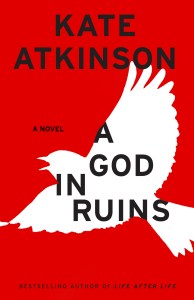
Early Thoughts on Kate Atkinson’s A God in Ruins

a god in ruins cover image

There’s some insomnia going on here at Casa Purgatory, and since it’s almost midnight I thought I would be productive and get Sunday’s blog post out of the way. It will be a short one, because I’ve only read 71 pages of A God in Ruins – which a friend recently told me was one of the best novels she had ever read. So far I am not quite so enthusiastic, though I am enjoying the novel well enough.

After reading Atkinson’s first novel, Human Croquet, a couple of weeks ago, I’m noticing the way her style and subject matter have evolved over the course of her career. Like Human Croquet, this novel concerns multiple generations of a not-very-wealthy, not-very-happy 20th-century English family. Some of the eccentricities of Human Croquet are mirrored here – the parallel between Aunt Vinny in Human Croquet and Aunt Izzie in A God in Ruins, for example. Both novels like to swirl around in time, ducking in and out of various decades as they see fit, and both are told from an omniscient point of view. A God in Ruins is the story of Teddy Todd, who was a pilot in World War II. So far, we’ve seen little of Teddy’s war years; instead, we see him as bewildered child and as bewildered parent and grandparent.

Another noteworthy quality of Human Croquet is that it became much, much more interesting as it progressed. I suspect that this may also be true of A God in Ruins. Kate Atkinson seems to me like the kind of writer who devotes much of each novel to painstakingly lining up her characters (and their accompanying backstory) like chess pieces, pretending not to have a care in the world, waiting for the moment when the reader will snap back from a daydream and discover that s/he has just been checkmated.

That’s what I predict will happen in A God in Ruins. We will see…

Posted in Fiction - general, Fiction - literary, Kate Atkinson, Reviews by Bethany, Uncategorized | Leave a comment

Progress report on David Mitchell’s The Bone Clocks (by Jill)


Bone clocks cover

Read All Day Friday was a complete bust yesterday. It turned into Organize Your Hall Closet, Take Old Clothes to Goodwill, and Buy a Bunch of Books You Don’t Need but Felt Obligated to Buy in Order to Support Small Business in Your Town Friday. I did make some progress into the next section of The Bone Clocks, in which we meet another narrator, this time a borderline has-been novelist named Crispin Hershey. His section takes place from 2015 to 2020, at a variety of writers’ conventions around the world. He ends up crossing paths with Holly Sykes at each one, and makes friends with her and her daughter Aoife eventually, after spending the first few meetings mocking Holly for her rapid rise to fame after writing a memoir about her bizarre psychic experiences. We learn that Ed Brubeck was killed in Syria at some point in the past. Crispin Hershey is kind of a pompous ass, but I think he’s going to find redemption with the help of Holly and Aoife, but I’ve got about fifty or so pages to go in his section before I find that out for sure. More later! Happy Saturday—at this time next week I’ll be in Yosemite, probably typing a blog post with pretty pictures of Half Dome or some snow or something. I know I’m excited about that!


Posted in David Mitchell, Fiction - Fantasy, Fiction - general, Fiction - literary, Reviews by Jill | Leave a comment

Thoughts on Act I of The Merchant of Venice

Merchant of Venice cover image

The next play being “covered” by a contemporary author in the Hogarth Shakespeare series is The Merchant of Venice. Howard Jacobson’s adaptation, called Shylock is My Name, was released last week, and I’m looking forward to reading it soon. And I was looking forward to rereading The Merchant of Venice – until I remembered how cringeworthy it is.

I’ve taught this play to high school sophomores a few times, and each day’s lesson required a veritable ballet of evasion and sleight of hand. I’ve designed grammar lessons out of this play. I’ve used it to teach iambic pentameter. I’ve done side lessons about economics, and once, in terrible desperation, I’ve even had the students “cast” the movie version. Markers were involved, as I recall, and possibly also old magazines and scissors and glue. The purpose of all of the smoke and mirrors was to distract myself and my students from the fact that in this play, Shakespeare goes beyond creating a racially-stereotyped character – that this play really does reveal Shakespeare himself to be anti-Semitic. Then and now, I have no doubt that this is true. Of course, Shakespeare may well have never seen or interacted with a Jewish person, Jews were expelled from England by Edward I in 1290 and did not return until Cromwell’s reign in the 17th century, though it is possible that Shakespeare could have encountered some Jews in continental Europe if he ever went there – though there’s no evidence to show that he did. I am optimistic about Shakespeare being “not of an age, but for all time” (as Jonson stated), and I like to hope that if Shakespeare had known some Jewish people he would not have painted Shylock in such a terrible way. But of course, it’s also possible that in this area Shakespeare was in fact a product of his time. I am always so disappointed when Shakespeare turns out to be a product of his time.

However, while the portrayal of Shylock is anti-Semitic, this play as a whole is not “about” anti-Semitism. What the play is “about” is money. The opening scene presents Antonio, a melancholy proto-capitalist whose friends are trying to figure out why he’s depressed. One friend, Salerio, posits that Antonio’s “mind is tossing on the ocean” (I.i.7) along with his ships, which have left Venice and are out on the open sea in pursuit of trade goods. Antonio dismissively responds that his assets are perfectly well diversified, thank you very much, and that no, he’s not in love either. This conversation fizzles out when Bassanio – who is upset about both money and love – arrives and asks Antonio for a loan so he can afford to go participate in a ridiculous guessing game, the object of which is to marry the rich, beautiful, and brilliant Portia. Antonio jumps at the chance to help Bassanio but admits that most of his funds are tied up in his various ships at sea, so he authorizes Bassanio to apply for credit in his name.

Enter Shylock. Back when I was on a constant hunt for things to do in class that didn’t involve reading the words “dirty Jew” out loud, I found an article on the biblical basis for usury laws. This article was great because it quoted a lot of Bible verses, which I could write on the board and have the students copy down, thus eating up time, and also because its ideas were complex enough that we could devote a whole class period to them without having to whip out scissors and glue or, worse, grammar handouts. I can’t find the essay online anymore, or I would quote from it – but the very short version is that a verse in the Old Testament (Leviticus or Deuteronomy, I’m almost sure) says that charging interest on money lent to one’s “brother” is forbidden. Ancient and medieval Jews, apparently, took this passage to mean that they could not charge interest on loans to fellow Jews. Much later, when Christians were codifying their own moral codes, they used the New Testament idea that all people are the “children” of God and therefore siblings to one another to interpret the Old Testament injunction to mean that they could not charge interest to anyone. In the Middle Ages, of course, many European cities forced Jews to live in ghettos, and Christians and Jews lived in near-seclusion from one another. Laws prohibited Christians from doing business with Jews in many arenas, but nowhere did it say that Christians couldn’t borrow money from Jews. Furthermore, many cities prohibited Jews from practicing many ordinary trades, and since they had to make a living in some way, and since the far-from-perfect medieval Christians did sometimes find themselves desperate to borrow money, moneylending became a common profession for Jews.

Act I, scene iii of The Merchant of Venice is one long spiteful hate-fest. Of Antonio, Shylock pronounces, “I hate him for he is a Christian” (I.iii.39) and accuses him of spitting on him (specifically, spitting on his beard), kicking him, and other acts of cruelty, none of which Antonio denies. Then he demands the famous “pound of flesh,” with the extra-creepy addendum that he will take the pound of flesh from “whatever part of your body pleaseth me” (I.iii.148).

(Brief aside: whenever I hear about the pound of flesh, I remember the time when Oprah lost 67 pounds and then rolled 67 pounds of animal fat out on stage in a little red wagon so everyone could be grossed out – this happened very early in Oprah’s trajectory as a celebrity; it was in 1985, but don’t ask me why I remember that. I was home sick from school that day and got to see it first-hand. It was also the same day – the SAME DAY – that Phil Donohue wore a dress. What? This is a blog about memory. And also books.)

See what I mean about looking for anything else to talk about besides Shylock? Don’t think I didn’t tell my Oprah story to my sophomores, because I totally did. I even told them the part about Donohue in a dress.

Of course there are ways in which this play is brilliant. Salerio’s speech at the beginning captures exactly how easy it is to let money dictate one’s emotions, and there is even something profound about the “chain” of creditors and debtors that Act I establishes. Bassanio borrows money from Shylock in Antonio’s name, and even Shylock doesn’t have the money Bassanio needs (like Antonio’s, Shylock’s assets are well diversified), so even he has to borrow money from another moneylender, Tubal – who, as a Jew, presumably does not charge Shylock the same interest that Shylock charges Antonio. This dynamic of borrowing and lending is highly germane to our era, and I can think of any number of ways to modernize this play in our world of financial crises and oil futures and interest rates and mortgages and credit cards. I am looking forward to reading Jacobson’s novel, and maybe I am also looking forward to reading the rest of the play too, if only because I’ll get to tell you how hilarious Portia and Nerissa are when they talk about men.

And that’s all! I’ll be back soon with more.


Posted in Drama, Hogarth Shakespeare, Reviews by Bethany, Uncategorized, William Shakespeare | Leave a comment

Progress Report on David Mitchell’s The Bone Clocks (by Jill)


Bone clocks cover

Yesterday was a very productive reading day. And I even finished the laundry, and got the dogs walked, and enjoyed a downpour during said walk. I wish I were retired sometimes. I’d get so much more done if I didn’t have to bother with working.

When last I updated about The Bone Clocks, we had just met the douche-y Cambridge undergraduate Hugo Lamb. His tale takes place during Christmas break of 1991-92, partially at Cambridge and partially in Switzerland where he and his friends go to ring in the New Year. There, he meets a bartender named Holly Sykes, and he falls in love with our Holly, now 22. Hugo, prior to meeting Holly, is exceedingly cynical when it comes to the concept of love, but after he meets her, he becomes exceedingly poetic about it. “Love is fusion in the sun’s core. Love is a blurring of pronouns. Love is subject and object. The difference between its presence and its absence is the difference between life and death. Experimentally, silently, I mouth I love you to Holly, who breathes like the sea. This time I whisper it, at about the violin’s volume: ‘I love you.’ No one hears, no one sees, but the tree falls in the forest just the same (192).” Hugo is conflicted after his night with Holly: some of his schemes of possibly questionable legality and definitely questionable morality are falling apart at home. Does he return home and face the music? Does he hide out in Switzerland with Holly? And then a third door presents itself, which advances our hidden plot a bit. More on that in a later post.

The next part of the novel jumps us forward to 2004, and our next narrator is Ed Brubeck, the nice boy who found Holly and brought her home when her brother Jacko disappeared back in 1984. He and Holly are partners, with a six-year-old daughter named Aoife, and Holly’s younger sister is getting married and they’re at the wedding. Ed is a war journalist who has been spending time in Iraq (where else would a war journalist be in 2004?), and Holly wants him to stop and come home. He’s missing their daughter’s childhood and she’s worried he’ll die over there. But Ed has become something of a war junkie and doesn’t think he can give it up. Ed’s section ends with his final decision on whether or not he will return to Iraq unknown. I’m sure we’ll learn it eventually.

I have been enjoying The Bone Clocks quite a lot now that I’ve been able to sit and read it in longer bursts than the ten to fifteen minutes before going to sleep every night. Mitchell is embedding the fantasy story deep beneath the more mainstream fiction tale, and I’m not going to lie, getting to the bottom of the non-aging people Hugo Lamb takes up with and the people living inside of other people that Holly runs into in 1984 is keeping up reading momentum, though the surface story is also quite compelling. The characters are sympathetic (even Hugo, once he falls in love with Holly, becomes less irritating) and the plots are interesting, though disjointed. I’m sure, knowing what I know about Mitchell’s work, that everything will get nicely tied together sooner or later. The next section of the novel takes place in 2015, and after that we head into the unknown future. At the time of publication, of course, 2015 was also the unknown future, though a very close one. I don’t think that The Bone Clocks leaves the twenty-first century, though I know Mitchell has done so in other works (or at least in Cloud Atlas he does). I’m interested to read about his take on the later parts of our current century—speculative fiction can be fun, as long as it doesn’t delve into dystopia. I’ve had a bit much of that so far in 2016.

Tomorrow I’m going to try to have a Read All Day Friday, though I’m not sure how successful I’m going to be. It’s victory enough to have had a Read Most of Wednesday this week, as well as a Read While Under the Dryer at the Salon Thursday in the same week. Next week I get to have a Read While Someone Else Drives to Yosemite Saturday, which is also very exciting to me. I hope I can get through The Bone Clocks quickly, so I can carry a smaller book around with me in Yosemite. I’m hoping to get some Books in Nature shots for the blog while I’m there!

Posted in David Mitchell, Fiction - Fantasy, Fiction - general, Fiction - literary, Reviews by Jill | 8 Comments

Yarn Along

Yarn ALong photo 2.17.16

The lollipop is looking more and more like a baby blanket every day, though I am disappointed by the hearts. I ripped these rows out so many times to figure out what I was doing wrong with the top curves of the hearts, and finally I had to conclude that there is an error in the pattern. The tops of the hearts just don’t line up with the bottoms. I’m not going to give up on the blanket, and I’m hoping that when the blanket is off needles and stretched out a bit, the misshapen hearts won’t look so awful. It’s possible they’ll look more like triangles; that would be OK too. But if I find any more errors in this pattern, I’m going to be really frustrated.

I am reading Lauren Groff’s novel The Monsters of Templeton, which annoyed me on the second page when the first-person narrator looks at herself in the mirror and comments on her “once-pretty face.” This line is one of my pet-peeve clichés, especially in the voice of a first-person narrator. Are there really people in the world who look at themselves in the mirror and bemoan their “once-pretty” faces? There probably are, but I don’t want to meet them. After that initial annoyance, though, the book has sucked me in, and I’m enjoying it. I’ll tell you more soon.

Yarn Along is hosted by Ginny on her blog, Small Things.

Posted in Uncategorized, Yarn Along | 13 Comments

Well it’s Tuesday….

And once again my “reading days” (that’s what I just now decided to call the days of the week when I am not responsible for adding new content to our blog) have passed and I find myself sitting in front of a blank document at 11pm wondering what the heck to post about today. Are my internal monologues entertaining enough to carry an entire blog post? Maybe. But it would probably be better to have an ultimate purpose or plan or something for the essay/monologue. I have very serious doubts that anyone who reads PfP wants to hear about the hormone-influenced emotional roller coaster I’ve been on for the past few days, though I’ve been working out how to tell the tale at work—I lead with how ridiculous I was to my husband last night, saying such nonsense as “I don’t want you to cook for me or make coffee for me anymore. I can take care of myself. I don’t need your help.” Anyone who knows me and my husband knows that I do not cook. He cooks and he especially likes to cook for other people. I like to eat. It’s a symbiotic relationship. So starting a story about me wanting to remove my personal chef from my life it automatically absurd. And it continues from there. So what I’m trying to say is that there will be no update on The Bone Clocks until Thursday. And here, enjoy a picture of my cats.

IMG_8514

Posted in Glimpses into Real Life, Reviews by Jill | Leave a comment

Sad News

1119_pat-conroy

Today at Postcards from Purgatory, our thoughts are with this guy, who announced to his social media contacts this morning that he has been diagnosed with pancreatic cancer. He says that he plans to fight it and I have no doubt he will do so. If you’ve been reading our blog for a while, you know that PAT CONROY has played an important role in our reading lives and in our friendship. I was reading his books when Jill and I first met at the beginning of our sophomore year in high school, and I soon passed the books along with the giddiness that one feels when one makes a new friend and then finds out that she likes to read. For me personally, PAT CONROY was inextricably connected to my own desire to write fiction. I’ve since divorced myself from his style, but his books are like little time capsules that propel me back to the excitement and discovery of recognizing what I wanted my life’s work to be. And yes, I also ran like hell from that life’s work for a while, Jonah-style, – but PAT CONROY was waiting for me when I came back. Jill and I are sending thoughts of strength and healing in PAT CONROY’s direction, and will continue to do so for the duration of his treatment.

And finally, when I texted Jill this morning to break this news, I learned that my iPhone auto-corrects “Pat Conroy” to “PAT CONROY.” Which I love.


Posted in Glimpses into Real Life, Pat Conroy, Uncategorized | Leave a comment

For Valentine’s Day: Some Not-So-Young Lovers

waffle-house

Yesterday I finished the full first draft of a novel I’ve been working on for about a year and a half. Last year I posted an excerpt in honor of Mother’s Day, and today I thought it only fitting to share another excerpt for Valentine’s Day. I hope you enjoy it and would love to hear what you think!

***

Rhondette had fallen asleep with her phone in her hand, the words ‘manumissive power’ typed into her search engine. Overnight the battery died, and Rhondette woke up mid-morning, having slept through what should have been her alarm. She was two hours late for her shift at Waffle House. She briefly wondered why no one had called to find out why she wasn’t at work, but then she remembered that they would have called her on her cell, which sat dark and dead in her hand. It’s like that old song about the hole in the bucket, she thought.

She felt frumpier than usual when she squeezed herself into the tiny bathroom stall and changed into her frilly yellow pinafore. She was still huffing and puffing from the climb up the stairs. When she emerged from the bathroom, the day manager – a jerkoff named Leland – was waiting for her with his arms folded.

“Leland,” Rhondette began.

He cut her off. “

Don’t you check your phone, Rhondette?” he asked. His nasty little moustache twitched. Rhondette dropped her eyes in embarrassment and saw that Leland’s fly was open. Dingy gray briefs peeked out at her to say hello.

“The battery died, Leland,” she said. “I’m sorry. I’ve had a lot on my mind. I fell asleep before I could plug in the charger.”

“And this morning?” Leland asked. “Did you check your messages this morning?”

No, Leland, I didn’t. I didn’t want anything to make me any later than I already was.”

“If you had checked this morning, you would have found that your employment at Waffle House had been terminated. This is your third late arrival, Rhondette. You know the rules.”

Rhondette scanned her memory. When had she been late before today? There was the day her cousins hijacked the tram just a few seconds before she got there, taunting her as the tram sped them off on a beach vacation. She had been maybe twenty minutes late that day, but she had called. Besides that? Maybe a minute here, a minute there, tops. She stopped herself before she asked, though, realizing in one sudden gasp that the last thing she wanted to know was how intimately Leland knew her past infractions by heart. She suspected that his mind was a veritable file cabinet filled with fractions of minutes and grievances involving frilly yellow uniforms and customers who complained that their coffee was cold, and a single glimpse inside that file cabinet might make her cry, and if she cried, who knew when she would stop? The only other thing she thought of saying was that her grandmother had gotten her this job and knew the regional manager, but how could she say that? She was thirty-nine. She lived in a burrow underground. Her parents were dead, and her grandmother and her cousin dictated every move she made. There was a time when she wanted things – lots of things – now all she wanted was not to cry in front of this squirrely little man who was so determined to ruin her day that he couldn’t even be bothered to zip his pants. She stood there for a moment with her mouth open, considering various responses, but finally she just nodded and pulled the yellow pinafore over her head. Then she stepped out the back entrance and stared at the landscape in front of her: a credit union with a drive-through ATM, a flower store with a broken sign, a Hardee’s, a doughnut place, a pet store. And, of course, also time. There was time out there too, as far as the eyes could see.

Slowly she made her way across the parking lot to the doughnut place. There would be coffee there, and surely a few doughnuts added to her hips would hardly make her day worse than it already was. She was surprised at how terrible she felt. The job at Waffle House had been her first real foray into mainstream employment. It was a job fit for a sixteen year-old kid saving money for a prom dress – a job even a sixteen year-old kid would complain about – yet it had suited her: she liked schmoozing with the regulars at the counter, a coffee pot in her hand and a pad of paper and a pen in the breast pocket of her pinafore. Where do you go once you’ve been fired from Waffle House? Rhondette had no idea.

A black pickup truck idled in front of the doughnut place. When Rhondette approached it, she detected a funky smell around the truck – a nauseating miasma somehow connected to the foul-looking fluids that mainstreams put into cars in those shops along route 82 called Pep Boys and Midas and Jiffy Lube. The smell turned Rhondette’s stomach, but because of the smell she scrutinized the truck more closely than she would have otherwise, wondering what kind of person would tolerate such a stench around his vehicle, and when she looked closely she realized that there was a man in the cab of the truck, and that man was Errol Borland.

She approached the truck slowly, thinking that she must be wrong, that it couldn’t possibly be him. What would he be doing here? Hadn’t he left last night, to go back to Oregon or wherever? But when she knocked softly on the window of the truck, his head turned and his mouth unfolded itself into a smile, exposing the gaps between his yellowish teeth, she felt her entire body slacken in relief.

Errol leaned across the front seat of the cab and pulled up the old-fashioned push-button lock on the passenger-side door. “Well, hey there,” he said when Rhondette opened the door. “What a coincidence.”

“I can’t tell you how happy I am to see a friendly face,” Rhondette said. “I just got fired.” She whispered the word fired. She couldn’t say it out loud.

“I’ll bet that’s a story,” Errol said. He nodded his head toward the doughnut shop. “Care to tell me about it over doughnuts?” he asked. “My treat.”

“I would love to,” Rhondette said. She shut the door and waited for Errol to climb down from the driver’s side, his body robust but cautious. How old was he anyway? Rhondette thought. Eighty? Older? Or, more to the point: Was there so much kindness in the world that Rhondette could afford to turn down an offer of friendship from this man? Of course there wasn’t. She smiled and accepted the offer.

Fifteen minutes later, they were in the cab of Errol’s truck, heading out of town on Route 295. Rhondette had jerked her head toward the truck as soon as Errol paid for the doughnuts, having immediately noticed that ants swarmed the floor of the shop and the few customers at tables looked like the sort that liked to talk to strangers. She held her own coffee and Errol’s as he backed out of the parking lot and merged onto the highway, and now that they had settled into the middle lane he held his own coffee and she handed him bite-sized pieces of chocolate-frosted old fashioned doughnuts from the bag she held in her lap. She told him how Leland had fired her with his zipper open and he almost choked.

“Strange breed of man, here in Beaufort, no?” Errol said through his laughter.

Rhondette looked around – first out of the windshield in front of her, and then out the window to her right. “I can’t say I’m going to miss that little fucker,” she said. She paused for a moment, hoping the thought of Leland and his nasty underwear would overtake her sadness. It didn’t, though, so she followed her feelings where they went – and where they went was to Errol. “What am I going to do, though?” she asked. She rested the frosted cake doughnut she had been eating in her lap. “It’s all well and good to laugh at that little pissant Leland, but what’s next? I’m no closer to finding Dale Deacon, and the minute my grandmother finds out about I got fired –

“The minute your grandmother finds out you got fired,” Errol said, “she’ll pour you a glass of wine and celebrate.”

“But – ” Rhondette began.

“You can say what you want about those cousins of yours,” Errol continued, plowing right through Rhondette’s objections. “They’re a bunch of peckerwoods, if you ask me – hearts in the right place notwithstanding. A bunch of power-worshippers. Hierarchy whores. Fuck ‘em. But your grandmother is the real deal. She’s got the goods. She may have to kowtow to those younger guys to make a point, but there’s no way she’s letting you suffer from being canned from that awful place. She’ll respect you more is all.”

“It’s not like I stood up against injustice or anything,” Rhondette said. She wiped her eyes and nose with a napkin from the doughnut place. “All I did was sleep through my alarm.”

“Your grandmother hasn’t woken up to an alarm clock in her life,” Errol said. When Rhondette didn’t comment, he asked, “has she?”

“I don’t know,” Rhondette said. “Probably not.”

“I can’t quite believe I’m about to admit this,” Errol said, “but the old ways of all you witches weren’t all bad. The harmony with nature. The circadian rhythms, the menstrual cycles and what-all. The phases of the moon. You Restorer folks are on the right track – full equality is the way to go – but I hardly think it’s an accident that you put a bunch of alpha males in charge and the next thing you know everyone’s putting on suits and ties and punching clocks, worshipping the almighty dollar.”

“It’s not about the – ”

“Fine. Worshipping what? If not the dollar, what?”

Rhondette was stumped. What did her family worship? Jordan wanted obedience. He loved that he could give commands and that Rhondette, six years his senior, had to obey. He wanted his own brain waves to emanate out into the real world and come to life there, without mistakes or effort. He wanted the rest of the movement to be his hands and feet.

“Recognition, I think,” she said slowly. “Status. Power.”

“That’s all just a long way of saying money,” Errol said. “I know, I know – the movement isn’t making anybody rich. But money is more than just a number in a bank account. It’s a culture. It’s about structures and spreadsheets and rules and regulations and getting fired. And yes, it’s about recognition and status and power too. And in case you hadn’t noticed,” Errol paused, “it’s mainstream culture. That’s what happened when your movement got going – it moved away from the culture of witchcraft and started acting like the worst of the mainstreams.”

Rhondette was impressed, but she withheld comment. Instead she said, “You use that word? You call yourselves mainstreams?”

Errol smiled. “Long habit. You get inured to it after while. Plus, it suits us: mainstreams. It’s what we are. And we’re not all bad – but your family seems to have a knack for imitating us at our worst.”

“So what then?” Rhondette asked. “What do we do? What do I do?”

Errol smiled. “I’m glad you asked. We have a long drive ahead of us to talk it through.”

***

“They’re burning the soybean fields,” Errol said. He had seen Rhondette sniffing the air and explained the concept of a control burn. The whole town stank. Rhondette even detected a faint trace of ash on her hamburger.

They sat in the cab of Errol’s truck, eating burgers and drinking cherry limeades outside of a Sonic in a town off I-40 called Stuttgart, Arkansas. Across the parking lot was a Waffle House. Irrationally, Rhondette wanted to stay low, as if her face were on a Waffle House wanted poster and employees all across the region would be on the lookout for her.

“You know what would make this thing better?” Rhondette said, holding the styrafoam cup that held her cherry limeade up to the light. Errol made a noise that sounded vaguely interested, so she answered her own question: “Vodka.”

“No can do,” Errol said. “Dry county.” With a wave of his hand he indicated the entire landscape: the gauzy gray over the soybean fields, the two-lane highway, the split concrete outside the Waffle House.

“I’ve heard of those,” Rhondette said. “I hoped I’d never see one.”

“Well, look around. I’m betting that about a hundred feet farther down the highway we find the First Baptist Church.”

“First of how many?” Rhondette asked. She had lifted the lid off her cherry limeade and was fishing around inside it for the maraschino cherry.

“Thousands,” Errol said, smiling. “Millions, even. Chock full of missionaries, every one.”

“Oh, you,” Rhondette said. She gave him a limp-armed backhand swat, her hand bouncing off his upper arm as harmlessly as a flounder.

“You think I’m joking?” Errol said. “The missionary position is going on all around us, millions of millions of times, in every house in the land. You and me are a variable nucleus in a big atom made up of the missionary position.”

“I keep trying to tell myself that you don’t know any better,” Rhondette said. “But you’re not making my job easy, let me tell you.”

“Now don’t take this the wrong way,” Errol said. “But when it comes to life up here on the surface – you know, the place everyone else thinks of as the real world – you, my friend, are the one who doesn’t know any better.” He took one last straw-suck of his cherry limeade and then passed it to Rhondette. “Drink this for me, will you?” he asked. “I’m supposed to take it easy on the sugar.”

Rhondette knew he was right but preferred to change the subject rather than concede the point. “So tell me,” she said, “what is the master plan? Now that you’ve kidnapped me, I mean?”

“What a coincidence,” Errol said. “I was just about to ask you the same question.”

“Were you looking for me when you were in that parking lot?”

Errol smiled and licked his fingers after eating the last of his French fries. “Oh, there’s a chance I was looking for you. I had a feeling you and I would make a good team.”

“A good team for what?”

“You’re a little slow, aren’t you?” Errol asked. “I’m beginning to see what your cousin – ”

Rhondette reached inside the remaining quarter of her cheeseburger, seized a pickle chip, and threw it at Errol. It hit him squarely on the forehead and stuck there like a stamp on a letter. Rhondette laughed out loud at her perfect aim, and Errol chuckled too as he peeled the pickle chip off his forehead and popped it in his mouth. “Let me rephrase my answer,” he said.

“Go ahead.”

“Would you, Rhondette Andrews, take me – old, grumpy, senile Errol Borland – as my awfully beautiful and delightful witch-hunting sidekick? As long as we both shall live?”

Rhondette laughed, but there was a sadness inside her too. The fact that this parody might be the closest thing she would ever hear to wedding vows that contained her name had not escaped her. But all she said, “Witch-hunting? Is that what you do? I thought that went out with arranged marriages.”

“Not witch-hunting,” Errol said. “Not witch-hunting at all. Witch – ” he paused, his face blank as his mind groped for language – “Witch-looking. Witch-man looking. Witch-man looking and helping. Did I mention that I’m senile?”

Rhondette laughed, turning her head to the side in case she coughed out Errol’s cherry limeade. “You are too much,” she said. “You really are too much.”

“You have to admit we have a common interest, no?” Errol said.

“I suppose we do,” Rhondette said. “Is that what we’re doing – looking for Dale Deacon?”

“If you’re willing,” Errol said.

“Of course I’m willing.”

“I thought I’d help you out – give you a little escape from your family while at the same time giving them a reason to take you back. And if we have a little fun along the way, so much the better. I’m a hoot in hotels.”

Rhondette laughed out loud and crammed the thick, heavy Styrafoam cup back into its cupholder. She couldn’t trust herself with a beverage if Errol was going to keep on being this funny. “I’m sure you are, Errol Borland,” she said. “I have a feeling you’re a hoot in a lot of places.”

“So you’re game?” he asked.

“I am as game for this as I’ve ever been for anything,” Rhondette said.

“You’ll have to do the driving after dark,” Errol said. He pointed at his eyes. “My eyes conk out in the dark.”

“Drive?” Rhondette said, surprised. “I can’t drive. You didn’t know that?”

“Are you kidding? A forty year-old woman who can’t drive? What is the world – ”

“I’m thirty-nine, thank you very much. And my family only travels by – ”

“By magical high-speed underground train, I know. But wouldn’t you like to be the first in your family to learn to drive?”

“Apologize for saying I’m forty and maybe I’ll let you teach me.”

“You’re honestly asking me to apologize for missing your age by one pesky year? Do you have any idea how young forty sounds when you’re eighty-one?”

“Eighty-one,” Rhondette considered. “You’re more than twice my age.”

“I’m nine times nine,” Errol said. “Nine squared. I’m nine nine-year-olds. I’m a regular little shrieking screaming birthday party at a bowling alley. If you want to know what it’s like inside my head, picture nine kids, all high on sugar and sliding around in big shoes.”

“And you call yourself senile,” Rhondette said. “I’d say you’re more of a poet.”

“Same difference,” Errol said.

“Speaking of nine year-olds,” Rhondette said, “Did you – ” She hunted for words. “Did you get to spend time with your children when they were little? Or your grandchildren?”

Errol began picking up trash and stuffing it into a paper Sonic bag. “You done with this?” he asked, pointing at the bag that still contained a few of Rhondette’s onion rings.

“Not on your life,” she said, seizing the bag and securing it near her chest.

Errol put up his hands in mocking surrender. “Point taken,” he said. “I’ll never again put myself between a woman and her onion rings.”

“You and I should get along just fine then,” Rhondette said. She wished he wouldn’t dodge her question, but she didn’t push him.

Errol opened the door and climbed down to throw the trash away. Rhondette got out of the truck as well and passed Errol the two near-empty Styrafoam cups. The both climbed back into the cab, and Errol waited until they were back on I-40 before he spoke. “The years when my kids were little – Leilani and Asher of course – they’re all – ”

“There’s a brother?” Rhondette asked. “I was briefed on the family, but no one mentioned a brother.”

“Twins,” Errol said.

“Where’s the brother?”

Errol paused. “He’s in prison, I’m sorry to say.”

“Jesus,” Rhondette said. “What for?”

“Kidnapping and assault.” Errol’s face grew more vertical as he spoke.

“What happened?”

“He – well – he kidnapped my grandson. Leilani’s son Max. I was just a few months out of my marriage to Callista when it happened. I was in no place to help. I barely even remember getting the news. He was twenty-five.”

“That’s terrible,” Rhondette said.

“It just about ruptured the family down the middle. First I left, then what happened with Asher. Leilani went into a sort of retreat. I didn’t hear from her for years. Then she resurfaced in Rhode Island, running that hair place.

“For a while after that she kept in touch. I saw her twins once a year or so. I couldn’t believe it. Those two kids– a boy and a girl – just like Leilani and Asher, just the same. Except that I was different. I held them and really felt them in my arms – smelled their hair, their breath. I looked at that poor man – Leilani’s husband – and saw what I had been like thirty years before. A quivering little mouse, just enslaved to my daughter’s moods. I can’t imagine the poor man slept much. It was seeing him like that that made me determined to help witches’ consorts break free. I left Rhode Island after one visit and drove straight west. That was when I met up with the coven in Oregon. I had heard they were helping male witches and mainstream consorts, and the rumors were true.”

“Was that the last time you saw the children?” Rhondette asked.

“Yes. I didn’t mean for it to be. But Leilani got wind of what I was doing with the Oregon coven – reaching out to ex-consorts, creating a network of men who could help us understand and control manumissive power. My name wasn’t on anything – the mistress of the coven in Oregon made sure of that – but Leilani is intuitive. I showed up at the house for a visit – we had talked just the night before when I told her what time my flight would get in – and she opened the door with this shut-down look on her face. ‘I don’t know who you are,’ she said. ‘Go away and – ’” he fought back tears; Rhondette searched the cab and handed him a stray napkin that hadn’t made it into the bag of trash; He took it and dabbed at his eyes – “Go away and don’t bother us again.’ While she was saying it I saw her husband in the house, looking like a ghost. I knew then that I wanted to be the one to get him out of there. I never could, of course, because she found ways to let me know she was keeping tabs on me. I’m not telepathic myself – ”

Rhondette laughed: one single cynical snort of indrawn breath. “Join that club,” she said.

“I’m the president of that club,” Errol said. “Now can I finish?”

“Of course,” Rhondette said, feeling just the tiniest bit abashed.

“I’m not telepathic – but I know when telepaths are tapping into my thoughts. I’m not sure if it comes from spending so much time under Callista’s power or if it’s something I came by naturally, but I know when a witch is in my head, and Leilani found ways to let me know that she was always watching me. I can resist Callista’s powers – and yes, she does still check in from time to time, just for fun – and with other witches I’m not connected to it’s no struggle at all to cast them off – but my daughter? Forget it. I might as well be under an obedience charm to her, although she never administered one. As far as I know, she’s the only witch on Earth that still has powers over me, and I can’t resist her. She tells me to go away, and I go away.”

“That’s heartbreaking,” Rhondette said. “I’m so sorry.” She rested her hand on his shoulder. “Pull over so I can give you a hug.”

“Give me a hug here,” Errol said. “What’s stopping you? This is Arkansas. Local cops have bigger fish to fry than some gal with her seatbelt off.”

Rhondette laughed and pushed the button to release her seatbelt with a glee usually reserved for the ceremonious removal of her bra each night. Tossing it free, she squirmed onto her knees and wrapped her arms around Errol: one behind his shoulders and one across his chest. His right shoulder fit like a puzzle piece into the space between her breasts. She leaned forward, smelled his hair, and planted a kiss on a spot of pink scalp visible beneath his hair, asking herself: Is this happening? Is this happening? Is this happening?

 

Posted in Bethany's Fiction, Uncategorized | Leave a comment