Early Thoughts on Sebastian Barry’s On Canaan’s Side (by Jill)


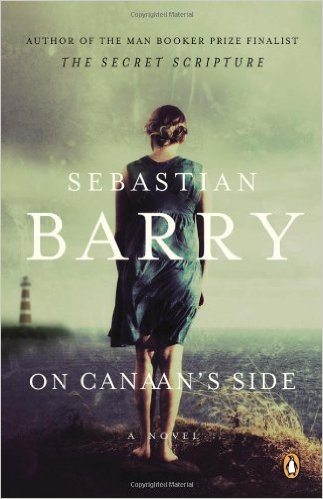
on canaan's side cover

When I started reading On Canaan’s Side a few days ago it was like slipping into a warm bed. I don’t know if that make a ton of sense, but I felt like trying to sound poetical, since Barry’s writing is that sort of writing. His stories of early twentieth century Ireland (and in the case of this novel, the United States as well) are just so beautifully written that I’m kind of sad that I only have one more of his books to read after I finish this one. I mean, listen to the first two sentences of this book. “Bill is gone. What is the sound of an eighty-nine year old heart breaking? It might not be much more than silence, and certainly a small slight sound (3).” Isn’t that nice? I mean it’s terribly sad, but beautiful, right? This time around, Barry is telling us the story of Lilly Dunne, the much younger sister of Annie Dunne, the titular character of the last Sebastian Barry book I read and blogged about. This time around, Lilly is being courted by a friend of her brother Willie’s from the war. Willie is killed in France (which we will learn all about in the novel A Long, Long Way, at some point before I move on to reading books in purgatory), and Tadg comes home to tell Willie’s family about his last days. He and Lilly are taken with each other. He gets a job as a policeman, but ends up on the wrong side of things when the Irish gain their independence, and the IRA puts him on their hit list, much like poor Eneas McNulty was. Tadg and Lilly board a ship to America, prior to being married, and find distant relations in Chicago. Before they can settle down, and before they can even get married, Tadg is gunned down in a museum, leaving Lilly alone in a country she doesn’t know, without any friends. That’s basically as far as I’ve gotten.

The novel is a frame thingy—eighty-nine year old Lilly is looking back on her life from the present day-ish, and we jump back and forth from the present to the past. In the present day story line Lilly is mourning the loss of Bill, her grandson. In the past, she has just lost her almost-husband. I guess we’ll be calling her “Poor Lilly Dunne” unless things start to look up soon.

So far, so good with this one, though I’m only eighty-five pages into it. On Canaan’s Side is not incredibly long, so I’m hopeful to get through it pretty quickly, though I don’t necessarily mind taking a while with a Sebastian Barry book. I wonder if the Dunne’s and the McNulty’s ever cross paths. I don’t think they have yet, but I’m not positive on that point. And now, I’m going to go back to watching Mockingjay Part 2, and deciding when this afternoon I’m going to torture myself with a Jillian Michaels workout. Probably soon.

Posted in Fiction - general, Fiction - Historical, Fiction - literary, Reviews by Jill, Sebastian Barry, Uncategorized | Leave a comment

Yarn Along

Yarn Along photo 4.6.16

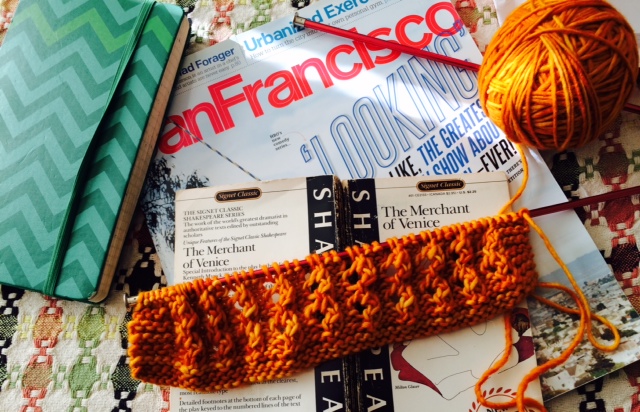
This picture is so orange it practically contains Vitamin C. I’m still enjoying the scarf I’m making with the leftover orange yarn, though I’ll have to buy some more yarn soon. I love when fancy camera tricks (performed unintentionally, at least when I’m the photographer) make books look huge. My favorite example is this one, but today’s is pretty good too. It looks as if the book barely fits on the shelf and has to jut off the edge – which I assure you is not the case.

I’m reading Geraldine Brooks’ The Secret Chord. I was very excited about this book when it came out because I love the David story, but when I first bought it I had trouble getting into it. I put it aside for a few months, and I found that after the prologue (Which is in italics. How do we feel about prologues in italics? I find them pretentious), the book is great. It tells the life story of David through the eyes and first-person narration of Natan, his prophet. I love the whole prophet-king dynamic in the Old Testament. Never gets old. This book reminds me of Annabel Lyon’s The Golden Mean, a book I loved but didn’t review here because I read it a year or so before we started the blog. That novel is the life story of Alexander the Great told in the first person by Aristotle. The Secret Chord jumps around in time and hasn’t covered the hundred-foreskins incident yet – but sooner or later it will, right? Brooks could hardly write a book about David without the hundred foreskins, could she? I think there’s a rule about that. And also, I hope that the title proves to be integral to this book on its own terms and not just a Leonard Cohen reference. I have no problem with Leonard Cohen references; I just worry that this one may be gratuitous.

Happy Wednesday!

Yarn Along is hosted by Ginny on her blog, Small Things.


Posted in Uncategorized | 10 Comments

True Confessions Tuesday, April 2016 Version

My true book confession for today is simple: I have been spending too much time the past week or so shopping for books and reading about books to actually do much reading.  I’ve started my next book, Sebastian Barry’s On Canaan’s Side, which is another story of the Dunne family (see my posts about Annie Dunne from 2014), this one focusing on the youngest Dunne child, Lily, who leaves Ireland for America in the aftermath of the Irish War for Independence of 1919 – 1921.  She lives a long life, and at the beginning of the novel we find Lily an old woman who has just lost her grandson, who she raised, in the most recent war the United States has found itself involved in.  I’m enjoying it, of course, because Barry is an amazing writer, but I’m not getting sucked in quite yet.  That usually happens eventually for me with this guy’s books so I’m not worried that it’s going to be a slog at all.

What have I been shopping for, you ask?  Well, it’s the first full week of April, so of course there are new Kindle deals to sort through.  And then last week Powell’s sent me a coupon for 30% off my purchase at their website.  So there’s that.  And then i was on amazon, trying to find all of the books from The Morning News Tournament of Books that piqued my interest during the competition in March.  If you don’t know what The ToB is, and you enjoy off the cuff fake book awards competitions, then please check out this year’s brackets! 

Posted in Glimpses into Real Life, Reviews by Jill, Uncategorized | Leave a comment

A Review of Armistead Maupin’s The Days of Anna Madrigal (by Jill)


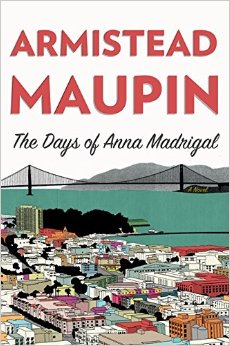
days of anna madrigal cover

It’s really very unfortunate that this is the ninth book in Armistead Maupin’s Tales of the City series, and also the first one I’ve ever talked about on the blog. I started reading this series when I was but a child of seventeen. Or maybe sixteen. Probably sixteen. Armistead Maupin’s stories of a bunch of San Franciscans living and loving and doing drugs in the late seventies and early eighties started off as a column in the San Francisco Chronicle and were eventually published as a series of novels. I was first introduced to the series in 1993 or so when PBS showed a mini-series version of the first novel on Masterpiece Theater, starring Olympia Dukakis as Anna Madrigal, the pot-growing landlady of an apartment building on Russian Hill, at 28 Barbary Lane. The novel focuses on Mary Ann Singleton, a newly transplanted secretary from Cleveland, Ohio, and her adventures as she adapts to a much different lifestyle than the one she experienced in the Midwest. Of course, anything with my hometown as a setting/character fascinated me at the time, and still does. I got totally wrapped up in the miniseries and had to watch it over and over, and then we had to go to Green Apple and get all of the books, used of course, though the fact that I don’t have a set with all the same type of cover art has not ceased to annoy me to this day. This is a book-hoarder problem of the first order. Anyway, as time went by in the series, the focus shifted from Mary Ann, who after a time turned from our plucky lead character to one of the villains of the piece, in a way. It never made sense to me why Maupin changed her character as much as he did, and maybe it would make sense now if I reread them as more of an adult, but I don’t really know. Maybe Mary Ann changed with the times and all of the other characters preferred to stay in the seventies forever. Regardless, by the end of the primary series, Mary Ann has left San Francisco to the true San Franciscans, and a piece of my childhood died with her departure. That may sound like hyperbole, but I swear it isn’t. I had never before experienced a character in a novel (or in this case series of novels) who I had liked so much initially changing so much so as to become completely unrecognizable and also unlikeable. It hurt my feelings, and I kind of resented Armistead Maupin for a few years. Fortunately, Mary Ann Singleton redeems herself in Mary Ann in Autumn, a book which came out back in 2010, and details Mary Ann’s return to The City, and back into Mrs. Madrigal’s fold, though on a somewhat limited basis.

Truly, the entire series focuses on a moderately sized cast of major characters, with many minor ones who turn up from time to time, though the most important ones in The Days of Anna Madrigal are Mrs. Madrigal, or Anna; Michael “Mouse” Tolliver; Brian Hawkins; and Shawna Hawkins. The most important things to know about Anna are that she was raised in a whorehouse in Winnemucca, and when that was going on her name was Andy Ramsey, and she was a he. We didn’t find out that Anna was a transgender person until the very end of Tales of the City, and as time has gone by Anna has become an icon of the trans community in the Bay Area, or possibly the whole country. Michael and Brian were residents of 28 Barbary Lane back in the day. Michael is gay, and Brian was a heterosexual man-whore until Mary Ann made an honest man out of him. Shawna is Mary Ann and Brian’s adopted daughter, who Brian raises on his own with Michael’s assistance after Mary Ann takes off at the end of book six, Sure of You. There, I think we’re caught up on characters and relationships, at least for the scope of this review.

So The Days of Anna Madrigal is told as all of the Tales of the City books are, with the exception of Michael Tolliver Lives, with third person omniscient narration with each short-ish chapter focusing on a different character. The difference in this book is that we also flash back to Anna’s time in Winnemucca, back when she was still Andy, and only sixteen years old. Maupin has never done this before; his focus has always been very much the present day. I loved actually getting to meet Andy Ramsey. He seemed like a nice boy, and much more sure of things than I would have expected. I do wish that we’d gotten further into Andy’s story—he goes to war and gets married and has a daughter before he finally decides to live his life as the person he is inside. Maybe that will be a later story, though I got the impression that this was the end of the series.

One disappointment I had with this book was that so much of the present-day story line takes place away from San Francisco, at Burning Man, a week long art festival in the Nevada desert that defies explanation. I’ve never been, but I’ve seen pictures, and heard stories. The festival originated in San Francisco, which is, I suppose, why so many of the characters end up there, and why Armistead Maupin felt the need to write about it. Hell, he was probably at the first one, which according to Wikipedia was on Baker Beach (which is a beach in San Francisco, for those of you who don’t know) in 1986. Though I wish more of the action had taken place in The City, I did enjoy the trip to Black Rock City and Burning Man—I sort of want to go now, but it’s kind of really expensive. And I kind of hate being dirty. So maybe I won’t go.

I wish I had more to say about The Days of Anna Madrigal. It was just a nice visit with characters who are more like old friends to me. I’ve “known” these people for over half my life, and it made me a little sad to see how feeble Anna has become, and how old Michael, Brian, and Mary Ann are now. In my mind they’ll always be in their mid-twenties, partying at the bath houses, and not worrying about serious things like AIDS and ovarian cancer. But life is life, and I guess it’s good that Maupin has had his characters grow and change and all that, more real and all that.

Maybe I’ll have more to say in a couple of days, but maybe not. This book is pretty plot-driven, and giving too much of the plot away will probably ruin it. I thought that this was supposed to be the end of the series, but it didn’t seem to close the door on future installments, which I hope is the case. I’m not done hanging out with these people yet, and I hope I get to see them again.


Posted in Armistead Maupin, Fiction - general, Reviews by Jill, Uncategorized | Leave a comment

Read-All-Day Friday

RADF Photo 4.1

No, I didn’t actually spend the whole day reading while facing the setting sun. That would be impossible outside of some environmental dystopian sci-fi novel, and I don’t live in an environmental dystopian sci-fi novel (not yet anyway). This photo is art, and catching those sunbeams was more important to me than actually showing you show I spent the day. Ceçi n’est pas un picture of what I actually did all day, though I did read a lot, and it was nice.

More soon.

Posted in Read-All-Day Friday, Uncategorized | Leave a comment

Yarn Along

Yarn Along photo 3.30

I’m meandering my way through several books at once, as usual, but my top priority right now is to finish The Merchant of Venice. It’s such a tight, efficient play. I remembered Act II as really long, mainly because it has nine scenes (I used to teach this play to high school sophomores; I know these things), but it moves along at a rapid clip. It’s actually a short play with a lot of ideas packed into it. I just read the scene in which the Prince of Morocco came to play the guess-the-casket game that will determine Portia’s husband, and it’s full of imagery that aligns the Prince of Morocco with Shylock. I know I will enjoy reading the rest of the play when I actually sit down and do it, and I am also looking forward to Howard Jacobson’s Shylock is My Name. Also included in the photo is my current planner book and a 2014 issue of San Francisco magazine – NOT because I’m two years behind in my periodical reading (I promise!) but because I use it as a surface when I hand-write on paper on the dining room table.

I had almost a whole skein of the bright orange yarn left over, so over the weekend I cast on a scarf. I’ll need more in order to finish the scarf, of course, but I won’t mind a dye-lot line in a scarf – and I really, really want to keep working with this yarn. It’s so bright and thick and soft.

Yarn Along is hosted by Ginny on her blog, Small Things.

Posted in Uncategorized, Yarn Along | 10 Comments

A Brief Update on a Short Book: Progress Report on Armistead Maupin’s The Days of Anna Madrigal (by Jill)

I’m going to be done with The Days of Anna Madrigal sooner rather than later, but I don’t think that I’ll have enough to say about it to warrant two full posts, and today was kind of a long day at work, so suffice it to say that with less than a hundred pages to go, I’m enjoying this book quite a bit, but not so much because it’s a high quality read, but more because of all the happy memories I have of reading this series when I was younger.  I love the characters like old friends, and I’m so glad to have some time with them again.  I’m a bit disappointed that so much of the action revolves around a trip to Burning Man rather than spending time in San Francisco, but I’ll survive.  Besides, reading about Burning Man shenanigans is pretty fun.

More next time…

Posted in Glimpses into Real Life, Uncategorized | Leave a comment

Reading on Muni

Reading on Muni photo

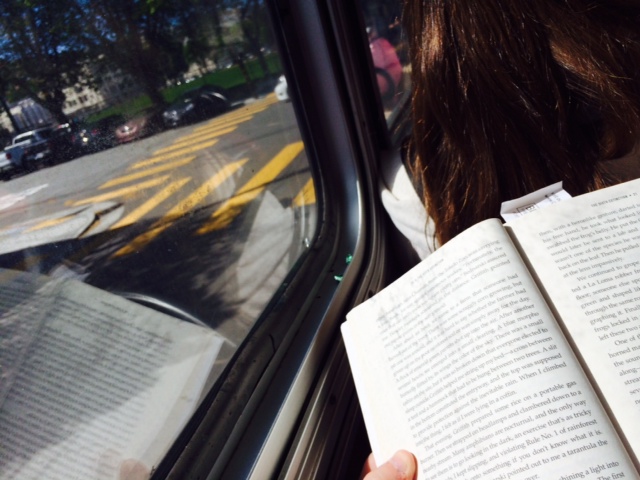
I only read a few paragraphs. It’s hard to read when a couple rows ahead of you there’s a guy with four prescription bottles that he’s trying to balance in his two cupped hands while also periodically opening one and swallowing a pill or two, while also making proclamations like “My mother says I RAPED her! My MOTHER!” and “You know what bipolar is?” But I did spend some serious time on Muni today – and also some serious time not on Muni. Let’s just say I spent some serious time today. Good night, all.

Posted in Glimpses into Real Life, Uncategorized | Leave a comment

Something There Is That Doesn’t Love a (Big, Beautiful) Wall

stone wall

The “something” in the first line of Frost’s “Mending Wall” is the physical world. To be specific, it’s a phenomenon that shares the poet’s name: frost heaving. A native San Franciscan like me, Frost would have seen frost heaving in effect only after he moved to New England with his parents. When land freezes, it expands, causing upward pressure on the surface. In the spring, the surface shifts again as the earth thaws. Asphalt cracks, and man-made structures can shift and be damaged.

When the speaker of the poem and his neighbor meet to repair the stone wall that divides their properties from one another, they follow a rigid custom. If a stone falls on the speaker’s side, he replaces it in the wall; the same applies to the neighbor. Because the entire wall, including the stones that did not fall to the ground, shifted when the earth froze and thawed, replacing the stones is not an easy task. The gap where each stone used to be is no longer there. The speaker recognizes the futility of the exercise, remarking that “We have to use a spell to make them balance: / ‘Stay where you are until our backs are turned!’” (18-19) and speaker calling this ritual “just another kind of outdoor game, / One on a side” (21-22), aligning it with baseball, football, and other games that are meant to be friendly but so often seem more like a form of warfare.

The neighbor sees the replacement of the stones as a rigid duty. When the speaker points out that neither he nor his neighbor has animals that might wander (“He is all pine and I am apple orchard” [24]), the narrator reasserts his refrain – one of the most well-known lines in American poetry – “Good fences make good neighbors” (27). The line “Spring is the mischief in me” (28) suggests the narrator’s desire to mimic the thawing earth by upsetting the foundations of his neighbor’s thinking – his neighbor whom he later calls “an old-stone savage armed” (40) and intimates that “he moves in darkness as it seems to me, /Not of woods only and the shade of trees” (41-42; Hint: want to emphasize something? Make it rhyme!).

In this poem, the neighbor’s very human desire to divide the world between “mine” and “theirs” runs counter to the earth’s annual disruption of man-made boundaries. The very fact that the speaker participates in this annual ritual with his neighbor shows that on some level he respects it. He likely grew up seeing men repair stone walls in this way, and his objections are gentle, fanciful, and mostly unvoiced. All of us, on some level, have an inherent fear of barbarians at the gate. I grew up a compulsive door locker: guests who leave my house – even my closest friends – haven’t even left the porch before they hear the deadbolt snap into place behind them. Others live in houses placed far back from main roads, behind privacy fences or hedgerows or locked gates. Some install alarm systems. Some own large dogs. Some worship the second amendment.

But the narrator’s question for his neighbor is key: “Why do they make good neighbors? Isn’t it / Where there are cows? But here there are no cows. / Before I built a wall I’d ask to know / What I was walling in or walling out, / And to whom I was like to give offense” (30-34). The speaker is not saying that unthinking loyalty to tradition is dangerous – though it can be, and the poem does beg that question. What these lines do instead is assert our identity as rational animals. We are not “old-stone savages” armed with rocks, nor are we wandering cows liable to eat other people’s apples. We can engineer our environment – as in the building of fences and walls – but we can also contemplate the consequences of our actions. We can be silly, offering “elves” (36) as a possible reason for the tumbling down of rock walls. We can be stubborn, like the neighbor, but we can also choose to be passive and let natural forces do what they may. We can be compassionate, as the narrator suggests he wants to be – though the suggestion is very much in the subjunctive, as if he lacks the guts. We can abandon outdated ways of thinking and living. We can contemplate the nature of the “something” deep in the earth that seems determined to – gently, patiently – grind our walls and distinctions to dust.

Consider this: in North America, the boundaries of our nations and of many U.S. states have their origins in the original borders put in place by the Europeans who colonized this continent beginning in the early sixteenth century. Florida was Spanish territory; Louisiana was Spanish too until it was ceded to the French. Canada was French until 1763, as were large swaths of the northern Midwest. Our current border with Mexico is only the latest iteration of the boundary between “New Spain” – which at one time included Texas, New Mexico, Arizona, and California – and the United States of America. Even Russia played along, staking a claim in Alaska and even establishing a little pied-à-terre in northern California.

All the nations that created colonies in North America were also fighting one another in Europe. The descendants of the barbarians that once sacked Rome lined up massive armies on the fields of France, Germany, Spain, the Netherlands, and England. They fought over many things, but in the years most associated with the colonizing of North America (let’s say 1550-1763), they mostly fought about religion. The borders of these nations shifted after each war, with slivers of territory changing hands, and when individuals, families, and, in a few cases, entire religious sects found themselves without safe homes, many left Europe to go overseas, where in most cases they found enough empty land that they could (temporarily) stop fighting about religion. Think the Puritans are assholes? Go to New York. French too Catholic for you? Go south. The land itself, which seemed limitless at first, became the primary object up for dispute. The French lost Canada to the British in 1763. The British lost its American colonies in 1783. The United States bought Louisiana and much of the Midwest and northwest from France in 1803. After a series of skirmishes and one big war, Mexico retreated to its current border in 1848, leaving behind thousands of Spanish speakers who never stopped speaking its language, eating its food, and practicing its traditions.

The Europeans kept fighting, for a while. France tore itself into pieces after its revolution, then united under Napoleon and turned its ire outwards. Traumatized, the continent quieted down for a while. Then the German states united under Bismarck, the Italian states under Garibaldi. The British held on to their Indian and South African colonies with  teeth and nails, while fighting the Russians in the Crimea and the Irish on their own borders. Archduke Franz Ferdinand was assassinated in Sarajevo, kicking off the event that most historians now agree was hardly the first world war. Punitive tactics in the Treaty of Versailles and a worldwide economic depression made the next war all but inevitable. Europe was divided in two by walls and tanks and guns and conflicting ideologies. Even when I went to elementary school in the 1980’s, history was the study of warfare and borders. North and South Korea; North and South Vietnam. Estonia, Latvia, Lithuania. The R.S.F.S.R. I learned all the SSR’s by heart in seventh grade; the next year the Berlin Wall was down and there were new boundaries to memorize.

But then something happened: it got better. Germany reunited without aggression. France and Britain put aside their ancient differences. England slowly learned to live at peace with Ireland. I know I picked a bad week to hold contemporary Europe up as a model of utopian living, and I know that its openness to Syrian immigrants is the source of serious dissent. But the system works. Wealthier nations in the EU bolster struggling ones, just as the wealthier southern states funded industry in the north in the years immediately after the American Revolution, when the new nation was bankrupt. Its healthcare systems – some but not all what we would call “socialist” – function efficiently. Its governments cooperate. Its nations trade freely. Even after the attacks in Belgium this week and in France in November, when many Americans cancelled their plans to vacation in Europe, the French and Belgian police, military, and intelligence services sprang into action to detect and stop active terror cells. All human communities are marked by violence. 21st-century Europe – though its history is hardly fully written – does as good a job at cooperating and stemming violence than any community I know of in history, and a better one than most.

So here’s my question. Why is it that Europeans cross borders passport-free while we still dicker over borders that their ancestors left behind centuries ago? Europeans made progress (or, more accurately, had progress beaten into them by a century of horror); we lag behind. We cling to old borders. We treat their enforcement as a sacred tradition. We parrot statements we’ve heard others made – statements more inflammatory than “Good fences make good neighbors” and a lot less euphemistic. We talk about drugs and guns and disease and rapists – all of which we have in this country, in spades, already. We rant about barbarians at the gate when, in this context, we are the old-stone savage armed.

It’s Easter. The sun is shining. Spring is the mischief in me.
Posted in Authors, Essays about literature, Essays on Politics, Poetry - General, Poetry - Lyric/Narrative, Reviews by Bethany, Robert Frost, Uncategorized | Leave a comment

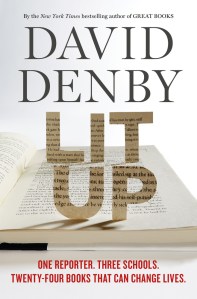
Early Thoughts on David Denby’s Lit Up and on High School English in General

9780805095852_LitUp_JK.indd

I’ve read almost nothing this week. I’ve been scrambling to finish some freelance jobs and other side work (bacon must be brought home, and so forth – preferably organic bacon), and I have several blog posts in progress, all of which are kind of complicated and are not going to be fully realized between now and midnight. So for now I’m just going to tell you a bit about David Denby’s Lit Up. First of all, Denby is the guy who wrote Great Books back in 1997, about how he returned to his alma mater, Columbia University, as an adult to retake that university’s core humanities courses. I sampled the book a long time ago and was put off by it for reasons I don’t remember. I read his book about playing the stock market, American Sucker, and learned a lot about day trading but found Denby’s persona bitter and unlikable. So far I am enjoying Lit Up, which is the result of a project in which Denby spent one full year observing 10th grade English classes at Beacon High School in Manhattan followed by another year of sampling a variety of other English classes at several other schools. I was prepared to love this book, but I knew there was always the danger that I would hate it, since the ground Denby is treading is sacred to me, though I sometimes like to pretend it isn’t.

Here’s how the book starts:

“Well, maybe not on the way home from the hospital. Maybe when the baby is six weeks old, or when she begins smiling. That might be a good time to pull her into your lap, or prop her up between you and your spouse or partner. Turning through pages, you read aloud a picture book. She won’t remember the words or pictures, but an impression of being held and read to will remain – a familiarity with the experience, an emotional reminder of pleasure, especially when it’s repeated hundreds of times. Second part of the deal: you talk to your baby constantly, from birth, asking questions, and gently demanding answers when she’s old enough to give them. Like a child in a fairy tale, she will possess an unknown power, which, sooner or later, will burst forth. The reading ego, and the speaking ego, need thousands of little victories before they assert themselves without fear, and she will be ready. A child held, read to and talked to, undergoes an initiation into a useful life; she may also undergo an initiation into happiness.” Italics/underlining/boldface type are mine, because OMG that sentence! And how brilliant is the idea that reading aloud should begin with the baby’s first smile?

The teacher Denby shadows for a year is Sean Leon, a mid-career teacher at Beacon High School – a magnet school for academics and the arts in Manhattan. Denby chose Beacon because a seasoned teacher told him that Beacon was noteworthy for delivering an outstanding education in spite of an absolutely horrible physical plant. Leon is one of those English teachers who can be kind of annoying – the kind who are a little bit too aware that they are in a position to change students’ lives. Denby doesn’t mention it, but there is absolutely no doubt that at some point in his career Leon has climbed up on a desk and O-Captain-My-Captained around up there for a while. It’s true, of course, that teachers do sometimes change students’ lives. It’s OK to know that, but you have to finesse it a little. You can’t wear it tattooed on your forehead on the first day of school. Ultimately, English classrooms are about the students and the texts. If teachers can find ways to efface themselves, they should do so – at least sometimes. Maria Montessori’s “A great teacher is one who makes herself gradually unnecessary” has never lost its power to give me shivers.

Denby quotes the beginning of a student essay: “Themes are a big part of The Kite Runner,” it begins. “In all great works of literature, themes are brought up. The Kite Runner is a great example of this, bringing up the themes of truth/realization, friendship, and manhood, which is brought up a lot in Azar Nafisi’s five quotes” (11). Denby offers some generalized sympathy for the man who will have to take that essay home and grade it: “A pang of despair. They were fifteen, they lived in a hyper-media age, and they were not, I was sure, easy, with literature and writing. Still, these sentences were a misfortune, a way of turning the devices Sean Leon had given them [i.e. the five quotations from Azar Nafisi’s Reading Lolita in Tehran that the instructor had given the students as part of the assignment] into lame tautology. He had brought on this kind of gibberish, and he would have to clear it out of their heads. He had his work cut out for him. They all did, the English teachers of America” (11).

Leon teaches Faulkner’s short story “A Rose for Emily” – which I’ve taught only once, and not in a school setting – and Hawthorne’s “The Minister’s Black Veil.” Denby is stunned by the students’ misinterpretations of the stories (ha!), but to me the most interesting part of this chapter is Denby’s observations of how the students read out loud. I think it is important for students (and teachers) to read out loud in class, but there has also always been a little bit of anxiety surrounding this subject for me. When my students read aloud, I used to be consumed with worries like Are we spending too much time reading from the book? Are they going to write on their course evaluations that all we ever did was read out loud from the book? Do they think they don’t have to read at home because we read in class? Have I called on everyone? Am I calling on the girls more than on the boys, or vice versa? Should I go easy on students who struggle with reading aloud? Should I make them read more, to build their skills? What about the ESL students? Are they embarrassed? Should I just read it all myself, and be done with it?

Any questions why I burned out at thirty-six?

Anyway, here’s Denby’s observation as he listens to a girl read from Hawthorne: “Like other students who had read aloud in class, she read efficiently, without hesitation or stumbling – they were all fluent, “good readers” – but she read it without emphasis, too, indeed without expression of any kind, as if reading aloud were simply an exercise, a duty that had to be got through. They all read that way, flatly, barely above a monotone, and I thought I knew why: they didn’t want to reveal any of themselves by giving one phrase or another extra emphasis. Not personal strengths or weaknesses, not sexual feelings – not anything. They were shy, and they read defensively, and I felt a traditionalist pang for earlier American schoolrooms in which public reading and even memorization had been a central part of education” (19).

The shyness and defensiveness Denby describes here is related to my chain of nervous questions above, of course, though I’m grateful to Denby for putting my questions into statement for. Denby feels “traditionalist pangs” with some frequency – this is part of what bothered me about Great Books and may eventually irritate me in this book too, but in this case I’m so struck by his statement that I forgive him.

Denby proceeds through some nonsense about how difficult The Scarlet Letter is to teach. This is a myth – as long as you have the good sense to NOT assign the forty-page introduction that doesn’t have anything to do with anything, The Scarlet Letter more or less teaches itself. It was one of my favorites when I was teaching. But Denby proceeds with this truism about Hawthorne being archaic and dated and irrelevant, and he sits in on an American literature class that is acting out the opening scene. The teacher has dressed some girl in a black dress and made her climb out of a cabinet holding a doll – of COURSE The Scarlet Letter is going to be hard to teach if you make it look ridiculous. I have no patience for silly stunts like this that infantilize kids, stunts that essentially announce to the students that the teacher thinks they can’t read the book without playing silly games. In my own education, preschool to grad school, the teachers who made an impression on me (a positive impression, that is) were the ones who took me seriously.

I say this in spite of the fact that, as I once heard a sophomore whisper to a classmate, “that’s the good thing about Ms. Edstrom – once a semester or so she whips out the markers.”

More soon.


Posted in Authors, David Denby, Nonfiction - Education, Nonfiction - General, Nonfiction - Literary Studies, Nonfiction - Media and Pop Culture, Reviews by Bethany, Uncategorized | 7 Comments