Yarn Along

Yarn Along photo 4.27.16

I went to the yarn store on Monday. I needed two more skeins of the orange yarn (Malabrigo Worsted #96 – Sunset) for my scarf, and I was putting off the trip because I more or less knew that the two skeins would not be my only purchase. Compared to my usual self, I’ve been a veritable paragon of thrift lately, so finally on Monday I went to Dharma Trading in San Rafael for the two skeins of orange and also enough of this variegated red/magenta/purple/pink/black blend (also Malabrigo Worsted, this time #173 – Stonechat) for a sweater. It’s hard to see how nicely the colors work together in this photo, but once the piece is larger I’ll make sure to take a photo in good outdoor light. The orange scarf is still progressing nicely, and I’ll be sure to post updates on that as well in the coming weeks. Having only one knitting project on needles really isn’t my style.

I’m reading – among many other things – Christopher McDougall’s Natural Born Heroes. It’s about the kidnapping of a Nazi officer by Resistance fighters on Crete during World War II, but it’s also about the ancient Greek tradition of heroism, dating back to mythological figures like Achilles and Hercules. It’s the sort of book I can’t stop myself from annotating. Here’s a passage:

“When the Greeks created the heroic ideal, they didn’t choose a word that meant “Dies Trying” or “Massacres Bad Guys.” They went with [a word that meant] “Protector.” Heroes aren’t perfect; with a god as one parent and a mortal as the other, they’re perpetually teetering between two destinies. What tips them toward greatness is a sidekick, a human connection who helps turn the spigot on the power of compassion. Empathy, the Greeks believed, was a source of strength, not softness; the more your recognized yourself in others and connected with their distress, the more endurance, wisdom, cunning, and determination you could tap into. The nearly indestructible Achilles had his loyal friend Patroclus. Odysseus fought his greatest battle with two loyal herdsmen by his side. Even Superman, who wasn’t human at all, kept Jimmy Olsen hanging around. Hercules had his twin brother and adoring nephew, and when things were darkest his best bud, Theseus, was always there. And of course, brainy boy detective Encyclopedia Brown had two-fisted Sally Kimball. A sidekick is a hero’s way of looking into his soul, of drawing strength from his weakest side, not his strongest. He has to remember that even though he shares the blood of a god, he’s still human at heart. He’s not a Titan who will swallow a baby to get out of a jam or a god who will never die. He has one shot at immortality, and it’s in the memories and stories of the grateful and inspired” (29-30).

More soon.

Yarn Along is hosted by Ginny on her blog, Small Things – which is even lovelier than usual this week because BABY GOATS. If you haven’t already, I encourage you to check it out.

And P.S. Did you know that Hercules had a “twin brother and adoring nephew”? I didn’t know Hercules had a twin brother and adoring nephew. Is it possible the author is confusing him with Scooby Doo? If I still had a 10th grade honors English class at my disposal, I would ask them. Honors sophomores always know all the mythology questions.

And P.P.S. Encyclopedia Brown!!! I can’t remember the last time I heard that name. The passage I quoted above gets a little cliché at times, but because Encyclopedia Brown got the “of course” instead of Achilles or Hercules, I will forgive Christopher McDougall for a few clichés.

And P.P.P.S. Stonechat? What kind of name is that for such beautiful yarn? I hereby rename it: SANGRIA.


Posted in Uncategorized, Yarn Along | 5 Comments

A Review of Geraldine Brooks’ The Secret Chord

the secret chord cover image

Told from the point of view of King David’s prophet Natan, this novel begins at the moment when David’s generals and military advisors declare that he is no longer fit to lead his army into war. While dealing with his anger, David does two things. First, he authorizes Natan (Nathan in most English translations) to write his biography – fearing, I suppose, that his ousting by his generals is the first step in his decline. He gives Natan a list of three people who can fill him in on David’s early life – his mother, Nizevet; his oldest brother, Shammat; and his first wife, Mikhal – and he also instructs these three people to tell Natan “everything.” The interviews between Natan and these three individuals make up much of the plot of the novel. Second, in the throes of his anger at no longer being the field commander of his army, he paces around and gazes out of windows until he sees Batsheva bathing on the roof of her house and, as you may remember, kidnaps her from her husband, Uriah the Hittite, whom David later has killed.

Natan is horrified at David’s commandeering of Batsheva because of the affront to Uriah. David already has multiple wives, so no one bothers to accuse him of adultery or of rape, which is how the encounter is depicted in the novel. But Uriah was one of David’s most trusted generals – in fact, the reason Uriah is not at home to protect his claim to Batsheva is because he is fighting the battle from which David has been excluded. From a modern pop-psychological perspective, it seems likely that this slight against David’s virility and authority might have unconsciously been a reason for the rape of Batsheva, though I don’t recall Natan considering that possibility in the novel.

I would love to fill you in on the details of the David story, but I’m going to try to keep this review rather brief. Here’s the short version: unloved shepherd boy; Cinderella-style visit from prophet Shmuel (or Samuel), who rejects all of David’s older brothers but anoints David as God’s new chosen one; service in Saul’s army; gradual rejection by Saul; marriage to Saul’s daughter; several years spent as an outlaw, building his own army while evading Saul’s murderous henchmen; rise to kingship after Saul’s death; unifying the tribes in Israel; establishment of capital city in Jerusalem. This is a bare-bones review of the plot, but what is most interesting about David’s story is his nearly limitless capacity for sin and contrition.

The first time I remember thinking seriously about the David story was in a college class on the King James Bible. The professor’s attitude toward the subject was rather irreverent, so his lectures went heavy on the Philistine foreskins and lighter on such matters as sin and atonement and the individual wrestling with his conscience. What I remember him emphasizing, though, was the sheer randomness with which God abandoned Saul. God had no reason to abandon Saul, the professor insisted. Saul was a bit of a chump, but he had always been plodding and dutiful and boring, the sort of person one compliments using the word “competent.” In other words, the consummate administrator. And even though Saul (Brooks uses “Shaul” in her novel in keeping with the Hebrew) is one of the “bad guys” in this novel, we’re still never given a glimpse of why God turned away from one king in order to anoint and then endlessly forgive the horrible behavior of a second.

To me, now, these irrational shifts in favoritism aren’t a side plot in the David story; they’re the point of the story. In her author’s note, Brooks cites a statement that I’ve heard before: that even though there is little archaeological evidence of the events in the David story, historians tend to agree that the story must be true because no culture would devise a national and religious hero who was so horribly, deeply flawed. David was a rapist and a murderer, and it’s really not much of an exaggeration to call him a serial killer. He killed his enemies in war, sure, but he also killed at random and without purpose (his own caprices imitating those of his God, I suppose). The title of the novel is taken from the Leonard Cohen song “Hallelujah,” of course, and I was mildly annoyed that the title had little to do with the novel’s plot. My first thought was that Brooks hoped to sell more books by reaching out to listeners of one of the most well-known modern pop songs – and on some level perhaps she did. But then I thought about it a little more. I am not a musician, but I do know what chords are, and it seems preposterous to me that someone might “like” one chord more than others. I have no doubt that musicians might disagree with me. However, for me, the idea that David created a chord that somehow pleased God more than other chords is just ridiculous. The Old Testament is full of these sort of random choices: God likes Abel’s offering more than Cain’s, God demands that Abraham sacrifice Isaac and then changes his mind, Isaac favors Esau over Jacob (“because he did eat of Esau’s venison”), God anoints Saul as king but then un-anoints him in favor of a feral shepherd boy with a knack for playing the harp. I am not religious, and I tend to agree with Spinoza’s insight that humans were the ones who invented God in their image, rather than the other way around. Taken as a whole, these stories suggest that the quality in themselves that the ancient Hebrews most needed to explore by superimposing it onto God was their capacity to change their minds irrationally. Having preferred chords doesn’t come close to matching the irrationality of human preferences. Colors, for example. Who in his right mind could have a favorite way that light refracts off a surface and then disperses? The answer is most of us. We have preferences for everything. We are toolmakers and we walk erect, sure, and we’re rational animals at least sometimes, but mostly we are Homo preferentialis – we are apes that like some things more than others for absolutely no goddamn reason.

Brooks’ novel reflects our preferential nature. David is impulsive and violent, constantly sinning and then sinking into periods of deep contrition during which he plays the harp and sings and writes poetry (i.e. the psalms). In many cases the consequences of his actions are dire. When he fails to punish his oldest son for raping David’s only daughter Tamar (never mind when he raised a son who would rape his sister in the first place), David sets the stage for his other son Absalom’s famous revenge plot, in which he invites all of his siblings to a party and then brutally murders his oldest brother in revenge for the rape. Even David’s favoritism of his youngest son (Shlomo in the novel, in keeping with the Hebrew; Solomon in most English translations) is wildly unfair. It’s true that the young, inquisitive, calm Shlomo is more appealing than his raping, murdering brothers, but the comparison begs the nature-vs-nurture question. David’s older sons were raised in armed camps in close proximity to their father; Shlomo is the son of David’s late middle age, and, in the novel at least, he is raised by the measured, careful, attentive, and highly diplomatic Natan.

I enjoyed the novel. I enjoyed it so much that I opened my King James Bible to the beginning of 1 Samuel, though I stopped reading after the first eleven or twelve begats. But I’ll go back eventually. As I said, I’m not religious, but every time I bump up against Old Testament ideas, I feel a kinship to them. The Old Testament is braver than the New, I think – it’s more willing to wallow in the muck of human nature. From the Christian perspective, the Old Testament is muckier than the New because it lays out the sinful human nature from which Jesus saves us, but this idea has always seemed evasive to me. I like David because he feels authentic. I like the fact that the people who tell his stories (Samuel originally, Geraldine Brooks most recently, and of course countless others) aren’t afraid to focus on the ugly parts of his nature. Honestly, my primary response to this novel was to want to take on a story like this one myself, and I’ve been thinking about how I might want to do so. I have no interest in sticking as close to the original as Brooks does, but I’ve been playing with the idea for a couple of weeks and will let you know if anything comes of it.
Posted in Authors, Fiction - general, Fiction - Historical, Fiction - literary, Geraldine Brooks, Reviews by Bethany, Uncategorized | 2 Comments

Sapiens

sapiens_3051413a

Human beings did not domesticate wheat;  wheat domesticated us. And yes, it makes sense. More soon.

Posted in Uncategorized | Leave a comment

A Review of Dave Eggers’ The Circle

The_Circle_(Dave_Eggers_novel_-_cover_art)

This novel’s protagonist is the twentysomething Mae, who sometime in the not-so-distant future lands a job at The Circle – a tech giant that makes Facebook, Google, Yahoo, and so forth obsolete by combining all their functions into one – through her college friend Annie. Annie has risen quickly through the ranks at The Circle and is part of the “Gang of 40,” a group of high-level Circle execs who counsel and advise the company’s three founders, who are known collectively as the Three Wise Men. Mae’s position is entry level – she responds to customer queries and complaints in the Customer Experience department – but she is happy to be there and is assured she will move up in no time.

In addition to responding to customer queries, Mae is slowly given more and more duties, most of which involve meaningless chit-chat with insipid people. One screen at her desk shows an endless feed of comments from other employees at the Circle (Way to go newbie Mae! and so forth); another shows a broader social media platform that connect millions of people worldwide who have Circle accounts. These social media platforms are not just entertaining distractions; they are job requirements. The first time Mae is reprimanded, it’s because she did not respond when a co-worker named Alistair invited her to a Portuguese-themed party. Her Circle account automatically connected with her previous social media accounts, and somewhere in the history of her Facebook account, Alistair found photos of a trip to Portugal that she took years ago. When he sends her multiple invitations and she misses them because she is getting acclimated to her new job, Alistair complains to HR and she ends up being reprimanded by the company. I don’t know about you – but to me this is my idea of hell.

Time passes; Mae gets more responsibilities and more screens. Soon she is supervising newbies and wearing a headset, through which she is asked survey questions all day long about various consumer projects. She also develops three competing love interests: Mercer – a high school boyfriend with whom Mae’s parents hope she’ll reunite – Francis, whom she met at a party on her first evening at the Circle, and the mysterious Kalden, who appears and disappears at odd moments and takes Mae to an eerie underground bedroom on the Circle campus, where they have sex. Mae also runs afoul of Circle rules on other occasions. When she leaves work immediately at the end of the day in order to visit her parents, she is called in to explain why she did not go to any of the evening social events the company offers. When she tells her boss that she wants to spend time with her parents because her father has recently been diagnosed with MS, she is chastised for not telling anyone on the Circle’s massive social media network that she has a family member dealing with a chronic illness – in other words, for failing to “reach out.” I’ve never been much of a fan of that expression, but by the end of this novel it kind of sickened me.

There is lots more plot to this novel, in which the situation I’ve described above continues to even more ridiculous levels. Dave Eggers knows how to imbue a story with forward momentum as well as any other contemporary novelist I know (and better than many). The text alludes to famous dystopian satires like 1984, both directly, with company mottos like SECRETS ARE LIES, SHARING IS CARING, and PRIVACY IS THEFT, and also in subtler ways, such as the way her life at the Circle eventually erodes away at Mae’s inner life. There’s no direct parallels to other characters in 1984, but Kalden is a little like Julia (or is he like the two-faced O’Brien??) and the machinations Mae makes to get a few minutes alone with Kalden or with her friend Annie resemble the lengths Winston and Julia take to steal some time alone together. But make no mistake – this novel is about our society, our world. The Circle’s central tenet is the principle of net neutrality – the founding principle of Khan Academy and the Internet Archive and other organizations that aim to make sure that all known information is available to all human beings, regardless of socioeconomic level, physical location, or other demographic. This is an egalitarian idea, one that I admire – but Eggers makes clear in this novel that this principle could be grossly misused.

This novel holds up less well in terms of character development. Mae is a bit of an enigma. She is hired at the Circle when she complains to her friend Annie that her job at a small-town public utility company is slowly killing her soul, but even her gratitude for the job doesn’t explain how quickly she kowtows to her supervisor’s ridiculous expectations and reprimands. We’re told that Mae was a college athlete, but we’re given no evidence of the hard-driving personality that most athletes bring to everything they do, including their work lives. She likes to steal away for an hour here and there to go kayaking, and in one case she takes significant risks in order to do so, but nowhere else do I see her as a character who enjoys solitude or has an aptitude for risk-taking and adventure. At work she is the opposite of a risk-taker (except, I suppose, in her liaisons with Kalden, although these are always initiated by him). Annie is a mystery as well. She is characterized as verbally bold and relentlessly charismatic, but by the end of the novel she has undergone a nervous collapse after she learns that she is descended from slave owners. Though she learns this information as part of a Circle project about mapping one’s family tree, it feels tacked on to the novel. It seems out of character for Annie – who seems to take everything else in her life as a joke – to be upset for more than a day or two about this information. Honestly, early in the novel I was expecting Annie to turn out to be one of the “evil geniuses” behind the Circle’s work. I thought that part of Mae’s character arc would involve coming to terms not only with the Circle’s overarching ambitions but also recognizing that her own best friend pulls the strings behind some of its most nefarious projects. But Mae doesn’t have a character arc – not really. She submits to the Circle’s authority and then holds on throughout the bumpy ride. The plot line about her father’s MS is dropped mid-novel and not picked up again, as is her alleged passion for kayaking,  and she shows little remorse or grief when the Circle’s aggressive surveillance drives her ex-boyfriend Mercer to suicide. On some level, of course it’s right that she surrenders much of her individuality to the Circle – but let’s keep in mind that Winston Smith in 1984 retains some vestiges of his individuality right up to the last few pages of the novel in a system that is at least as oppressive as the corporation in this novel, if not more so. I had lost interest in Mae as a character by the halfway point in the novel, though I never really lost interest in the plot. I never stopped wanting to know who Kalden really was and whether the Circle would “complete” itself (an oft-stated goal of the corporation) and what exactly that would mean when it happened. I do recommend this book as an engrossing read suitable for a vacation or a flight (I read most of it over the course of a few days with an eight-month old napping on my shoulder), but I can’t say that it truly succeeds.

Posted in Authors, Dave Eggers, Fiction - Dystopia, Fiction - general, Reviews by Bethany, Uncategorized | 4 Comments

Final Thoughts on Sebastian Barry’s On Canaan’s Side (by Jill)


on canaan's side coverNothing annoys me more than having a book ruined by the length of time it takes me to finish it. By rights I should have loved On Canaan’s Side. I’ve loved every other book of Sebastian Barry’s that I’ve read, and I’ve read all but one of them. Looking back on my memories of the story of Lilly Dunne, there’s nothing I find reproachable in the plot, or in the character development, though I have to say that maybe Barry lays the tragedy on a little thick this time, even for him. Nope. My lukewarm feelings about this book are all because the past few weeks have been too busy for me to get much reading done, and the times of my life when I don’t have time to read are the worst for me.

The point I’m trying to make here is that I can’t come up with anything good to say about On Canaan’s Side, but I can’t come up with anything bad other than it took me a long time to read it. But I got through the last eighty pages today with no problem (which is about a third of the book, by the way), and it’s not like the pace quickened at all. Well, my pace quickened. The book stayed the same.

The last time I talked about this book I think Lilly had run off to America with her almost husband Tadg Bere because the IRA had contracts out on them, and they ended up in Chicago, where Tadg got gunned down in a museum. Lilly makes her way to Cleveland, and then Washington, DC, and then, finally, to the Hamptons in New York. She marries a man named Joe, who “dies” in a fire. She raises their son Ed herself, and then her grandson Bill. Ed runs off to the mountains after a couple of tours in Vietnam, and Bill goes to war in Iraq (I think for Desert Storm, but the chronology is a bit off). Lilly seems destined to have men leave her, and to have no women in her life to stick with her, except her boss Mrs. Wolohan, who is a loyal person indeed, but is not the same as a family member or good friend.

I think anyone who has enjoyed Sebastian Barry’s other books, or those of Colm Tóibín, or really any male Irish writer of a certain generation, would enjoy On Canaan’s Side, and I think that if I read it again at another, less busy, time, I would probably like it at least as much as Annie Dunne, though not maybe as much as The Secret Scripture.

Next up is Voyager, the third book in Diana Gabaldon’s Outlander series. I know this is going to be a long read, but I’m hoping it goes quickly. I just started watching season two of the Starz series, and I’m sort of excited to see what happens next with Claire and Jamie.


Posted in Fiction - general, Fiction - Historical, Fiction - literary, Reviews by Jill, Sebastian Barry, Uncategorized | 1 Comment

Yarn Along

Yarn along photo 4.20.16

I’ve found that I like my Yarn Along photos best when they are a bit “busy.” I’m not sure if this is an aesthetic preference or if it’s because busy photos feel more authentic to me, since my book and yarn storage systems start at “busy” and are often downright chaotic. This photo includes my Kindle, on which I am reading Dave Eggers’ The Circle; my current knitting project (still the orange scarf); a random ball of yarn that my cat sometimes likes to play with; my copy of Claudio Saunt’s West of the Revolution, which I am not reading but hope to read soon; the case for my Surface; assorted magazines; a coaster in a place where no one in his right mind would ever put a beverage; a crescent-shaped sliver of lamp; and a ceramic otter that my mom bought at the Monterey Bay Aquarium in 1986. Ladies and gentlemen, my  life.

Yarn Along is hosted by Ginny on her blog, Small Things.

Posted in Uncategorized | Leave a comment

A Review of Elizabeth Kolbert’s The Sixth Extinction: An Unnatural History

The Sixth Extinction cover image

Can you imagine childhood without dinosaurs? I can’t. What did three year-olds do before there were books of dinosaurs to pour over? How did they learn to pronounce multisyllabic words in the absence of archaeopteryx, velociraptor, and tyrannosaurus? Were they forced to study German? Maybe this is why young children in pre-twentieth-century novels always seem so developmentally stunted.

My favorite chapter in Elizabeth Kolbert’s The Sixth Extinction: An Unnatural History is the one called “The Mastodon’s Molars.” Though it is about intellectual history more than about dinosaurs, this chapter narrates the transatlantic hoo-hah that ensued when settlers in the American Midwest started turning up huge femurs and teeth on their land in the late 18th century. At the time, the concept of extinction had not even been considered. “Aristotle wrote a ten-book History of Animals without ever considering the possibility that animals actually had a history” (23), Kolbert writes, while “Pliny’s Natural History includes descriptions of animals that are real and animals that are fabulous, but no descriptions of animals that are extinct” (23-24). Like so much else in science, the idea that species of animals could exist at one time and then disappear came into conflict with religious teachings. The idea of extinction seemed heretical – as if it suggested that God had made terrible mistakes and needed a do-over. If occasionally a freethinking scientist came to the conclusion that God actually had made terrible mistakes and needed a do-over, he could easily rely on the story of Noah and the ark – and indeed for centuries naturalists explained away fossils and other traces of unfamiliar life forms using this story and the many flood myths in other cultures. A tooth from an animal unlike any known creature on earth was simply a relic from a species that didn’t survive the flood.

Of course, extinction is troubling even if one is capable of separating science and religion – since the existence of extinct species begs the question that we ourselves might someday become extinct. One of the key themes in 18th- and 19th-century thought, in Western culture anyway, is the idea that randomness plays a greater role in the natural world than medieval and early modern thinkers ever imagined, and Judeo-Christian philosophy has always taught that God has special plans for human beings. Much of modern science discredits this idea, by (to name just one example) suggesting that someday our species might be all gone and creatures like none we’ve ever known will be pulling our bones and teeth from graphite mines and struggling to place them into their own taxonomies.

Kolbert’s book, however, is not about dinosaurs. It’s about the extinctions that are underway in the world today. Each chapter in this book highlights one extinct or almost-extinct species or genus, explains how or why it became extinct (or is currently becoming extinct). The book’s primary thesis, of course, is that the wave of extinctions that began tens of thousands of years ago with the Neanderthals and continues today with rhinos, frogs, and corals is caused by the actions of human beings. The idea that human beings have done damage to the earth is not new, but most discussions of the subject begin with the Industrial Revolution. We mythologize the pre-industrial past, believing that sure, medieval cities were a little gross, but overall human life was pastoral and gentle in its relation to the land. To the contrary, Kolbert writes in detail about the kooky French scientist named Cuvier who was the first to argue (correctly) that the earth has undergone several cataclysms over the course of its history, one of which we now know to be the asteroid collision that killed off the dinosaurs. In his study of the bones of dinosaurs and other extinct creatures like mammoths and mastodons, Cuvier predicted that the most recent such cataclysm took place “just beyond the edge of recorded history” (45) – and Kolbert makes the connection that it is the unconscious memory of that cataclysm that led  nearly every culture on earth to develop its own flood myth. In the haunting final paragraph of the second chapter of her book, Kolbert writes: “The American mastodon vanished around thirteen thousand years ago. Its demise was part of a wave of disappearances that has come to be known as the megafauna extinction. This wave coincided with the spread of modern humans and, increasingly, is understood to have been a result of it. In this sense, the crisis Cuvier discerned just beyond the edge of recorded history was us” (46) – meaning that even in our hunter-gatherer years we were already killing off the species with which we shared the planet.

dum dum DUM.

I’ll stay away from a lengthy treatment of the chapters that follow, except to say that Kolbert traveled all over the world with researchers and did more foraging around in the dark for frogs and bats and such than I have ever done – and I admire her meticulous research and her accessible, often-humorous prose. My own interests are anthropological rather than zoological, and I will admit that I was not the best of students during the coral reef chapter. Overall, though, I enjoyed the book very much. After the chapter on Cuvier and the dinosaurs, my favorite chapter was the one on Neanderthals, who were, genetically speaking, Homo sapiens’ closest relative. Kolbert is very good at pointing out the ironies of evolutionary history, including the following: “Somewhere in our DNA must lie the key mutation (or, more probably, mutations) that set us apart – the mutations that make us the sort of creature that could wipe out its nearest relative, then dig up its bones and reassemble its genome” (240).

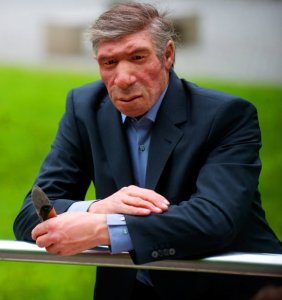
Even if you’re not as interested in Neanderthals as I am, this chapter is worth a read if only for the fact that it contains this picture, which is a simulation of what a Neanderthal man would look like if he dressed in modern clothes:

image_1837-Neanderthal

I can’t stop looking at this picture. What is that in his hand – a stone tool? A candy bar? I had hoped to tell you that Google-imaging “Neanderthals dressed in modern clothes” would lead to a wealth of hilarity, but unfortunately, that was not to be. That Google search only leads to a handful of photos of this same guy, plus lots and lots of photos of Jon Snow from Game of Thrones.

The Sixth Extinction is a great read for the non-scientist who wants to keep tabs on how our understanding of the earth is developing and changing. Part history, part biology, part ecology, and part philosophy, Kolbert’s book entertains and instructs, pointing out the Neanderthal’s resemblance to Yogi Berra in one breath while in the next delivering knockout punches like the fact that all amphibians currently face extinction. All of them. Did you know that? I didn’t know that. My only small quibble is that Kolbert never questions her use of the word “unnatural” in the title. I don’t doubt a single case she cites in which Homo sapiens has out-competed or downright slaughtered its fellow creatures in the past thirteen thousand years. However, I have trouble with the idea that this is somehow “unnatural.” From a scientific perspective, we came about our enlarged cerebral cortexes, our opposable thumbs, our descended larynxes, and the other anatomical and behavioral characteristics that helped us to thrive in the same way other species arrived at theirs: through natural selection. Now that we understand how evolution works, it’s true that human beings can and sometimes do attempt to manipulate it for their own ends, with “designer babies” and so forth – but for most of human history we had no idea that we were subject to this slow, invisible process. As I see it, Homo sapiens may have won the evolutionary lottery, but there is nothing “unnatural” about how it did so. I know that this is a contested subject, and that Kolbert may in fact believe that human dominance of the natural world is somehow “unnatural”; I just wish she had engaged with the subject instead of taking it as a given.

Posted in Authors, Elizabeth Kolbert, Non-fiction - History, Nonfiction - Anthropology, Nonfiction - General, Nonfiction - Important Award Winners, Nonfiction - Science, Reviews by Bethany, Uncategorized | Tagged , , | 2 Comments

And now, a picture of books. (by Jill)

IMG_1116

A couple of weeks ago Powell’s City of Books was kind enough to send me an email with a coupon for 30% off my entire purchase either in-store or online.  Seeing as how I had no free time to get up to Portland on short notice, I went ahead and placed an online order, though I would have preferred to use my coupon in person.  This is a picture of the books I got, as well as the book I’m currently reading, Sebastian Barry’s On Canaan’s Side, in case you had forgotten.  It’s coming along and it’s lovely, as Barry’s books tend to be.  But work has been busy and time to read has been minimal.  I’ll make some progress tomorrow and update on Saturday.  And now I’m going to get back to watching tonight’s episode of Bones, despite the fact that the show may have jumped the shark by putting Jack Hodgins in a wheel chair.  I’m keeping hope alive on that front, because I really do like that show.

Posted in Glimpses into Real Life, Uncategorized | Leave a comment

Yarn Along

Yarn Along photo 4.13.16

I’ve been reading Elizabeth Kolbert’s The Sixth Extinction bit by bit for the last few weeks, but I realized today as I sat down to read the last couple of chapters that I’ve never included it in a Yarn Along photo. This is a book of interconnected essays about the environmental consequences of the fact that we have recently entered the Anthropocene – the geological age in which the primary change agent is Homo sapiens. I loved the first few essays, which deal with humankind’s slow process of coming to terms with the concept of extinction. A French scientist named Cuvier was the first to claim in writing that many species that had once lived on the earth were now extinct. Cuvier’s theory was published a generation or so before Darwin’s theory of evolution, and like Darwin’s, Cuvier’s faced a lot of criticism from orthodox scientists who maintained that the earth had been created in a sort of homeostasis and had never deviated from that point. It was amusing to read about the lengths 19th-century thinkers (including, of all people, Thomas Jefferson – as if he didn’t already have enough to do) went to explain away the huge mammoth femurs and fossilized T-Rex teeth that were being pulled out of graphite mines right and left during that era. But then the middle of the book was about trees and coral reefs and microscopic doo-hickeys and such, and while I know that these organisms are essential to the biodiversity of the earth, they interest me less than silly 19th-century scientists. So I put the book down for a while but became newly absorbed in it yesterday by the promise, according to the table of contents, that Neanderthals are coming soon. And what’s not to like about Neanderthals?

I’m still working on my orange scarf, and it’s still fun.

Yarn Along is hosted by Ginny on her blog, Small Things.

Posted in Uncategorized, Yarn Along | 15 Comments

The Things I Do For You People: Thoughts on Diana Gabaldon’s A Plague of Zombies

A Plague of Zombies

Diana Gabaldon’s Lord John books serve a number of purposes in the Outlander world, none of which are especially important. First, they fill in backstory about what happened in Gabaldon’s universe during the twenty years that are missing from the Outlander plot. At times these revelations are interesting and contribute meaningfully to our understanding of Jamie, Claire, and the other characters in the series. More often, though, they are tangential to the extreme. In the context of Gabaldon’s primary series (i.e. the really, really thick books), Lord John is a good enough character. He’s first introduced in Dragonfly in Amber when, in an attempt to impress his older brother, he tries to “rescue” Claire, whose accent he recognizes as English, from Jamie and the rest of the Scottish Highlanders. His plan is foiled, and he ends up 1) tied to a tree, 2) eventually being released unharmed, and 3) madly in love with Jamie Fraser. The story continues from there for about eight million more pages. Lord John’s character is well developed and complex. He manages to be a supportive friend and confidante to Jamie while keeping his passions under control and also – long story – raising Jamie’s illegitimate son. He manages his awkward and uncomfortable relationships with his various family members, and he’s never entirely happy but manages to inject happiness into the lives of others, making him a highly sympathetic character. And sometimes he wanders around injured and disoriented for fifty pages, but we don’t need to rehash that.

The separate Lord John series, though, is just silly. One book is centered around a chancre that he sees on the penis of a man he is checking out in a public restroom. In another one, he delivers a baby in a stairwell. And in this one, he gets attacked by zombies – but keeps himself and others safe by just being a gosh-darn good guy.

In Voyager, Jamie and Claire meet Lord John when he is assigned to a position of some authority in Jamaica during their own Caribbean years. They also have a “final” confrontation with Geillis Duncan (now remarried and named Mrs. Abernathy). A Plague of Zombies is set around this same time period. Lord John has been sent to Jamaica to investigate why the “maroons” (Caribbean slang for escaped slaves) keep burning sugar cane fields and otherwise conducting acts of terrorism against their fine British imperial overlords. The novel opens with an absurdly long scene in which Lord John, his valet Tom, and a slave named Rodrigo with whom Lord John is infatuated all fight off a series of tropical creepy-crawlies like cockroaches, spiders, and snakes. This scene is pure slapstick comedy and totally ridiculous (“Tom and the black servant uttered identical cries of horror and lunged for the creature, colliding in front of the dressing table and falling over in a thrashing heap”), and it takes up a full 15% of the book, according to my Kindle, but it also foreshadows the equanimity with which Lord John will eventually extricate Tom, Rodrigo, and some British soldiers from the place in the jungle where they are being held captive by a “maroon” leader who likes to outsource his torture to a zombie wrangler named Ishmael (who, in a totally unnecessary aside, introduces himself to Lord John with the words “Call Me Ishmael”). And Geillis Duncan is in this book, which made me happy – though she doesn’t do anything especially interesting.

You don’t really need me to tell you more, do you? It’s a comic zombie book with masturbation and anachronisms in it, but you’re going to read it anyway because it’s by Diana Gabaldon and everyone is all atwitter about Season 2 of Outlander, and that’s why I read it first and wrote my thoughts down here

Posted in Authors, Diana Gabaldon, Fiction - general, Fiction - Historical, Fiction - stupid, Fiction - Vampire Porn, Reviews by Bethany, Uncategorized | Tagged , , , | Leave a comment