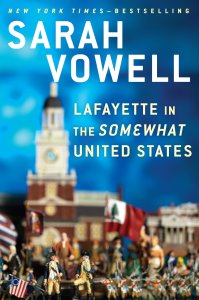
A Review of Sarah Vowell’s Lafayette in the Somewhat United States

Lafayette in the somewhat united states cover photo

Sarah Vowell has been a favorite of mine for a few years, ever since I read The Wordy Shipmates. If I could stomach NPR, I probably would have known of her sooner. Sarah Vowell does for American history what I aspire to do when I write about literature on this blog, which is to say that she irreverently reveres it. I know that’s an oxymoron, but it’s an honest statement of what she does – and I can’t get enough of it.

This book begins with the Marquis de Lafayette’s 1824 tour of the United States, about 45 years after he helped the colonies win their independence. Vowell reports that Lafayette was in the country for 13 months and attended a formal celebration in his honor every single night of his trip. Her point is that a general affection of Lafayette is one of the few things this ornery country of ours has ever managed to agree on. Vowell’s narrative quickly moves back in time to the early days of the American Revolution, when Lafayette was a nineteen year-old orphaned French aristocrat looking for something to do, and Benjamin Franklin was in Paris, desperate to drum up support among the French for the pending Revolution. The reason Franklin thought this strategy would work – and the reason that it did work – is that France had recently lost the Seven Years’ War to England and was happy to join forces against England in another war. Vowell traces a hilarious-if-tangential subplot involving a French playwright named Beaumarchais who came up with a scheme to launder money through a fake corporation called Rodrigue Hortalez & Company, financed by the kings of both France and Spain (Vowell makes a great to-do in this book – probably correctly – about the fact that both King Louis XVI and Lafayette were extremely young when they were making decisions about their roles in the American Revolution; she cites the currently-trendy research that says the brain doesn’t achieve adult cognition until around age 25 – a theory that explains much of world history).

Anyway, there was corruption and deception and taxation without representation, and the next thing we know Lafayette is in North America – against the direct orders of his king – and is at work ingratiating himself into the good favor of George Washington. Vowell is fairly hilarious on this subject, emphasizing Washington’s famously stoic demeanor and calling Lafayette “puppyish” in his affections toward the commander in chief. She also quotes from Lafayette’s effusive letters; for example, after waking up in South Carolina the morning after his ship arrived in North America: “The next morning was beautiful. Everything around me was new to me, the room, the bed draped in mosquito curtains, the black servants who came to me quietly to ask my commands, the strange new beauty of the landscape outside my windows, the luxuriant vegetation – all combined to produce a magical effect” (73). Vowell’s commentary: “In other words, it was a buggy swamp chock-full of slaves.”

This is what Sarah Vowell does so well. The very attention to detail she pays to history indicates her respect for the people and places of the past, yet her willingness to puncture holes in history’s perception of itself reminds us that history is deeply flawed and should be viewed (and revered) with skepticism.

Another of Vowell’s signature moves is to visit tourist sites related to the historical events or persons she is writing about. In this book she visits an emphatically anti-war Quaker-run reenactment of the Battle of Brandywine Creek, which includes a puppet show about Lafayette, and elsewhere she reports that the actors who play historical figures at Colonial Williamsburg were not the “cheerful butter churners” she dreaded but actual angry, abrasive pretend-Revolutionaries – a fact I wish I had known when I lived on the east coast (I never went to see any reenactments; I was worried about the butter churners too). While nothing in this book lives up to the weird tourist attractions of Assassination Vacation – like the William McKinley-themed totem pole in Alaska – Vowell is up to her usual tricks in pointing out not just the absurdities of history but also – or especially – our own absurdities as we commemorate and reshape history. And she finds these absurdities not only at tourist traps but in primary-source documents as well. In her discussion of Cornwallis’ surrender at Yorktown, she quotes General Knox’s letter home, in which he told his wife that Washington intended to deprive the British of the usual dignities associated with surrender. The rules of European warfare in the 18th century included the practice of “allowing” a surrendering army to play an anthem or song associated with the victorious army as a “tribute” to the victor after a well-fought campaign. “They will have the same honors [i.e. no honors] as the garrison of Charleston,” Knox wrote. “That is, they will not be permitted to unfurl their colors, or to play Yankee Doodle” (252). Vowell writes, “It’s hard to believe that the redcoats not being allowed to play a song with the word ‘macaroni’ in it was, in the context of eighteenth-century European military culture, a bone-deep snub. But from what I can tell, it was met with the same combination of revulsion and indignation I once saw on the face of a Japanese tour guide when I accidentally walked on a tatami mat without taking off my shoes” (252).

There is something very “Panglossian” about Lafayette – presumably because he was of exactly the right demographic to have read Candide and taken it at least somewhat seriously. I’m assuming that Candide is the chicken and Lafayette the egg (confusing metaphor intended), but maybe I’m wrong. Maybe Voltaire wrote Candide partially as a commentary of what young European aristocrats were like when they traipsed around the world ignorant of just how much long-term damage they were doing to the world. In this book as well as in her other works, Vowell’s humor always has a dark side. She’s always aware that for every aristocrat sashaying around looking for glory, hundreds of ordinary people (slaves very much included) were schlepping around their majesties’ wardrobes and gnawing at their leftovers.

I enjoyed this book and recommend it, but I don’t think it’s Vowell’s best. If you are new to Vowell, I suggest that you start with The Wordy Shipmates or Assassination Vacation. These kept me laughing aloud more than Lafayette did, though this most recent book has its moments. Assassination Vacation has the advantage of sidestepping Vowell’s usual allergy to chapters by being divided into three sections: one on Lincoln, one on Garfield (whom she calls “Loner McBookworm”; I’m still laughing three or so years after I read it), and one on McKinley. Her other books are set up as long rambles, with sections set aside with occasional page breaks, but no chapters. This is my least favorite thing about Vowell’s work.

If you enjoy history – or if you think you might enjoy it more than you usually do in pre-digested, comic form – I recommend Vowell’s work highly. Vowell’s slant is egalitarian and liberal, and she always has at least as much to say about the present as about the past. She’s the David Sedaris of American history, and I recommend her work highly.
Posted in Non-fiction - History, Nonfiction - General, Nonfiction - Humor, Nonfiction - Memoir/Biography, Nonfiction - Military, Reviews by Bethany, Sarah Vowell, Uncategorized | Leave a comment

Happy Monday (on a Saturday)!

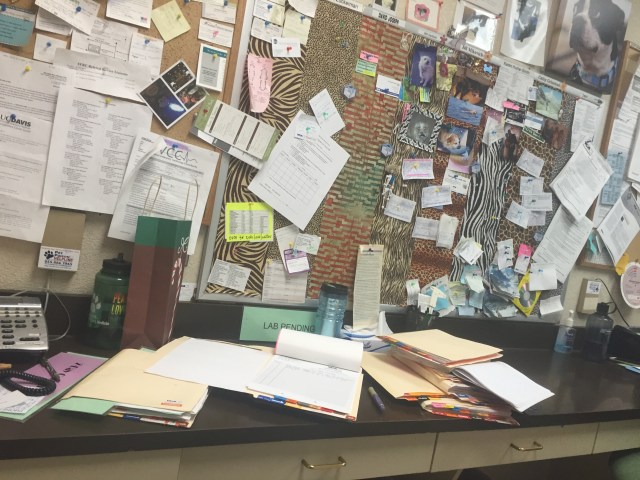
Days of the week have very little meaning to us weekend workers.  While most of you were doing Saturday things today, I was dealing with all of this stuff.  This is actually not so bad, now that I look at it again.  At the time I took this picture, it seemed pretty significant.

IMG_0517.JPG

Right now I’m reading Augustus, by John Williams.  It is an epistolary novel, telling the story of Augustus Caesar’s rise to power.  It is really interesting so far (I’m at about page 90), though I’m having a hard time with all of the long Roman names.  Take, for example, Gaius Cilnius Maecenas.  Marcus Tullius Cicero.  Marcus Aemilius Lipidus.  Marcus Junius Brutus.  I just realized how many men named Marcus are in this book.  it’s pretty absurd, actually, except these are actually real people.  I’ll have more to say about Augustus on Tuesday, hopefully, but for now, enjoy counting how many animals are in that picture.


Posted in Glimpses into Real Life, John Williams, Reviews by Jill, Uncategorized | 1 Comment

A Review of Thom Jones’ The Pugilist at Rest

the pugilist at rest cover image

A teaching mentor once told me that while “B” essays tend to be “B” essays from start to finish without exceptions, “A” essays are often occasionally “C” essays or even “D” essays or “F” essays. The reason, of course, is that when a student is working at the top of his game, he will bump up against ideas that he doesn’t understand fully or that he doesn’t have the maturity to really explore. As a whole, the essay will be excellent, but on occasion – maybe for a whole paragraph, or maybe just for a sentence or two – the essay will be clunky and awkward and just plain ill-advised, because the writer has encountered intellectual terrain that he is not prepared to address.

I found this advice very helpful when I worked with student writers, and it’s equally true of Thom Jones’ 1993 debut collection of short stories, The Pugilist at Rest. Most of the stories in this collection are excellent, and I am going to try to spend most of this review somewhat reluctantly explaining why. I say “somewhat reluctantly” because criticizing and mocking a less-than-perfect story is generally more fun than praising excellent ones. While there is one story in this collection that deserves a little mockery (it’s called “Unchain My Heart” – hee hee), overall the collection is fantastic. I read it with my jaw slack, and I can’t wait to read more of this author’s work.

The title story is the first in the collection, and it’s one of the best short stories I’ve ever read. Like many of the characters in this book, the protagonist is a Marine and a boxer. The story opens in boot camp with some fairly standard-issue drill instructor anecdotes, but soon the focus narrows to the protagonist’s relationships with two of his fellow recruits: Hey Baby – a nickname acknowledging a letter to his girlfriend that the drill instructor confiscated and read out loud – and Jorgeson, the protagonist’s friend who starts out a Kerouac devotee who wants to be a surfer but later becomes a gung-ho Marine and persuades the narrator to join Force Recon with him. The story focuses on the subtle changes in the men during and after boot camp, especially after their drill instructor gives an inspirational speech about the sacred lifelong bond they would have with their fellow Marines. Shortly after that speech, Hey Baby shoves Jorgeson – who still is not putting his full effort into his Marine training – and the narrator runs up behind Hey Baby and slams the blunt end of his rifle into Hey Baby’s temple. “My idea before this had simply been to lay my hands on him, but now I had blood in my eye. I was a skilled boxer, and I knew the temple was a vulnerable spot; the human skull is hard and durable, except at its base. There was a sickening crunch, and Hey Baby dropped into the ice plants along the side of the company street” (8). None of the recruits tell the drill instructor who assaulted Hey Baby, and the protagonist never gets in trouble. Sometime after Hey Baby is hospitalized with a skull fracture, the rumor circulates that he regained consciousness, and for a while the narrator assumes he will soon be confronted about the assault. But nothing ever happens – which is “good” in the sense that the narrator is never punished, but also bad in the sense that – presumably – Hey Baby never does achieve the consciousness needed to identify his attacker.

The best stories in this collection deal with similar situations. Violence is often at the forefront: violence in war, the regulated violence of the boxing ring, and unsanctioned violence of the sort the narrator inflicts on Hey Baby. The long-term physical effects of violence are at the forefront as well. By the end of this first story, the narrator has been injured himself in a boxing tournament, and he suffers from temporal-lobe epilepsy and is heavily medicated. His sister visits him and tries to talk him into getting a new kind of surgery (“It’s not a lobotomy,” she insists [25]), and the story ends when he agrees to try it.

But there’s another element to this story, and to almost every other story in the collection: the great thinkers of Western civilization. This story features Dostoevsky and St. Paul and a legendary ancient Greek boxer named Theogenes, who is the subject of a sculpture called “The Pugilist at Rest.” More than two pages of text are devoted to the sculpture: “His head is turned as if he were looking over his shoulder – as if someone had just whispered something to him. It is in this that the “art” of the sculpture is conveyed to the viewer. Could it be that someone had just summoned him to the arena? There is a slight look of befuddlement on his face, but there is no trace of fear. There is an air about him that suggests that he is eager to proceed and does not wish to cause anyone any trouble or cause a delay, even though his life will soon be on the line. Besides the deformities on his noble face, there is also the suggestion of weariness and philosophical resignation. All the world’s a stage, and all the men and women merely players. Exactly! He knew this more than two thousand years before Shakespeare penned the lines” (19). This sort of art history lesson is, more than anything, what makes this book different from other excellent collections of short stories. I resented it a little at first because my fiction teachers were always so adamant that every last word of a short story has to serve the character and the plot, and I felt like a younger sibling whining Why does THOM get to put Schopenhauer in his stories and I don’t? (There is a small chance that the 22 year-old me was not integrating her allusions quite as shrewdly or as gracefully as Jones does, of course).

This story moves forward in time, without flashbacks, from boot camp to Vietnam to the boxing match where the protagonist was injured and then to his life years later as a semi-invalid at the mercy of his seizures. At the same time, though the protagonist’s interior life – not so much his memories, which are present too, but his intellectual life, his reading life – almost serves as an additional setting in the story. The world of Dostoevsky and Schopenhauer is like a room the protagonist goes to when no one else is around to bother him or when he needs to escape his own reality. Almost every story in the collection is in the first person, so the long interludes about philosophy and history come not from an omniscient narrator but from the complicated, gritty protagonists who have earned their philosophy degrees the hard way.

This story, and many others in the collection, had a strong impact on me. I walked around in a bit of a daze while I was reading this book. In this opening story, the protagonist’s injuries are in the same parts of his brain as my own brain injuries; they are just more severe. I felt a strong connection to this character for that reason, and my whole body went cold when I saw a medication that I myself take in a list of the ones the protagonist takes. This is neither here nor there; you don’t need to have a brain injury in order to appreciate the story. Alongside the details on brain injuries, the first-person narration and the presence of all the allusions to literature and history and philosophy made me feel an extremely strong personal connection to the stories in this collection. I recommend it highly and can’t wait to read more of this author’s work.

Posted in Fiction - general, Fiction - literary, Fiction - Short Stories, Fiction - short story collections, Reviews by Bethany, Thom Jones, Uncategorized | Leave a comment

Thoughts on Atul Gawande’s Being Mortal (by Jill)

BeingMortal


I don’t even know how to begin talking about this book. Atul Gawande is a surgeon who has written several books before this one. Being Mortal is, essentially, about dying in a time in human history when more can be done to prolong life than ever before. But the question has become: “To what end?” The medical profession has become so focused on preserving life at any cost that when it comes to the inevitable end there is no dignity in it, but there could be. Gawande posits that there is a better way, lots of better ways, actually, to face the end of life.

When my boss read this book she emailed all of the doctors in our practice and said that everyone needs to read it, because she saw that a lot of the ideas could be applied to veterinary medicine, and also because we all have aging parents, and we ourselves are aging. I got to read it first because, well, we share books.

Gawande organized this book really well.  He started with general discussion and then talked about a few alternatives to the traditional “nursing home” that he visited while he was working on the book, and tells us about a few people he met at each place. The uniting factor amongst these alternative places is that they have returned choice and free will to the residents of these homes, and what about that word, “home”? The people who run these residences have gone out of their way to make their places feel like home to the residents. It seemed to help a lot.

Gawande then moved into talking about some of his own patients, and cases that went well and badly as far as providing a good death for these people. This section was the one that applied the most to my veterinary life, because Gawande was writing as a physician, and trying to help his patients and their families make the best decisions for them about the last few months/weeks/days of their lives. He also talked about the three different types of physician: the kind who tells the patient what the plan is, the kind who give the patient multiple possible plans and lets him or her decide, and the kind who lays out options and then makes a recommendation on what she thinks is the best plan for that particular patient. Gawande said that he tends to be the second type, but that he’s trying to be more of the third type. I started thinking about the kind of veterinarian I tend to be, and I think I’m generally the third, but when it comes to the more sick patients, the ones I know are at the end of their lives, I definitely tend to be more of a “this is what we are going to do” type, because I don’t want to prolong an illness that I know isn’t going to end well, and I’ll do everything I can to spare that poor cat or dog any additional misery. I do think I prefer to be the options with advice type of veterinarian, but I know that the give options and no advice is the easiest way to practice, because the stress of decision-making is off of our shoulders.

The last section of Being Mortal was about the death of Gawande’s father, and how his family made it a good death for him. I cried, of course. Dr. Gawande, Sr., himself a physician, develops a slow-growing spinal tumor. It starts in typically vague manner, and progresses to extreme weakness and near paralysis at the end. The interesting decision that Dr. Gawande makes when faced with his initial diagnosis is to forego surgery until his symptoms had progressed to the point that his quality of life is diminished, when learning that the surgery itself could leave him even worse off than he was prior. Doing so makes the possibility of a cure much less likely—because the longer the tumor sits there, the more likely it is to become so big that it isn’t resectable, or for it to spread to other tissues. Most people would, I think, go for the chance of cure, but Dr. Gawande chooses to enjoy his life, but possibly shorten it… He and his family make this decision over and over in his last couple of years of life, and it seems to me that they did it the same way I hope I’ll be able to someday.

Emotion definitely builds as the book goes on, and I think that was the right way to go about this topic, from more clinical to more personal. I think that if Gawande had started with the story of the death of his father it would have been much too heavy, and he probably would have lost some readers. Being Mortal is the first book I’ve ever reviewed that I will say, in no uncertain terms, that has something for everyone, and is important for all of us to read. Like, I don’t even care if you enjoy reading it or not (though I think you will), you just need to know what it has to say.

Posted in Atul Gawande, Nonfiction - General, Nonfiction - Memoir/Biography, Nonfiction - Science, Nonfiction - Self-Help, Reviews by Jill, Uncategorized | 1 Comment

Yarn Along

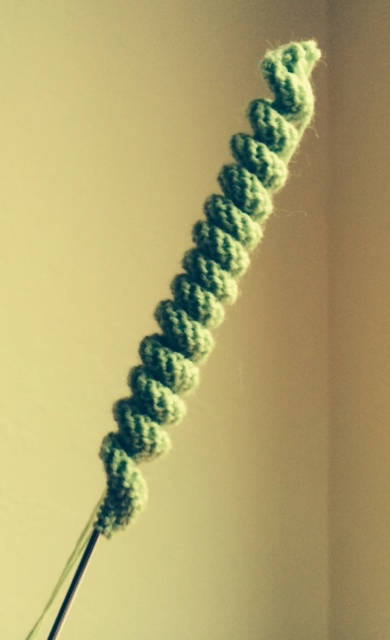
That moment when your knitting project looks like one of those fancy lollipops they sell at tourist traps:

knitting lollipop picture

(It’s going to be a baby blanket, I promise).

And also that moment when it’s raining outside and your Yarn Along picture gets photobombed by a gnome:

Yarn Along photo 1.6.16

That’s Ludmila Ulitskaya’s The Big Green Tent. I know the photo’s too dark to show the book well. So far I’m not seeing all the comparisons to Tolstoy – but I’m still trying to give her a chance.

I will aim for photos of my finished English rib sweater next week. It’s in that awkward stage right now: the neck on needles and lots of ends hanging loose.

Yarn Along is hosted by Ginny on her blog, Small Things.

Posted in Yarn Along | 12 Comments

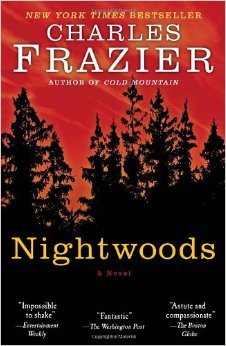
Thoughts on Charles Frazier’s Nightwoods (by Jill)

Nightwoods cover


I still remember the day my boss brought me this book. It was the summer of 2012, and I looked at it and thought, “Well, I guess I’m going to read this book before I read Cold Mountain.” And I was right. I did. Just like I read Solar before Atonement, and Beatrice and Virgil before The Life of Pi. I did not think it would be three and a half years before I read Nightwoods, of course. When my boss gave me this book to read it was several months into us having our blog, and a few months into the AP English Challenge. Prior to starting the blog I was working through my “Cathy Books” pretty efficiently, to the detriment of my own book piles, but remember, this was 2012. I had no blog posts to write, no exercising to do. I basically read and ate back then. It was sort of awesome. Sort of not, too. But that’s cool. It was a different time, those early 2010’s. I’ll have time later on to read.

Nightwoods tells the story of Luce, a young-ish woman who lives in semi-solitude working as a caretaker of a lodge in the woods outside her hometown. The circumstances of how Luce came to be living alone out there are shown, not told, as the book goes on. The first thing I noted and appreciated about Frazier’s writing style is that he definitely shows the reader, and doesn’t spend a lot of time in exposition, which is kind of nice—I felt like he trusted me to figure it all out in due time. One thing it took me a little while to figure out was the approximate time frame of the story. I knew it wasn’t present day, but it could have been the eighties or the seventies, for all I knew. Eventually I figured out it was the early sixties, but then I felt like an idiot because it actually said that on the back of the book….

So, Luce lives alone, and her sister’s two children, who are weird, and like to start fires, come to live with her because her sister was murdered, probably by her husband (but not the kids’ dad), though he was not found guilty for the crime since there were no witnesses, and this was the sixties. Gradually Luce’s world opens up as she cares for the children, and then Stubblefield, the grandson of the owner of the lodge, shows up, and her world opens up some more. Then, a new bootlegger named Bud comes to town, and it turns out that he’s the guy who probably murdered Luce’s sister. He gets in with Lit, the town sheriff and Luce’s estranged father, and basically roams around town selling pills and booze. Eventually things come to a head with Bud, and there’s a big chase through the woods. But that’s all the summary you’re getting from me.

I loved this book. There was just something about it that appealed to me. The scenery descriptions are beautiful, even when the location being described is a very gloomy, dark, deep pit of water in the middle of the forest. Frazier’s manner of storytelling pushed me along as well. Like I mentioned above, he is very much an author who shows you the plot rather than telling you. There are no periods of exposition here. Every detail we learn about the characters is revealed in its own good time. And I definitely kept going some nights when I was reading in bed in the hope that a tiny detail about what happened to Luce before she went to live at the Lodge. Luce is a sympathetic protagonist, though I almost feel like we could stand to learn more about her. Those tiny details are scattered like breadcrumbs throughout the book, and I wanted more of them! She was just so interesting to me; she seemed like she was trapped in the wrong decade. And some of the characters were definitely a bit two-dimensional, but I’m kind of okay with it. Actually, let me modify that statement. I’m ambivalent about how one-sided Bud is. He is one hundred percent awful, terrible human being. I can appreciate a complete villain in these days of the sympathetic bad guy, the “vampires who sparkle” characters, as it were. Those characters can be exhausting sometimes, what with their “Oh, I killed ten people but I did it to save five hundred orphans” moral dilemmas. I sort of think that the characters of Lit and Stubblefield served to highlight Luce’s struggle to leave behind her past (Lit) to go towards her future (Stubblefield and the twins).

Also, I can’t believe I’m saying this but I think that this book could have been longer. I wasn’t ready for it to be done when it was over, and after the past few months that’s a happy thing for me to say. I mean, I loved The Omnivore’s Dilemma, but it was a long one. And of course there’s The Great Glass Sea, the book that set me behind on my 2015 reading challenge. I never quite recovered my reading momentum after that book in the fall. It was like it sucked the joy from the rest of the year or something. I can’t quite explain it. And I want to just put it behind me. New year, new and improved attitude, and all that.

So, yeah. I think most people would enjoy this book. I don’t know how it stacks up to Frazier’s other two novels, Cold Mountain and Thirteen Moons, so I can’t speak to that. Taken on its own merits, Nightwoods was an enjoyable, and reasonably fast, read. I think that it could be a good book for discussion or a book club or something, because I’d really like to talk to someone about it one day.

Posted in Charles Frazier, Fiction - general, Fiction - Historical, Fiction - literary, Reviews by Jill | Leave a comment

For Copy Editors Everywhere

Jefferson

I read a fantastic book of short stories this weekend – Thom Jones’ The Pugilist at Rest – and I really want to review it for you, but I don’t quite have the wherewithal for that now. I’ve been copy-editing like crazy for a freelance job, and I declare today to be National Hug a Copy Editor Day (except not me because eww – germs), and on National Hug a Copy Editor Day one does not write reviews if one cannot do one’s best work. It’s the law.

Besides wrangling dependent clauses, my other obsession these days is the Hamilton soundtrack. My God – it’s just fantastic. For those who may not know, it’s a new Broadway musical about the life of Alexander Hamilton. It gets a little Schoolhouse Rockish sometimes, but just as I start to roll my eyes a little it does something so subtle or ironic or charming that it seduces me right back in again. Thanks to this obsession, I’ve pulled out every Founding Father biography I own (and I raided the library too) and read the first chapter or two before becoming distracted by other things – you know, like you do. In the spirit of National Hug a Copy Editor Day, I thought I would share with you the first draft of Jefferson’s iconic sentence from the Declaration of Independence. The famous final draft, of course, is We hold these truths to be self-evident: that all men are created equal, that they are endowed by their creator with certain unalienable rights, and among these are life, liberty, and the pursuit of happiness. Got a little chill down your spine, didn’t you?

But back to the copy editing connection: I read today in Joseph J. Ellis’ American Sphinx: The Character of Thomas Jefferson that Jefferson’s first draft of that sentence was as follows:

“We hold these truths to be sacred & undeniable; that all men are created equal & independent, that from that equal creation they derive rights inherent and unalienable, among which are the preservation of life, & liberty, & the pursuit of happiness.” (Ellis 10)

The revised version isn’t as much shorter than I thought: the original draft contains 42 words, the revision 35. But the syntax! The deleting of synonyms in favor of words that add new meaning. And who would have thought a Latinate clunker like “self-evident” could jazz up a sentence so much? I will say, because I’m a nerd, that when I typed it up I caught a little dactylic tetrameter snippet that almost fits the hip-hoppish rhythms of parts of Hamilton. Imagine a hard stress on each capitalized syllable: “THEY derive RIGHTS inheRENT and unAlienable.” I know there’s a syllable at the end that I didn’t account for, but you can hear the hip-hop rhythm to it, can’t you?

To sum up: copy editors do important work, both today and in 1776. And whoever got rid of all those ampersands deserves an obelisk on the Capitol Mall.

Posted in Glimpses into Real Life, Joseph J, Ellis, Non-fiction - History, Nonfiction - General, Nonfiction - Memoir/Biography, Reviews by Bethany, THE HAMILTON SOUNDTRACK, Uncategorized | Leave a comment

A Review of Thomas C. Foster’s How to Read Novels Like a Professor (by Bethany)

how to read literature like a professor cover image

Even a bookblogger needs a refresher course sometimes. I’ve found Thomas C. Foster’s books How to Read Literature Like a Professor and Twenty-Five Novels That Shaped America enormously helpful in my work as a teacher and as a reader. I read the former in 2007, shortly after I started teaching again after a three-year stint as an administrator, and it’s not unfair to say that Foster’s book helped me to decide what kind of teacher I wanted to become. Early in my career, I didn’t want my class discussions to focus on symbolism. My graduate program taught me to read for craft, not for symbolism and the sorts of things that are addressed in critical theory (topics I had covered well in my undergraduate education). In graduate school, we sometimes spent hours just looking at the implications of point of view, or at the way sets of details early in a novel set the stage for the resolution. When I started teaching high school, I didn’t think I would have trouble using this approach, since students usually learn about point of view and characterization and foreshadowing in middle school. However, my students weren’t ready to look at point of view and characterization at the level I had hoped (this method requires a LOT of time spent staring at pages in search of one specific detail or phrase), and since my students thought of these topics as middle-school material some of them were a little miffed that 1) we were covering these topics in high school classes, and 2) that their teacher seemed to think they were WRONG all the time. While my graduate school education changed me permanently as a reader, How to Read Literature Like a Professor really helped me put together a basic high school course in literary analysis, including some eye-rollers like the idea that all fishermen are Jesus – but also useful resources like the prevalence of symbolic baptism (any time someone gets wet – it sounds silly but it’s everywhere in literature) and the even more ubiquitous Eden imagery. A snake is never just a snake. There’s even a chapter on VAMPIRES.

Back then, Foster’s second book, How to Read Novels Like a Professor, interested me less because time was of the essence and this volume had less practical application to the class prep I was always so urgently doing, but when I reread it recently I enjoyed it a great deal. Foster devotes a lot of time to the specific ways that serial publication – the predominant way that novels were published throughout the 19th century – impacted what we still think of as the tropes of the form. For example, the extensive exposition and characterization and foreshadowing that we expect at the beginning of novels is left over from an era when it was common for 18-24 months to elapse between the time the first installment was published in a magazine and the novel’s final installment (this is the time when you get to point at me and say, Cough – The House of Mirth – Uncough). When serialization stopped being the dominant method by which novels were published, within just a few years novelists were experimenting with other ways of opening novels (and some remained true to the old ways too). When I reread Jane Eyre a couple of years ago, I mentioned that the opening of the novel seemed strangely modern, but I didn’t go into a lot of detail about what exactly I meant by “modern.” The opening of that novel tosses the reader right into a moment – a fairly ordinary one: a decision about going for a walk. It doesn’t begin with a first-person narrator introducing himself and his background, as Pip does in Great Expectations, nor did it begin with endless foreshadowing and details of setting, as you’ll find at the beginning of Bleak House. It just… begins. It’s the 19th-century equivalent of “Mrs. Dalloway decided that she would buy the flowers herself” – just a little bit ahead of its time.

This book delves into topics that Jill and I often discuss, such as the effects of long chapters versus short chapters (and of no chapters at all). Foster spends a lot of time on the various ways that writers end their novels, and he offers a very simple chart that could easily be the only resource a teacher could need for a high school honors or A.P. course. The chart has to do with the responses that authors want to elicit from their readers (with the rhetoric of novels, in other words). It looks like this:

Nineteenth century writers Twentieth century writers
Priority #1 Emotional Response Aesthetic Response
Priority #2 Intellectual Response Intellectual Response
Priority #3 Aesthetic Response Emotional Response

This chart is so simple – it’s even simpler than it looks when you realize that Priority #2 is the same in each column. But just think of the fun a teacher and a great group of students could have with just this chart and, say, Huck Finn, The Scarlet Letter, Great Expectations, Anna Karenina, The Great Gatsby, The English Patient, If on a winter’s night a traveler, and Beloved. These titles are interchangeable with dozens of others, of course.

This book is effortless to read – because he writes like he lectures, Foster builds a great deal of tension in each chapter. His discoveries are our discoveries, and we feel his joy when he arrives at ideas that, like the best mathematical equations, are simple and perfect – like the chart above and many of the other ideas in the book as well.

I don’t read books about books very often, but Foster’s three such books come with my highest recommendation. If you are looking to become a better-informed reader (or teacher), of course I hope that your first step would be to read Postcards from Purgatory. This book, however, makes an excellent second choice.

Posted in Authors, Nonfiction - General, Nonfiction - Literary Studies, Reviews by Bethany, Thomas C. Foster, Uncategorized | Leave a comment

Thoughts on Michael Pollan’s The Omnivore’s Dilemma (by Jill)


IMG_0429

Yes, I’m aware that I’m reading this book about nine years after the rest of the world discovered The Omnivore’s Dilemma. In my defense, I did purchase it when it was in the height of its popularity, but, well, you know how that goes. This book is the first in a personal reading challenge I planned for myself back in late 2012, when our blog was in its infancy, and I actually thought that reading challenges on Postcards from Purgatory were things that were meant to be completed, not to go on, and on, forever. (Remember the AP English Challenge, everyone?) So, somehow I put off starting my “Foodie Book” reading challenge for about three years, and not for any particular reason other than I’ve had a lot of books to read.

The inspiration for the “Foodie Book” challenge was my late 2012 lifestyle change wherein I (along with my husband, of course) stopped eating constantly and started taking breaks from reading and internet shopping to walk my dogs and do Jillian Michaels DVDs. At this point, eating relatively healthfully has become a fact of life, and with the exception of once-weekly (or maybe twice) Triscuit and mug cake binges, not something I think a whole lot about. Well kind of. I think about food all the time. I’m not one of those people who forgets to eat, and being hungry is not something I enjoy. I told one of my coworkers on Facebook recently when she was complaining about being hungry all the time because of some meds she is on, that at least she had an explanation for being constantly hungry–I just like food. No, I love food. I used to eat when I was happy, and eat when I was sad, and eat when I was bored, and eat when there was some combination of these emotions. And I still think about it. At this point, I’m maintaining (approximately) the weight I lost in 2012 and 2013. I get anxious if I go more than one or two days without exercising. I feel kind of yucky when I eat too much processed or carb-heavy food. So that’s where I was when I started The Omnivore’s Dilemma in early November (right around when my 2015 Goodreads Reading Challenge went off the rails)—trying to stay away from foods that are generally considered unhealthy, but not thinking much about where my food comes from, though that being said, my husband has developed a preference for eating locally grown produce, and since we started trying to be more healthful our food choices have tended towards the fresh and away from the processed. It wasn’t for any moral reasons, I assure you. But what this book taught me is that we should all probably be thinking more about what we are eating. Like a lot more. And maybe Michael Pollan is advancing his own agenda, but maybe he isn’t. Maybe he’s speaking truth, and we all need to listen.

Michael Pollan is a journalist, and since The Omnivore’s Dilemma came out in 2006 he’s become mostly known as a food writer. I believe this book was his first one in this vein. It’s organized around four different meals that Pollan consumes, starting with a meal from McDonalds, then a “big organic” meal, then a meal prepared from ingredients from a small family farm, ten a meal prepared from ingredients that Pollan himself hunts, forages, and grows. And this book was fascinating. It took me a month to read this book because it was long and work has been super busy, but when I was actually reading it, I was lost in the worlds Pollan took me to, from the industrial corn fields of Iowa (where I learned that corn isn’t the devil that people make it out to be, but that the people who have turned it into what it is may be the ruin of America) to the hills of Sonoma County, California, where Pollan shot a wild pig. This book made me cry a little, and it also made me laugh. I wanted to do a post about each individual meal, but life got in the way while I was reading, and that fact still makes me disappointed in myself, because there is no way I’m going to spend a ton of time with each meal in a single post—it’d be way too long for anyone to actually finish.

I will, however, devote a paragraph to each meal. The first one, a McDonald’s feast consumed by Pollan, his wife, and son in their car while driving around Marin County, California, was the most troublesome to me. Not the eating of the meal itself, of course. I’ve eaten many a McDonald’s meal while driving somewhere in my car, though it’s been a few months since that’s happened, and after reading this book I’m sure it’s going to be a few months more until it happens again. Pollan’s goal with this book is to follow all the ingredients in each meal he writes about from their start to their finish in his meal. The distressing thing about the McDonald’s meal is that pretty much every ingredient seems to start off as corn in Iowa. Pollan talked about how the government subsidizes farmers these days, and that upset me—the market is saturated with corn, and they have to keep growing more and more to support themselves but the more they grow the cheaper it gets to buy and it’s just not the way that things should be. But man, those fries are delicious.

The second meal was purchased with ingredients obtained from a big box organic food store (i.e. Whole Foods Market), and it seems that the founders of the big organic movement have had to make quite a few concessions in order to succeed on a large scale, and that’s not entirely surprising, but it is disappointing, and it makes me feel better, in a way, that we don’t eat much organic food.

For the third meal, Pollan visits a small farm in Virginia called Polyface, which has been in the Salatin family for a couple of generations. It seemed like the perfect place to get food from—they grow grass to feed the cows and chickens, and have vegetables as well. The ecosystem here is endlessly complicated, and likely not something that can be done on a large enough scale to feed everyone in the country, but I really wish it would be someday.

The fourth meal turns Pollan into a hunter of wild boar and a gatherer of wild fungi and a thief of fruit. Nothing is processed or corn-fed. This meal is obviously the least feasible one for day-to-day life in modern society, and many people don’t have the constitution for hunting their own meat, but talk about having a close connection with every single thing you put in your mouth.

This book was fascinating and I enjoyed it very much. It wasn’t always easy reading: Pollan describes slaughtering chickens at Polyface Farms in more detail than I needed to read, but at the same time I wouldn’t consider it excessive. Same goes for the description of the boar hunts he went on. The descriptions of the short, awful lives of feedlot cows, pigs, and chickens made me convinced of my feeling that I’d rather eat game my dad hunts, fish my husband catches, or pigs my friend’s aunt raises than buy any of it from the grocery store. My husband has become a dedicated farmers market shopper over the past couple of years, and I was so glad of that while I was reading this book! I felt like we were doing right by local growers. I think that this book should probably be required reading to be a person who eats in America. Obviously that’s sort of hyperbolic, but anyone who wants to be a more thoughtful eater should definitely read this book. I want to say that it changed my life, but I think that could also be hyperbole. The Omnivore’s Dilemma solidified some notions about food that I was haphazardly working on on my own, and I will be making people I see often read it so we can talk about it, so look out.

Posted in Michael Pollan, Nonfiction - Food and Cooking, Nonfiction - General, Reviews by Jill | 5 Comments

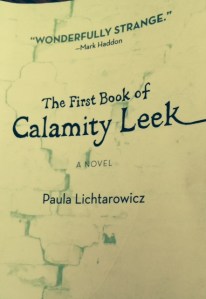
A Review of Paula Lichtarowicz’s The First Book of Calamity Leek

Calamity Leek cover image

I don’t have a very admirable history with books I do not get. I was the kid who came to school after reading Treasure Island and said, “What do you mean there’s a boat in it?” I was capable of reading Treasure Island – it wasn’t above my reading level or anything – but early on there was something about it, maybe the prose style or some exposition that I didn’t understand, that made me declare that novel to be permanently and pathologically opaque. In college, some wrestling matches with James Joyce turned me into a compulsive annotator, and annotating does help with comprehension. I was in lying-around-on-the-couch mode when I read Paula Lichtarowicz’s new novel The First Book of Calamity Leek, however, and I generally do not annotate when I am in lying-around-on the-couch mode. So here I was in the face of a book I did not get, in the absence of my usual coping device. It was a primal struggle, friends.

And for the most part, the experience was rewarding. I did figure out the novel’s secrets by the end, and – in hindsight – I think the author released information at the right pace. The first half of the novel is maddening – each time I thought I had a grip on who these characters are and why they are in their strange predicament, I found evidence to tell me I was wrong. Or to maybe tell me I was wrong. I do think that this is the sort of book a reader should puzzle through on her own, so I will not be releasing any “spoilers.” Instead, I want to walk you through the plot and introduce the many theories I entertained as I read.

Calamity Leek is a teenage girl who lives in a tightly-knit but deeply strange community of other young girls and two adults. One of these adults is “Aunty,” and the other is “Mother.” Aunty is present more often than Mother, and Calamity has something resembling a nice relationship with Aunty, which is to say that Aunty sometimes invites Calamity to tea and tells her that they are special pals and that she is perhaps Aunty’s favorite niece. It is possible that Aunty has these little bonding sessions with some of the other girls as well. Mother is more distant. When she does appear, she makes pronouncements from on high, and no one is allowed to speak to her or touch her. Think of Mother as a general and Aunty as a second lieutenant (and no – that’s not a hint as to how to interpret the novel. It’s just an analogy I thought of). However, while Aunty can be solicitous sometimes, she also beats the girls with sticks on occasion.

The culture of Calamity’s world takes time to process. The girls live in a space that is protected by a wall. The outside of the wall is called “Outside,” and the girls understand Outside to be dangerous. I suppose the wall is a symbolic hymen of some sort (because what’s New Year’s Day without a little Freud?). The girls are told that there are “injuns” out there beyond the wall – odd, especially for a novel set in Wales rather than, say, New Mexico or Arizona. What these injuns will do to someone who ventures Outside is never clear. Men in general are established early on as sources of danger – they are always referred to as “demonmales,” and even though Calamity has never met a demonmale (as far as she knows), she is aware that they have hot pulsating sticks between their legs with which they perpetrate horrible violence on women.

I spent much of the first quarter of the novel trying to understand Calamity’s world in the context of Margaret Atwood’s The Handmaid’s Tale. Many of the details fit, and I think Atwood uses the word “Aunt” to describe the supervisory figures in her novel. Yet this novel didn’t seem like a real dystopia to me, and I had a hard time grasping why. In The Handmaid’s Tale, the horrible treatment of women and odd domestic arrangements are explained by the fact that nuclear weapons have made most women in the world infertile, so the few who can bear children are a commodity managed by the rich and powerful. In Calamity Leek, we do eventually learn the reason that Calamity and the other girls live in such odd circumstances, but the reasons are less societal and more personal – so I wouldn’t call this novel dystopian even though it has so much in common with Atwood’s novel, which is dystopian.

Other oddities: Calamity and the other girls live in a “dorm,” which eventually we learn to be more of a barn, where the girls sleep in piles of straw on the bare floor. They don’t find these sleeping arrangements unusual since they don’t know anything different, so it’s up to the reader to put the details together. There are pigs and chickens around, but we are told that they live “next door.” Also, Aunty spends a lot of time fixating on the girls’ beauty. They are protected fiercely from the sun and are required to wear headscarves whenever they are outdoors, and certain physical features, like Calamity’s obtrusive ears, are corrected with various braces and other contraptions. “Moisturize” is repeated constantly, like a religious mantra.

And speaking of religion. Aunty and her pathetic nieces do not seem to practice a particular religion, but certain items are revered as if they were icons or relics. The outside world knows Aunty’s compound (if they know it at all) as “St. Emily’s.” I presume they think it’s an orphanage or some such. There are statues of St. Emily around – lots of them – and at some point everyone celebrates Emily’s birthday. There are also references to someone called “the Goddess Daughter.”

Oh, and one more thing: show tunes. Aunty seems to speak in lines from classic musicals, from “how do you solve a problem like Maria” to “practically perfect in every way. “ Les Mis gets a lot of mileage, as does Mary Poppins, and Aunty bears an uncanny resemblance to Miss Hannigan – from her unkempt red hair to her nonstop drinking to her emotional manipulation – though this resemblance is never directly mentioned. While I think I’m missing a few of the allusions because my education in the ways of cheesy musicals is incomplete, each of the girls at St. Emily’s gets her first name from a character from a musical and her last name from a town in Great Britain – yet another puzzling detail to chew over.

In the abstract, this novel is not my sort of thing at all – I usually want to read work by authors who view me (the reader) as an equal partner, not as a dumb kid beguiled by a magic trick. Nevertheless, I really did enjoy the novel. I admire the author’s imagination, as well as her ability to wrangle the details of an unfamiliar and deeply skewed fictional world without alienating me. She releases information about this world at exactly the right pace, and the unsettling relief I felt at the end of the novel was well earned. I recommend this novel enthusiastically to readers who like the offbeat and weird, as well as to readers like myself who only venture away from the mainstream occasionally and judiciously.

I promised I wouldn’t reveal spoilers, and I won’t. But I will say this: if you’re reading this novel and trying to put it into some kind of context, put aside Margaret Atwood. If you’ve read Emma Donoghue’s novel Room, you’ll find some similarities in the way children raised in isolation develop an altered worldview, though I wouldn’t look to Room to crack this novel’s unique code. If you’re really struggling to put this novel in context, if you feel like you’re groping with both hands and grasping nothing, I have two words for you: Miss Havisham. And that is all.

Posted in Authors, Fiction - general, Paula LIchtarowicz, Reviews by Bethany, Uncategorized | Leave a comment