A Quick Review of Holly Tucker’s Blood Work: A Tale of Medicine and Murder in the Scientific Revolution

bloodworkbookcover

This will need to be a brief review, as my newly-reconstituted work schedule requires me to go to bed early some nights, including tonight. But that’s OK – all I really need to tell you is that this book is a readable, layperson-friendly, and fascinating look at the early stages of blood transfusion in the second half of the 17th century. Small groups of scientists in both England and France were working independently to transfuse blood, usually from animals to animals or from animals to humans. If you’re squeamish about blood or about animal cruelty, parts of this book will be a difficult read, because of course the animal subjects in these experiments suffered terribly – and Tucker includes drawings from the era – dogs and calves and sheep hog-tied to people’s dining-room tables and so forth – to illustrate her narrative.

Of course many 17th-century types had moral objections to blood transfusion, especially in France. The Protestant Reformation officially ended in 1648, but tensions between Catholics and Protestants were still simmering in these years. As a rule, medical experimentation was considered a Protestant endeavor. Catholic beliefs dictated that all medical procedures should be dictated by long-deceased experts like Galen and Aristotle. According to these ancient authorities – whose works were the only ones allowed to be taught at medical schools in Catholic France – the stomach makes blood out of the food people eat. Then the blood takes a short one-way journey from the stomach to the heart, where the heart “burns” it for fuel to keep our bodies going. Tucker never addressed my primary question, which was how Galen would have explained that we bleed when we are cut on the head, foot, and other parts of the body that are nowhere near the stomach and the heart. The medical approach to blood, then, was to attempt to keep it from getting too hot. Galen is also the genius behind the humoral theory of medicine – you know, the idea that our bodies are supposed to sustain a balance of the four “humors” – blood, phlegm, yellow bile, and black bile – and that illness is the result of imbalance among these four substances. This is why bloodletting was such a widespread medical treatment – it was prescribed every time a patient was determined to be troubled by excessive blood. Ancient, medieval, and early modern doctors also used a wide variety of emetics and purgatives for the same reason – to rid the body of the other three humors as needed.

In the late 17th century, Harvey had already published his theory about the circulation of blood, but many in the medical establishment – especially Catholics – refused to accept his findings. However, a small group of scientists in each of the two countries did start to experiment with transfusion. The problem, though, is that in addition to all the silliness I explained in the last paragraph, many thinkers of the era also believed that blood was the physical manifestation of the soul. People assumed that after a blood transfusion, a patient would have taken in part of the soul of the blood donor. If a large enough quantity of blood was transfused, they thought, a person would actually undergo physical changes, becoming less like themselves and more like their donor – this was especially troubling since most blood donors at that time were not human. One of the more comic moments in the book is the response of a mental patient who received a transfusion (mental patients were often the subjects of medical experiments in early modern Europe, since it was difficult to persuade people in their right minds to volunteer) and then refused to undergo another transfusion because he insisted that he had been turned into a cow as a result of the first transfusion. He looked and sounded like a human to the experimenters, mind you, but in his own eyes he was now a cow who ate grass and needed to be milked. Not that the doctors had any particular qualms about experimenting on cows, mind you.

This book is also about the interpersonal politics of this chapter in medical history. I won’t go into elaborate detail here, but Tucker spends a good deal of time on the rivalries among the experimenters, the correspondence between rival scientists back and forth across the channel, and the lengths a few anti-transfusion scientists went to discredit their more open-minded colleagues. I enjoyed the book a good deal – and, to be honest, would have been happy with significantly more medical detail, even though I am not a scientist myself. If you enjoy medical history and have a strong stomach for vivisection, I recommend this book highly.

Posted in Authors, Holly Tucker, Non-fiction - History, Nonfiction - General, Nonfiction - Science, Reviews by Bethany, Uncategorized | Leave a comment

“You Put Your Whole Self In”: Final Thoughts on on Lily King’s Euphoria

Euphoria cover image

I ended up enjoying Euphoria quite a lot. Once I got used to the quirks of the narrative voice (more on that in a moment), I found that this novel follows a classic love-triangle plot, though in a way it’s more of a love rectangle if one factors in a fourth character who is never on the page – and in a way it’s also a love pentagon if you factor in –

Never mind. How about if I just tell you the story?

Fen, Nell, and Bankson are all anthropologists studying native tribes in New Guinea. Fen and Nell are married. They met on an ocean liner, where Nell was already engaged in a love affair with a woman named Helen. One of the moments the novel keeps swooping back to is the moment Nell chose Fen over Helen. Helen had just made the agonizing decision to leave her husband for Nell, but Nell ended up choosing Fen, and her memory of leaving Helen alone on the quai in Marseilles haunts Nell throughout the novel. Complicating this situation is the fact that shortly before he boarded the ship, Fen took a love potion prepared for him by a medicine man in the tribe he had been studying. The idea that Fen somehow “trapped” Nell into rejecting Helen and marrying him is one of many elephants in the proverbial room in their marriage.

Andy Bankson, who helps Fen and Nell find a new tribe to study after the disastrous end to their time with the Mumbanyo, has come to New Guinea to hide out from his overbearing, grief-stricken mother, who lost both her husband, Bankson’s father, and her other two sons within the space of a couple of years. Bankson lost these family members too, and he is haunted by his loss and also by the terrible isolation he feels at being so far from home. He meets Nell when she is ill, miserable, covered with lesions, and at odds with Fen. At this point, Nell and Fen are planning to leave New Guinea and go back to Sydney, Fen’s hometown. Bankson helps find them a new tribe – the Tam – to study, and they do become very attached to the Tam and grateful for Bankson’s help. And then Bankson falls in love with Nell, and Nell falls in love with Bankson. And Fen falls in love with Bankson too – or at least he kisses him passionately on one occasion and no one ever mentions it again (which is how gay relationships worked in the ‘30’s, right?)

And speaking of the ‘30’s – I mentioned in my earlier post that this novel and its narrative voice never felt authentically situated in the early 20th century. On the one hand, as it is written right now, the 1930’s is this novel’s perfect setting. First of all, the science of anthropology was quite new in the ‘30’s; Fen, Nell, and Bankson are part of the second generation of anthropologists, having studied under the pioneers in the field. Lily King mentions in her acknowledgements that Nell’s character is loosely based on Margaret Mead. It’s true that anthropologists in the 1930’s could feel a bit “ahead of their time” compared to their compatriots. As a woman with an advanced degree, Nell certainly might have seemed different from other women of her era. But still – there is something fishy about the way this novel is situated in time.

(I did find one clear anachronism: at one point, Nell refers to something as “harmless as the Hokey Pokey.” That reference set off my Spidey Senses, so I googled “the history of the Hokey Pokey” – honestly, the things I do for you people! – and learned that the Hokey Pokey was “composed” [yes, composed is the exact word Wikipedia used to describe the genesis of the Hokey Pokey] in 1942 by a gentleman named Al Tabor. So HA, Lily King! Just HA!)

The complex love relationships among the western characters are complemented by the array of sexual practices, procreative traditions, and gender roles they study among the New Guinea natives. One tribe has never made the connection between sexual intercourse and pregnancy – they believe that women are impregnated by magical spirits. Another tribe reveres the female orgasm, practicing frequent all-female orgies for the purpose of pleasuring one another. Another tribe – the Mumbanyo – kill all twins that are born in their tribe because they think that the birth of two babies at once means that the mother slept with two different men.

The possessiveness behind the ritual killing of twins is also connected to an ongoing motif. The arrival of Bankson sets off possessive alarm bells in Fen, who is aware almost right away that Bankson is in love with Nell. Fen’s possessiveness is heightened by the fact that he is sure that the love potion he was given before his sea voyage is responsible for luring Nell away from Helen, and he does feel some genuine guilt over this deception, along with the uncertainty about whether Nell really loves him now that the potion has worn off. The anthropologists are possessive not only of their lovers but of the tribes they study. There are a lot of statements like “I won’t presume to analyze the Duna; that’s your tribe, Fen.” When Helen sends Nell a copy of a book she has just written, Nell, Fen, and Bankson sit up all night together analyzing it and critiquing it, and their excitement at being part of a new mode of study is palpable, as is their competitiveness with one another and with Helen, whose book is very good. As their all-night orgy of intellectual debauchery continues, they develop a theory that they end up calling “the Grid.” The Grid is essentially a system to organize and classify the tribes that they and other anthropologists study. They conceive of the Grid as organized around the four cardinal directions: “Northern” tribes are aggressive while “southern” tribes are passive, and so forth. They truly feel that they are creating a groundbreaking new way of studying human beings that will change the way anthropologists work. The fantastic energy and camaraderie they feel that night is part of the “euphoria” of the title, by the way.

If you’ve made the connection between the 1930’s setting and “the Grid,” you may already have figured out where this novel goes. Shortly after Fen, Nell, and Bankson leave New Guinea, Nell dies in childbirth, and both Fen and Bankson grieve for her in solitude. In their misery, they barely notice when the article that they wrote back in New Guinea and sent out for peer review is published in a major journal. They also pay little attention when the article is translated into many languages, including German, and is soon co-opted by the Nazis, who place it on a mandatory reading list for Party members and use it to support the cause of Aryan superiority. This is the other reason this novel must be set in the ‘30’s, of course. Any anthropologists working after the early 1940’s would know better than to create a grand classification system for human beings – this is one of the positive ways the world changed as a result of the Second World War. King doesn’t get the narrative voice right, and I was never convinced that I was being spoken to by characters born at the turn of the 20th century – but I do understand why this novel needs to be set in the ‘30’s.

With this one exception, this novel is really well executed. It’s full of onion-like layers about its Western characters and the tribes they are studying, and the emotional lives of Fen, Nell, and Bankson are rendered very well. This book definitely contributes to the idea that books about anthropologists are always good, helping win back some of the credibility this sub-genre lost after the debacle that was Hanya Yanagihara’s “The People in the Trees.” I recommend it highly as an engrossing and thought-provoking read.

Posted in Authors, Fiction - general, Fiction - Historical, Fiction - literary, Lily King, Reviews by Bethany, Testing the Theory That Novels About Anthropologists are Always Good, Uncategorized | Leave a comment

Well, crap. (by Jill)


I have been staring at a blank Word document for about twenty minutes. Well, not for the entire twenty minutes. I’ve also been screwing around on my FitBit dashboard, and also on the RunDisney website. I guess it’s kind of obvious based on these two internet activities what has been occupying my free time lately, and it hasn’t been reading. I’ve been trying to push my fitness goals forward again, after spending most of 2015 being stable/stagnant. Jacob and I started Jillian Michaels’ Body Shred workout system in early March and we’ve been working through a progression of DVDs since then. While this system has been doing wonders for my triceps, it, combined with an exceptionally busy few months at work, has caused my sleep to suffer (though I have been insisting that sleep is for the weak to anyone who will listen, I don’t actually mean that), and it’s also cut down on my reading time. And I hate that so much. I wish I could read and do my Jillian Michaels DVDs at the same time, but that is a veritable impossibility. My point in writing this is basically to apologize for the lack of an actual post about, you know, books, tonight. And now, I’m going to go to bed so I can read for a few precious minutes before I pass out. My FitBit tells me I have absolutely no trouble falling asleep. But then, like most of the things my FitBit tells me, I already knew that.  More on my new life with a FitBit strapped to my arm another time when I don’t have anything bookish to talk about.

Posted in Glimpses into Real Life, Uncategorized | 2 Comments

The Hamiltome is Here!

Hamilton the Revolution

THE HAMILTON SOUNDTRACK has been in my car’s CD player for 108 days. It arrived from Amazon on December 22, when I plucked it from the mailbox right before I went out to do one last round of Christmas shopping. I was hooked by the end of the block. Ten minutes later I pulled over in the Presidio to text about twenty people about whether they had heard it yet. The only time I removed it – other than to switch disks, of course – was to play it for a friend in her home. Even after 108 days (that’s almost three Noah’s floods, people!) I can’t quite imagine listening to anything else.

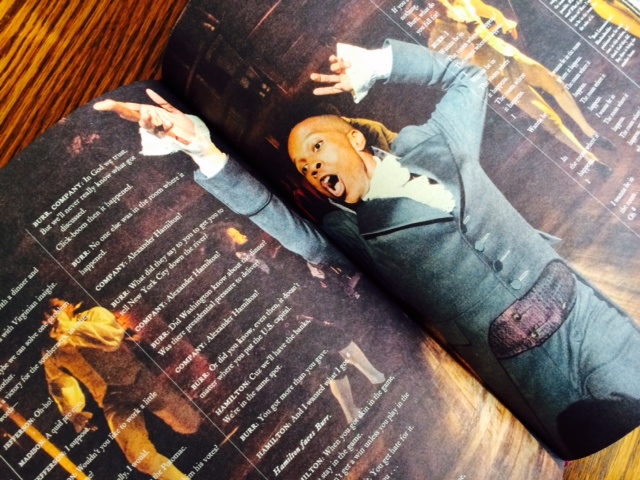
I ordered Hamilton: The Revolution – which one is supposed to call the #Hamiltome when one mentions it on Twitter and which is sort of a Hamilton yearbook, with annotated lyrics for every song, plus short essays on the actors, the behind-the-scenes elements of the show like the set designs and costumes, and information on the history behind the show – on the day it was released. It didn’t arrive until yesterday, though, because Amazon was already sold out on the day it released (I’m pretty sure Amazon being sold out of things on the day they’re released is one of the signs of the Apocalypse, so watch out for horsemen and brimstone). But it’s here now, and it’s beautiful. It’s the most beautiful book I’ve ever owned.

Like the musical itself, the #Hamiltome is part retro and part hyper-modern. The paper is thick and made to last (it even smells old!), with a letterpressy sort of font that leaves a palpable imprint on the paper.

Hamilton 2

And the photography is so good that sometimes Aaron Burr jumps out and shoots you in the ribs in your living room:

Hamilton 4

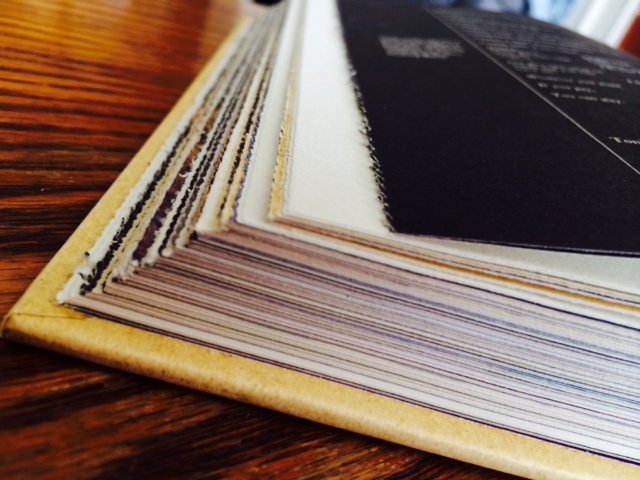
Even the deckle edges are beautiful (and I don’t usually like deckle edges).

Hamilton 3

If all this book contained was this shade of red, it would still be a contender for the most beautiful book in my collection (though I’m glad it contains much more):

Hamilton 5

I love that I share the world with this play. And with this book that promises to be just as great.

Hamilton 1


Posted in Glimpses into Real Life, Lin-Manuel Miranda and Jeremy McCarter, New Books That Have Clearly Been Treated With Some Chemical to Make Them Smell Old, Non-fiction - History, Nonfiction - General, Nonfiction - Music, Nonfiction - Theatre, THE HAMILTON SOUNDTRACK, Uncategorized | 2 Comments

Progress report on Diana Gabaldon’s Voyager (by Jill)


Voyager CoverToday ended up being a read-all-day Thursday, which I desperately needed, complete with gloomy skies and a midday thunderstorm. The only downside to the dreary weather, as far as I’m concerned, is that my Golden Retriever Bailey has developed a horrible storm phobia the past few years, and I ended up having to spend about two hours of the day holding her in my lap or spooning with her on the couch/napping, which was valuable reading time lost. I don’t mean to sound like I’m annoyed with my dog. I’m not annoyed with her. I feel terrible for her when something like this happens out of the blue. Fourth of July and New Year’s, we are prepared. She gets sedatives and we figure out where the quietest part of the house is and go there. There’s not really any hiding from Thor, the God of Thunder when he gets going really good, though, and today was one of those days.
Other than the strange weather (it is historically not normal for my part of the world to have thunderstorms more than once every year or two, though they seem to be increasing lately, probably a happy byproduct of global warming or ObamaCare or something else Donald Trump would want to get rid of), I did have a relatively pleasant, quiet day. I think I cleared about a hundred pages of Voyager today, including the scene in which Jamie and Claire reunite after twenty years apart, which was, as Bethany promised it would be, magical. I had absolutely been enjoying the book up until this point, but now that Jamie and Claire’s stories are once again the same story it’s been even better. The general air of sadness has been lifted from the novel, and I think things are going to fly from here on out.

Briefly, Jamie gains parole from the prison he had been incarcerated in, and his friend Sir John Grey get him a placement at an estate of friends of his in the Lake District of England. Knowing of Jamie’s love of horses, John asks his friend the Lord Dunsany to take Jamie in as a groom/indentured servant to serve out his parole in relative comfort to the others from Ardsmuir prison, who are being shipped off to the American Colonies. Jamie finds peace there for several years, until one of the Count’s daughters, the Lady Geneva, takes a shine to Jamie, and blackmails him (she intercepts a letter from his sister Jenny with information about the ongoing Jacobite activities) into having sex with her. She then marries, learns she is pregnant (and not by her husband), has the baby, dies in childbirth, Geneva’s husband insists the baby isn’t his but that he’s keeping him regardless so he will have an heir, the Lord and Lady Dunsany find this unacceptable, somehow pistols are drawn, and somehow Jamie ends up killing the Lord Ellesmere, and the child, Willie, goes to live at Helwater with his grandparents and his biological father. Because the Dunsanys are so happy about what Jamie did for them, they arrange for a pardon for him, which he takes them up on after Willie begins to look more like him when he is six or so. That’s in 1756, I believe. And then we know no more of Jamie’s story until Claire finds him under the name Alexander Malcom working as a printer, in Edinburgh, in 1765. Hopefully that will get filled in by Jamie to Claire over the rest of the novel. Mostly what Claire does after they track Jamie down in historical documents is make the decision to go back to him and then set about severing ties with her twentieth century life. By the time she goes back through the stones at Craigh na Dun at Halloween 1968 Bree and Roger are in love, and have a feeling that they will be able to go back in time as well, because they can “hear” the stones like Claire can. I’m not getting into it beyond that, or I’ll end up on some sort of time travel tangent, and it’s already almost ten o’clock, so I will digress for the time being.

I’m really enjoying Voyager. Bethany said once that this one is her favorite of the entire series thus far, and I can see that happening with me as well. I am looking forward the reading An Echo in the Bone, because that one was the one that got me interested in reading the Outlander series in the first place. It was out in hardcover back in 2008 and I spent a lot of time cruising Barnes and Noble back then, so I picked it up a lot, and was appalled that I had just then learned about this time travelling female English doctor from the mid-twentieth century and her Highland Scot husband living in pre-Revolutionary North Carolina and elsewhere in the Colonies. I enjoyed reading it so much that I didn’t want to stop reading to write a post, which is always a good sign.


Posted in Diana Gabaldon, Fiction - Funny, Fiction - general, Fiction - Historical, Reviews by Jill, TIME TRAVEL, Uncategorized | Leave a comment

Yarn Along

Yarn Along photo 5.4.16

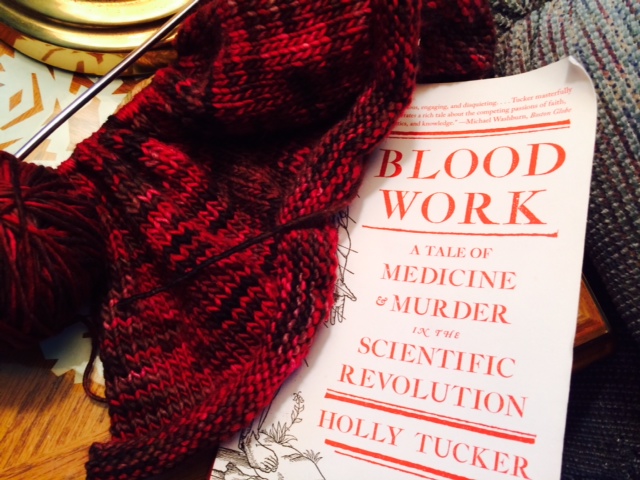
My name for this project – the sangria sweater – has stuck, and since “sangria” comes from the Spanish word for blood, this sweater is a perfect match for one of the many books I’m reading right now. Blood Work – hardly a hard-core work of historical scholarship, as you can see from the cover – is about the development of both the theory and practice of blood transfusion, which was the subject of a sort of “space race”-style competition between England and France in the 17th century. This book is not for the faint of heart: I’m sure you can imagine all the trial and error that had to happen between the bleeding-with-leeches era and the sterile, comfortable environment of the modern blood bank. I love this kind of history, though some of the experiments the book describes make me cringe. I look forward to telling you more in my full review in a few days.

I’m still just madly in love with this yarn. Game of Thrones Season 5 is on its way from Netflix, and my weekend schedule is more open than usual. There will be knitting. There will be blood, guts, and brains on my TV screen. There may even be some real sangria!

Happy Wednesday, everyone!

Yarn Along is hosted by Ginny on her blog, Small Things.

Posted in Uncategorized, Yarn Along | 2 Comments

Adulting is hard sometimes, especially this week.

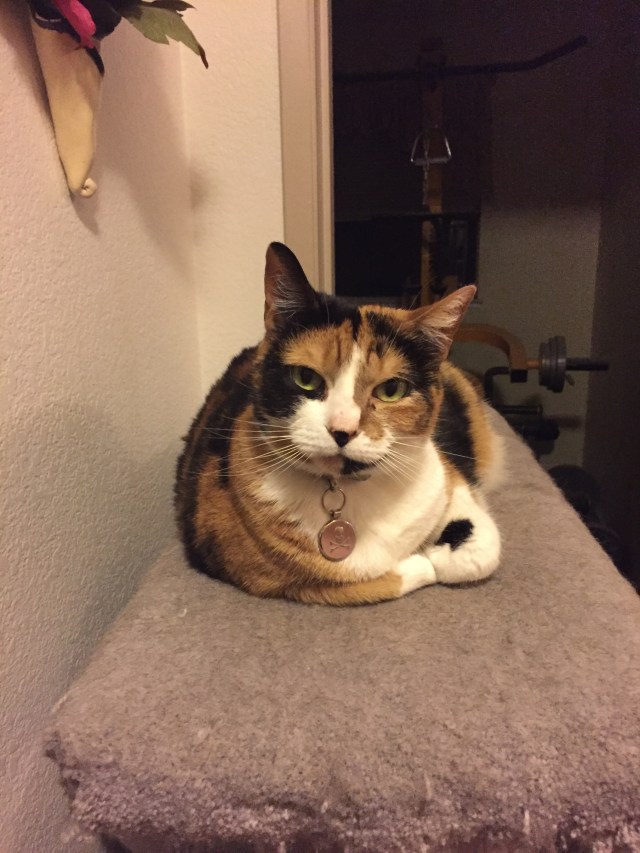
I’ve had a lot going on the past week or so and I’m not going to get into it now, but I wanted to ask everyone to bear with me. Tomorrow is my Friday and I’ll hopefully get back on track soon. In the meantime, enjoy this picture of my cat, The Kitten.  Isn’t she just the cutest?IMG_1090.jpg.


Posted in Glimpses into Real Life, Uncategorized | Leave a comment

In the Mood for Nonfiction

Nonfiction book photo

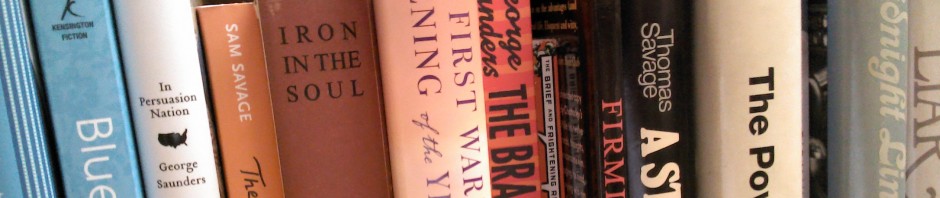
I’ve been reading lots of nonfiction lately – much more than usual. I’m actively involved in all four of these, though it’s been longer than I’d like to admit since I’ve dipped into Lit Up. My goal is to review one of these books per week throughout the month of May – and that’s on top of whatever novels I might read as well. We’ll see…

Posted in autobiographical photo montages, Uncategorized | Leave a comment

Thoughts on the First Third of Lily King’s Euphoria

Euphoria cover image

A while ago I introduced the idea that novels about anthropologists are always good. This judgment was based on my love for Norman Rush’s Mating and Mary Doria Russell’s The Sparrow and Children of God, but it was quickly disproved by Hanya Yanigihara’s The People in the Trees. Nevertheless, this theory is still fun to test. In a way, any fiction writer is an anthropologist, as long as their work is at least partly character driven, and introducing an anthropologist as a protagonist adds a level of irony and “meta”-ness to the novel.

The protagonist of Euphoria is Andy Bankson, who became an anthropologist by default when his father and two older brothers died and he needed a refuge from his clingy mother. Where better than New Guinea? In chapter 1, however, we don’t know that Andy is the protagonist – because the focus in this chapter is a married couple named Fen and Nell. They are barely speaking to one another, and Nell is covered with painful lesions. These details make it necessary for the reader to become an anthropologist too, but readers are always anthropologists, I suppose – at least if they are paying attention. The opening paragraphs are dynamite:

“As they were leaving the Mumbanyo, someone threw something at them. It bobbed a few yards from the stern of the canoe. A pale brown thing.

‘Another dead baby,’ Fen said.

He had broken her glasses by then, so she didn’t know if he was joking” (1).

All kinds of mysteries there, no? A fantastic novel for how a novel should begin. I’ve read 37% of the book, and I still don’t know exactly what happened with the Mumbanyo. Of the two, Nell seems to be the one whose heart is most fully active in her work. She longs to know everything there is to know about every remote tribe she encounters. Later in chapter 1, she worries about “all the people she was missing, the tribes she would never know and words she would never hear, the worry that they might right now be passing the one people she was meant to study, a people whose genius she would unlock, and who would unlock hers, a people who had a way of life that made sense to her” (8). Of course it’s clear that the “tribe” she really needs to study is her own. An American, Nell came to New Guinea because she wrote a book about sexual activity among children in the Solomon Islands, and now the American public is scandalized. Now, this book is set in the 1930’s, in spite of the fact that it doesn’t feel like the ‘30’s, and I will try to have a better explanation of why it doesn’t feel like the ‘30’s the next time I post – but my impression of the 1930’s American public is generally heavier on the Little Orphan Annie decoder rings and lighter on the widespread reading of anthropological field notes – but perhaps I am missing something. Anyway, the American public is scandalized, so Nell is in New Guinea looking for the tribe that will somehow become her destiny.

As for Fen, he is tortured and angsty and a bit of a dick. He initiates sex with the words “Time to procreate!” The narrator (i.e. Andy Bankson, though we don’t know that yet) reflects that “[Fen] didn’t like [Nell] strong, nor did he like her weak. Many months ago he’s grown tired of sickness and sores. When his fever rose, he took forty-mile hikes. When he had a thick white worm growing beneath the skin of his leg, he cut it out with a penknife” (10).

Andy Bankson knows about all of this because he is hiding behind a Christmas tree, watching Fen and Nell interact. He knows Fen from the past, though we don’t know when or where. Nell asks Fen if Andy is the one who stole his butterfly net, and Fen tells her to shut up. After a paragraph about Nell drinking champagne at a “governor’s station” in New Guinea, King gives us a page break and then the point of view shifts to the first person. The paragraph before the page break is this: “She took a glass from a tray held out to her. On the other side of the room, beyond the tray and the arm of the Taway man who held it, she saw a man beside the tree, a man quite possibly taller than the tree, touching the branch with his fingers” (12). After the page break, the chapter concludes: “Without her glasses, my face would have been little more than a pinking smudge among many, but she seemed to know it was me as soon as I lifted my head” (12). And voila, the narrator.

Andy Bankson is clearly an unreliable narrator, though I’m not sure exactly how. There is something very familiar about the chapters that flash back to his childhood – his saintly oldest brother John, his poetic suicidal brother Martin, his science-obsessed father, and his neurotic mother all living in a huge house passed down through the generous and packed to the gills with scientific instruments. I don’t know what the familiar quality is, exactly: essence of the DeLuce family in Alan Bradley’s Flavia DeLuce novels, with a soupçon of Isherwood’s A Meeting by the River and – I don’t know, maybe a tincture of Evelyn Waugh and a certain Kate Atkinson je ne sais quoi and some heady overtones of the “Frobisher” sections of Cloud Atlas? I don’t know. Maybe I’ve just read so many novels that some of them seem familiar not because they are but because of the law of averages. Homo sapiens can be an awfully repetitive species.

Anyway, Andy falls in love with Nell. There is another figure named Helen, with whom Andy exchanges letters and who seems to know Nell as well, but I haven’t figured out how she’s connected to everyone else. In its premise, this novel reminds me a lot of Rush’s Mating (which I plan to reread soon, by the way): highly intelligent female American anthropologist adrift in unfamiliar tribal setting, complicated relationship with difficult man, a willingness to explore the complexities of love without worrying too much about explaining them. So far I suspect that this novel will not execute this premise as well as Rush did in Mating, though I would be happy to be proven wrong.

More soon.

P.S. I promise that I will never again use the word “soupçon.” Let this rainbow be a symbol of our covenant. And also this woman in a windbreaker singing “YMCA” alone in a field.

Double-alaskan-rainbow

Posted in Authors, Fiction - general, Fiction - Historical, Fiction - literary, Lily King, Reviews by Bethany, Testing the Theory That Novels About Anthropologists are Always Good, Uncategorized | Leave a comment

Early Thoughts on Diana Gabaldon’s Voyager (by Jill)

Voyager Cover


I’ve finally gotten myself back to the saga of Claire and Jamie Fraser with this, the third in Diana Gabaldon’s Outlander series. It’s been about a year since I read Dragonfly in Amber, and I’ve very carefully kept away from the Fraser clan since then, because I knew if I read the books too close together I’d get sucked in and there was no way I would stop reading before getting totally caught up on the series, which would mean I’d be finishing Written in My Own Heart’s Blood right around now, and then I’d be S.O.L. until Gabaldon gets around to publishing the next book. And I have no intention of being S.O.L. where Claire and Jamie are concerned, at least not for a good long while.

Voyager starts pretty much were Dragonfly in Amber left off—Claire and her daughter (with Jamie) Brianna are in Scotland with Roger Wakefield in 1968, and they have just figured out that Jamie didn’t die at the Battle of Culloden in 1745. They start trying to figure out what happened to him after Culloden. Where I am right now, they’ve learned that he hid out in a Cave near Lallybroch, the family home in the Scottish Highlands, for the better part of seven years, until he arranges to get caught by the British Army so his tenants can claim the price on his head so they can eat (there’s a famine on in Scotland). He goes to prison in Ardsmuir, and after a few years there, Lord John Grey becomes the head officer there. You’ll remember John Grey. Gabaldon likes to write books about him too, and Bethany likes to mock them a bit. He made his first appearance in Dragonfly in Amber, when he was a teenager, and Jamie saved him from something prior to Culloden. Lord John is a homosexual, and falls in love with Jamie, and that fact leads him to help Jamie out on many occasions. I suspect his presence at Ardsmuir will be advantageous to Jamie. But I haven’t read ahead, or cheated by reading plot summaries on Wikipedia. Nope.

And that’s pretty much all that’s happened so far. I’ve only just reached page 100, but things are zipping along. I don’t love that Jamie and Claire aren’t together, and I will admit to having skimmed ahead a bit to see how long I have to wait until I get to read their “magical” reunion. I honestly thought it was going to be a much longer wait—only about two hundred more pages. But since Voyager is close to nine hundred pages long, that doesn’t seem like very many pages to wait.

More later!


Posted in Diana Gabaldon, Fiction - general, Fiction - Historical, Reviews by Jill, TIME TRAVEL, Uncategorized | Leave a comment